Bible Prophecy, Signs of the Times and Gog and Magog Updates with Articles in the News
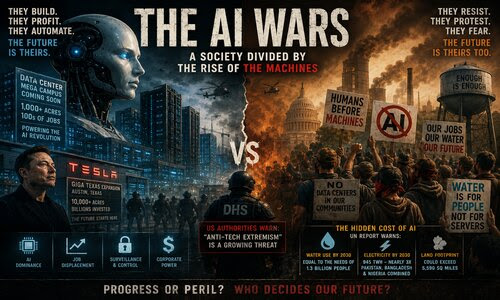
The AI Wars: A Society Divided By The Rise Of The Machines
For decades, the idea of a “Terminator” future existed primarily in science fiction. Humanity would build intelligent machines, those machines would eventually surpass us, and society would fracture between those who embraced the technology and those who resisted it.
What once seemed like Hollywood fantasy is beginning to look disturbingly familiar.
No, killer robots are not marching through our streets. Yet a different kind of conflict is already emerging–one that pits technology enthusiasts, AI developers, and corporate interests against growing numbers of citizens who view artificial intelligence as an existential threat to their jobs, their communities, their privacy, and perhaps even their future.
Federal law enforcement agencies are paying close attention.
According to recently disclosed intelligence assessments, the FBI, Department of Homeland Security, and regional fusion centers are increasingly monitoring what they classify as “anti-tech violent extremism.” Internal reports warn that opposition to AI, data centers, automation, and major technology projects could evolve into civil unrest and potentially violent activity over the next several years.
A New York Intelligence and Counterterrorism Bureau assessment issued a stark warning, suggesting that rapid AI development could create social instability capable of fueling large-scale protests and unrest in major cities.
Think about that for a moment.
Government agencies are no longer merely studying the dangers of artificial intelligence itself. They are now studying the dangers posed by people who oppose artificial intelligence.
That alone should tell us how rapidly this technological revolution is accelerating.
The reason isn’t difficult to understand.
Millions of workers are watching AI systems perform tasks that were once considered uniquely human. Writers, graphic designers, programmers, legal researchers, customer service agents, translators, accountants, and even medical professionals are seeing AI steadily move into areas once believed safe from automation.
Historically, technological revolutions created new jobs as they eliminated old ones.
The concern today is different.
Artificial intelligence is not simply replacing muscle. It is replacing mental labor.
Entire professions may be disrupted simultaneously.
When families begin losing careers they spent decades building, resentment grows. When communities feel excluded from decisions affecting their future, opposition hardens. When people feel powerless, some become desperate.
History shows that technological upheaval often generates backlash.
The Industrial Revolution sparked riots. Workers destroyed machinery they believed threatened their livelihoods. The Luddites became famous for attacking textile equipment they saw as enemies of ordinary laborers.
Today, many observers see echoes of that period emerging once again.
Only this time, the machines are vastly more powerful.
Consider what is happening in Texas.
Elon Musk’s growing technology empire continues to expand enormous infrastructure projects across the state. Massive data centers, AI training facilities, and industrial developments are reshaping local communities. While supporters see economic opportunity and technological leadership, many residents have raised concerns about land use, environmental impacts, resource consumption, and quality of life.
Similar battles are appearing across the United States and around the world.
What makes these disputes particularly dangerous is that they intersect with another growing concern: resources.
Artificial intelligence requires staggering amounts of electricity, water, and land.
A recent report from the United Nations University Institute for Water, Environment and Health highlighted the scale of the challenge.
By 2030, global data centers could consume nearly 945 terawatt-hours of electricity annually. To put that into perspective, that is nearly triple the combined electricity consumption of Pakistan, Bangladesh, and Nigeria.
Even more alarming is the water requirement.
Researchers estimate AI infrastructure could require enough water to match the annual basic domestic needs of approximately 1.3 billion people in Sub-Saharan Africa.
Many modern data centers consume millions of gallons of water every day simply to keep servers cool.
Residents in drought-prone regions are already asking difficult questions.
Should local water supplies be diverted toward cooling AI servers while communities face restrictions?
Should farmland give way to data centers?
Should neighborhoods absorb rising utility demands to support technologies that may eventually eliminate local jobs?
These are not hypothetical questions anymore.
They are becoming political flashpoints.
The danger is that both sides increasingly view the other as irrational.
Technology advocates often portray critics as anti-progress alarmists standing in the way of innovation.
Opponents increasingly view tech leaders as unelected oligarchs building systems that enrich corporations while destabilizing society.
That combination creates a recipe for escalating conflict.
What begins as peaceful opposition can evolve into sabotage.
What begins as legitimate security concerns can evolve into government surveillance.
What begins as public debate can harden into ideological warfare.
The most troubling aspect may be that neither side appears willing to slow down.
Technology companies are investing hundreds of billions of dollars into AI infrastructure. Governments view artificial intelligence as essential for economic competitiveness and national security. China, the United States, and other major powers are racing toward AI dominance.
Nobody wants to be left behind.
Meanwhile, citizens increasingly feel that decisions affecting their communities are being made without their consent.
The result is a growing collision between technological ambition and public resistance.
Christians should pay particular attention to these developments because they reveal a timeless truth about human nature.
The problem is not technology itself.
The problem is humanity’s tendency to place ultimate trust in its creations.
Throughout history, civilizations have repeatedly believed that new inventions, political systems, or economic structures would solve humanity’s deepest problems.
They never do.
Artificial intelligence may cure diseases, improve productivity, and unlock remarkable discoveries. But it cannot solve the brokenness of the human heart.
In fact, history suggests that powerful technologies often amplify existing human flaws rather than eliminate them.
The real danger may not be that machines become human.
The real danger may be that humans increasingly surrender their judgment, freedom, and dependence upon God to the systems they create.
As AI expands into every corner of society, we may witness a new kind of conflict emerge–not merely between man and machine, but between competing visions of what it means to be human.
The early stages of that struggle are already visible.
And if current trends continue, the coming decade may look far more like science fiction than many people ever imagined.
The World Is Approaching “Tank Bottoms” – Very Painful Oil Shortages Are Ahead
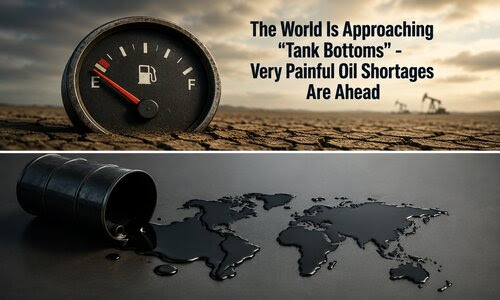
Without sufficient quantities of oil, the global economy will not be able to operate normally. So the fact that the global economy is running a massive “oil deficit” right now should deeply alarm all of us.
Even since the war with Iran began, the world has been consuming far more oil than it has been producing. We have been running down commercial oil inventories and strategic oil reserves all over the planet, and now those supplies are starting to run dry.
In the not too distant future, global demand for oil will substantially exceed what is available, and that will mean much higher prices and very painful shortages. Asia will be hit the hardest because they are more dependent on oil from the Middle East than anyone else, but we will certainly feel this crisis very keenly as well.
According to the International Energy Agency, global oil stocks are being depleted at a record pace and they could reach “critical levels” by the middle of the summer…
Global oil inventories could hit critically low levels ahead of the peak July-August fuel demand period if drawdowns continue at their current pace, the International Energy Agency said Tuesday.
Global oil stocks fell by more than 250M barrels between March and May, with on-land commercial and strategic stockpiles draining at a record pace, the IEA reported.
“We’re seeing stock draws continuing into the summer, and with the possibility or the likelihood that we reach critical levels or historical low levels just ahead of the peak summer demand,” said Toril Bosoni, the head of the IEA’s oil industry and markets division.
This isn’t a crisis that may or may not happen someday.
This is a crisis that is very real and that is rapidly approaching.
One expert is warning that we are headed for a “disaster” and that rationing could start to happen in some areas of the globe during the months ahead…
The supply situation is manageable for now, but higher summer demand in July and August likely would lead to rationing, Baron Lamarre, former head of trading at Petronas, told Dow Jones.
“The cry is that they want a deal right now because if they don’t have it three months from now, there will be a disaster,” Lamarre said.
A lot of people out there seem to think that the U.S. will be immune because we produce so much of the oil that we use.
But the truth is that U.S. oil stocks just fell “to their lowest level in two decades”…
The Iran war has driven US oil stocks to their lowest level in two decades as his administration drains stockpiles to contain surging prices and exporters capitalise on the drop in Middle Eastern supply.
US government data published on Wednesday showed total stocks of crude and petroleum products such as petrol fell by 10.6mn barrels last week to 1.57bn barrels — the lowest level since 2004.
The sharp fall triggered new warnings from industry analysts that oil prices are poised to move sharply higher again within weeks.
We are running an “oil deficit” too.
It isn’t as severe as what we are witnessing in other industrialized nations, but it is significant.
Withdrawals from the Strategic Petroleum Reserve have helped keep things running fairly smoothly, but the fact that in recent weeks we have seen “the largest weekly withdrawals in history” is not a good sign at all…
The Strategic Petroleum Reserve is also part of the backdrop. The EIA reported that SPR inventories fell by 9.1 million barrels during the week and were 36.2 million barrels below year-ago levels. The recent drawdowns in the SPR have been the largest weekly withdrawals in history.
Gasoline inventories in the U.S. are falling too.
In fact, we just witnessed the largest February to May gasoline drawdown ever recorded…
In early February, U.S. gasoline inventories reached 259.1 million barrels. By late May, they had fallen by 47.5 million barrels in roughly 15 weeks.
In weekly EIA data going back to 1990, there is not another February-to-May gasoline drawdown that comes close. The next-largest drawdowns were clustered around 30 million barrels, and that was 15 years ago. This year’s decline is far larger.
That does not mean gasoline shortages are imminent. It does mean the market has burned through a remarkable amount of inventory before the summer driving season has even fully arrived.
If the Strait of Hormuz is not reopened, shortages are inevitable.
The only debate is about when they will hit.
One industry insider just told Politico that his company has warned “the highest levels of government about what’s coming in mid-to-late June”…
“We’re at dangerously low levels already,” said one industry executive who was granted anonymity to discuss private conversations with the administration. “We have shared those concerns at the highest levels of government about what’s coming in mid-to-late June. … I hope they are paying attention to inventories right now. You’re hitting tank bottom.”
He isn’t talking about June 2027.
He is talking about this month.
Another expert is warning that we could be “looking at industrial shortages” if the situation in the Strait of Hormuz does not change by September or October…
Drained storage tanks are an “iceberg under the water,” Helima Croft, global head of commodity strategy at RBC Capital Markets, said during a Council on Foreign Relations event Wednesday.
“You may not see immediately on the horizon the actual economic challenges that will be coming, because you look at the flat price and you say, ‘OK, we can muddle through this and Iran will come to terms eventually,’” Croft said. “But if we get in a situation where we have this strait effectively closed, or the strait status quo, and we’re sitting in September or October, then you’re going to be looking at industrial shortages.”
Needless to say, an agreement to reopen the Strait of Hormuz is not going to happen right away.
If the U.S. and Iran are able to eventually reach an agreement, we are being told that it could take six to eight months to fully restore traffic to pre-war levels…
A full reopening of the Strait of Hormuz could take 6-8 months in the best-case scenario if an agreement was reached today, Bosoni said at the S&P Global Energy Middle East Petroleum and Gas Conference in London.
What this means is that global energy supplies are going to get tighter every single day for an extended period of time no matter what occurs now.
Gasoline prices will continue to rise, and shortages and rationing are looming.
Godzilla El Niño Could Absolutely Devastate Global Food Production

The waters of the Pacific Ocean are getting extremely warm, and that could provide fuel for an immensely destructive climate event that is unlike anything we have ever seen before. Even the United Nations has issued an ominous warning about the El Niño event that is in the long-term forecast, because it will have a dramatic impact on every man, woman and child on the entire planet.
We are being told that there is more than an 80 percent chance that El Niño conditions will arrive by the end of next month due to rapidly warming equatorial waters in the Pacific.
Meanwhile, an unprecedented “9,000-mile marine heatwave” has developed in the North Pacific. Many experts are concerned that the confluence of those two factors could produce a “Godzilla El Niño”…
The chance of an El Niño event emerging by July is now over 80 percent, which will likely make 2026 one of the hottest years on record. At the same time, an exceptionally large 9,000-mile marine heatwave has been forming in the North Pacific since the end of 2025. These extreme warming events are now evolving together across the Pacific. Scientists are increasingly concerned that the warm water will fuel a “super” or “Godzilla” El Niño, potentially prolonging marine heatwaves, disrupting fisheries and ecosystems, and intensifying global climate impacts well into 2027.
The “9,000-mile marine heatwave” in the North Pacific is absolutely astounding climate scientists.
At the same time, the warming in the equatorial waters where El Niño events normally develop is at a level that we haven’t seen since at least 1877…
The temperature of the ocean in the equatorial waters where these El Niños form was predicted to be 3 degrees Celsius above average. Experts are saying that this is a level of heat in the Pacific Ocean that hasn’t been recorded since 1877.
I have written about the “Super El Niño” that started in 1877 before.
That “Super El Niño” was one of the primary reasons why 50 million people starved during the Great Famine that stretched from 1876 to 1878…
This El Niño, they say, could rival the intense event of the late 19th century that triggered “the Great Famine” on a global scale, killing millions of people. And its scythe sliced through southern Africa.
“The 1876-78 Great Famine impacted multiple regions across the globe, including parts of Asia, Nordeste [Northeast] Brazil, and northern and southern Africa, with total human fatalities exceeding 50 million people, arguably the worst environmental disaster to befall humanity,” a team of scientists said a decade ago in a ground-breaking paper presented at a meeting of the American Geophysical Union.
3 percent of the entire population of the world starved to death during those years.
Today, 3 percent of the entire population of the world would be 240,000,000 people.
In 1982 and 1983, we experienced the most severe “Super El Niño” of the 20th century…
In 1982-83, the most intense El Niño of the 20th century caused extreme weather events throughout the world, including floods in the American Pacific and in the southern United States, and droughts in north-eastern Brazil and Indonesia. It also caused a very mild winter in the mid-latitudes of Europe, Asia and North America.
That “Super El Niño” sparked a horrific famine in eastern Africa that wiped out a very large proportion of the population…
A widespread famine affected Ethiopia from 1983 to 1985. The worst famine to hit the country in a century, it affected 7.75 million people (out of Ethiopia’s 38-40 million) and left approximately 300,000 to 1.2 million dead. 2.5 million people were internally displaced whereas 400,000 refugees left Ethiopia. Almost 200,000 children were orphaned.
Now we are being warned that the most powerful “Super El Niño” of all time could potentially be ahead of us.
We could see insanely hot temperatures all over the world this summer, and we are being told that we are likely to see severe drought conditions “in southern Africa, Australia, India, the Indochina Peninsula and Oceania”…
Easterly trade winds across the equator, meanwhile, are replaced by bursts of westerly surface winds. Those pile warm waters against the western shores of South America. That suppresses cool ocean upwelling from below, which is needed to bring nutrient-rich waters closer to the surface. That starves baitfish and means poor fish harvests for dependent countries in Central America and the Pacific coast of South America.
Drought, meanwhile, is likely in southern Africa, Australia, India, the Indochina Peninsula and Oceania. Southeast Asia, meanwhile, could see above-average rainfall and more flooding.
Here in the United States, we could see a lot less rain than normal in the Midwest, and temperatures in the heartland could be 3 to 6 degrees above normal.
In other words, it would be horrible growing weather.
Our farmers are already facing much higher diesel prices, much higher fertilizer prices and a multi-year drought that never seems to end. Now a “Godzilla El Niño” could be on the way, and the World Meteorological Organization is telling us to brace for the worst…
The World Meteorological Organization is warning that this summer’s El Nino event could be the worst yet. Compounded by fertiliser shortages, inflation and rising oil prices, these shocks threaten to push an already fragile food industry to the brink, and the impact will land squarely in consumers’ shopping baskets.
Coming into this year, the number of people around the world experiencing acute food insecurity was already at the highest level ever recorded.
And now a “Godzilla El Niño” could absolutely devastate food production in many of the areas around the world that grow the four crops that account for 60 percent of all global calories…
Global food security relies heavily on a highly concentrated supply chain. Just four crops, wheat, rice, maize and soybeans, account for over 60% of global calories. While localised regional shortages are typically balanced by other markets, a global El Nino triggers teleconnections: simultaneous weather anomalies across different continents that cause correlated crop failures. And this systemic drop in supply leads to direct price increases at supermarket tills.
In this country, where do we grow most of our wheat, rice, corn and soybeans?
Everyone knows that it is in the heartland, and the heartland of this country is about to get hit by a climate sledgehammer.
Of course we all still have to eat, and so demand for food is not going to go down.
Since there won’t be as much food produced, that means that prices are likely to spike…
Because demand for basic food staples is relatively inelastic—people must continue buying food regardless of price—even small supply shortages can trigger disproportionately large increases in prices. Current El Niño projections suggest price increases of 10% to 50% across many key agricultural commodities. Crops that are especially vulnerable to weather disruptions, including rice, palm oil, sugarcane, and coffee, could see prices rise by 50% to 100% or even higher if production is significantly affected.
In the past, price shocks struck one commodity at a time. A simultaneous, cross-category surge means consumers will be hit harder and broader than ever before.
If you think that food prices at your local supermarket are high now, just wait until you see what they are like in the future.
What will struggling American families do if basic staples that they purchase on a regular basis suddenly go up by 50 percent or more?
Of course conditions will be much worse in many impoverished nations around the globe.
In some cases, there simply won’t be nearly enough food to feed everyone.
We really are facing a nightmare scenario, and the vast majority of the global population is completely and utterly unprepared for it.