Bible Prophecy, Signs of the Times and Gog and Magog Updates with Articles in the News
When Apostate Pastors Make Disciples: The Dangerous Legacy of Progressives
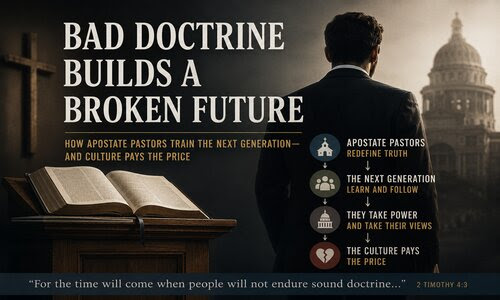
Every generation leaves a spiritual inheritance to the next. Faithful pastors pass on sound doctrine, a love for God’s Word, and a commitment to biblical truth. But what happens when pastors abandon those foundations? What happens when church leaders begin treating Scripture as something to be corrected, edited, or explained away rather than believed?
The answer is now playing out in real time across the World CHURCH.
One of the clearest examples may be found in Austin, Texas, where progressive pastor Jim Rigby has spent decades reshaping Christianity according to modern cultural values. Now one of his most prominent disciples, Texas politician James Talarico, is taking those same ideas beyond the walls of the church and into the public square as he runs for the Senate.
This is how theological drift works. It rarely stops with one pastor. Ideas reproduce. Beliefs spread. Teachers make disciples who become teachers themselves.
And eventually entire generations inherit the consequences.
The recent profile of Rigby and Talarico reveals far more than a simple pastor-congregant relationship. It provides a window into how progressive Christianity trains the next generation to embrace a faith that increasingly bears little resemblance to historic biblical Christianity.
Consider the environment in which Talarico was spiritually formed.
During a Sunday service at Rigby’s church, congregants were asked what came to mind when they heard the name of the Apostle Paul. The responses included “villain,” “homophobic,” and “he’s a jerk.”
Imagine that for a moment.
The Apostle Paul was not merely an influential Christian thinker. He was chosen by Christ, inspired by the Holy Spirit, and responsible for much of the New Testament. Through his writings, God gave the church foundational doctrines concerning salvation, grace, sanctification, marriage, church leadership, and Christian living.
Yet in this congregation, one of Christianity’s greatest apostles is openly ridiculed.
This should alarm every Bible-believing Christian.
The problem is not merely disrespect toward Paul. The problem is what such attitudes reveal about the authority of Scripture itself. Once believers are taught that biblical authors were morally defective, culturally backward, or fundamentally wrong on important issues, it becomes easy to dismiss any biblical teaching that conflicts with modern values.
The authority shifts from God’s Word to human opinion.
That shift becomes even more evident when examining Rigby’s theology.
He reportedly avoids referring to God as “Lord.” He avoids masculine pronouns for God. He says he does not particularly care for the word “God” itself. In sermons, he has referred instead to a vague “creative impulse of the universe.”
This language may sound spiritual, but it is a far cry from the God revealed in Scripture.
The Bible does not describe God as an undefined force. God reveals Himself personally and specifically. He identifies Himself as Father. Jesus repeatedly refers to Him as Father. Christ Himself is called Lord. These are not accidental descriptions that modern believers are free to rewrite. They are divine revelations.
Yet progressive Christianity increasingly treats God’s self-revelation as something that must be adjusted to fit contemporary sensitivities.
The consequences become evident in the positions being promoted.
Rigby played a significant role in pushing his denomination toward affirming same-sex relationships. His church has hosted ceremonies affirming transgender identities. The church uses an “Inclusive Bible” that alters traditional wording in an effort to accommodate modern ideological concerns.
What began as theological accommodation has become theological transformation.
And now those same ideas are appearing in politics through figures like Talarico.
Talarico frequently frames progressive political positions using biblical language. He has argued for abortion rights using the story of Mary. He has promoted interpretations of Scripture that critics say blur or redefine biblical understandings of gender. He regularly presents progressive political priorities as natural extensions of Christian teaching.
This is precisely why doctrine matters.
Ideas have consequences.
What pastors teach on Sunday eventually shapes what leaders advocate on Monday.
When pastors teach that Scripture is flexible, politicians learn to use Scripture as a tool to support whatever cultural cause they favor. When pastors question biblical authority, future leaders become comfortable reinterpreting God’s Word to fit contemporary ideologies.
A generation ago, many Christians assumed progressive theology would remain confined to declining mainline denominations.
They were wrong.
The influence of these ideas now extends through social media, seminaries, universities, political movements, and increasingly visible public figures who speak the language of Christianity while redefining its content.
Perhaps the most sobering aspect of this story is that Rigby himself expressed delight at seeing Talarico “taking the ideas out there.”
That statement captures the heart of the issue.
Every pastor is making disciples.
Every church is producing a next generation.
The question is not whether ideas are being passed down. The question is which ideas are being passed down.
Will the next generation inherit a faith anchored in the authority of Scripture, the lordship of Jesus Christ, and the historic truths of the Gospel?
Or will they inherit a Christianity that treats biblical authors as villains, Scripture as optional, doctrine as negotiable, and God’s revelation as something to be revised whenever culture changes?
The Apostle Paul warned that a time would come when people would no longer endure sound doctrine but would gather teachers who tell them what they want to hear (2 Timothy 4:3).
That warning feels increasingly relevant today.
The church’s greatest threat has never been opposition from outside. It has always been corruption from within.
And when apostate pastors train the next generation, the damage rarely ends with one congregation. It spreads into institutions, communities, and even governments.
That is why Christians must remain vigilant.
Because today’s progressive pastor may be producing tomorrow’s influential leader.
And what is planted in the pulpit today may shape an entire culture tomorrow.
Three Incorrect Approaches To Biblical Prophecy With Disastrous Consequences
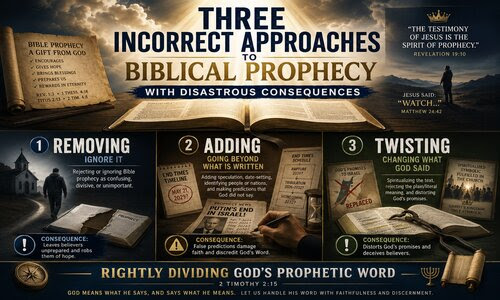
Bible prophecy is an exceptional gift given to us by God. The Creator of the universe, in His sovereignty and authority, provides us with an astonishing glimpse into the future.
Sadly, instead of reading these prophecies with hopeful anticipation, discernment, and assurance, vast segments of the church are spiraling down a dangerous road, failing to recognize the disastrous consequences of three incorrect approaches to Biblical prophecy.
Removing — In the first category are those who ignore Biblical prophecy as a whole; unfortunately, they make up a considerable portion of the church.
In this case, over one-third of Scripture is disregarded entirely, often branded as confusing, divisive, impractical, disruptive, or a stumbling block scaring away new believers. Each of these accusations misrepresents God’s prophetic Word and its powerful impact.
The apostles not only used Bible prophecy as a witnessing tool to showcase the authenticity of Jesus Christ, but they also considered the topic to be essential to a Christian’s understanding from the very beginning of their walk with the Lord. Equipped with knowledge about the future from Scripture, Christians are encouraged (1 Thess. 4:18, Luke 21:28, 2 Peter 1:19), filled with hope (Titus 2:13, Phil. 3:20), receive special blessings (Rev. 1:3), and are promised rewards in eternity (2 Tim. 4:8).
Considering that “the testimony of Jesus is the spirit of prophecy” (Rev. 19:10) and Christ frequently urged the church to “watch” for the season of His return (Matt. 24:42), the position of rejecting Biblical prophecy is an untenable position for any believer to take. It is also deeply damaging, leaving us with an incomplete picture of God’s plan of redemption, and having a ripple effect through our understanding of Scripture.
Adding — The second incorrect approach to Biblical prophecy comes at the other end of the spectrum and is related to those who add to the text–sensationalizing or making predictions that go beyond what God’s Word has expressly stated.
While this can also arise from those who declare themselves to be prophets and apostles in the modern day, I would like to focus on those who apply considerable conjecture when examining what God’s Word has to say about the future.
For example, in Ezekiel 38 we read about a future war, where a coalition of countries–including Russia, Iran, and Turkey–will attack the nation of Israel. The prophecy references the death of the Russian leader during this war. The challenge, however, arises when Christians make statements declaring: “According to Bible prophecy, Russian President Vladimir Putin will face his ultimate demise on the mountains of Israel.” Now wait just a moment! The text doesn’t explicitly say that. The leadership in Russia could change tomorrow, and then, in the eyes of all those who heard this declaration, God is viewed as the liar!
This also applies to date-setting and other assumptions added to the text, and it happens routinely among many popular prophecy commentators.
The danger is obvious. When we say, “thus saith the Lord” based on our own conjecture, we damage how others view the authenticity of God’s Word, and consequently, we significantly damage our witness.
Twisting — The third incorrect approach to Bible prophecy surrounds those who twist the text. As the late Dr. Chuck Missler would routinely warn: “Torture the data long enough, and it will confess to anything.” This “torture of the data” is precisely what is occurring among the groups who spiritualize Bible prophecy. When the plain/literal meaning is abandoned, a verse can mean anything under the sun!
One of the most prominent examples surrounds the nation of Israel. Through a significant spiritualization of the text, replacement theology emerged, and God’s future plans and promises to Israel were distorted. Suddenly, the Jewish people were branded as perpetually forsaken, and God’s everlasting covenants were bestowed upon the church. Under this view, Jews were no longer beloved by God, and the modern re-established state of Israel–an awe-inspiring fulfillment of ancient prophesies–was disregarded and demonized.
The spiritualization of God’s prophetic Word didn’t stop with robbing the Jews of their promised future; it has also been used to rob Jesus Christ Himself of His future millennial kingdom, with many distorting His ruling and reigning on the earth as merely symbolic. Once again, these promises were stolen and given to another, as many claim the church is spiritually ruling the earth as we speak!
While a great deal more could be mentioned, it is not difficult to see why “torturing” the text is a treacherous trail to go down.
Rightly Dividing — All three of these approaches to Bible prophecy are monumentally dangerous (Rev. 22:19). God means what He says, and says what He means. While many venture into these positions out of ignorance, or the blind trust in a particular denomination, we must all understand our responsibility to rightly divide God’s Word, examining it with clarity and discernment.
Bible Prophecy was lovingly given by God for a purpose. When we remove it, add to it, and twist it, we are making a significant mistake–one that not only affects our personal understanding, rewards in eternity, and walk with the Lord, but also our witness to the unsaved world.