Bible Prophecy, Signs of the Times and Gog and Magog Updates with Articles in the News
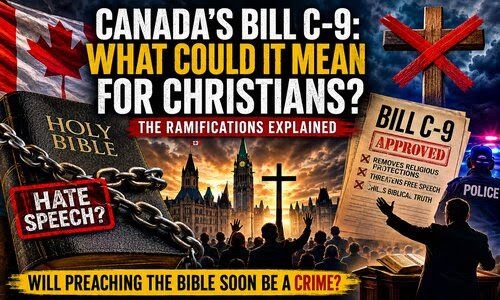
Canadian Bill Puts Bible In The Crosshairs: Sermons Could Become A Hate Crime?
For generations, Canadians have enjoyed a reputation for being among the freest people in the world. Freedom of speech, freedom of religion, and the ability to openly debate moral and social issues have long been considered foundational rights. That is why the advancement of Bill C-9 through Canada’s Senate has generated such intense concern among Christian leaders, constitutional experts, and faith communities across the nation.
Supporters of the legislation argue that it is necessary to combat hatred and protect vulnerable groups from targeted abuse. Few would dispute the importance of protecting citizens from violence, harassment, or genuine threats. The concern, however, is not whether hatred should be opposed. The concern is whether the government is redefining biblical beliefs themselves as hateful.
At the center of the controversy is Bill C-9’s removal of Section 319(3)(b) of Canada’s Criminal Code. That provision has historically protected individuals who express religious beliefs in good faith based on sacred texts such as the Bible. Critics warn that removing this safeguard creates a legal environment where long-held Christian teachings could become vulnerable to criminal complaints.
The legislation is now headed back to the House Of Commons where it is expected to clear Parliament and become law before the summer recess.
Many Christians are asking a simple question: What happens next?
The answer is that nobody knows exactly how the law will be enforced. Yet history shows that laws often begin with narrow promises before gradually expanding through court rulings, government interpretations, and activist pressure campaigns. Christians therefore have reason to examine not only what the legislation says today but also what it could enable tomorrow.
Consider a pastor preaching through Romans 1, where the Apostle Paul describes same-sex relationships as sinful. For two thousand years, this has been a standard Christian teaching shared by the Christian church. Under previous protections, a pastor could confidently teach that passage knowing the law recognized the legitimacy of religious expression.
Under the new framework, critics fear that a complaint could be filed claiming such preaching promotes hatred against a protected group.
Perhaps the complaint would ultimately fail. Perhaps charges would never be laid. But even an investigation can become punishment. Churches could face legal expenses, reputational attacks, media scrutiny, and pressure to self-censor.
This is how speech restrictions often evolve—not necessarily through dramatic arrests, but through intimidation.
Imagine a Christian school teaching students that marriage is between one man and one woman. A teacher quotes Jesus’ words from the Gospel of Matthew. A parent objects and files a complaint. Suddenly administrators must consult lawyers, revise policies, and determine whether biblical instruction exposes them to liability.
Even if the school eventually prevails, the message to other institutions becomes clear: avoid controversy, soften doctrine, and stay silent.
The chilling effect becomes the real victory.
Christian Counseling and Pastoral Care
Another area of concern involves Christian counselors, pastors, and church leaders who provide spiritual guidance. Imagine a young adult seeking advice from a pastor regarding questions about sexuality, gender identity, or biblical morality. If the pastor responds by explaining traditional Christian teachings and encouraging the individual to align his or her life with those beliefs, critics worry that such conversations could eventually become the subject of complaints.
Perhaps no charges would ever be laid. Perhaps a court would ultimately side with the pastor. But once legal uncertainty enters the picture, many ministries may begin avoiding these conversations altogether. Some pastors could decide that discussing certain topics simply carries too much risk. The result would be a chilling effect on one of the church’s most important functions: providing biblical counsel to people seeking spiritual guidance.
Employment Standards and Church Leadership
Many churches require pastors, elders, youth leaders, and ministry staff to affirm statements of faith and live according to the church’s understanding of biblical morality. Critics of Bill C-9 fear that maintaining such standards could become increasingly difficult if traditional Christian beliefs are portrayed as hateful or discriminatory.
Consider a church that requires youth leaders to affirm biblical teachings regarding marriage and sexuality. A rejected volunteer or former employee could potentially file a complaint alleging that such standards promote hatred toward a protected group. Even if the church eventually prevailed, it could face significant legal costs, public controversy, and pressure to abandon long-standing doctrinal requirements.
For many believers, the concern is not merely whether churches would win such cases. The concern is whether years of investigations, legal battles, and public scrutiny would gradually pressure Christian institutions to soften or abandon biblical convictions in order to avoid conflict altogether.
Another practical concern involves online ministry. Many Canadian pastors now reach thousands of people through YouTube, Facebook, podcasts, and livestreams. If authorities begin viewing certain biblical teachings as potentially hateful, online content could become a prime target.
Will pastors begin avoiding certain passages altogether?
Will ministries remove sermons from their archives?
Will Christian publishers stop printing books that address controversial moral issues?
These questions may sound alarmist to some, but similar patterns have already emerged in parts of Europe where speech laws have increasingly collided with religious expression.
The deeper issue extends beyond homosexuality.
Once government authorities gain greater power to determine which religious beliefs are acceptable, every unpopular biblical doctrine becomes vulnerable. Christian teaching on gender, marriage, sexual morality, exclusivity of salvation through Christ, and even certain pro-life arguments could eventually come under scrutiny.
The problem is not merely what today’s government believes. Governments change. Cultural standards change. What one administration considers protected speech, another may classify as harmful expression.
Christians understand this principle because church history is filled with examples.
Throughout history, governments have often tolerated Christianity until biblical teaching collided with prevailing social values. The conflict rarely begins with a direct ban on Christianity. Instead, authorities typically insist that believers may continue worshiping privately so long as they refrain from publicly expressing certain convictions.
That distinction matters.
Freedom of worship is not the same as freedom of religion.
Freedom of worship means Christians can gather inside church buildings and conduct services. Freedom of religion means believers can live out and proclaim their faith in public life without fear of government punishment.
Many critics argue that Bill C-9 pushes Canada closer toward the former model while weakening the latter.
Even Alberta Premier Danielle Smith has voiced concerns about authorities monitoring church services. Such warnings would have seemed unthinkable in Canada only a few years ago. Yet they are now being discussed openly by elected officials.
For Canadian Christians, the response should not be panic, but preparation.
Churches should educate congregations about their constitutional rights. Ministries should seek competent legal counsel. Christian organizations should strengthen partnerships with religious liberty groups prepared to challenge unconstitutional applications of the law.
Most importantly, believers should resist the temptation to retreat into silence.
The New Testament was written largely by men who lived under governments hostile to Christian teaching. The apostles repeatedly affirmed that believers must speak truth with both courage and love, even when doing so carries personal cost.
Christians should never use the Bible as a weapon to demean or mistreat others. Genuine hatred has no place in Christian witness. At the same time, Christians cannot abandon biblical truth simply because society increasingly labels it offensive.
That is the tension Bill C-9 brings into sharp focus.
The coming years may determine whether Canada continues to protect robust religious freedom or moves toward a model where certain biblical convictions are tolerated only when kept private. For many believers, this debate is no longer merely political or legal.
It is becoming a test of whether Christians will remain free to openly proclaim what they believe God has already spoken.
Woke Pastors Want You To Affirm Queer Holiness
Every generation of Christians faces the same fundamental question: Will the church conform to the world, or will it call the world to conform to Christ?
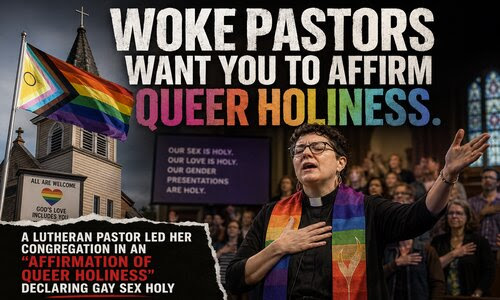
That question was on full display recently when a pastor at an ELCA Lutheran church stood before her congregation and led them in what she called an “Affirmation of Queer Holiness.”
“The first time another pastor told me that my gay sex was holy, I cried,” she told the congregation.
Then came the congregational liturgy:
“Our sex is holy. Our love is holy. Our gender presentations are holy.”
For many Christians watching the video, it was difficult to believe they were listening to a church service rather than a political rally wrapped in religious language.
Yet this is not an isolated incident. It is part of a much larger transformation taking place across portions of the American church. Pride flags now fly outside thousands of church buildings. Entire denominations dedicate Sundays to celebrating sexual identities. Church websites proudly advertise themselves as “affirming.” Sermons increasingly focus on validating personal identities rather than proclaiming repentance, redemption, and reconciliation with God.
What was once considered fringe has become commonplace.
The troubling aspect of this trend is not merely that churches are discussing homosexuality. The church has always wrestled with difficult moral questions. The deeper issue is that many pastors are no longer arguing for tolerance, compassion, or even coexistence. They are declaring something much more profound.
They are declaring holiness.
That distinction matters.
Historically, Christianity has taught that holiness belongs to God. Holiness is not something human beings define for themselves. It is not determined by our desires, preferences, feelings, or experiences. Scripture consistently presents holiness as God’s standard, God’s character, and God’s design.
When Moses encountered God at the burning bush, the ground became holy because of God’s presence.
When Isaiah encountered God in the temple, the angels cried out, “Holy, holy, holy is the Lord Almighty.”
The biblical story has never been about humanity declaring itself holy. It is about sinners being transformed by a holy God.
Yet in many progressive churches today, that order has been reversed.
Instead of asking whether our desires align with God’s will, the question becomes whether God can be redefined to affirm our desires.
Instead of bringing our lives under Scripture, Scripture is reinterpreted to accommodate our lives.
Instead of repentance, affirmation.
Instead of transformation, validation.
Instead of Christ-centered worship, self-centered spirituality.
That is why so many Christians reacted strongly to the phrase “queer holiness.” The controversy is not merely about sexuality. It is about authority.
Who gets to define what is holy?
The church or God?
Culture or Scripture?
Feelings or revelation?
These questions help explain why so many mainline Protestant denominations have experienced dramatic membership declines over the last several decades.
The ELCA itself provides a revealing example. Once numbering roughly 5 million members, the denomination has lost millions over the past generation. While many factors contribute to church decline, there is a growing body of evidence suggesting that churches which become increasingly indistinguishable from secular culture often struggle to convince people they offer anything unique.
After all, if the church simply echoes the same messages already being promoted by corporations, universities, Hollywood, government agencies, social media influencers, and activist organizations, why attend church at all?
If Christianity merely baptizes whatever culture currently celebrates, then it ceases to function as a prophetic voice.
The irony is striking.
Many progressive church leaders embraced these changes believing they would make Christianity more relevant to modern society. Instead, many congregations have continued shrinking while conservative and orthodox churches often show greater stability and, in some cases, growth.
People do not generally seek out churches because they want cultural affirmation.
They can get that everywhere.
People come to church searching for truth, meaning, forgiveness, purpose, hope, and answers to life’s deepest questions.
They come looking for God.
The church’s mission was never to place a divine stamp of approval on every human desire. It was to proclaim the Gospel.
That Gospel begins with the uncomfortable reality that every person is a sinner in need of grace.
Not just some sinners.
All sinners.
Every Christian has desires, temptations, habits, and inclinations that must be surrendered to Christ. The call of discipleship has always involved denying ourselves, taking up our cross, and following Him.
That message is not popular.
It never has been.
But Christianity was never designed to be a mirror reflecting society’s latest values back at itself. It was intended to be a light shining into darkness, even when that light exposes uncomfortable truths.
This is why the growing trend of churches raising Pride flags outside sanctuaries deserves serious attention. The flag itself has become more than a symbol of hospitality or welcome. For many churches, it functions as a theological statement — a declaration that traditional Christian teachings on sexuality have been abandoned in favor of a new moral framework.
That shift is reshaping entire denominations.
The question facing Christians today is not whether they should love their neighbors. Scripture commands that unequivocally.
The question is whether love requires affirming everything a culture celebrates.
Historically, Christianity has answered that question with a clear no.
Love tells the truth.
Love warns.
Love calls people toward God’s design, not away from it.
As the Apostle Paul warned nearly two thousand years ago:
“For the time will come when people will not put up with sound doctrine. Instead, to suit their own desires, they will gather around them a great number of teachers to say what their itching ears want to hear.”
What Happens When Machines Become The Majority On The Internet?

For decades, the internet was fundamentally a human creation. Every website, every comment, every search, every purchase, and every viral trend ultimately traced back to a real person sitting behind a keyboard. That reality has now changed.
According to Cloudflare, one of the largest internet infrastructure companies in the world, automated bot traffic has officially surpassed human traffic online. More than 57 percent of requests hitting the websites it monitors now come from bots, AI agents, and automated systems, while less than 43 percent come from actual people.
That milestone may sound like a technical curiosity reserved for programmers and network engineers. In reality, it could represent one of the most significant transformations in the history of the internet—and one that will eventually affect everyone.
For years, discussions about artificial intelligence focused primarily on what AI could create. Could it write articles? Generate images? Produce videos? Answer questions?
Now we are entering a new phase.
AI is no longer simply creating content. It is becoming an active participant in the internet itself.
Imagine a human shopper browsing five websites before making a purchase. An AI shopping assistant might scan 5,000 websites in seconds. AI research agents can visit thousands of pages while gathering information. Automated systems can monitor prices, compare products, collect data, generate reports, and interact with websites continuously without human intervention.
The result is an internet increasingly populated by machines talking to machines.
That raises a much bigger question: What happens when humans are no longer the primary audience online?
For the average person, the most immediate impact may be the quality of information itself.
Much of today’s internet already suffers from fake reviews, clickbait articles, manipulated social media engagement, and AI-generated spam. As bot traffic grows, distinguishing between genuine human experiences and machine-generated content could become even more difficult.
When you read product reviews, are they written by customers or AI agents? When a story trends on social media, are real people discussing it or thousands of automated accounts amplifying it? When search engines rank information, are they prioritizing human value or machine-generated popularity?
Trust—already in short supply online—could become even harder to find.
The economic consequences may be equally profound.
The modern internet is largely funded through advertising. Websites publish content, attract visitors, and earn revenue when those visitors view or click advertisements.
But as Cloudflare CEO Matthew Prince pointed out, bots don’t click ads.
If AI agents increasingly consume information on behalf of humans, the traditional advertising model begins to break down. News organizations, blogs, independent creators, and countless websites could find themselves losing revenue even as their traffic appears to increase.
The internet may eventually shift toward subscriptions, paywalls, licensing agreements, and direct payments from AI companies seeking access to content.
That transition could dramatically reshape which websites survive and which disappear.
There is also a deeper concern that many people instinctively recognize.
Human interaction may become increasingly diluted.
The internet was originally designed to connect people. Social media, forums, blogs, and discussion boards were all built around human conversation. But if a growing percentage of traffic comes from machines generating content for other machines to consume, the internet could begin feeling less like a global community and more like an automated ecosystem operating largely without us.
This is where the so-called “Dead Internet Theory” enters the discussion. While many of its more extreme claims remain speculative, the core fear resonates with people: that authentic human participation could eventually be drowned out by endless streams of AI-generated content.
Even if that never fully happens, there is another practical concern.
Security.
Every new AI agent represents another automated system crawling websites, gathering data, testing services, and interacting with online platforms. While many uses are legitimate, the same technology can be weaponized by cybercriminals, foreign governments, scammers, and malicious actors.
Future cyberattacks may not be launched by human hackers typing commands but by armies of autonomous AI systems operating around the clock.
The internet could become increasingly difficult to secure.
Yet there is another side to this story.
AI is also allowing millions of people to create websites, videos, software, and businesses who previously lacked the technical skills to do so. Content creation has become dramatically more accessible. Small businesses can compete with larger organizations. Individuals can launch projects that once required teams of developers.
In that sense, AI is expanding human creativity even as it transforms the environment in which that creativity exists.
The challenge moving forward will be ensuring that the internet remains fundamentally human-centered.
Technology should serve people—not replace them.
The internet was built as a tool to connect human beings, share ideas, conduct business, and build communities. If bots become the dominant participants online, society will face an important choice: whether to allow the web to evolve into a machine-to-machine ecosystem or to deliberately preserve spaces where authentic human interaction remains at the center.
The bots may now outnumber us online.
The real question is whether humans will continue to matter most.