
Bible Prophecy, Signs of the Times and Gog and Magog Updates with Articles in the News
Meet The Democrat Candidate Calling For ‘American Zionist’ Prison Camps
In what would have once been viewed as career-ending rhetoric, a Democrat candidate running for Congress in Texas is now openly discussing prison camps for ideological opponents — and doing so in a political environment where outrage, extremism, and online performance increasingly generate attention instead of condemnation.
Maureen Galindo, a Democrat candidate for Texas’ 35th Congressional District, stunned many Americans after comments in which she called for converting the Karnes ICE Detention Center into a prison for “American Zionists” and former ICE officers. Even more chilling, she suggested the facility could also become “a castration processing center for pedophiles, which will probably be most of the Zionists.”
Read that sentence again carefully.
A candidate seeking public office in the United States openly discussed imprisoning a broad political and ideological group while associating them with monstrous criminal behavior.
That is not normal political disagreement. That is the kind of rhetoric history repeatedly warns nations about.
And yet in today’s political climate, the truly disturbing part is not merely that such comments were made — it is that many Americans barely seem shocked anymore.
Galindo’s remarks sparked outrage among Jewish groups and critics who warned that the rhetoric echoed some of history’s darkest anti-Semitic language. Critics pointed to her repeated comments about “billionaire Zionists” allegedly controlling trafficking networks and political systems, rhetoric that mirrors conspiracies that have circulated for generations.
But Galindo is hardly the only example of political extremism emerging from today’s activist-driven Democratic movement.
In Maine, far-left Democrat Senate candidate Graham Platner recently came under fire after resurfaced online comments showed him viciously mocking a wounded American soldier nearly killed in Afghanistan. Purple Heart recipient Pfc. Ted Daniels had been shot four times while fighting the Taliban in 2012. Platner’s response?
“Dumb motherf****** didn’t deserve to live.”
He then mocked the wounded veteran’s weight, survival, and combat decisions, saying poor Taliban marksmanship was the only reason Daniels survived.
Once upon a time, comments like that would have instantly destroyed a political campaign.
Today, they become another 24-hour outrage cycle before the news machine quickly moves on to the next controversy.
At the same time, America is witnessing politics increasingly transformed into social media performance art.
One Democrat congressional candidate now making headlines is Shelby Campbell, whose campaign has gone viral not because of groundbreaking policy ideas or compelling leadership experience, but because of videos featuring twerking, sexually suggestive dancing, and profanity-laced online content. Critics blasted the videos as unserious and degrading to public office, while supporters celebrated them as “authentic” and “empowering.”
That reaction alone says something profound about modern political culture.
Behavior that once would have been considered embarrassing or disqualifying for someone seeking national office is now defended as bold self-expression. Viral attention matters more than dignity. Internet fame matters more than statesmanship. Shock value matters more than substance.
And that may be one of the clearest signs of how far America’s political culture has drifted — not simply that outrageous behavior exists, but that so many now celebrate it.
But perhaps the greater danger comes from those who present themselves as calm, compassionate moderates while quietly advancing the same radical ideological foundations underneath the surface.
Texas Democrat James Talarico has become one of the most visible examples of this phenomenon. Talarico frequently speaks the language of Christianity, morality, compassion, and unity. He presents himself as a thoughtful pastor-like figure capable of bridging divides in America’s increasingly toxic political climate.
To many casual voters, he appears reasonable, calm, and deeply sincere.
But critics argue that image masks a far more progressive agenda than many moderate Christians realize.
Talarico has supported expansive abortion policies, progressive gender ideology positions, left-wing educational activism, and policies many Christians believe directly contradict Biblical teachings. He has aligned himself with movements pushing DEI ideology, LGBTQ activism within schools, and broader progressive cultural policies that many conservative Christians view as deeply harmful to the moral direction of the country.
Unlike candidates such as Galindo, who loudly broadcast extremism, candidates like Talarico package progressive ideology in softer, more approachable language.
That may ultimately prove far more persuasive — and far more dangerous politically.
Because most Americans can immediately recognize rhetoric about prison camps as extreme. The danger becomes far harder to identify when radical policies are wrapped in the language of compassion, inclusion, empathy, and faith.
History shows societies rarely collapse morally all at once. Instead, lines slowly blur over time.
First the outrageous becomes tolerated.
Then tolerated behavior becomes normalized.
Then normalized behavior becomes celebrated.
And eventually those warning about the dangers are portrayed as the true problem.
America appears to be moving rapidly through those stages.
When candidates openly discuss imprisoning ideological opponents, mock wounded veterans, or build campaigns around internet spectacle and vulgarity while still receiving applause, donations, and media attention, it reveals a nation losing its moral center.
Politics is no longer simply about disagreements over taxes, spending, or foreign policy.
It is becoming a battle over the very definition of truth, morality, identity, and human dignity itself.
The question Americans should now ask is not merely whether certain candidates are too extreme.
The far more important question is this:
What kind of culture produces them — and why are so many people applauding?
ChatGPT Wants Access To Your Finances — What Could Go Wrong?

The warnings about artificial intelligence have often focused on dramatic scenarios: robots replacing workers, deepfakes disrupting elections, or autonomous systems making dangerous decisions without human oversight. But one of the most significant and potentially invasive developments may be unfolding much more quietly — through convenience.
Now, according to reports surrounding a new rollout from OpenAI, select users are being given the ability to link their bank accounts directly to OpenAI’s chatbot platform, allowing the AI to analyze financial information such as balances, spending habits, investments, debts, and liabilities across thousands of financial institutions.
The pitch is predictable: smarter budgeting, personalized recommendations, automated financial insights, and a more “helpful” digital assistant.
But beneath the sleek marketing lies a deeply unsettling question:
How much of your life should artificial intelligence really know?
For years, people have already handed over enormous amounts of personal data to technology companies. Smartphones know where we travel. Search engines know what we think about. Social media knows our political opinions, fears, habits, and relationships. Email providers scan inboxes for ad targeting and algorithms track nearly every click online.
Now the next frontier appears to be financial surveillance.
And unlike social media posts or browsing habits, financial records expose the deepest realities of a person’s life.
Your bank account can reveal your medical struggles, marriage problems, addictions, political donations, religious giving, travel patterns, income level, debts, investments, and vulnerabilities. It can show when you are desperate, when you are prosperous, when you are fearful, and when you are under pressure.
That is an astonishing amount of power to place into the hands of an AI-driven ecosystem.
Supporters argue that secure third-party integrations already exist throughout the financial industry. Budgeting apps, investment platforms, and tax software have long connected to banking institutions. But AI changes the equation dramatically because it is not merely storing data — it is interpreting it, learning from it, and building increasingly detailed behavioral profiles around it.
That distinction matters.
Artificial intelligence systems thrive on data. The more intimate the information, the more powerful the predictive capabilities become. An AI that understands your financial behavior can potentially anticipate your stress levels, purchasing impulses, future needs, ideological preferences, or even emotional states.
Imagine a system that knows when you are financially vulnerable and can tailor advertisements, suggestions, or recommendations accordingly. Imagine AI-driven financial nudges steering users toward certain products, investments, or services based not only on need, but on psychological susceptibility.
This is where the issue moves far beyond convenience and enters dangerous territory.
The concern is not merely hacking — though cybersecurity risks alone should alarm people. Major corporations, governments, hospitals, and financial institutions have all suffered data breaches despite claiming strong protections. Consumers are repeatedly told systems are “secure” until they suddenly are not.
The larger concern is what happens when AI systems become permanently intertwined with the infrastructure of daily life.
Today the system offers budgeting advice.
Tomorrow it may determine creditworthiness.
Next it could influence insurance rates, lending decisions, employment screenings, or government compliance systems.
History shows that technologies introduced for convenience often evolve into systems of dependence. Social media began as harmless connection. Smartphones promised productivity. Digital payment systems simplified commerce. Yet over time, each became deeply embedded into the structure of society in ways few originally anticipated.
Financial AI integration may follow the same path.
What happens when people become accustomed to allowing AI to monitor every transaction? What happens when banks, governments, or corporations begin expecting users to participate in these ecosystems? Could refusing AI integration someday become suspicious, inconvenient, or even economically limiting?
Those questions may sound extreme today. But many developments that seemed unthinkable a decade ago are now routine.
There is also another issue that deserves far more public attention: data permanence.
Even when companies promise information will not directly train AI models, the reality is that digital information rarely disappears completely. Data can be copied, retained, subpoenaed, leaked, sold, or repurposed years later under changing policies or corporate ownership structures.
Consumers are essentially being asked to trust that future executives, future governments, future AI systems, and future cybersecurity environments will always handle this data responsibly.
That is an enormous leap of faith.
And once privacy is surrendered, reclaiming it is almost impossible.
Many Americans are already uneasy about the growing merger between technology, finance, and centralized digital systems. Concerns surrounding digital IDs, central bank digital currencies, biometric authentication, and algorithmic monitoring continue to intensify worldwide. The idea of AI gaining direct visibility into personal finances only deepens those fears.
To be clear, artificial intelligence itself is not inherently evil. Used wisely, it can improve efficiency, assist with research, streamline financial planning, and help consumers make informed decisions.
But wisdom requires boundaries.
Just because technology can access something does not mean it should.
In the race toward an AI-driven future, society is moving faster than its ethical safeguards. Consumers are being encouraged to surrender highly sensitive information before long-term consequences are fully understood. Convenience is once again becoming the bait used to normalize deeper surveillance and dependency.
And history suggests that once the public becomes comfortable with a new technological norm, there is rarely any going back.
The danger is not simply that AI may know too much.
The danger is that humanity may slowly become comfortable with living in a world where nothing remains private at all.
Cities, States, And Individuals Are Pushing Back Against Pride Activism
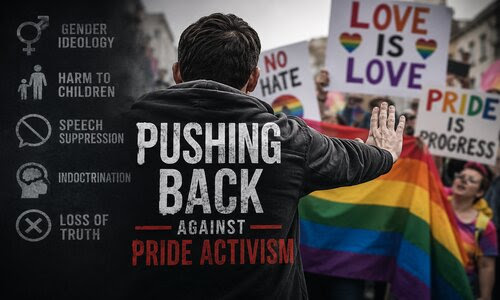
As the month of June arrives each year, I find myself bracing mentally for the flood of rainbow flags on display, announcements of parades that celebrate perversion and ungodly lifestyles. However, this year feels somewhat different compared to the last few years. It almost seems as if there is a subtle reversal happening towards traditional views, family values, and even Biblical truth.
Rather than accepting Pride activism as the norm, some cities, states, and individuals are beginning to push back against its symbols and events.
Signs of Cultural Pushback
Take, for example, Arlington, Texas, which announced the cancellation of one of the largest Pride events in Northern Texas this year. Similarly, in the city of Hamtramck, Michigan, a ban on LGBTQ+ flags on public flagpoles was upheld in September by a U.S. District Judge. In Florida, the city of Clearwater decided to abandon the recognition of Pride Month in favor of “Faith and Family Month.” At the state level, Oklahoma, Idaho, and Utah have advanced or implemented laws banning Pride flags from being flown on government property, and in Tennessee, Governor Bill Lee signed a resolution declaring June as “Nuclear Family Month.”
Praise God for victories like these and others like them! But, even if Pride activism appears less prominent this year, it most certainly has not disappeared, nor has the broader cultural embrace of sexual immorality. More likely, LGBTQ activists and organizations are regrouping until new opportunities arise to promote and normalize their beliefs and values. Just as David Brainered warned about his enemies rising when he let down his guard, the same principle is true regarding the LGBTQ Pride agenda. Becoming complacent will only cause it to roar back stronger than ever.
Public Opinion Still Strongly Favors LGBTQ Causes
Despite recent pushback, public support for LGBTQ causes remains extremely strong, especially regarding anti-discrimination laws. In March, the results from a survey conducted by the Public Religious Research Institute (PRRI) stated that, “The survey finds that strong majorities of Americans support nondiscrimination protections for LGBTQ individuals (72%) and favor same-sex marriage (65%), although support for both measures has decreased slightly over the past three years (down from 80% and 69% in 2022, respectively).”
On the one hand, these survey results show a declining trend related to offering legal advantages for individuals identifying as LGBTQ. On the other hand, there clearly remains an overwhelming majority of people who endorse these efforts.
Recently, NBA player Jaden Ivey criticized the league’s promotion of Pride Month. Ivey, who is Christian, posted a video saying Pride Month is a celebration of “unrighteousness” and opposing the NBA’s promotion of it. In response, the Chicago Bulls released a statement saying Ivey’s behavior was “conduct detrimental to the team” and immediately released him from their roster on March 30, 2026. This incident demonstrates that backlash against those willing to speak truth about sexual immorality is real, swift, and costly! I commend Ivey for his courage to publicly speak Biblical truth when so many others remain fearful.
Another notable example of continued support for Pride Month involves the Stonewall National Monument, the site often considered the birthplace of the modern LGBTQ rights movement. In February, the Trump administration called for the removal of the Pride flag which has flown at the monument ever since it was installed in 2022 under Joe Biden.
Unfortunately, after a lawsuit challenged the decision, the flag was restored, which supporters viewed as another victory for LGBTQ Pride representation. The monument was established in 2016 by former President Barack Obama to commemorate the 1969 police raid on the Stonewall Inn, a gay bar in Greenwich Village. The protests that followed became a major turning point in the modern LGBTQ rights movement and is closely tied to the origins of Pride Month.
A Nation Divided
Although attitudes toward Pride may be shifting somewhat toward traditional, Biblical values, it’s clear that widespread support for LGBTQ lifestyles still remains. All things considered, what we have are two very divergent views over a contentious topic that continue to divide our country. While one segment of Americans champion LGBTQ Pride, the other segment vehemently stands against it. The recent push toward conservative values may largely reflect the current Republican political climate. If so, those cultural shifts could quickly reverse should political power change in future elections.
Division Within the Church
The divide over LGBTQ Pride isn’t one which the American Church has escaped either. Many mainline Protestant denominations have moved beyond tolerance and now openly affirm LGBTQ identities and relationships. Denominations such as the Evangelical Lutheran Church and Presbyterian Church (USA) affirm same-sex marriage and ordain LGBTQ clergy. In contrast, denominations like the Southern Baptist Church and the Lutheran Church-Missouri Synod remain strongly opposed to same-sex marriage and refrain from ordinating LGBTQ ministers.
In between these opposing ends of the spectrum, there are countless churches that struggle over this issue. One such notable example of a larger denomination is the United Methodist Church. The UMC has seen many of its affiliated local churches renounce their membership after a vote in 2024 which removed anti-LGBTQ bans, solidifying a divide within the denomination. This schism isn’t unique to the Methodist Church. Individual churches across the entire spectrum of the Christian faith find themselves having to evaluate where they stand on the subject of “Pride.”
The Importance of Biblical Interpretation
Churches with a high view of Scripture generally oppose LGBTQ Pride and related cultural shifts. These churches are known for interpreting the Bible literally, grammatically, and historically (as they should), and therefore align with the Biblical view that all forms of sexual perversion are sinful and wrong. They believe God meant what He said and said what He meant. Churches that follow other methods of interpretations arrive at vastly different conclusions. This highlights an important truth: how someone interprets Scripture directly shapes their views on cultural issues like LGBTQ Pride.
Standing Firm Without Compromise
While it may feel like a breath of fresh air as we witness a pullback on Pride for those of us who stand on Biblical truth, we can’t stop fighting for righteousness in our country. Christians must continue defending Biblical principles such as traditional marriage, the nuclear family, biological sex, and sexual purity. Advocating for righteous ideals like these isn’t simply limited to discussion either. One of the most powerful tools at your disposal is where and how you spend your money.
As I’m sure many of you remember, just a few years ago, companies like Budweiser, Target, and Disney all experienced significant financial setbacks caused by their customer base due to their promotion of LGBTQ Pride related campaigns. Today, these same companies have scaled back on these initiatives to avoid further financial declines. There is truth to the phrase “money talks.” So, don’t just speak with your voice, but let your actions speak as well knowing that they can be just as powerful!
Truth Spoken in Love
As followers of Jesus, we must never forget His love for every person, regardless of their views on “Pride.” Those within the LGBTQ community and those who support and affirm Pride are still our neighbors and not our enemies. Our disagreement isn’t with the individuals themselves who embrace these views, it’s with the ideology that has captivated them and leading them to ruin. Knowing this, standing for righteousness and speaking Biblical truth should never be motivated by spite, hatred, or vengeance. Instead, defending Godly values should be driven by love, compassion, and a desire for all to have a saving relationship with Christ.
This doesn’t mean that our words or actions will be graciously received with acceptance or perceived as caring by those who affirm Pride, but it does mean that when we stand for truth, we are doing it with a heart that aligns with God’s.
Remaining Vigilant
Sadly, the divide caused by LGBTQ Pride won’t be resolved anytime soon. On the contrary, we know from Scripture that society will continue to worsen and hearts will be darkened as we approach Christ’s return (Ro. 1:20-32, 2 Ti. 3:1-5, 13). But knowing this shouldn’t discourage us.
Instead, it should help us to understand just how great the need is to shine the light of Jesus in an ever-present darkness. For now, let us give thanks to God for the victories we have seen in the battle against Pride, and let us not lower our guard nor cease in our efforts to uphold that which is good, moral, and just.
Instead, I encourage us all to remain vigilant, rooted in Scripture, and committed to shining the light of Christ in a world that increasingly celebrates darkness over truth.