Bible Prophecy, Signs of the Times and Gog and Magog Updates with Articles in the News
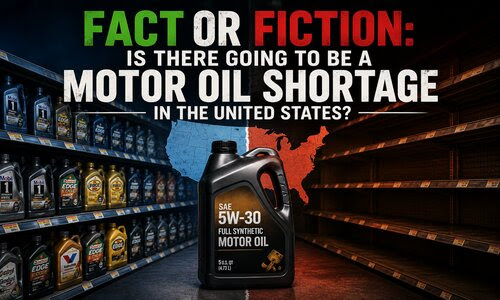
Fact Or Fiction: Is There Going To Be A Motor Oil Shortage
There have been persistent rumors that industry insiders are bracing for a widespread shortage of motor oil. Are these rumors accurate? I decided that I was going to investigate this and discover the truth.
Unfortunately, I have very bad news. Multiple sources within the industry are confirming that we are facing much higher prices and physical shortages of certain products if the Strait of Hormuz is not reopened soon.
I realize that what I have just shared is not welcome news, but it isn’t going to do any good to stick our heads in the sand.
According to Axios, supply chains for lighter-viscosity synthetic oils are particularly vulnerable, and one industry insider is warning that “actual shortages are starting to appear”…
Industry groups and analysts say lighter-viscosity synthetic oils — including 0W-8, 0W-16 and certain 0W-20 grades commonly used in newer vehicles — are most vulnerable to disruption.
“Actual shortages are starting to appear” for some synthetic oil products, Amanda Hay, global lead for base oils at ICIS, told Axios, adding that “security of supply is the chief concern for industry players.”
What we are experiencing now is the leading edge of this crisis.
An internal memo that was apparently meant for AutoZone stores in the Southeast region got leaked to the public, and it is causing a great deal of concern…
Over the past week, reports about looming motor oil shortages have started popping up from multiple directions. The most pointed of them surfaced today, when a person posted what looks like an internal memo to the Southeast region of AutoZone stores.
In the memo, the writer says, “Realistic, middle-of-the-road estimates are for our average available supply in this product category [lubricating fluids] to drop by 40%.” That figure continues to pop up, and it basically means one thing. Oil changes, transmission fluid changes, really anything that lubricates your car is about to get more expensive. We reached out to AutoZone for comment, but haven’t received a reply at the time of writing.
So far, AutoZone has not confirmed or denied that the memo is real or not.
But what local repair shop owners are hearing appears to confirm that big trouble is brewing…
Shops on the ground are already bracing for it. Speaking to a local repair store here in Little Rock, Arkansas, a general manager tells Carscoops that “They are being very secretive about all that. They say the price is for sure gonna go up, but they don’t know how the mainline volume will be affected yet.”
Another shop owner in DC said on Monday that Mobil and Shell informed Costco and Walmart that they’re out of product to ship. Later that same day, he posted what appears to be a bulletin focused on managing supply chain issues. Guidance included partially substituting 0W-8 oil with 0W-16 and then doing the same for 0W-16 with 0W-20. These are just the most recent and easily accessible examples of the current concern.
What I have shared so far is certainly alarming enough.
But now Toyota and Nissan are both openly warning their service departments that shortages are on the way…
Rising fuel prices are not the only petroleum-related problem facing drivers this summer. According to internal service bulletins reportedly tied to Toyota and Nissan, automakers are now preparing for potential shortages of certain motor oils as global supply chain pressure spreads beyond gasoline and diesel.
The issue primarily affects low-viscosity synthetic oils like 0W-8 and 0W-16, which are commonly used in newer hybrid and fuel-efficient engines. These lightweight oils have become increasingly important as automakers chase tighter emissions standards and better fuel economy numbers, especially in hybrid-heavy lineups like Toyota’s.
Toyota is instructing their dealers to temporarily substitute heavier oil grades if necessary…
According to the leaked Toyota bulletin, the company warned service departments that 0W-8 and 0W-16 oils could become difficult to source due to production and logistics constraints affecting the petrochemical industry.
To manage inventories, Toyota reportedly instructed dealers to occasionally substitute heavier oil grades for certain service intervals. The guidance specifically notes that these substitutions are intended only as temporary measures rather than permanent changes to maintenance schedules.
And it is being reported that Nissan is warning their dealers to “expect oil allocations limited to roughly 55% of prior-year supply levels”…
Nissan’s draft bulletin reportedly warned dealers to expect oil allocations limited to roughly 55% of prior-year supply levels. The company later confirmed the authenticity of the document, although it stated the memo itself had not yet been officially distributed across the dealer network.
The shortage concerns are not isolated to one automaker, either. Nissan’s customer communication draft specifically stated the supply issue is affecting the entire automotive industry rather than only Nissan-branded service departments.
Clearly, there is widespread expectation that at least certain types of motor oil will be in short supply throughout the rest of this year.
So I would encourage you to stock up while you still can.
Meanwhile, the largest budget airline in Europe is bracing for an “Armageddon situation” due to a looming shortage of jet fuel…
Europe’s biggest budget airline has warned weaker carriers could collapse under soaring jet fuel costs as the industry braces for what one executive described as a possible ‘Armageddon situation’.
Ryanair finance chief Neil Sorahan said the airline has contingency plans in place as fears grow over fuel shortages and surging oil prices linked to instability in the Middle East and disruption risks around the Strait of Hormuz.
‘Do we have plans for some kind of Armageddon situation? Of course we do,’ Sorahan told CNBC.
I don’t think that this will be a major problem in the United States yet.
Asia and Europe will be the first to experience a serious lack of jet fuel.
But one thing we are already experiencing in the United States is much higher gasoline prices…
US gas prices have gone up, and up, and up since the country bombed Iran in late February. In March, I reported that the average price of gas in the country had gone up from $2.89/gallon to $3.48/gallon. Now, the average price of gas in the US is $4.517/gallon. That’s a 56% increase in the price of gasoline since the US bombed Iran!
Read the last sentence of that quote again.
A 56 percent increase in just a matter of weeks is insane.
Sadly, things will only get worse if the fighting in the Middle East resumes.
Retired Army General Jack Keane has close ties to the Trump administration, and he just told Fox News that “we’re on the cusp of going back into military operations”…
“Where are we? The president has exhibited a huge amount of patience here since the ceasefire on April the 8th. And we’ve tried to work a deal with these guys, and it just doesn’t seem possible. And where we are, we’re on the cusp of going back into military operations. When we stopped. Bill and Dana, we had two weeks to go, a little less than 30% of the targets. Those targets remain, but we have better intelligence now, after these five, six weeks. So that target list is expanded. It’s considerably more comprehensive,” he continued. “It’ll be a combined operation with the United States and Israel going full throttle, all out, no half measures here whatsoever.
And when those target lists are complete and they will consist of the rest of the weapons that are remaining, to indicate some of what you just mentioned, to include what remains of nuclear, and also all the organizations that sustain the regime. We have better intelligence on locations and other things associated with that, and certainly they’re going to be a comprehensive target list in of itself, and then a grouping of targets that really deal with all of Iran’s revenue sources to force an economic collapse of the regime. Obviously, Kharg Island blockade is having significant impact. But this attack will even further aggravate their ability to gain revenue source. Without revenue, it’s hard to see how this regime can survive. So we put it on a path.”
I believe that General Keane is correct.
I believe that we are right on the brink of more fighting.
The bottom line is that the Strait of Hormuz is not going to be reopened any time soon and even with a deal – it will take weeks if not months to get caught up.
So there will be rationing and there will be shortages.
And the entire global economy is entering a major downturn.
We really are facing a nightmare scenario, and most of the general population still has no clue.
GOG / Russia Just Tested A Missile That Could Destroy An Area The Size Of Texas

The Russians have developed the most sophisticated nuclear missile in the history of the world by a very wide margin, and it is specifically designed to be used in a future nuclear war with the United States.
The RS-28 Sarmat is an intercontinental ballistic missile that has a maximum speed of approximately 15,500 miles per hour. It is 116 feet tall, and that makes it roughly as tall as a ten story building. It can carry up to 10 metric tons of thermonuclear warheads, and those warheads can destroy an area the size of the state of Texas.
We have no defenses against the Sarmat, and so once it is launched we will get hit. It is an incredibly terrifying weapon, and many believe that it is only a matter of time before it actually gets used.
The Sarmat is the crown jewel of Vladimir Putin’s very long campaign to modernize Russia’s strategic nuclear arsenal…
Since coming to power in 2000, Putin has overseen efforts to upgrade the Soviet-built components of the Russian nuclear triad — deploying hundreds of new, land-based intercontinental ballistic missiles, commissioning new nuclear submarines and modernizing nuclear-capable bombers.
The United States doesn’t have anything like the Sarmat.
Neither does anyone else.
It has a maximum range of more than 21,000 miles, and it can carry up to 16 independently targetable nuclear warheads…
The Sarmat intercontinental ballistic missile has an expected range over 10,000 kilometers (6,200 miles) and can reportedly carry up to 16 independently targeted nuclear warheads, according to the Missile Defense Advocacy Alliance, a US-based nonprofit. Putin claims the range extends to more than 35,000 kilometers (21,750 miles).
Let me try to put this into language that anyone can understand.
This missile has enough range to reach any target on the entire planet.
So there is nowhere that is out of reach.
A single Sarmat can release 16 independently-targetable nuclear warheads.
That means that one missile goes up, and 16 warheads come down.
And each one of those warheads can instantly destroy an entire major city.
Russia plans to eventually produce more than 40 of these ICBMs.
According to Newsweek, a single Sarmat intercontinental ballistic missile can carry enough nuclear warheads to wipe out “an area the size of Texas”…
The RS-28 Sarmat will reportedly carry a nuclear payload large enough to wipe out an area the size of Texas or France.
The Sarmat is the most advanced intercontinental ballistic missile in the entire world by a wide margin, and we have no way to defend against them.
In fact, a study that was conducted by a team of 13 physicists and engineers with the American Physical Society determined that our anti-missile defenses are so feeble that we couldn’t even do much “to stop a relative handful of old-fashioned North Korean ICBMs” from reaching their targets.
But just in case we are able to improve them in the future, the Russians have equipped the Sarmat with “a host of capabilities intended to defeat ballistic missile defenses”…
The Sarmat is a silo-launched, liquid-fueled, nuclear-armed ICBM. The missile will reportedly have a host of capabilities intended to defeat ballistic missile defenses, ranging from decoys and other countermeasures to a fractional orbital bombardment capability, and independent post-boost vehicles (IPBV). There have even been suggestions that it could carry a payload of multiple hypersonic boost-glide vehicles.
If Vladimir Putin decides to push the button, we are toast.
Of course most people in the western world assume that Putin would never do that because our retaliatory strikes would destroy the Russians.
But the truth is that so much has changed over the past couple of decades.
The Russians now have the most sophisticated anti-missile systems in the world by a very wide margin, and we are still relying on extremely outdated Minuteman ICBMs that first went into service in the 1960s and 1970s.
If we launched our extremely outdated ICBMs at the Russians, are you sure that they would get through?
The balance of power has shifted dramatically, and most people in the western world have no idea.
Earlier this week, the Russians conducted a test launch of the Sarmat that Putin called an “unconditional success”…
The test-launch from the Plesetsk Cosmodrome in the Arkhangelsk region took place at 11:15 a.m. Moscow time today, according to the Kremlin. Around half an hour later, Russian officials said that the missile hit its target at the Kura test range on the Kamchatka Peninsula in Russia’s Far East.
The commander of the Strategic Rocket Forces, Sergei Karakayev, informed Putin of the successful test. The Russian leader monitored the launch via video link from his office bunker.
Putin called the test a “major event and unconditional success.”
This should have received a lot more attention from the media in the western world, because it is a huge story.
According to Putin, Sarmat missiles will start entering combat service by the end of this calendar year…
Putin said that the nuclear-armed Sarmat missile would enter combat service at the end of the year. It was built to replace the aging Soviet-built Voyevoda.
“This is the most powerful missile in the world,” Putin declared, adding that the combined power of the Sarmat’s individually targeted warheads is more than four times higher than that of any Western counterpart.
In contrast, the next-generation U.S. intercontinental ballistic missile, the LGM-35 Sentinel, is scheduled to enter combat service in the early 2030s.
In other words, we are way behind.
The Russians are also in the “final stages” of development for two other exceedingly fearsome weapons…
Putin also announced Russia was in the “final stages” of the development of the nuclear-armed Poseidon underwater drone and the Burevestnik cruise missile powered by miniature atomic reactors.
The Poseidon is designed to explode near enemy coastlines and cause a radioactive tsunami. The Burevestnik has virtually unlimited range thanks to nuclear propulsion, allowing it to loiter for days, circling air defenses and attacking from an unexpected direction.
In the future, a Poseidon drone armed with a nuclear weapon could be lurking just off the east coast and we would never even know it.
Once it explodes, a gigantic wall of radioactive water could come sweeping over Washington D.C. or New York City in just moments.
The Russians have been feverishly preparing for the wars of the future.
Meanwhile, our leaders have been focused on other things.
So let’s hope that a shooting war between the United States and Russia does not erupt any time soon, because it would not go very well for us.
AI Is Coming For Both Blue-Collar And White-Collar Jobs

The warnings are no longer coming only from science fiction movies or fringe commentators. Increasingly, they are coming from the very executives building the artificial intelligence systems reshaping the global economy. And if even half of their predictions prove accurate, the world may be heading toward one of the largest labor disruptions in modern history.
For decades, Americans were told automation would mostly threaten repetitive factory work while white-collar professionals remained relatively safe. That assumption is rapidly collapsing. AI is now coming for both the office cubicle and the warehouse floor — and the speed of the transition may leave societies dangerously unprepared.
At the center of the latest debate is Mustafa Suleyman, the CEO of Microsoft AI, who recently warned that within 12 to 18 months, artificial intelligence could perform most professional white-collar tasks at human levels. His comments sent shockwaves through industries once viewed as stable career paths: accounting, legal analysis, project management, software development, customer service, and marketing.
The implications are staggering.
For years, college degrees were presented as protection against economic instability. Parents encouraged children to avoid manual labor and pursue “knowledge work” because those careers were supposedly future-proof. But AI systems are rapidly learning to draft contracts, analyze financial reports, write code, create advertising campaigns, summarize meetings, and even generate strategic business recommendations.
Large law firms are already using AI tools to conduct legal discovery and contract review tasks that once required teams of junior associates billing hundreds of hours. Accounting firms are deploying AI systems capable of auditing transactions, spotting irregularities, and preparing financial summaries in seconds. Marketing departments increasingly rely on generative AI to create ad copy, social media campaigns, graphics, and customer analytics with minimal human involvement.
Even software engineers — long considered among the safest professions in the digital age — are now under pressure from AI coding systems. GitHub Copilot, ChatGPT-based coding assistants, and autonomous AI agents can already generate large blocks of functioning code, debug software, and assist with app development. Some companies have begun reducing entry-level coding hires altogether because AI can now handle much of the routine work previously assigned to junior developers.
The threat extends into customer support as well. Klarna, the Swedish fintech giant, revealed that its AI assistant was handling work equivalent to hundreds of customer service agents. IBM has also openly discussed slowing hiring for back-office roles that AI may soon replace.
But while white-collar workers are only beginning to feel the pressure, blue-collar industries are also undergoing a revolution that could fundamentally alter employment.
One of the clearest examples came recently from viral demonstrations involving robotic warehouse systems competing directly against humans in package sorting and fulfillment tasks. Videos circulated online showing AI-powered robotic arms rapidly identifying, grabbing, sorting, and packing packages with incredible speed and consistency. Unlike human workers, the machines do not tire, require breaks, call in sick, or demand overtime pay.
Amazon has become a major symbol of this transformation. The company has deployed hundreds of thousands of robots throughout its fulfillment network, including systems capable of lifting heavy inventory, transporting shelves autonomously, and sorting products at high speed. New AI vision systems allow robots to identify damaged products, track inventory movement, and optimize warehouse flow faster than human supervisors.
The automotive service industry is also being transformed. Companies like Automated Tire Inc. and RoboTire are already operating robotic tire-changing systems that can replace and balance four tires in around 23 minutes — roughly twice as fast as experienced human technicians. One technician can now oversee multiple robotic bays simultaneously, dramatically increasing productivity while reducing labor requirements.
And the transportation industry may face even greater disruption. Autonomous trucking technology continues advancing rapidly, with companies testing AI-guided freight systems capable of operating long-haul routes with minimal human input. Considering trucking remains one of the largest employment sectors for American men without college degrees, widespread automation there could devastate entire communities.
Fast food is another frontline. Chains such as McDonald’s, Wendy’s, and Chipotle have experimented with AI drive-thru systems, robotic fry stations, automated beverage dispensers, and AI scheduling tools. Some restaurants are testing fully automated kitchen operations where machines prepare meals with little human involvement.
Supporters argue these changes will increase efficiency, reduce costs, and solve labor shortages. And in some cases, that is true. But history shows that societies become unstable when large numbers of people suddenly feel economically discarded.
The Industrial Revolution created extraordinary wealth, but it also triggered riots, worker uprisings, and decades of painful social adjustment. Entire populations saw their livelihoods disappear almost overnight. The difference today is speed. AI is not evolving over generations. It is evolving monthly.
If millions of both blue-collar and white-collar workers begin losing jobs simultaneously, the political and cultural consequences could become explosive. Rising unemployment combined with inflation, housing shortages, and declining faith in institutions could create fertile ground for growing civil unrest.
What happens when a 45-year-old accountant discovers his career has been automated? What happens when warehouse workers, truck drivers, customer service agents, and retail employees all compete for a shrinking pool of human jobs? What happens when young people spend tens of thousands on degrees only to discover AI can perform much of the work cheaper and faster?
The danger is not merely economic. It is psychological and societal. Work provides purpose, structure, dignity, and stability. Remove that too quickly from millions of people, and societies begin to fracture.
Artificial intelligence will undoubtedly bring enormous breakthroughs in medicine, logistics, research, and productivity. But America may be dangerously underestimating the human cost of the transition already underway.
The conversation can no longer be limited to whether AI is impressive. The far more urgent question is whether society is prepared for what happens when millions of people realize the machines are no longer just assisting workers — they are replacing them.