
Bible Prophecy, Signs of the Times and Gog and Magog Updates with Articles in the News
Israel At 78: The Growing Call To Rebuild The Third Temple
The banners waving through Jerusalem this year were not only blue-and-white Israeli flags. During the recent Jerusalem Day celebrations, another symbol appeared again and again among crowds marching through the Old City: images of a future Third Temple standing upon the Temple Mount. For some, it was political theater. For others, it was a declaration of destiny.
The timing felt significant to many Israelis. This year marked Israel’s 78th birthday as a modern state — a milestone many religious Jews increasingly connect to what they see as the gradual restoration of biblical Israel after nearly 2,000 years of exile. To them, the rebirth of the nation in 1948 was never the end of the story. Jerusalem’s reunification in 1967 was another step. And now, growing numbers believe the next phase may center around the Temple Mount itself.
What was once considered a fringe religious aspiration inside Israel is steadily moving closer to the mainstream. The idea of rebuilding a Third Temple in Jerusalem — on the very site where the First and Second Temples once stood — is no longer confined to obscure activist circles. It is now openly discussed by rabbis, politicians, members of the military, and growing segments of Israeli society still reeling from the trauma of October 7.
And for Christians who study Bible prophecy, those developments are impossible to ignore.
During Jerusalem Day events, Israeli National Security Minister Itamar Ben-Gvir made headlines once again after ascending the Temple Mount and declaring that Israel had “restored sovereignty” over the site. He celebrated what he described as increased Israeli control and praised stronger security measures that, in his words, produced one of the quietest Ramadan periods in years.
His words were not accidental.
The Temple Mount remains the single most explosive religious site on earth. Jews regard it as the location of the First and Second Temples. Muslims revere it as the site of the Dome of the Rock and Al-Aqsa Mosque. Since Israel captured the Old City during the 1967 Six-Day War, a fragile arrangement has remained in place in which Israel controls security while the Jordanian-backed Islamic Waqf oversees daily administration.
But men like Ben-Gvir increasingly argue that arrangement should end.
His decision to raise the Israeli flag on the mount during Jerusalem Day celebrations sent a message not only to Israelis, but to the entire Middle East: there is a growing movement inside Israel that no longer wishes to merely visit the Temple Mount — it wants to reclaim it.
That movement has been growing for years.
Organizations like the Temple Institute have spent decades preparing for the possibility of a future temple. Temple vessels have been recreated. Priestly garments have been sewn. Training for ritual practices has resumed. Even discussions surrounding red heifers and purification rituals — once dismissed as symbolic religious curiosities — are now taken seriously by many observant Jews.
The preparations go even further. The Temple Institute has also completed a massive golden menorah intended for a future temple and placed it on public display overlooking the Western Wall. The organization has also worked extensively on training men believed to be descendants of the biblical priesthood for future temple service and has even developed architectural plans and educational models envisioning how a Third Temple could function in modern Jerusalem. What once sounded symbolic increasingly appears methodical and deliberate.
The movement no longer feels theoretical.
October 7 changed Israel profoundly. The Hamas massacre shattered assumptions about security, peace, and coexistence. In its aftermath, many secular Israelis have reportedly begun revisiting faith, identity, and biblical history. In moments of national trauma, nations often return to their spiritual roots. Israel appears to be no exception.
That spiritual awakening is becoming visible inside the IDF itself.
Religious expression among soldiers has surged, particularly among younger troops shaped by war and loss. Yet that trend has also sparked conflict with Israel’s secular establishment. Recently, controversy erupted after an Israeli soldier reportedly faced punishment for displaying a “Moshiach” — Messiah — patch on his uniform. Others have been photographed wearing patches depicting the future Temple alongside the words, “Soon in our days.”
The reaction from military leadership exposed a growing tension within Israeli society.
The wording of the reprimand disturbed many religious Israelis. Israel’s founding vision openly referenced the “redemption of Israel,” yet soldiers expressing messianic Jewish hope can reportedly face severe punishment, while Hamas openly frames its war in explicitly religious terms. Hamas even uses the Dome of the Rock — built atop the ruins of the ancient Jewish Temple — as a central emblem of its movement.
To many religious Israelis, the contradiction feels glaring.
And now some rabbis are pushing for tangible action.
Rabbi Shmuel Eliyahu recently called on Prime Minister Benjamin Netanyahu and Israeli leadership to establish a synagogue directly on the Temple Mount as a first step toward expanded Jewish worship there. Speaking opposite the mount during Jerusalem Day events, Eliyahu declared that the Islamic structures currently standing there are tied to Israel’s exile and insisted that a future Jewish Temple will one day rise again.
“In the meantime, until the Temple is built, there needs to be a synagogue here,” he said. “Now the Muslims already understand that it is not theirs; we need to take hold.”
The Taiwan Countdown Is Ticking – And America May Not Be Ready
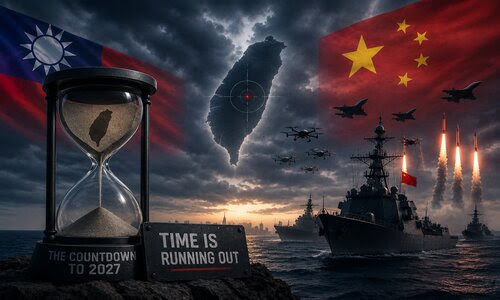
After the latest Trump-Xi summit in Beijing, one warning is becoming harder to dismiss: Taiwan may no longer be a distant crisis. It may be the next great test of American power.
According to Axios, some advisers close to President Donald Trump now fear China could move against Taiwan within the next five years, after Xi Jinping used the summit to project China not as a rising power, but as America’s equal — and Taiwan as something Beijing ultimately intends to take. One adviser reportedly summarized Xi’s posture bluntly: “Taiwan is mine.”
That matters because Taiwan is not just another island on the map. It is the center of one of the most dangerous military, economic, and technological flashpoints in the world.
China has long claimed Taiwan as its own, while Taiwan has operated as a self-governing democracy for decades. But the language coming from Beijing has grown sharper, the military exercises more aggressive, and the timeline more alarming.
Former CIA Director William Burns said in 2023 that U.S. intelligence believed Xi had ordered the People’s Liberation Army to be ready by 2027 to conduct a successful invasion of Taiwan — while stressing that readiness does not mean a final decision has been made.
That is the key distinction. China may not have decided to invade. But it is preparing for the option.
And preparation is exactly what should concern Washington.
China’s navy is already the largest in the world by number of ships, and that matters enormously in any Taiwan scenario. A fight over Taiwan would not begin as a conventional land war. It would likely begin with control of the sea and air: blockades, missile strikes, cyberattacks, drone swarms, satellite targeting, and attempts to isolate the island before America and its allies could respond.
The Pentagon’s latest China military report describes how Chinese forces have already practiced encircling Taiwan, including simulated blockade operations. In 2024, China’s Joint Sword exercises involved aircraft, naval vessels, and Coast Guard ships surrounding Taiwan and its outer islands. The report notes that China’s Coast Guard became more integrated with PLA operations and, during one exercise, encircled Taiwan for the first time.
That is not symbolism. That is rehearsal.
China’s military strategy around Taiwan is increasingly built around overwhelming pressure from multiple directions. Its missiles could target airfields, ports, command centers, and U.S. bases in the region. Its cyberwarfare units could attempt to blind Taiwan’s communications and disrupt American logistics. Its satellites could help track U.S. ships and aircraft. Its drones could be used for surveillance, targeting, electronic warfare, and attacks against both military and civilian infrastructure.
This is the danger of looking at Taiwan through yesterday’s lens. A future conflict may not begin with landing craft rolling onto beaches. It may begin with Taiwan’s internet failing, ports being mined, power grids disrupted, drones filling the skies, and Chinese naval forces cutting off the island’s lifelines.
That is why the size and reach of China’s navy is so critical. Taiwan is an island. Its survival depends on access to the sea. If China can blockade Taiwan, it may not need to conquer every inch immediately. It could strangle the island economically, test America’s willingness to break the blockade, and force the world into a brutal choice: risk a major-power war or watch Taiwan be slowly coerced into submission.
Then there is the semiconductor nightmare.
Taiwan is home to TSMC, the company that dominates production of the world’s most advanced chips. These chips power smartphones, cars, weapons systems, artificial intelligence, data centers, and nearly every major sector of the modern economy.
The United States is trying to rebuild domestic chip manufacturing through the CHIPS Act and new facilities, including TSMC’s Arizona investment, but experts warn the supply chain remains deeply dependent on Asia and still has major weak points. Harvard Business Review recently noted that even as advanced fabs rise in the U.S., America still lacks enough back-end chip packaging capacity.
That means America is trying to bring the industry home — but slowly. China may be moving on a faster clock.
This is the central problem: Washington is trying to rebuild industrial strength on a timeline measured in years and decades. Beijing may be preparing military options on a timeline measured in months and a few short years.
If China moved against Taiwan before America had secured enough domestic chip capacity, the economic shock would be staggering. It would not simply be a military crisis. It could become a supply-chain crisis, an inflation crisis, an AI crisis, a defense-industrial crisis, and a global recession trigger all at once.
The uncomfortable question is whether America is ready.
Is the U.S. Navy large enough and positioned well enough to break a blockade? Are American missile stockpiles deep enough for a prolonged Pacific conflict? Are U.S. bases hardened against Chinese missile strikes? Is the defense industry capable of replacing weapons quickly? Are American companies prepared for a sudden loss of Taiwanese chips? Are voters prepared for what a Taiwan war would actually mean?
These are not theoretical questions anymore.
Xi’s 2027 military readiness goal is approaching fast. China’s navy is expanding. Its missile forces are growing. Its cyber and space capabilities are becoming central to its war planning. Its military exercises around Taiwan increasingly look like practice for the real thing.
The Beijing summit may have ended with diplomacy and ceremony. But beneath the handshakes was a colder reality: China is no longer merely talking about Taiwan as a future ambition. It is building the tools to take it.
And the clock is ticking.
TOTALY UNFAIR !!! The Shared Podium That Left Many Female Athletes Feeling Humiliated

The scene at the California state track and field finals this week was about far more than medals, podiums, or records. It became yet another flashpoint in a national debate that refuses to go away because, for many parents and female athletes, the issue cuts to something fundamental: fairness.
Transgender athlete AB Hernandez dominated multiple girls’ events at the state finals, winning first place in the high jump, long jump, and triple jump, triggering visible frustration from competitors, parents, and spectators alike. The controversy surrounding transgender participation in girls’ sports has simmered for years, but what unfolded in California showed just how emotionally charged the issue has become.
The reaction in the stadium told the story more clearly than any political talking point could.
Some female athletes reportedly avoided Hernandez entirely during medal ceremonies. Malia Strange of Shadow Hills High School, who finished behind Hernandez in the triple jump, declined to appear on the podium. Parents wore “Protect Girls Sports” shirts in protest. Tournament officials, evidently aware of the optics and backlash surrounding the competition, handed out additional gold medals to biological female athletes who finished second behind Hernandez.
But the controversy went even further than that.
Under a pilot program enacted by the California Interscholastic Federation (CIF), any biological female athlete who finished behind a transgender athlete was elevated one placement higher. The policy also allowed girls who narrowly missed qualifying for state finals due to competing against a transgender athlete to still advance.
The result was one of the most surreal images in modern high school sports: female athletes being required to share podium spots with the very athlete many believed held an unfair biological advantage over them.
Photos and videos of Hernandez standing atop shared podiums alongside female runners-up spread rapidly across social media, igniting outrage nationwide. For many critics, the shared podium arrangement spoke volumes. Officials appeared to be attempting to symbolically preserve fairness without actually addressing the underlying issue itself.
If the competition were truly viewed as fair and equal, critics asked, why was there any need to redesign the ceremony at all?
That question became central to the backlash.
Many online commenters described the scene as deeply uncomfortable, arguing that female athletes were effectively being asked to publicly celebrate circumstances they privately believed were unjust. Others argued the split-podium system unintentionally revealed that even officials understood the competitive imbalance but lacked the willingness to directly confront it.
And that is the central issue driving the outrage.
The question is whether biological differences matter in competitive athletics.
For decades, women fought to create protected spaces in sports precisely because those biological differences were recognized as real and consequential. Title IX was not created because male and female athletic performance is identical. It was created because it is not.
Elite-level competition is often decided by fractions of inches, split seconds, or tiny advantages in explosiveness, muscle density, wingspan, bone structure, lung capacity, and recovery. Even after hormone treatment, many sports scientists and female athletes argue that biological males retain advantages that cannot simply be erased. Many parents and athletes pointed to the results in California as evidence of those concerns, noting that Hernandez beat the field in the girls’ long jump by over a foot — an enormous margin in elite high school competition where events are often decided by mere inches.
That is why so many female athletes increasingly feel they are being forced into an impossible position: stay silent or risk being labeled hateful.
Olivia Viola’s mother, Tracy Howton, captured the frustration many parents now feel when she said her daughter was simply “fighting for the rights of female athletes.”
“She thinks it’s a fundamental issue of fairness for women,” Howton said. “It shouldn’t be that controversial.”
Yet in many progressive political circles, it has become controversial to even say biological sex exists in meaningful athletic terms. Critics of transgender participation policies are frequently branded as bullies, extremists, or bigots regardless of how respectfully they raise concerns.
California Governor Gavin Newsom has faced growing criticism from parents who believe state leaders have ignored the concerns of female athletes altogether. Howton accused Newsom of trying to silence dissent by portraying girls who object as aggressors rather than victims of an unfair system.
Across the country, this issue has become increasingly toxic for Democrats, particularly among suburban parents and women who traditionally supported progressive causes but now feel uncomfortable with the direction of the debate. Polling consistently shows that a majority of Americans oppose biological males competing in women’s sports, especially in high school and collegiate competition.
What happened in California may only deepen that divide.
The images coming out of the event were striking precisely because they did not look celebratory. They looked tense, awkward, and emotionally divided. Athletes standing apart from one another. Officials improvising ceremonies to soften public backlash. Parents protesting from the stands. Young women appearing afraid to openly express frustration.
That is not unity. That is managed conflict.
And perhaps the most revealing part of all is that officials themselves appear to understand the public relations problem. If they truly believed there was no fairness issue whatsoever, why alter the ceremony? Why create duplicate honors? Why attempt to symbolically compensate biological female athletes afterward?
Because deep down, even many supporters of these policies recognize the discomfort Americans feel when watching biological males dominate girls’ competition.
The tragedy is that young athletes on all sides are now being placed in the center of a political and cultural battle adults refuse to resolve honestly. Female athletes should not have to choose between silence and social backlash. Transgender athletes should not be turned into political weapons by activist groups seeking to force cultural change through sports.
But pretending there are no legitimate fairness concerns is only making the conflict worse.
Sports depend on trust in the integrity of competition. Once athletes and parents begin believing the rules themselves are unfair, the entire foundation starts to crack. And judging by the outrage erupting in California, many Americans believe that crack is growing wider by the day.