Support For Rebuilding The Temple In Israel Surges As Thousands Prepare To Serve
For generations, the rebuilding of the Jewish Temple in Jerusalem was viewed as little more than a dream held by a small number of deeply religious Jews. It was discussed in prophecy conferences, debated by theologians, and dismissed by many as politically impossible.
Not anymore.
Something remarkable is happening inside Israel.
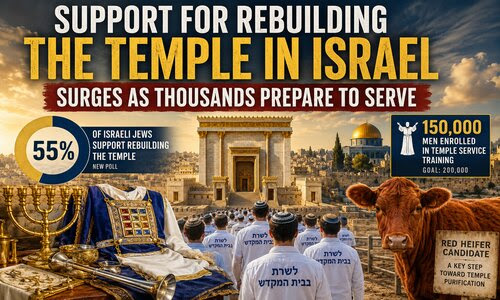
A new poll commissioned by Temple Mount Heritage Foundation and conducted by the Direct Polls Institute, shows that 55 percent of Israeli Jews now support rebuilding the Third Temple on the Temple Mount. That statistic alone represents a dramatic cultural shift. But perhaps even more astonishing is another development: reports indicate that 150,000 men have already enrolled in training for Temple service, with plans eventually calling for as many as 200,000 participants.
Stop and think about that for a moment.
People do not spend years preparing to serve in a Temple they never expect to exist.
Whether one approaches these developments from a political, historical, or biblical perspective, something significant is clearly changing. The conversation surrounding the Temple is no longer confined to a small religious movement. It is steadily moving into Israel’s mainstream consciousness.
A Dream Becoming Preparation
For nearly forty years, organizations dedicated to preparing for a future Temple have quietly gone about their work.
They have painstakingly recreated the sacred vessels described in Scripture. The golden menorah has been fashioned. Priestly garments have been woven. Silver trumpets, incense altars, priestly crowns, and dozens of other instruments required for Temple worship have already been completed according to biblical specifications.
To many observers, these projects once seemed more symbolic than practical.
Today they look increasingly like preparation.
The shift is subtle but important.
Instead of simply talking about rebuilding the Temple someday, increasing numbers of Israelis are preparing for the possibility that “someday” could actually arrive.
Preparing The Next Generation Of Priests
One of the most overlooked developments is the growing emphasis on training.
Temple worship is not something that can simply begin overnight.
According to biblical law, priests must understand detailed purification procedures, sacrificial regulations, ceremonial worship, and countless practical responsibilities. These traditions require years of education and preparation.
That helps explain why reports of 150,000 men enrolling in Temple service training are so significant.
Even if only a fraction eventually serve, the numbers reveal something much larger than simple religious curiosity.
They reveal expectation.
Preparation on this scale suggests that many Israelis are beginning to view the restoration of Temple worship as a realistic possibility rather than an unreachable ideal.
The Red Heifer Conversation Returns
Adding even more momentum is renewed interest surrounding one of the Bible’s most fascinating requirements–the red heifer.
According to Numbers 19, the ashes of a perfectly qualified red heifer are necessary for the purification rites associated with Temple worship.
For centuries, no suitable animal could be found.
Then several years ago, the arrival of five red heifers from Texas captured worldwide attention. Many prophecy watchers wondered whether history was approaching another major milestone.
As those animals matured, however, questions emerged over whether they continued to satisfy every biblical requirement. Even the smallest imperfection can permanently disqualify a candidate.
Now attention has shifted once again.
A young red heifer born in Israel has become the latest candidate under careful observation. Temple authorities emphasize that no final determination can be made until the animal fully matures, and history reminds us that several previous candidates ultimately failed inspection.
Still, the search itself has become increasingly serious.
Not long ago, discussions about finding a red heifer seemed almost mythical.
Today they are part of ongoing preparation.
The Greatest Obstacle Still Remains
Of course, enormous challenges continue to stand in the way.
The Temple Mount remains one of the most disputed pieces of land on earth.
It is home to the Dome of the Rock and the Al-Aqsa Mosque, making any discussion of rebuilding the Jewish Temple politically explosive. Any attempt to change the status quo would likely trigger enormous international tension.
Yet this is precisely why these developments deserve attention.
For decades critics argued that biblical prophecy concerning a future Temple could never happen because there was neither the desire nor the preparation for such a project.
That argument grows weaker every year.
The desire is increasing.
The preparation is advancing.
The equipment exists.
The priestly garments are ready.
Training is underway.
The search for a qualified red heifer continues.
Piece by piece, foundations that once seemed unimaginable are quietly falling into place.
Why Christians Should Pay Attention
For Christians who study biblical prophecy, these developments are impossible to ignore.
Scripture speaks repeatedly of a functioning Temple during the last days.
Daniel describes sacrifices being interrupted.
Paul writes of the “man of lawlessness” taking his seat in God’s Temple.
Revelation refers to a Temple that is measured during the Tribulation.
Those passages have puzzled generations of Bible readers because no Temple has existed in Jerusalem since A.D. 70.
Today, for the first time in nearly two thousand years, we are watching an entire generation actively preparing for one.
That does not mean construction begins tomorrow.
Nor should Christians fall into the trap of predicting dates or claiming every headline fulfills prophecy.
Jesus warned against that.
Instead, He told His followers to watch.
There is a profound difference between setting dates and recognizing seasons.
Preparation is not fulfillment–but it often precedes fulfillment.
That may be the most remarkable aspect of everything happening today.
The Temple has not yet been rebuilt.
But the obstacles that once made such a possibility seem impossible are steadily being removed.
Perhaps the most striking lesson is this: prophecy often advances quietly before it suddenly accelerates. Noah built an ark long before the first raindrop fell. The wise virgins prepared their lamps before the bridegroom arrived. In much the same way, what we are witnessing today may not be the fulfillment itself, but the preparation that makes fulfillment possible.
Whether these events unfold in our lifetime or another generation’s, they remind believers that God’s prophetic clock has never stopped ticking. As Jesus instructed, our calling is not to speculate–but to watch, remain faithful, and be ready.
The Church’s Surrender To The Culture Of Death – Special Liturgy For Euthanasia
For centuries, the Church has stood at the bedside of the dying with a simple but profound mission: to comfort the suffering, proclaim the hope of Christ, and remind both the living and the dying that life belongs ultimately to God. That sacred calling is now being dramatically redefined in Canada.
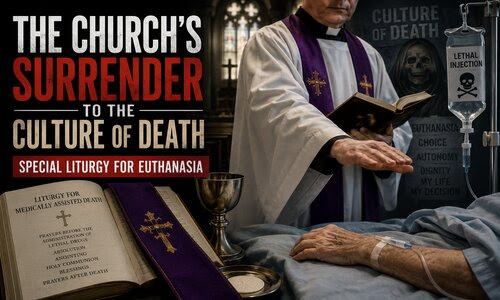
The Anglican Church of Canada has authorized the trial use of a 66-page liturgy specifically designed for those choosing Medical Assistance in Dying (MAiD), complete with prayers before the lethal drugs are administered, prayers afterward, confession, anointing with oil, Holy Communion, blessings, and other rites traditionally reserved for preparing believers to meet God.
It is difficult to overstate the significance of this decision.
This is not merely the Church ministering to someone who has already decided to end his or her life. It is the Church creating an official religious framework surrounding the act itself. Whether intended or not, the message received by many believers will be unmistakable: euthanasia is compatible with faithful Christian discipleship.
That represents a profound theological shift.
The Anglican Synod attempts to avoid taking a direct moral position by emphasizing the Church’s responsibility to provide pastoral care regardless of the circumstances. Compassion is certainly central to Christianity. Jesus ministered to the sick, the brokenhearted, and the dying. Christians should never abandon those facing unbearable suffering.
But biblical compassion has never meant affirming every decision someone makes.
Throughout Scripture, shepherds are repeatedly commanded not only to comfort God’s people but also to teach, correct, warn, and guide them in truth. Pastoral care separated from moral truth ceases to be biblical shepherding. It becomes little more than emotional accompaniment.
The document itself illustrates this tension.
It speaks movingly about people enduring terrible illnesses, exhausted by pain, longing for rest, and wishing not to burden their families. Few Christians would fail to sympathize with those heartbreaking realities. Yet nowhere does suffering itself become justification for intentionally ending innocent human life.
Instead, Scripture consistently presents suffering as one of the painful consequences of living in a fallen world while simultaneously affirming that human life remains sacred from conception until natural death.
King David declared, “My times are in Your hands” (Psalm 31:15).
Job, after losing everything, confessed, “The Lord gave, and the Lord has taken away.”
God Himself tells Israel in Deuteronomy, “I put to death and I bring to life.”
The consistent biblical witness is clear: God alone possesses ultimate authority over life and death.
This is precisely why historic Christianity–whether Roman Catholic, Orthodox, or Protestant–has overwhelmingly opposed both suicide and euthanasia for nearly two thousand years.
The concern is not merely about death itself.
It is about sovereignty.
Who ultimately determines when a human life ends?
When physicians intentionally administer lethal drugs, and the Church surrounds that act with sacramental language and sacred ritual, it inevitably communicates that the act itself has moral legitimacy.
The Anglican liturgy repeatedly refers to God’s presence during the euthanasia procedure. One suggested prayer speaks of the room becoming “a thin-space that is sacred.” Afterwards, another prayer thanks God for helping those present offer their loved one “their final gift” and seeing them “safely home.”
These are extraordinarily powerful theological statements.
Language shapes belief.
Liturgy shapes doctrine.
For generations, Christians have understood this principle. What churches repeatedly pray eventually becomes what congregations believe.
That is why this decision extends far beyond denominational Politics
Canada already has one of the world’s most expansive euthanasia programs. Since MAiD was legalized in 2016, eligibility has expanded dramatically–from terminal illness to chronic conditions, and from those whose deaths were reasonably foreseeable to many whose deaths are not. Debate continues over future expansion involving mental illness and other categories.
Many Christians have watched those developments with growing concern, asking where the cultural boundaries ultimately end.
Now, rather than serving as a prophetic voice questioning that trajectory, one of Canada’s historic churches appears to be adapting to it.
History repeatedly demonstrates that when the Church stops challenging culture, it soon begins reflecting it.
The earliest Christians gained respect in the Roman Empire precisely because they refused to adopt Rome’s practices surrounding unwanted infants, suicide, and the value of vulnerable human life. They became known as people who rescued the abandoned, cared for plague victims, and defended life when doing so was costly.
Their witness was not built upon cultural accommodation.
It was built upon holy distinction.
Today’s Church faces a remarkably similar crossroads.
Modern Western culture increasingly defines compassion as affirming personal autonomy above all else. Christianity has historically defined compassion differently: walking faithfully beside those who suffer without surrendering God’s definition of truth.
Those are not always the same thing.
Christians absolutely should sit with the dying.
They should pray with them.
They should anoint them.
They should remind them of Christ’s promises, encourage reconciliation with loved ones, proclaim forgiveness through the Gospel, and assure them that death itself has been conquered through Jesus Christ.
But there is a profound difference between preparing someone for the natural end of life and preparing someone for an intentionally induced death.
One ministers through suffering.
The other risks sanctifying the act that ends it.
The tragedy of this moment is not merely that another denomination has adopted a controversial position. The greater tragedy is that countless confused believers may now conclude that because the Church has created prayers for euthanasia, God must surely approve of it as well.
That is precisely why the Church exists–not simply to echo society’s changing moral consensus, but to proclaim God’s unchanging truth with both conviction and compassion.
When the Church ceases calling sin what Scripture calls sin, it may temporarily gain cultural approval.
But it inevitably loses its prophetic voice.
And when the Church begins blessing what God has never blessed, it is not merely changing its liturgy.
It is changing its witness.