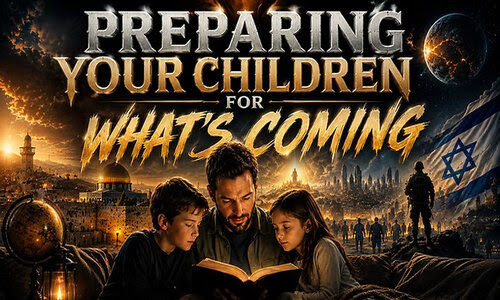
Should Christians Teach Their Children Bible Prophecy?
For many believers, the answer is not as obvious as it should be. Some Christians assume prophecy is too complicated for children. Others worry that it might frighten them or cause unnecessary anxiety. Still others believe prophecy is simply a topic for pastors, theologians, or older believers who have spent years studying Scripture.
Yet when we step back and consider the question honestly, the answer becomes remarkably straightforward. Yes, we should teach our children Bible prophecy. The reason is simple: Bible prophecy is part of God’s Word.
The apostle Paul declared that he had not hesitated to proclaim “the whole counsel of God” (Acts 20:27). The whole counsel of God includes Genesis all the way to Revelation. It includes salvation and sanctification, heaven and judgment, Israel and the nations, the first coming of Christ and His return. Nearly one-third of Scripture was prophetic when it was written. God intentionally chose to reveal future events to His people, not to confuse them but to prepare them.
As parents, we do not have the authority to decide which portions of Scripture our children need and which portions they can safely ignore. If God considered prophecy important enough to place throughout His Word, then we should consider it important enough to teach to the next generation.
We Are Living in a Battle for Our Children
The reality is that we are living through a time when the battle for our children has become increasingly intense. Every generation has faced spiritual warfare, but modern parents are dealing with challenges previous generations could scarcely imagine. The culture surrounding our children constantly competes for their attention, their values, their identities, and ultimately their allegiance.
Children today spend countless hours connected to devices that deliver a steady stream of messages about truth, morality, gender, identity, and purpose. Social media influencers often have more access to a child’s mind than parents do. Entertainment companies openly promote worldviews that directly contradict Scripture. Educational systems increasingly embrace philosophies that remove God from the picture altogether.
Children are being exposed to increasingly aggressive messaging regarding sexuality, gender identity, and morality. Ideas that would have been considered fringe only a generation ago are now presented to children as unquestionable truths. Many parents find themselves feeling overwhelmed as they attempt to navigate a culture that appears determined to disciple their children for them.
Paul reminds us in Ephesians 6:12 that our struggle is not against flesh and blood but against spiritual forces of wickedness. The battle for our children is ultimately a spiritual battle. Satan has always targeted the next generation because he understands that if he can shape the worldview of children, he can influence the future.
God Gave Your Children to You
This is precisely why the Bible places the responsibility for raising children squarely upon parents. Deuteronomy 6 commands parents to teach God’s Word diligently to their children, speaking of it throughout the normal rhythms of life. Ephesians 6 instructs fathers to bring their children up in the training and admonition of the Lord.
Scripture never delegates this responsibility to governments, schools, or even churches. While pastors, teachers, and youth leaders can certainly assist in the process, they were never intended to replace parents as the primary spiritual influence in a child’s life.
When God entrusts parents with a child, He entrusts them with a soul. That responsibility extends far beyond providing food, shelter, and education. Parents are called to disciple their children, introduce them to Jesus Christ, teach them Scripture, and prepare them to stand firm in a world that often stands opposed to God.
By the time a child reaches adulthood, he or she should have been exposed to the truths of God’s Word and equipped to face the realities of the world through a biblical worldview.
Bible Prophecy Gives Children a Framework
Many young people leave home completely unprepared to understand the world they are entering. They see increasing wars, political instability, moral confusion, technological advancement, and growing hostility toward Christianity, yet nobody has ever explained how Scripture speaks to these issues.
Bible prophecy provides that framework.
Prophecy teaches our children that God knows the future. It explains why deception increases. It reveals why evil appears to be growing. It shows why Israel remains significant and why spiritual darkness intensifies as history moves toward Christ’s return.
Rather than creating fear, prophecy provides understanding. Jesus rebuked the religious leaders because they could discern the weather but failed to discern the signs of the times. Our children should not grow up spiritually blind to the world around them. They should understand that God has already revealed where human history is heading and that current events do not occur outside His sovereign control.
Why Many Young People Leave the Church
Unfortunately, many churches have neglected these important conversations. Children often hear the same Bible stories repeatedly throughout their early years. David and Goliath, Noah’s Ark, Jonah, and Daniel are all tremendously important accounts that should absolutely be taught.
However, many students eventually graduate from youth ministries without ever seriously studying the Rapture, the Tribulation, the Antichrist, the nation of Israel, or the prophetic teachings of Jesus.
Many youth groups have become heavily focused on entertainment and social activities. Students may enjoy games, retreats, and fellowship events, yet receive only brief devotional messages that never challenge them to think deeply about Scripture or engage difficult questions.
Then graduation arrives.
Young adults suddenly enter universities, workplaces, and social environments where Christianity is openly challenged. Questions about truth, morality, science, sexuality, and religion arise almost immediately. Many discover they were never equipped to answer these questions because nobody prepared them for the realities of the world. One reason many young adults walk away from church may be that they were never fully discipled. They inherited Bible stories but never developed a biblical worldview.
Prophecy Produces Hope, Not Fear
One of the greatest misconceptions surrounding prophecy is the idea that it frightens children. Certainly prophetic passages contain serious warnings, but prophecy ultimately points believers toward hope.
Paul described the Rapture as a source of comfort, instructing believers to encourage one another with these truths. Our children live in a generation marked by anxiety. They hear constant reports about wars, disasters, economic instability, violence, and uncertainty.
Bible prophecy reminds them that God remains in control.
It reminds them that evil does not win.
It assures them that Jesus Christ is returning.
It teaches them that history is moving toward God’s appointed conclusion.
That message produces hope, not fear.
Parent, This Responsibility Is Yours
Pastors matter. Churches matter. Youth pastors matter. But God has entrusted your children to you.
Parent, your child is your responsibility. You are the one called to teach them Scripture, answer their questions, model faithfulness, and prepare them for the world they will inherit.
Teach them about Jesus.
Teach them the Gospel.
Teach them Genesis all the way to Revelation.
Teach them about the Blessed Hope!
Because the world is already teaching them its version of the future. The culture is already discipling them. The only question is whether parents will intentionally disciple them first.
The days are growing darker, but God’s Word shines brighter than ever. Our children need more than entertainment, activities, and shallow lessons. They need truth. They need discernment. They need hope.
And perhaps most importantly, they need to know that history is not spiraling out of control. Jesus Christ is coming again, and the God who holds the future has already revealed enough for His children to live faithfully until He comes.
That is why we teach our children Bible prophecy.
First Adults. Now Children. The Slippery Slope of Euthanasia

There was a time when the phrase “slippery slope” was dismissed as little more than a scare tactic. Opponents of euthanasia warned that once a society accepted the deliberate ending of innocent human life under limited circumstances, those limits would not remain in place. Supporters scoffed. Strict safeguards, they insisted, would prevent abuse. The law would apply only to the rarest and most tragic of cases.
Today, those assurances ring increasingly hollow.
This week, the Netherlands confirmed that, for the first time since expanding its euthanasia policy in 2024, a child under the age of 12 has died through medically assisted death. According to Dutch Health Minister Sophie Hermans, the child was terminally ill, had no hope of recovery, and was suffering unbearably. The parents consented, physicians followed the legal process, and prosecutors will now review the case to ensure every procedural requirement was met.
The forms were completed.
The regulations were followed.
The system worked exactly as intended.
And that is precisely what should give us pause.
No decent person is indifferent to the suffering of a dying child. Every parent can only imagine the heartbreak these families endure. Christians, perhaps more than anyone, should be leading the way in providing comfort, compassionate care, and support for those walking through unimaginable pain.
But compassion and killing are not the same thing.
The tragedy of suffering does not erase the sanctity of life.
The Netherlands became the first nation to legalize euthanasia for adults in 2002. At the time, supporters emphasized that it would be carefully limited to mentally competent adults facing unbearable suffering. The public was assured that strict safeguards would prevent the practice from expanding.
Yet over the past two decades, those boundaries have steadily shifted.
First came broader eligibility for adults.
Then provisions involving minors over the age of 12.
Protocols were established allowing euthanasia for newborns with severe medical conditions.
Then, in 2024, Dutch authorities expanded the policy again–this time to include children between the ages of 1 and 12 suffering from terminal illnesses with no prospect of recovery.
Now that policy has claimed its first life.
Every expansion was described as an exceptional circumstance. Every new category was presented as compassionate. Every previous boundary quietly disappeared.
That is exactly how slippery slopes work–not through sudden leaps, but through incremental steps that, viewed individually, seem reasonable. Only when looking back do people realize how far they have traveled.
If anyone doubts that trajectory, they need only look across the Atlantic.
Canada legalized Medical Assistance in Dying (MAID) in 2016. Canadians were told it would remain a narrowly defined option for competent adults nearing the end of life.
Within just a few years, those restrictions had already begun to disappear.
The requirement that death be reasonably foreseeable was removed. Eligibility expanded to include people living with serious disabilities under broader circumstances. Today, Canada has recorded more than 60,000 medically assisted deaths, with the annual number continuing to rise. What was introduced as a rare exception has become an increasingly common part of the nation’s healthcare system.
The debate has not stopped there.
Canada has repeatedly considered expanding MAID to include those whose sole underlying condition is mental illness. Although implementation has been postponed amid concerns from psychiatrists, physicians, and disability advocates, the proposal remains very much alive. There have also been ongoing discussions surrounding so-called “mature minors”–children considered capable of making significant medical decisions–even though such cases are not currently permitted nationally.
Notice the pattern.
The debate is almost never about where the line should permanently remain.
It is about where the next line should be drawn.
That should concern every society considering these policies.
The United States has not traveled nearly as far down that road, but the direction bears watching. In recent months, Delaware, Illinois, and New York have all legalized physician-assisted suicide for terminally ill adults under carefully defined circumstances, joining a growing list of states where the practice is now legal. Other legislatures continue debating similar measures.
Supporters argue these laws are fundamentally different from Canada’s MAID system or the Netherlands’ euthanasia policies. In many respects they are. American laws generally require a terminal diagnosis, mental competency, multiple physician approvals, and that the patient self-administer the prescribed medication.
Yet history demonstrates that nearly every expansion begins with assurances that the practice will remain narrowly confined.
Those assurances deserve careful scrutiny.
Christians approach this issue from an entirely different foundation.
Human dignity is not measured by productivity. It is not determined by physical ability, intelligence, independence, or the absence of pain. Scripture teaches that every person is created in the image of God (Genesis 1:27). That truth does not disappear in a hospital room.
We should devote ourselves to relieving pain.
We should pursue the very best palliative care medicine can offer.
We should surround suffering families with prayer, love, practical support, and hope.
But intentionally ending an innocent human life crosses a moral line that Scripture never grants us authority to cross.
One seeks to relieve suffering.
The other ends the sufferer.
That distinction matters.
The Netherlands insists this latest case is exceptional. Canada continues debating its next expansion. More American states continue legalizing physician-assisted suicide under carefully defined limits.
The question is no longer whether safeguards exist.
The question is whether those safeguards remain fixed over time.
The experience of the Netherlands suggests they do not.
Canada’s experience suggests they do not.
History suggests they rarely do.
Every expansion begins with compassion.
Every expansion is presented as carefully limited.
Every expansion promises there will be no further movement.
Then another line is crossed.
A society is ultimately judged by how it treats its most vulnerable. When we begin deciding that some innocent lives are no longer worth preserving because suffering has become too great, we risk replacing the duty to care with the power to kill.
The slippery slope is no longer a hypothetical argument.
For one child in the Netherlands, it has become a heartbreaking reality.