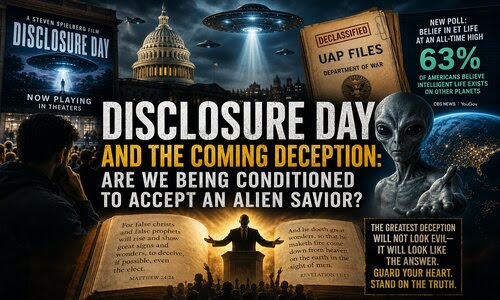
Disclosure Day: Are We Being Prepared For An Alien Savior?
“Disclosure” has become one of the most powerful narratives of our generation.
This week, the cultural fascination with extraterrestrial life received yet another major boost as Steven Spielberg’s highly anticipated film Disclosure Day opened in theaters, introducing millions of moviegoers to questions surrounding alien life, government secrecy, and humanity’s place in the universe. Combined with a steady stream of UFO documentaries, streaming series, podcasts, and social media discussions, the topic of non-human intelligence has never been more prominent in the public consciousness.
At the same time, the Department of War released yet another batch of declassified Unidentified Anomalous Phenomena (UAP) files as part of its Presidential Unsealing and Reporting System for UAP Encounters (PURSUE). According to the department, its UFO disclosure website has already received a staggering 1.7 billion hits worldwide since launching in May.
Adding to the momentum, a new CBS News/YouGov poll reveals that belief in extraterrestrial life continues to surge. Sixty-three percent of Americans now believe intelligent life exists on other planets, up dramatically from previous decades. Nearly half expect humanity will eventually make contact with extraterrestrial beings, while one in five Americans already believes such contact has occurred.
Whether one believes the government’s disclosures represent genuine mysteries, advanced military technology, psychological operations, or something else entirely, one thing is undeniable: society is being conditioned to think about non-human intelligences on an unprecedented scale.
Movies, television shows, congressional hearings, Pentagon videos, whistleblower testimony, social media influencers, and now official government disclosures are all pushing the conversation into the mainstream.
For Christians, this raises an important question.
What if humanity discovers we are not alone?
The answer may surprise many people.
Biblically speaking, Christians have never believed we are alone in the universe.
Long before modern science contemplated extraterrestrial intelligence, Scripture revealed the existence of a vast spiritual realm populated by intelligent beings created by God.
The Bible describes angels, archangels, cherubim, seraphim, living creatures around God’s throne, and countless heavenly hosts carrying out divine assignments.
Some angels function as messengers. Others serve as warriors. Some appear to oversee nations. Others worship continually before God’s throne.
The prophet Isaiah describes seraphim with six wings crying out, “Holy, holy, holy is the Lord of hosts.” Ezekiel describes extraordinary living creatures unlike anything found on Earth. Revelation expands the picture further, revealing heavenly beings surrounding God’s throne in continual worship.
The biblical worldview is already far bigger and stranger than most modern depictions of extraterrestrial life.
Christians do not need aliens to explain mysterious non-human intelligences.
God has already revealed the existence of an unseen realm.
The Bible also records the greatest rebellion in cosmic history.
Lucifer, once a glorious heavenly being, rebelled against God and led a portion of the angelic host into rebellion with him. These fallen angels became what we commonly refer to as demons.
Genesis 6 introduces another mysterious episode involving the Nephilim, where “sons of God” interacted with humanity in a way that produced widespread corruption before the flood.
While Christians debate the exact interpretation of these passages, the larger point remains clear: the Bible repeatedly warns that spiritual beings can influence human affairs and that not every supernatural manifestation originates from God.
That warning becomes especially important when we examine biblical prophecy concerning the last days.
Jesus warned repeatedly that deception would become one of the defining characteristics of the end times.
“Take heed that no man deceive you.”
Those words appear again and again throughout Christ’s teachings.
The Apostle Paul warned of a coming “strong delusion” that would deceive many. Revelation describes astonishing signs, wonders, and supernatural displays that will convince much of the world to follow the Beast and the False Prophet.
This is where the modern UFO narrative becomes particularly interesting.
What happens if humanity is eventually presented with undeniable evidence of advanced non-human intelligences?
What happens if those beings claim to have created humanity?
What if they deny the biblical account of creation?
What if they present themselves as humanity’s saviors?
What if they offer solutions to global conflict, climate concerns, technological challenges, or even death itself?
Would a secular world be more likely to embrace such beings than the God of Scripture?
Many Christians have long wondered whether an extraterrestrial explanation could someday be used to explain away biblical truths or justify a new global spiritual system.
After all, Revelation’s False Prophet is described as performing astonishing miracles that persuade the world to follow the Antichrist.
The Bible says he will call fire down from heaven and deceive those who dwell on the earth through supernatural signs.
Imagine those events unfolding in a world already conditioned to expect advanced non-human intelligences.
Imagine a generation raised on decades of alien disclosure suddenly witnessing miraculous displays from a charismatic global leader.
Could people conclude that humanity has finally made contact with superior beings?
Could such manifestations be interpreted as proof of extraterrestrial intervention?
Scripture does not explicitly say this will happen.
But it does repeatedly warn that the final deception will be global in scale and supernatural in nature.
The Antichrist himself is described as being empowered directly by Satan. Some theologians even speculate that he may become uniquely possessed by satanic power in a manner unlike any previous world ruler.
Whatever the exact details, the Bible leaves little doubt that the coming deception will be persuasive enough to fool billions.
That is why Christians should approach today’s disclosure movement with both discernment and humility.
We should not fear every unexplained object in the sky.
Nor should we blindly accept every official narrative presented to us.
Instead, we should remember that Scripture already tells us there is more to reality than the physical world we can see.
A spiritual realm exists.
Angels exist.
Demons exist.
God’s kingdom is real.
And so is spiritual deception.
As governments release more files, blockbuster films draw millions into conversations about extraterrestrial life, and public fascination with non-human intelligence grows, Christians should remember that our ultimate authority is not Pentagon reports, congressional hearings, Hollywood productions, or viral UFO footage.
It is the Word of God.
The greatest question facing humanity is not whether intelligent life exists beyond Earth.
The Bible settled that long ago.
The real question is whether we will recognize truth when the ultimate deception finally arrives.
The Spiritual Impact Of A Generation That No Longer Reads
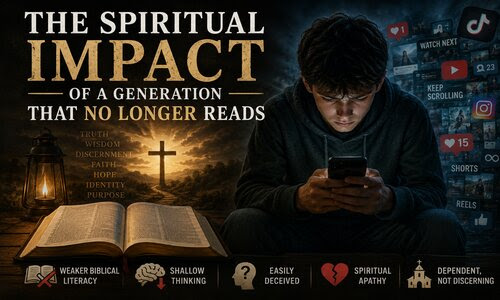
A quiet crisis is unfolding across America, and unlike many of the cultural battles that dominate headlines, this one receives surprisingly little attention.
The next generation is losing the ability to read deeply, think critically, and comprehend complex ideas.
That may sound dramatic, but educators across the country are sounding the alarm. What they are witnessing in classrooms is not merely a decline in test scores. It is a fundamental shift in how young people process information and engage with the written word.
College literature instructor Tyler Jagt recently described how his students struggled to complete a simple 20-page article. Not a novel. Not a lengthy textbook chapter. A 20-page article.
Some students admitted they repeatedly lost track of the author’s main points before reaching the end. Others relied on AI-generated summaries rather than reading the material themselves. What once would have been considered a routine assignment has become an overwhelming challenge for many incoming college students.
The data confirms what educators are seeing.
According to the 2024 National Assessment of Educational Progress (NAEP), reading scores among American 12th graders have fallen to their lowest levels since tracking began in 1992. Nearly one-third of graduating seniors scored below the basic reading level.
The numbers become even more alarming among younger students. The Annie E. Casey Foundation reports that roughly 70 percent of fourth graders are not reading proficiently. That represents nearly two million children who are struggling with a skill that forms the foundation of every other area of learning.
Some major urban school districts report even more concerning outcomes. In cities such as Baltimore, Detroit, and Cleveland, large percentages of students fail to meet grade-level reading standards. In certain schools, fewer than 10 percent of students demonstrate reading proficiency. While the exact numbers vary by district and year, the broader trend is undeniable.
America has a reading crisis.
The causes are not difficult to identify.
For generations, children grew up reading books, newspapers, magazines, and lengthy articles. Reading was not merely an academic exercise; it was entertainment. Students consumed hundreds of pages of novels throughout the year and built the mental muscles necessary for concentration and comprehension.
Today, many young people consume information almost exclusively through short-form videos, social media clips, memes, and AI-generated summaries.
Why struggle through a chapter when a 60-second video promises the same information?
The problem is that it doesn’t.
Reading is not simply a method of acquiring facts. Reading develops attention span. It strengthens memory. It builds vocabulary. It teaches reasoning. It trains the brain to follow complex arguments and connect ideas over extended periods of time.
Video content excels at delivering information quickly. Reading excels at teaching people how to think.
Those are not the same thing.
The consequences are already beginning to appear.
At the educational level, colleges are increasingly forced to lower expectations or provide remedial support for students who arrive unprepared for traditional academic work.
At the workforce level, employers increasingly complain that younger workers struggle with written communication, technical manuals, reports, contracts, and detailed instructions.
At the societal level, the implications become even more troubling.
A population that cannot carefully read and analyze information becomes more vulnerable to manipulation. Complex issues are reduced to slogans. Nuance disappears. Emotional reactions replace thoughtful analysis.
When people lose the ability to engage with lengthy arguments, public discourse naturally becomes shallower.
This may help explain why modern debates often generate more outrage than understanding.
There is also an economic dimension.
Many of the highest-paying careers still depend heavily upon advanced reading comprehension. Lawyers analyze documents. Engineers study technical specifications. Medical professionals absorb vast quantities of research. Business leaders evaluate contracts, reports, and market analysis.
Strong readers gain access to opportunities that weaker readers often cannot.
In many ways, reading remains one of the greatest economic advantages a person can develop.
Yet perhaps the most overlooked consequence is the spiritual one.
For Christians, this crisis strikes at the heart of discipleship itself.
God chose to reveal Himself primarily through a written book.
The Bible contains history, poetry, prophecy, wisdom literature, letters, parables, apocalyptic visions, and theological instruction. Understanding Scripture requires careful reading, reflection, comparison, interpretation, and meditation.
A five-minute devotional video cannot replace that.
Neither can listening to a sermon once a week.
Pastors can teach. Podcasts can encourage. Christian influencers can inspire.
But none of them can substitute for personally opening God’s Word and studying it for yourself.
The Bereans in Acts were praised because they searched the Scriptures daily to verify what they were being taught. They were not passive consumers of religious content. They were active students of God’s Word.
That requires reading.
It requires concentration.
It requires the ability to follow arguments across chapters, understand context, compare passages, and think deeply about truth.
If the next generation loses those skills, they become increasingly dependent on others to tell them what the Bible says rather than discovering it themselves.
That is a dangerous place for any believer to be.
Perhaps this is why Bible literacy continues to decline even among churchgoers. Many Christians consume endless amounts of content about Scripture while spending very little time actually reading Scripture.
The solution is neither complicated nor easy.
We must read again.
Parents need to prioritize books over screens. Schools need to restore reading fundamentals. Churches need to encourage Bible engagement beyond Sunday mornings.
Most importantly, individuals must reclaim the discipline of sustained reading.
The ability to sit quietly with a book, wrestle with ideas, and follow a thought from beginning to end may seem old-fashioned in an age of endless scrolling.
But it remains one of the most powerful skills a person can possess.
A society that stops reading eventually loses the ability to think deeply.
And a church that stops reading God’s Word risks forgetting the very truths that gave it life in the first place.
Spielberg’s New Film Asks If Aliens Would Shatter Faith. The Bible Already Answered That Question.
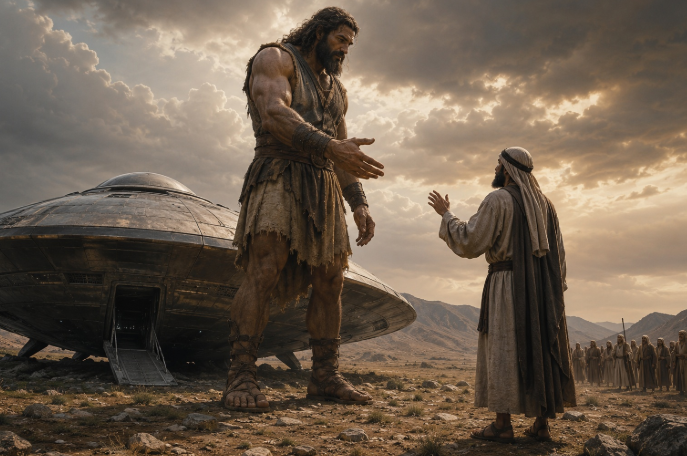
Steven Spielberg has spent half a century making movies about aliens. At 79, his latest — Disclosure Day, opening June 12 — may be the most theologically charged of them all. The film, starring Emily Blunt and Josh O’Connor, follows a Kansas City weather personality who suddenly speaks foreign languages she has never learned and a rogue cybersecurity expert racing to release a massive trove of classified government UFO files. But the real story Spielberg wants to tell is about God.
“The movie also takes the position of the church,” Spielberg told CBS News. “What does this do to the fundamental beliefs that many of us have? Is God our God only on this planet, or is God a God for every system where there’s civilization, intelligent life, and even developing life?” One character in the film, a former Roman Catholic nun, warns that people will see the aliens as deities and “stop believing in God.” The villain, played by Colin Firth, is a Pharaoh-like corporate tyrant devoted to keeping humanity ignorant — a figure drawn, consciously or not, from the pages of Exodus.
The film arrives at a culturally combustible moment. The U.S. government recently launched a UFO website and declassified UAP files, and the White House briefly teased a sci-fi-branded aliens.gov that turned out to be a site for tracking illegal immigrants. Politics and entertainment are blurrier than ever.
Spielberg is not hiding his personal convictions. In his CBS News interview, he said flatly: “I absolutely think that they have been here, and they are here.” He described Disclosure Day as “a summation of my life in science fiction,” rooted in what he calls a “foundation of truth” — not fiction, not speculation, but something he treats as settled. The 2017 New York Times tic-tac video, the 2023 House Oversight Committee testimonies under oath, decades of consistent eyewitness accounts — for Spielberg, the cumulative weight is overwhelming.
The reaction from religious communities was swift and, notably, far less panicked than Spielberg seems to have expected.
A clip of Spielberg’s remarks went viral on X, framed as a claim that extraterrestrial disclosure would shake Christian faith. Many users pushed back hard. “No, it won’t. Hollywood is obsessed with the idea that the discovery of aliens will rock Christian faith. It’s weird,” said Christian podcaster Josh Daws. “The only people who think the existence of aliens would mess with Christianity are non-Christians who don’t understand the first thing about Christianity,” said Eric Sammons, editor-in-chief of Crisis Magazine.
CBN’s Billy Hallowell noted that what people identify as “aliens” may actually be phenomena rooted in the spiritual realm — angels and demons. He pointed out that the Bible focuses on the salvation of human beings: Jesus came to die and save people, not other creatures or entities.
Christian author and UFO researcher L.A. Marzulli called the film “very disturbing,” arguing that Spielberg is “filmically signaling” a coming global event. “Cling to Jesus,” Marzulli urged. “Understand that what was foretold is unfolding. Do not be deceived.”
One Christian reviewer who attended a press screening noted something unexpected: unlike films on similar themes from the 2000s and 2010s that would have placed Christians firmly on the side of bigotry and fear, in Disclosure Day Christians are without exception portrayed in a positive light. The theologically grounded nun character, Sister Maura, ultimately steers the more fearful ex-novitiate toward confidence rather than panic — a portrayal reviewers across the spectrum found surprisingly generous.
Jewish tradition, it turns out, had already grappled with this question long before Spielberg reached for his iPad to write the story. Jewish scholars have contemplated extraterrestrial life and concluded it poses no theological crisis. As one rabbi put it plainly: the discovery of extraterrestrial beings “would pose no more of a threat to Judaism than would the discovery of a new species of rabbit. It would be limiting God’s power to say that He could not have placed life on other planets.” Notably, the Talmud itself identifies a place called Meroz, referenced in Judges 5:23, as a star — and treats it as inhabited.
Kabbalistic and traditional Torah texts, including Rabbi Pinchas Eliyahu Horowitz’s Sefer HaBris, entertain the idea of advanced, “super-intelligent” beings dwelling on other planets.
Exotheology is a word that sends the etymological geek-meter spinning, and very few can claim to have even a passing knowledge of this esoteric field. Dr. David Weintraub, professor of astronomy at Vanderbilt University and the author of Religions and Extraterrestrial Life: How Will We Deal With It?, is uniquely qualified to answer questions on the subject. His book presents a staggering array of opinions, ranging from Aristotle’s premise that extraterrestrials cannot possibly exist, to the more recent Enrico Fermi, who, over 600 years later, came to the same conclusion.
Dr Weintraub reassured Breaking Israel News that Judaism is spiritually prepared for little green men.
“Judaism accepts the possibility of extraterrestrial life. At this level, Judaism is similar to most, but not all other major religions. A few other religions clearly demand and embrace the idea that extraterrestrial life exists. Except for a few extreme kabbalistic interpretations of a few passages in the Talmud, Judaism does not go that far,” he said.
The professor states that Jewish theology may actually require a belief in extraterrestrials since “there are no limits on the power of the creator. Thus, for Jews to say that no life beyond the Earth could possibly exist would be unacceptable, as such an idea would appear to place shackles on God’s creative power…the universe belongs to God (or is God) and God can do what God wishes to do with the universe.”
The film’s final word — spoken by an alien — is “listen.” Spielberg is drawing unmistakably from Shema Yisrael, the declaration that stands at the center of Jewish life: “Hear, O Israel: the Lord our God, the Lord is One” (Deuteronomy 6:4). The Shema is not a call to doubt. It is a call to attention. The God of Israel is not diminished by a large universe. He made it.
The deepest irony of Disclosure Day is that the question Spielberg poses — would the discovery of other intelligence unsettle everything we believe? — was answered definitively by the prophet Isaiah thousands of years ago. “I am God, and there is none else” (Isaiah 45:22). Not “none else on this planet.” None else. The scope of creation does not threaten the Creator.
Spielberg himself has attributed his fascination with aliens partly to his Jewish identity and his childhood experiences of being “othered” — a sense of solidarity with fantastic beings from elsewhere. That instinct is authentically Jewish. But the tradition he comes from already knew: a God vast enough to create the cosmos is not rattled by what the cosmos contains.
THE REAL MAGOG – Erdoğan’s neo-Ottoman war on Israel

Washington cannot continue treating Erdoğan as an indispensable ally and harmless irritant.
On June 10, 2026, Turkish President Recep Tayyip Erdoğan told Justice and Development Party lawmakers that Israeli operations in Lebanon and Syria “also threaten Turkey.”
He tied Ankara’s security to Beirut and Damascus and declared that Israel’s “aggression” endangers the world and “must be stopped.” This was not an isolated outburst.
It echoed his earlier threat that Turkey might intervene against Israel, “just as we entered Karabakh and Libya.”
Erdoğan’s dictatorial rhetoric has crossed from theater into doctrine. Israel should treat it accordingly.
For decades, Jerusalem concentrated on Iran: nuclear breakout, Islamic Revolutionary Guard Corps proxies, Hezbollah missiles, Hamas tunnels, and violence culminating with the October 7, 2023, massacre.
That threat remains existential. But Erdoğan’s Turkey is the next structural challenge.
Unlike the mullahs’ regime, Turkey sits inside the North Atlantic Treaty Organization (NATO).
It possesses a large army, a growing drone industry, Western technology, and leverage over alliance decisions. Ankara is hostile with institutional cover.
The danger begins with ideology. Erdoğan does not treat Hamas as a terrorist organization. He has called its members “mujahideen” and “liberation fighters.”
Turkey has hosted Hamas figures, allowed political activity, and tolerated fundraising networks.
This reflects the ruling Justice and Development Party’s Muslim Brotherhood roots and Erdoğan’s ambition to lead political Islam.
The geopolitical picture is no less troubling. Turkey’s “Blue Homeland” doctrine claims roughly 462,000 square kilometers of maritime space across the Black Sea, Aegean, and Eastern Mediterranean.
It challenges Greek, Cypriot, and Israeli interests while threatening the energy architecture that could bind the Eastern Mediterranean to Europe.
Erdoğan’s naval intimidation near Cyprus, entrenchment in northern Syria, intervention in Libya, drone support for Azerbaijan, and pressure on Greece are not disconnected adventures; they are neo-Ottoman revisionism.
NATO membership magnifies the problem. Turkey fields the alliance’s second-largest army, a substantial defense budget, upgraded F-16s, submarines, drones, and an expanding defense industry.
It also hosts an estimated several dozen American B61 nuclear bombs at Incirlik, though their status remains officially unconfirmed. Erdoğan exploits the alliance when useful and obstructs it when convenient.
That makes Turkey particularly dangerous. Iran attacks through proxies and deniability. Ankara can operate through proxies, too, but also with conventional forces, diplomacy, migration pressure, energy leverage, and NATO procedure.
It can threaten Israel from Syria, squeeze Greece and Cyprus at sea, empower Hamas politically, and then accuse Jerusalem of destabilization.
Jerusalem’s answer must be qualitative superiority, strategic depth, and deterrence by denial and punishment.
Erdoğan must understand that any direct Turkish move against Israel, any Turkey-backed escalation from Syria or Lebanon, or any attempt to coerce Israeli energy routes would produce costs beyond the battlefield.
The first layer is regional architecture. Israel should strengthen its partnerships with Greece and Cyprus into a security framework with joint exercises, shared intelligence, anti-submarine cooperation and air-defense coordination, port access, and energy protection.
Greece and Cyprus should join the Abraham Accords as full members. Their accession would weld the existing Accords states to NATO’s southern flank, recruit India’s growing naval and economic reach, and rally willing European partners