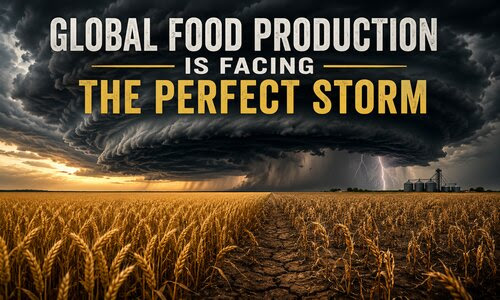
Global Food Production Is Facing The Perfect Storm
Global hunger was already soaring as we entered 2026, and now it appears that we have a historic crisis on our hands. The war with Iran has significantly restricted the flow of fertilizer out of the Middle East, and even the UN is admitting that this will make global food supplies much tighter in the months ahead. Meanwhile, the war in Eastern Europe has greatly escalated and that has resulted in severely reduced wheat exports from Ukraine.
On top of everything else, it is being projected that the strongest Super El Niño in recorded history will peak later this year, and as a result crazy weather patterns will continue to hammer crops all over the planet. At this stage, no rational person can deny what we are witnessing.
Experts are warning that this upcoming fall harvest season will be a real turning point.
Agriculture analyst Noel Fryer recently explained to CNBC why we are facing a “perfect storm” for global food production…
“A lot of things will come together to seriously affect crops next year,” Fryer said on Thursday.
“We’ve had crops decimated by weather in Europe and the U.S. A searingly hot summer in Europe has eroded grazing potential, with no hay and grass for cattle. A possible result of that is significant herd liquidation,” he said.
“We’ve got no end in sight to the Black Sea problem. The issue with fertilizer since the start of the Iran conflict is still there and if anything getting worse. U.S. corn yields look concerning after a wet spring and less fertilizer use, and could push prices up.”
We have never been through anything quite like this.
Everyone assumed that commercial traffic would always be able to flow freely through the Strait of Hormuz, but now everything has changed.
Much of the fertilizer that normally comes out of the Persian Gulf didn’t get to farmers in the northern hemisphere this year, and as a result the Food and Agriculture Organization of the United Nations is projecting that there will be a substantial tightening of global food supplies following the coming harvest season…
The Director-General of the Food and Agriculture Organization of the United Nations (FAO), QU Dongyu, emphasized today that the global fertilizer scarcity caused by disruptions in the Strait of Hormuz will lead to lower yields and tightening food supplies in the latter half of 2026 and into 2027. He spoke at the Ministerial Meeting of the MED9++ Countries on “Supporting Food Security and Access to Fertilizers” co-chaired by FAO, Italy and Croatia.
Addressing ministers and senior representatives gathered in Rome, the Director-General stressed that the current crisis extends far beyond geopolitics, increasingly affecting food production, trade, agricultural inputs and access to food worldwide.
“We meet at a moment of profound strain,” the Director-General said. “This is not only a geopolitical crisis, but also a disruption at the core of the global agrifood system.”
We really struggle to feed the planet even in the best of years.
So what will 2027 be like?
In addition to facing a global fertilizer crisis, the rapidly escalating war in Eastern Europe has severely disrupted Ukrainian grain exports…
Recent military strikes on grain export facilities, oil tankers and vessels in the Black Sea region have now made it too challenging for shipping firms to get insurance, meaning many are avoiding its ports. Alternative land routes for Ukrainian grain are also being stymied by low water levels on the Danube river, and by rail maintenance in Eastern Europe.
Ukraine is one of the great breadbaskets of the world.
That is one of the things that makes Ukraine so valuable.
But now it has become much more challenging to get grain shipped out of that nation…
Separately, Bloomberg pointed out that Russian attacks on Odesa have nearly halted Ukraine’s grain exports this peak harvest season. Total grain shipments from Ukraine have amounted to about 500,000 tons since the start of August, equivalent to roughly 20% of the country’s potential exports. The Greater Odesa ports normally handle about 90% of Ukraine’s grain shipments.
This is not a small matter.
There are some countries that are really starting to panic because it appears that the shipments that they ordered are not going to arrive on time…
Asian processors booked between 2 million and 2.5 million tons of Black Sea wheat for delivery from July through September, representing about 30% to 50% of regional import demand, according to Singapore-based traders. Traders are fretting over some grain shipments won’t arrive in time because of the widespread disruptions.
At the importer level, Egypt and Indonesia are among some of the top countries exposed to Black Sea shipments. Egypt, the world’s largest wheat importer, sourced more than 82% of its first-half imports from Russia and Ukraine. Indonesia contracted for roughly 600,000 tons from suppliers in the region for delivery in July to September.
One Singapore-based trader who sells Black Sea wheat to millers in Asia told the outlet, “The cargoes were due to start arriving from mid-August, but many ships could not go in to load. Buyers are thinking about replacing some of these cargoes with other origins, such as Australia, North America and Argentina.”
Meanwhile, the wheat harvest in the United States is going to be very disappointing this year.
According to Newsweek, it is being estimated that the U.S. will “harvest its lowest acreage of wheat since 1877″…
America is expected to harvest its lowest acreage of wheat since 1877, due to drought, scorched crops, high input costs and uncertainty in export markets.
The U.S. Department of Agriculture’s (USDA) National Agricultural Statistics Service released estimates on June 30 that the total area of all wheat planted was 42.7 million acres in 2026, down six percent from the previous year. This was also 1 million acres below the agency’s March forecasts.
The harvested area of all wheat for 2026 is forecasted to be around 32 million acres, which would be the lowest level in about a century and a half, according to USDA data.
So who is going to volunteer to eat less wheat in 2027?
Not me.
I love bread.
Sadly, this has been such a difficult year for wheat farmers in the heartland of America…
It’s a perfect storm of terrible conditions for wheat farmers this year. Drought, dramatic swings in temperature, the skyrocketing price of fertilizer and diesel, plus multiple viruses affecting wheat have all led to one of the most challenging years for farmers in decades.
The outlook for the months ahead is not promising at all because we haven’t even reached the peak of the Super El Niño yet.
According to CNN, the latest forecast from the National Oceanic and Atmospheric Administration says that there is almost a 70 percent chance that this Super El Niño will be the strongest Super El Niño in recorded history…
There is a nearly 70% chance that the building Super El Niño will be the strongest such event on record, according to a National Oceanic and Atmospheric Administration forecast released Thursday.
Previously, NOAA had been projecting that this event would likely rank “Among the largest El Niño events in the historical record.”
The change in the forecast largely stems from how rapidly this El Niño is intensifying, along with computer model guidance nearly unanimously showing it will peak in late fall and early winter at a level that is stronger than previously thought. NOAA’s El Niño intensity records date back to 1950.
The projections for this Super El Niño just keep getting worse and worse.
One prominent climate scientist named Daniel Swain is openly admitting that we are “already at record-breaking or record-tying territory now”…
“This is a genuinely remarkable event,” said University of California climate scientist Daniel Swain in a YouTube briefing on El Niño broadcast this week.
“We’re already at record-breaking or record-tying territory now, and we’re expected to skyrocket,” he said.
What this means is that a lot more really crazy weather is ahead.
There will be more epic storms, more flooding, more droughts and more gigantic wildfires.
Of course there will be a lot more unusually hot temperatures too.
In fact, we are being told that it is “virtually certain” that 2027 will be the hottest year ever…
Because of the strength of this El Niño, it is virtually certain that 2027 will set a record for the hottest year on record, and possible that 2026 will as well.
So what is the bottom line?
In wealthy western countries, absurd food prices will become even more absurd.
In impoverished nations all over the globe, there will be very serious shortages.
The number of people in the world experiencing acute hunger was already at the highest level ever as we entered this year.
Needless to say, the situation has deteriorated significantly in recent months.
We have never faced a global food crisis of this magnitude, and this is only just the beginning.
AI Was Supposed To Help Us Work – Now We’re Asking It How To Live
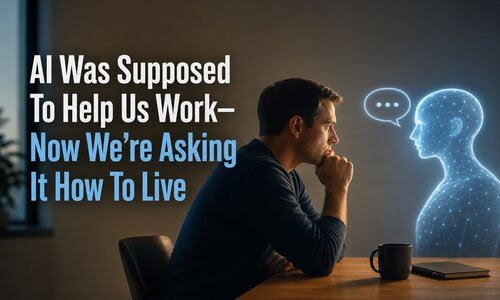
For years, Americans have been told that the artificial intelligence revolution would transform the workplace. AI would write reports, analyze spreadsheets, generate computer code, automate customer service and potentially eliminate millions of jobs.
All of that may still happen. But something quieter–and potentially far more consequential–is already taking place.
AI isn’t merely entering our workplaces. It is entering our private lives.
New research from the AI Observatory examined more than 23,000 anonymized conversations with major AI chatbots and found that nearly half–48 percent–were not related to work. People were talking to artificial intelligence about health, relationships and other deeply personal subjects.
That should get our attention.
The biggest AI revolution may ultimately have less to do with whether a machine replaces your accountant and more to do with whether it replaces your counselor, confidant, pastor–or eventually, your conscience.
From Tool To Adviser
There is an enormous difference between asking artificial intelligence, “Can you summarize this report?” and asking it, “Should I divorce my husband?”
One is assistance. The other is counsel.
Yet the transition between the two can happen almost imperceptibly.
Someone begins using AI to compose emails. Then he asks for career advice. Soon he is discussing an argument with his wife, worries about his children, questions about his health, or doubts about his faith.
The attraction isn’t difficult to understand.
AI is available at 2 a.m. It doesn’t appear impatient. It doesn’t become offended. It can respond sympathetically and immediately, and there is none of the embarrassment that might accompany admitting something painful to another human being.
But convenience can slowly become dependence.
The progression could look something like this:
AI as tool -> AI as adviser -> AI as confidant -> AI as counselor -> AI as authority.
And that final step should especially concern Christians.
We Are Creating A “Thought History”
There is another dimension to this transformation that deserves much more attention: privacy.
For years, people have worried about their search histories. Google searches can reveal interests, medical concerns, political questions and purchasing intentions.
Social media reveals something different: what we want other people to see about us.
But conversations with AI can potentially reveal something much deeper–how we actually think.
Imagine several years of conversations with a highly personalized AI assistant.
It could potentially know about your marriage problems, financial fears, medical worries, political opinions, religious doubts, sexual temptations, family conflicts, ambitions and insecurities.
It might know what makes you angry.
It might know what frightens you.
It might even know which arguments are most likely to persuade you.
We are moving from the age of the search history toward the age of the thought history.
That could become one of the richest collections of personal information ever created.
The danger is not necessarily that someone is sitting somewhere reading everyone’s conversations. The larger concern is that society is rapidly normalizing the creation of extraordinarily detailed digital portraits of human beings without fully considering what such information could eventually mean.
The Ultimate Persuasion Machine?
That leads to an even more unsettling possibility.
Traditional advertising attempts to categorize people. You are male or female, young or old, conservative or liberal, wealthy or struggling. Advertisers then determine which messages might appeal to someone like you.
Social media made that process considerably more sophisticated by tracking what people click, watch and share.
But personalized AI could potentially go much further.
After thousands of conversations, an AI system could theoretically understand not simply what you believe, but why you believe it.
Does fear persuade you? Statistics? Emotional stories? Religious arguments? Financial concerns? Appeals involving your children?
The machine that knows you best could eventually become the machine best equipped to persuade you.
That possibility becomes particularly concerning when AI systems are controlled by corporations that determine their rules, training methods and acceptable boundaries.
AI doesn’t descend from heaven possessing perfect neutrality.
Someone builds it. Someone trains it. Someone establishes its parameters. Someone decides what it should refuse to say and what perspectives it should emphasize.
That matters tremendously when people begin asking machines moral questions.
Christians Cannot Outsource Discernment
For Christians, there is an important distinction between using AI to obtain information and allowing AI to determine truth.
Asking, “What are the major interpretations of this biblical passage?” can be useful.
Asking, “What should I believe?” is something very different.
AI can summarize theological arguments, locate historical information, compare translations and explain difficult concepts. Those can be valuable tools.
But artificial intelligence cannot replace Scripture, prayer, the Holy Spirit, mature Christian counsel or the fellowship of believers.
Proverbs repeatedly emphasizes the importance of godly wisdom and counsel. The New Testament tells Christians to test what they hear and exercise discernment.
The danger is that AI makes bypassing those processes incredibly easy.
Why approach a pastor about a difficult moral issue when a chatbot will answer instantly?
Why discuss a troubled marriage with mature Christian friends when AI will listen without embarrassment?
Why wrestle through Scripture when a machine can provide an immediate conclusion?
Over time, convenience can quietly transfer authority.
Christians who would never consciously say, “I want Silicon Valley deciding my theology,” could nevertheless find themselves consulting AI every day about relationships, morality, sexuality, parenting, politics and Scripture.
Eventually the question changes from “What information can AI give me?” to “What does AI think I should do?”
That is a very different relationship.
A Tool Must Remain A Tool
Artificial intelligence is not inherently evil. Like countless technologies before it, it can be used productively or destructively.
The warning is about something more subtle.
We are creating machines capable of speaking with remarkable confidence, empathy and apparent wisdom. At the same time, millions of people are increasingly willing to tell those machines things they may not tell another human being.
The AI revolution therefore isn’t simply about automation.
It is about authority.
Who will advise us? Who will interpret our problems? Who will help define right and wrong? And who–or what–will we increasingly trust when making life’s most important decisions?
Christians should use powerful new tools without becoming dependent upon them.
Because there is an enormous difference between having artificial intelligence in your pocket and allowing artificial intelligence to become your conscience.