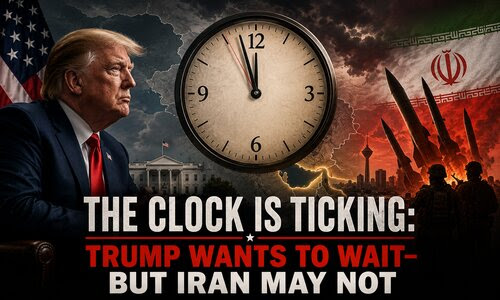
The Clock Is Ticking: Trump Wants To Wait – But Iran May Not
The most dangerous period in the conflict with Iran may not be determined by missiles, aircraft or troop movements. It may be determined by the calendar.
President Donald Trump appears increasingly willing to slow the military tempo and let economic pressure do the work. His administration is preparing what Treasury Secretary Scott Bessent has called the “toughest sanctions in history,” targeting Iran’s oil revenues, financial networks and countries that continue doing business with Tehran. Trump himself recently described the approach as “low-keying it,” signaling that, at least for now, he prefers economic warfare to another major round of strikes.
That strategy requires something Washington believes it has: time.
Iran may be reaching exactly the opposite conclusion.
If Tehran believes the sanctions campaign will steadily weaken its economy, limit its ability to rebuild damaged military capabilities and increase internal pressure, then waiting until winter could leave it with fewer options than it has today.
And hanging over both calculations are two dates: Israel holds its national election on October 27. The United States holds its midterm elections exactly one week later, on November 3.
That creates a potentially explosive window in which Washington has powerful reasons to avoid escalation–and Tehran may have powerful reasons to provoke it.
Trump’s Strategy: Let Time Work Against Iran
From Washington’s perspective, another large-scale military offensive carries substantial risks.
It could produce American casualties. It could trigger larger Iranian retaliation. It could further disrupt the Strait of Hormuz and send oil and gasoline prices higher at precisely the moment voters are deciding control of Congress.
Economic pressure offers Trump another option.
The administration believes months of warfare have left Iran substantially weakened and that sanctions may now accomplish what earlier financial pressure could not. The United States can squeeze Iranian petroleum exports, banking relationships and international trade while maintaining military pressure in the background.
The strategy is essentially: Why risk another costly military campaign today if Iran might be significantly weaker several months from now?
There is also an obvious political advantage to patience.
Even if the White House never publicly says it wants to avoid major escalation before November 3, presidents understand that wars are politically unpredictable. A successful operation can strengthen public confidence. A failed raid, captured American soldiers, rising gasoline prices or an unexpected regional escalation can dominate an election overnight.
Trump therefore has every reason to keep his options open while avoiding unnecessary surprises.
Iran, however, understands the same calendar.
Tehran’s Problem: Waiting May Only Make Things Worse
Iran must ask a very different question:
What will its position look like after November 3?
If American sanctions become increasingly effective, Iranian oil revenues decline, military equipment becomes harder to replace and Trump emerges from the midterms with fewer immediate political constraints, Tehran could find itself negotiating from an even weaker position.
That creates an uncomfortable strategic possibility.
Iran’s best opportunity to create leverage may be before the elections rather than after them.
Mark Dubowitz, CEO of the Foundation for Defense of Democracies, has warned specifically about the possibility of an Iranian “October surprise”–an operation deliberately timed around the Israeli and American elections. His argument is not that anyone knows precisely what Iran will do, but that Tehran has an unusually strong incentive to exploit this narrow political window.
Recent Iranian rhetoric makes the possibility harder to dismiss.
Iranian Army commander Amir Hatami announced a $30,000 reward for killing or capturing an American service member, reportedly doubling the reward if carried out by a woman. Iranian propaganda has simultaneously featured increasingly graphic threats against American political and military targets.
The question is whether those threats are merely psychological warfare–or preparation for something more.
Iran Doesn’t Need To Defeat America
This is where Tehran’s potential strategy becomes especially dangerous.
Iran cannot defeat the United States conventionally. But it does not have to.
It only needs to create a crisis Washington cannot easily ignore.
Imagine several possible scenarios.
A significant number of American troops are killed at a regional base.
American service members are captured.
An Iranian proxy conducts a major attack that Washington attributes to Tehran.
Israel suffers a missile attack severe enough that retaliation becomes unavoidable.
Shipping through the Strait of Hormuz is disrupted again, sending oil prices sharply higher.
None of those events would defeat the United States militarily.
But occurring in late October, any one of them could dramatically alter the political environment.
Trump would immediately face a difficult choice: respond forcefully and risk a larger war days before an election, or exercise restraint and face accusations that America had failed to answer an attack.
From Tehran’s perspective, forcing Washington to make that choice may itself be a strategic victory.
Israel Could Be The Trigger
Iran would not necessarily need to target Americans directly.
Israel votes October 27, creating another potential pressure point.
A sufficiently damaging Iranian attack against Israel could make a major Israeli response politically and militarily almost inevitable.
Israel retaliates.
Iran strikes again.
The United States becomes more deeply involved.
Oil prices rise.
And suddenly the American midterms are taking place amid another major Middle Eastern escalation.
That is the essence of the “October surprise” theory: Tehran could attempt to create circumstances in which Israel delivers the escalation Iran wants and Washington becomes trapped by it.
Oil May Be Iran’s Most Powerful Political Weapon
There is another option that requires no spectacular terrorist attack.
Energy.
The conflict has already demonstrated how quickly events surrounding the Strait of Hormuz can affect global petroleum markets. Brent crude was trading above $90 this week as markets continued reacting to tensions over Iranian exports and Gulf shipping.
Tehran understands something very important about American politics: millions of voters who never follow nuclear negotiations or military strategy understand the price displayed at their local gas station.
Disrupt oil supplies sufficiently and a distant geopolitical conflict becomes an immediate household economic issue.
That gives Iran a form of asymmetric leverage far beyond its conventional military strength.
But An October Attack Would Be An Enormous Gamble
There is another side to Tehran’s calculation.
An attack designed to politically damage Trump could produce exactly the opposite result.
Americans could rally behind the president after American troops are killed or captured. Congress could support overwhelming retaliation. Israel could respond far more aggressively than Iranian planners anticipated.
And Washington could conclude that Tehran had deliberately attempted to manipulate an American election–removing whatever restraints had previously existed.
Iran therefore has powerful reasons for both escalation and caution.
That is precisely what makes the coming weeks so dangerous.
Two Countries, Two Opposite Clocks
Washington appears to believe:
We can afford to wait because Iran gets weaker with every passing month.
Tehran may increasingly believe:
We cannot afford to wait because we get weaker with every passing month.
Those two conclusions can exist simultaneously.
And when they do, pressure increases for the weaker side to act before its position deteriorates further.
The calendar is now remarkably compressed.
Washington is intensifying economic pressure in late August. September will reveal whether that pressure begins producing meaningful results. Israel votes October 27. America votes November 3.
Then the political landscape changes.
That makes late September through early November potentially one of the most dangerous periods of the conflict.
Trump’s strategy depends on patience.
Iran’s strategy may increasingly depend on denying him that patience.
The greatest danger, therefore, may not be that either side deliberately chooses an all-out war.
It may be that Tehran decides its best remaining opportunity is to manufacture a crisis before the clock runs out.
Ai Vision The End Of Privacy: AI Glasses Turn Every Encounter Into Potential Content
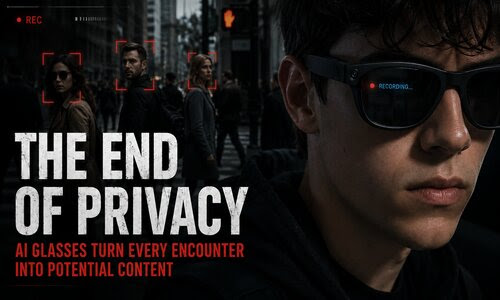
For years, The World have worried about surveillance cameras mounted on buildings, government facial-recognition systems and smartphones quietly collecting enormous amounts of personal data.
But the next stage of surveillance may not be mounted on a wall or sitting in someone’s hand.
It may be sitting on someone’s face.
Meta has filed a patent describing AI-powered smart glasses capable of using facial recognition to identify people in the wearer’s field of view, analyze facial expressions, track the wearer’s gaze and use relationship data to determine which people and moments deserve attention. The system could then automatically create clips and highlight reels from what the wearer has seen.
A patent does not guarantee that every feature will reach consumers. But it reveals something important about where wearable technology may be headed.
The question is no longer simply whether someone can record you.
The question is whether the glasses on a stranger’s face may eventually be able to identify you, interpret your reaction and decide that your interaction is worth saving.
That represents a profound change in the meaning of privacy.
A Camera You Wear, Not One You Hold
Smartphones already made almost everyone a potential cameraman. But there is still an important social signal when somebody pulls out a phone and points it in your direction.
Smart glasses remove much of that signal.
They can resemble ordinary eyewear while containing cameras, microphones and AI capabilities. Instead of periodically deciding to take out a camera, the wearer can move through the world with the camera already positioned exactly where he is looking.
Researchers at the University of Sydney have described the phenomenon as “ambient capture.” Their ongoing study examined hundreds of social-media videos in which men wearing smart glasses approached women in everyday settings and secretly recorded the interactions for online audiences. The women were filmed in locations including workplaces, gyms and beaches, often apparently unaware that the conversation was becoming content.
A stranger may believe she is having a private, fleeting conversation.
The person across from her may know that thousands–or hundreds of thousands–of people could eventually watch it.
Schools Are Already Offering A Warning
One of the clearest examples is appearing in schools.
Futurism recently reviewed numerous videos filmed with smart glasses inside middle and high schools and posted to social media. The publication reported that teen boys were recording classmates, with girls frequently becoming the targets of harassment, unwanted attention and humiliating encounters.
That is more than another version of cyberbullying.
The possibility of online attention can become the motivation for the encounter itself.
A student wearing recording glasses can approach a girl, say something provocative, continue after she signals that she wants the interaction to end and capture the entire episode from his own point of view.
Then comes the second humiliation: the footage can be uploaded for an audience.
The incentives of social media make the problem even worse. Ordinary conversations are unlikely to generate enormous engagement. Awkwardness, conflict, embarrassment and outrage often do.
When attention becomes currency, provoking a stronger reaction can become part of the content strategy.
Schools are therefore offering an early glimpse of a much larger cultural problem.
Everyone Becomes Potential Content
The same behavior is already appearing among adults.
Researchers studying smart-glasses recordings found persistent interactions with women who appeared uncomfortable or attempted to disengage. Meanwhile, CBS News recently reported the case of a woman who discovered that an ordinary interaction had secretly been recorded with Meta smart glasses only after acquaintances began sending her the resulting social-media video. It reportedly accumulated more than 200,000 views across platforms before being removed.
Similar concerns are surfacing in workplaces. Employees have complained about customers and others recording them with smart glasses, while businesses and institutions are beginning to wrestle with whether such devices should be restricted.
British cinemas have begun restricting camera-enabled smart glasses over recording concerns, and courts in England and Wales have also prohibited their use in courtrooms.
These responses suggest society is beginning to understand the problem.
When cameras become nearly indistinguishable from ordinary clothing, traditional assumptions about when we are being recorded begin to collapse.
When AI Starts Deciding What Matters
Meta’s patent takes that concern considerably further.
The proposed system would not simply capture everything indiscriminately. It could use facial-recognition algorithms to identify people, evaluate facial expressions, incorporate information about the wearer’s relationship with those individuals and use eye-gaze information to determine which subjects deserve focus.
In Meta’s dinner-party example, the technology could recognize people important to the wearer and automatically assemble memorable moments afterward.
That sounds convenient.
But consider the same capability from the perspective of everyone else in the room.
You may not merely be visible to another person.
You may be visible to a computer system attempting to determine who you are, what expression is on your face and whether something you just did qualifies as an interesting event.
That moves wearable technology from recording reality toward interpreting reality.
And the people being interpreted may never have agreed to participate.
The Loss Of Social Obscurity
Privacy has never meant that nobody can see us in public.
Something subtler has traditionally protected everyday life: obscurity.
You could walk through a restaurant, attend a church service, shop at a store or have an awkward conversation without assuming that the moment would permanently follow you.
Someone might remember what happened.
But usually there was no searchable video archive of it.
AI glasses threaten that social expectation.
Imagine a world in which every stranger may be wearing a camera capable of recording what they see. Add facial recognition, automated analysis and AI-generated memory systems, and ordinary life begins looking very different.
Every employee becomes recordable.
Every disagreement becomes uploadable.
Every embarrassing reaction becomes shareable.
Every stranger becomes a potential broadcaster.
And increasingly, the person wearing the glasses may not even need to decide consciously which moments to preserve. Artificial intelligence can begin helping make that choice.
Privacy Doesn’t Disappear All At Once
The most significant changes in technology usually arrive gradually.
First cameras moved into our phones.
Then phones became constant companions.
Then social media transformed private moments into public entertainment.
Now the camera may move directly onto the face, accompanied by artificial intelligence capable of understanding more of what it sees.
Each individual step can appear relatively harmless.
Together they point toward something much more consequential.
The greatest danger of AI glasses is not simply that someone might record you.
It is that we may be building a culture where everyone increasingly assumes they are being recorded–and begins behaving accordingly.
Once that happens, something fundamental changes about human interaction.
Conversations become performances. Strangers become suspicious of one another. Embarrassing moments cease to disappear. Consent becomes harder to establish, and ordinary people become involuntary participants in someone else’s content stream.
The school hallway is only one warning.
The larger issue is a future in which no encounter is necessarily private, no reaction is guaranteed to remain fleeting and every moment of everyday life has the potential to become content.
That may prove to be one of the most consequential prices society pays for putting artificial intelligence directly in front of our eyes.