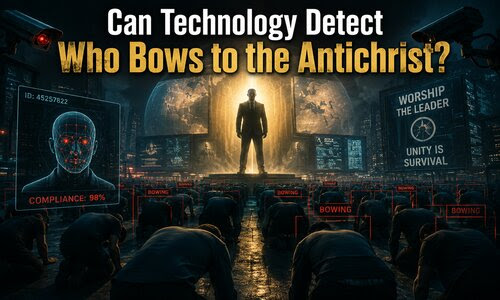
Can Technology Detect Who Bows to the Antichrist? Introducing 6G That Can See Through Walls:
For generations, students of Bible prophecy have asked a fascinating question about Revelation 13:15. How could the Antichrist and False Prophet possibly know whether someone, anywhere in the world, actually bowed down and worshiped the image of the Beast–or refused to do so?
Revelation 13,17, and 18 describe an unprecedented system of global political, religious, and economic control. The False Prophet will cause an image of the Antichrist to be constructed and will demand that the world worship it.
Revelation 13:15 says: “He was granted power to give breath to the image of the beast, that the image of the beast should both speak and cause as many as would not worship the image of the beast to be killed.”
Notice what the text says. Those who do not worship the image are identified and killed. That raises an obvious practical question. How would the system know? For most of human history, accomplishing something like this on a massive scale would have seemed almost impossible. Not anymore.
Introducing 6G That Can See Through Walls:
An article published by TechNext24 examining the privacy implications of 6G technology describes an emerging capability that should get our attention. Future wireless networks are being developed not simply to transmit information but potentially to sense the physical environment around them. This is known as Integrated Sensing and Communication, or ISAC. Instead of radio waves merely carrying information between devices, the same wireless environment can potentially function somewhat like radar. Signals interact with objects and people, and sophisticated systems analyze changes in those signals.
Researchers describe future 6G networks as potentially capable of performing localization, activity recognition, and even monitoring certain vital signs. In other words, the communications network itself could become a sensing network. And we are not merely talking about recognizing that somebody is in a room. Researchers are already working on systems capable of recognizing human activities through walls.
A 2025 study using MIMO radar tested activity recognition through 24-centimeter brick walls and reported 97.1% classification accuracy in its experimental environment. Researchers at MIT have previously demonstrated radio-frequency systems capable of reconstructing human skeletal positions and recognizing human actions even when people are behind walls or otherwise visually obstructed. Other research has demonstrated through-wall recognition using Wi-Fi signals. Think about what that means. The system doesn’t necessarily need to “see” you with a camera in order to determine what your body is doing.
Your Body Disturbs the Wireless Environment
When wireless signals encounter the human body, those signals are altered. Those changes can contain information. Researchers can analyze them to determine things such as whether someone is present, where that person is located, whether the person is moving, what type of activity the person is performing, aspects of body posture, respiration, and potentially heartbeat-related information.
An ETSI report on integrated sensing and communications describes a future 6G scenario in which sensing data includes information about a person’s arms and legs, stride frequency and step size, while a device estimates heart rate and respiration. Researchers have also experimentally demonstrated integrated communication-and-sensing systems capable of detecting respiration and heartbeat from reflected wireless signals. A 2026 discussion of ISAC privacy warns that future networks using millimeter-wave and sub-terahertz frequencies could infer location, movement, activities, and physiological information, such as breathing or heart-rate data.
This creates enormous privacy implications. Your walls may eventually provide far less privacy from electronic sensing than people assume. But for students of Bible prophecy, it raises another remarkable possibility.
Could a System Determine Whether Someone Bowed?
Now go back to Revelation 13. The issue surrounding the image of the Beast isn’t simply identification. It is behavior. The world is commanded to perform an act of worship. Revelation 13:8 says: “All who dwell on the earth will worship him…” Then Revelation 13:15 identifies those who refuse to worship the image and says they will be killed.
For years people have wondered: How could a government actually know whether millions–or potentially billions–of people bowed before an image? The emerging technology gives us at least a conceivable answer. If wireless sensing can distinguish between standing, sitting, walking, falling, and other body positions and movements, then technologically it is no longer difficult to imagine a future system trained specifically to recognize the physical motion associated with kneeling or bowing.
This distinction is important: Current research does not demonstrate an Antichrist “worship detector.” But the underlying capability to detect and classify human posture and movement already exists in experimental settings. Through-wall research has demonstrated systems capable of classifying multiple human activities, while broader wireless sensing research is investigating human posture recognition. The technological barrier that once made Revelation 13 seem impossible is disappearing.
Now Combine Sensing with Digital Identification
But Revelation 13 goes further. The same chapter connects worship of the Beast with another system–the Mark of the Beast. Revelation 13:16-18 says:
He causes all, both small and great, rich and poor, free and slave, to receive a mark on their right hand or on their foreheads, and that no one may buy or sell except one who has the mark or the name of the beast, or the number of his name. Here is wisdom. Let him who has understanding calculate the number of the beast, for it is the number of a man: His number is 666.
Notice the convergence. Revelation describes a system capable of controlling: Identity. Worship. Commerce. And ultimately life and death. We should not claim that today’s biochips, AI, digital IDs, or 6G systems are the mark of the Beast. Scripture does not tell us what technological mechanism the Antichrist will employ. But consider what becomes theoretically possible when these technologies converge.
Imagine a future system in which a person’s digital identity is permanently associated with them. The sensing network identifies the individual’s location. Artificial intelligence determines what the individual is doing. A digital identity system determines who the individual is. A financial system determines whether the individual can buy or sell. And an authoritarian government determines what happens to those who refuse to comply. Suddenly Revelation 13 doesn’t sound technologically impossible. It sounds frighteningly conceivable.
A Potential Automated Enforcement System
Imagine the scenario. A person enters an area where allegiance to the Beast is demanded. The image commands everyone to worship. The sensing system analyzes the people in the area. Person 1 bows. Person 2 bows. Person 3 bows. But Person 4 remains standing. The system recognizes the difference in posture. It connects that behavior with the person’s digital identity. The person’s economic privileges can be terminated. And under the regime described in Revelation 13, refusal ultimately carries the death penalty.
Again, the Bible never says the Antichrist uses 6G, artificial intelligence, radar sensing, or implanted microchips to accomplish this. Those would be possible guesses at technological mechanisms, not biblical claims. But for the first time in history, we can see that technologies capable of producing this level of automated surveillance and enforcement are becoming plausible.
The Walls May Not Hide You
There is another sobering aspect to this. A person might think: “I’ll simply refuse privately.” But what happens when surveillance no longer depends upon a visible camera? Through-wall sensing research changes the equation. If radio-frequency systems can identify human activity behind physical barriers, hiding an act of resistance becomes considerably more difficult.
The same infrastructure delivering communications could potentially participate in sensing the physical environment. That is one of the revolutionary–and potentially dangerous–ideas behind integrated sensing and communications. The network doesn’t merely connect the world. The network can potentially perceive the world.
Did John See the System 2,000 Years Ago?
We need to be careful here. John did not describe 6G. He did not describe artificial intelligence. He did not describe microchips. He would not have understood those technologies even if he had seen them in his vision. What John described was the end result.
And that end result indicates that something would have to be in place technologically for one man to exercise this kind of control over the world. John described a worldwide ruler, a global religious authority, an image that must be worshiped, a system capable of identifying those who refuse, economic exclusion for those who reject the mark, and ultimately the execution of those who refuse to worship the Beast.
For nearly two thousand years, readers could understand what the passage said while having little idea how such comprehensive surveillance, identification, economic control, and enforcement could actually be achieved on a global scale. There was a gap between the result John described and our understanding of how such a system could function in practice.
Today, technology is filling that gap. Our generation is beginning to see technologies that make such a system conceivable, giving us a possible answer to how the global system John described could function
Technology Is Not the Prophecy–But It Can Make the Prophecy Possible
6G is not the fulfillment of Revelation 13. Wireless sensing is not the Mark of the Beast. Artificial intelligence is not the False Prophet. And today’s identification technologies should not automatically be labeled as prophetic fulfillment. But technology is rapidly removing the practical obstacles that previous generations would have encountered when reading Revelation.
What I am saying is that we are living at a time when technology is making the fulfillment of these prophecies increasingly possible. Technology is paving the way for the result the Bible describes.
A system that can know who you are. Know where you are. Determine what your body is doing. Potentially sense you without a camera and even behind certain walls. Connect your identity to a digital economic system. And automatically enforce penalties for noncompliance.
The pieces do not prove that Revelation 13 is being fulfilled today. That would be wrong to say, since we are not in the Tribulation period. But they demonstrate something extraordinary: The kind of surveillance and control described in Revelation 13 is no longer technologically unimaginable. They demonstrate that the days described in biblical prophecy are rapidly approaching because the technological capability to make such a system possible now exists.
And perhaps one of the most remarkable developments is this: For centuries, people asked how the Antichrist could possibly know whether someone actually bowed before his image. We may now be living in the first generation capable of answering: The technology can potentially know whether you bowed–even when it cannot physically see you.
The Bible told us the system was coming. Technology is showing us how such a system could work. So, what does this mean?
That is the good news. As Jesus said:
“Now when these things begin to happen, look up and lift up your heads, because your redemption draws near.”– Luke 21:28
From Scripture To Queer Tarot-The United Methodist Church’s Theological Collapse
There was a time when the controversy inside the United Methodist Church centered primarily on homosexuality, same-sex marriage and the ordination of practicing LGBTQ clergy. Those battles were serious enough to fracture one of America’s largest Protestant denominations.
But what is happening at one United Methodist congregation in Omaha, Nebraska, illustrates how much further theological drift can go once Scripture stops functioning as the final authority.
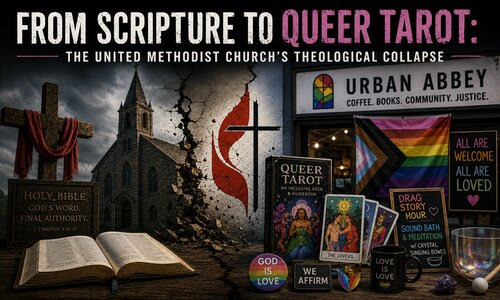
Urban Abbey is not a traditional church building. It operates as a United Methodist congregation inside a bookstore and coffee shop, describing itself as an intentionally progressive Christian community. Its founding pastor, Rev. Debra McKnight, is openly identified by the church as an advocate for “social justice, women’s rights, and the LGBTQ+ community” who seeks to “heal the wounds created by conservative Christianity.”
The question Christians should be asking is: heal people from what?
If “conservative Christianity” means believing that Scripture actually establishes boundaries regarding sexuality, worship and the nature of God, then what McKnight appears to be offering is not healing from Christianity’s abuses. It is liberation from Christianity’s doctrines.
Consider what Urban Abbey itself promotes.
The congregation proudly hosts Drag Story Hour, describing it as an event where drag performers read to children so they can encounter people who “defy rigid gender restrictions.” The church says it provides an “affirming environment” for what it calls “gender creative children and adults.”
Urban Abbey’s spiritual experimentation extends considerably further. Its own spiritual-formation page advertises “sound baths and singing bowls,” Mandala meditation and other practices presented as ways of expanding one’s spiritual journey. A past event specifically promoted a meditative “Sound Bath” using crystal singing bowls, chimes and other instruments to facilitate what organizers called healing and spiritual renewal.
Recent reports have also highlighted merchandise reportedly promoted through Urban Abbey’s bookstore, including Pride items, LGBTQ-inclusive literature and Queer Tarot: An Inclusive Deck & Guidebook.
For Christians, tarot is not simply an edgy lifestyle product. Scripture consistently warns God’s people against divination, sorcery and attempts to seek spiritual knowledge through occult practices. Deuteronomy 18:10-12 could hardly be more direct.
Yet perhaps even more revealing is McKnight’s approach to Scripture itself.
A widely circulated 2024 sermon drew attention because McKnight attempted to reconsider the biblical portrayal of Jezebel and the religious environment surrounding the worship of Baal and Asherah. Conservative critics who documented the sermon noted that she presented Jezebel far more sympathetically than the biblical narrative traditionally has and challenged conventional Christian interpretations surrounding Asherah worship.
That is an extraordinary theological road to travel.
Throughout the Old Testament, Israel’s accommodation of Baal and Asherah was not presented as beautiful religious diversity. It was apostasy.
Judges repeatedly describes Israel provoking God by serving the Baals and Asherahs. Elijah’s confrontation on Mount Carmel was not an interfaith dialogue between equally valid spiritual traditions. It was a confrontation between the living God and false worship. Jezebel’s campaign against the prophets of God is hardly incidental to her biblical reputation.
The danger here is larger than one controversial sermon.
Once biblical villains must be rehabilitated, pagan worship reconsidered, sexual boundaries overturned and practices historically associated with occult spirituality incorporated into church life, Christians eventually must ask what remains that the church is actually willing to call false.
That question now hangs over the United Methodist denomination itself.
More than 7,600 American United Methodist congregations left the denomination during its recent disaffiliation process–roughly 26 percent of its U.S. churches and approximately 24 percent of its members.
Then, at the 2024 General Conference, the UMC formally removed its prohibition against ordaining practicing gay clergy, eliminated restrictions surrounding same-sex weddings and removed longstanding language declaring homosexual practice “incompatible with Christian teaching.” Those changes are now fully in effect.
Urban Abbey therefore should not simply be dismissed as an isolated progressive congregation that wandered off on its own.
It represents the logical danger facing any denomination that gradually replaces the question “What does Scripture say?” with “How can Scripture be reinterpreted to affirm what contemporary culture already believes?”
There is an enormous difference between welcoming sinners and affirming sin. Jesus welcomed people considered moral outcasts, but He did not redefine holiness so they could remain unchanged. Christianity offers grace precisely because it recognizes that every one of us needs repentance, forgiveness and transformation.
That distinction is disappearing across much of progressive Christianity.
For Methodists who still believe in biblical authority, however, the collapse of one denomination does not mean the collapse of Methodism.
The Global Methodist Church officially launched in 2022 with an explicit commitment to the authority of Scripture, historic Christian doctrine, Wesleyan holiness and the transforming power of the Gospel. It continues to define marriage as the covenantal union of one man and one woman while welcoming everyone to experience Christ’s redemptive grace.
That offers Bible-believing Methodists an increasingly important alternative.
John Wesley did not launch the Methodist movement because Christianity needed fewer doctrines, fewer calls to holiness or greater accommodation with the spirit of the age. Methodism grew because Wesley preached repentance, conversion, sanctification and “scriptural holiness.”
The tragedy of today’s United Methodist crisis is therefore deeper than disagreements over sexuality.
A church can survive changing music, changing buildings and changing cultural circumstances.
What it cannot survive spiritually is changing the authority that determines what Christianity is.