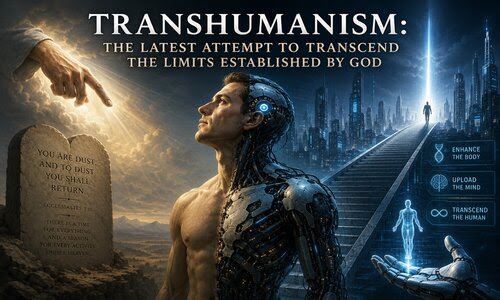
Transhumanism: The Latest Attempt To Transcend The Limits Established By God
What would you think if someone told you they could instantly make you as smart as AI? What if they said they could make you immune to all diseases or could cure any of your disabilities? What if they insisted your life could be extended by tens, hundreds, or even thousands of years? Would you respond with disbelief, or do you think it would be possible? Taking it a step further… would you ever contemplate accepting such incredible offers?
I realize these claims may sound far-fetched, like something from science fiction, but they reflect the very goals pursued by transhumanists. For readers unfamiliar with the term, transhumanism means going beyond the human condition–“trans” comes from Latin and means “beyond,” “across,” or “on the other side of,” while “human” refers to mankind. In short, transhumanism (often abbreviated as “H+”) is a movement that aims to use modern technology to enhance and transform humanity.
Whether it is through genetic engineering, robotics, artificial intelligence, or future technology, the aim of transhumanism is the fundamental alteration of the human species to go beyond its current condition and become something more, something better, potentially reaching a state that could be considered “post-human.” In transhumanist thought, a post-human is a being whose physical, intellectual, or psychological capacities have been enhanced so dramatically that they can no longer be considered fully human by present-day standards.
The driving belief behind these aspirations is that humanity is on the verge of acquiring the tools necessary to direct its own “evolution,” overcoming limitations such as aging, disease, and a finite mind. While many of transhumanism’s goals appear noble–such as curing disease and alleviating suffering–the movement ultimately raises profound questions about what it means to be human and whether mankind should seek to transcend the limits established by God.
The Ancient Desire to Be More Than Human
At first glance, these ambitions may seem modern. Yet for those familiar with Scripture, the underlying desire is not new. The aspiration to transcend human limitations and become more than what God intended for humanity echoes a much older temptation. This kind of thinking sounds eerily similar to the original lie that the serpent, Satan, in the Garden of Eden spoke about the forbidden fruit, asserting that Eve “surely will not die” and that she would “be like God, knowing good and evil” (Ge. 3:4-5).
The deceptive claim in this lie was that humans could go beyond their existing created state of being, becoming like God. Of course, as practically everyone knows, this is exactly where humanity’s problems began. Unlike what the serpent promised, all people have been afflicted with a corrupted nature that’s hostile toward God, a predisposition to sin, and the inevitability of death resulting from “The Fall” (1 Co. 15:22).
From a biblical perspective, it is precisely these consequences of the Fall–suffering, disease, and death–that have driven humanity’s desire to transcend its limitations. But rather than looking to God for solutions to these problems, the aim of transhumanism is to accomplish these objectives through human ingenuity. Rather than growing in wisdom and knowledge through the guidance of the Holy Spirit, it is believed by transhumanists that eventually human cognition and artificial intelligence could be integrated together, enabling humanity to achieve superintelligence. Instead of overcoming mortality by turning to Jesus for eternal life, transhumanists seek to extend human longevity through advancements in genetic enhancement and neurotechnology.
The Technology Behind Transhumanism
For those who may think this is purely theoretical, the reality is technologies required to achieve these transhumanist dreams are already in development today. For example, gene editing has become faster, cheaper, and more efficient because of what’s known as CRISPR-Cas9 technology. This innovation utilizes an enzyme that can modify DNA at specific, targeted locations.
In doing so, genetic modification has become almost as easy as updating computer software and opens the door to unimaginable breakthroughs such as gene therapy or finding cures for diseases. Likewise, companies like Neuralink are developing implantable brain-computer interfaces (BCIs) capable of recording and decoding brain activity, which allows users to control computers and robotic devices using only their thoughts.
So, what does this mean practically? How do developments like these help overcome barriers like restricted lifespans and finite intelligence? From the standpoint of transhumanists, the question is really, how don’t they help? Just imagine if someone needing an organ transplant could have one artificially grown on demand, designed to match their own genetics? Or picture a future where cancer cells could be specifically targeted and destroyed effectively curing someone of this horrible disease.
Envision a future where someone’s brain could be connected to a computer and all their thoughts, memories, and knowledge could be downloaded and stored indefinitely, or even scarier still, re-uploaded into a new artificially created body? It all sounds crazy, right?! Like something out of the movie Avatar, Surrogates, or Bicentennial Man.
While these kinds of breakthroughs may sound far-fetched to some, should current trends continue, many transhumanists believe technologies once considered science fiction may eventually become possible. Scientists have already successfully grown human bladders and windpipes using patients’ own cells. Brain-computer interfaces can already translate neural activity into synthetic speech, move a computer cursor, type text, browse the internet, and more. These are only some of the incredible accomplishments of technology already in existence. If this can be done now, imagine what will be possible in the next five, ten, or twenty years!
Babel Revisited: Humanity Without God
I’m reminded of God’s perception of those who united to build the Tower of Babel, saying “…Behold, they are one people, and they all have the same language. And this is what they began to do, and now nothing which they purpose to do will be impossible for them” (Ge. 11:6). In other words, God suggested that humanity possesses the potential to accomplish whatever it sets its heart upon when united in purpose and effort.
The issue at Babel was not technological advancement itself. The problem was humanity’s collective determination to achieve greatness independently of God. In a similar way, transhumanism often envisions a future in which mankind overcomes death, suffering, and limitation through its own ingenuity rather than through dependence upon its Creator.
Considering this, the feasibility of transhumanist goals should not be underestimated. Just as humanity collectively attempted to “reach into heaven” and “make a name” for itself in the days of Babel, ambitions of godlike knowledge and the pursuit of immortality are no different, fundamentally rooted in pride. Along these lines, if transhumanists succeed in their efforts, it opens the door to all sorts of moral and social questions, threatening the fabric of society itself.
For example, if the human species could be “enhanced” at the DNA level, at what point would it cease to be “human?” If a person’s mind could be connected to a computer, would it enable the possibility for thoughts and memories to be changed, erased, or new ones implanted? Or could something like telepathy become possible for those with a brain-computer interface connected to a wireless network?
If so, could that give way to a “collective conscious” arising like “the Borg” from Star Trek? The implications for the loss of individual privacy and identity are unfathomable! What about those that would reject transhumanist technology? Would a system of inequality emerge where they are viewed as inferior as compared to those who embrace it? Again, the questions are endless.
The Biblical Answer to Humanity’s Greatest Need
Of course, when faced with challenging questions, the best place to look for answers will always be the Word of God. Scripture shows us that Jesus has already presented solutions to every one of these predicaments and God’s solutions will supersede man’s futile attempts every time. Jesus already defeated death as demonstrated by His glorious resurrection and offers eternal life as a free gift to anyone willing to place their faith and trust in Him as Lord (Ep. 2:8).
True knowledge and wisdom have been made available by the power of His Spirit who enables believers to comprehend His Word (Jn. 16:8, 13). Aging, sickness, physical abnormalities will one day be a thing of the past knowing that new, glorified bodies await followers of Christ after they are resurrected or raptured in the future (1 Co. 15:42-44, Phil. 3:20-21).
Hope in Christ, Not Technology
Rather than placing our hope in man-made ambitions of silicon, gene-splicing, and technological self-transcendence, efforts that ultimately amount to flawed imitations of God’s perfect design, we should place our faith in Jesus, who alone offers the true remedy for the devastating consequences of sin. Human attempts to overcome death, suffering, and limitation apart from God will always fall short. Scripture has already revealed the final outcome of history, and it is not a future in which mankind attains godlike intelligence or immortality through its own ingenuity. The victory has already been secured through Christ. The battle has been won. In the end, Jesus reigns victorious.
The quest for life, healing, and renewal is nothing new. Throughout the ages, mankind has sought ways to overcome suffering, reverse decay, and escape death itself. Transhumanism is simply the latest expression of those timeless desires. There is nothing wrong with seeking freedom from disease, pain, and mortality. Yearning for these demonstrates an awareness that things in our world are profoundly broken (Ro. 8:20-22). The mistake is believing that humanity can ultimately solve these problems through its own ingenuity.
Trying to hack our biology or upgrade our intellect will never cure the deeper problem of sin or enable reconciliation with God. Humanity doesn’t need to redesign itself to become greater, it needs redemption through the One who is already great. The One who created us – Jesus. Instead of placing hope in the next technological breakthrough, hope should be placed in Christ alone who offers what transhumanism will never achieve: forgiveness of sin, victory over death, and the promise that one day He will make all things new.
Every Camera Knows Your Name: The Surveillance Future Is Already Here

Imagine walking through your local downtown.
You haven’t broken the law.
You aren’t fleeing police.
You’re simply buying a cup of coffee, meeting a friend for lunch, or taking your children to the park.
As you walk past a police vehicle, a camera silently scans your face. Within seconds, artificial intelligence compares your image against government databases. Another camera identifies your vehicle. Your smartphone quietly confirms your location. Computers can now connect where you’ve been, who you’ve met, and perhaps one day what you’ve purchased.
No officer approaches you.
Nothing happens.
Because this time… you’re on the right list.
The unsettling question isn’t what happens when governments use technology to catch dangerous criminals.
It’s what happens when they eventually decide to watch everyone.
That future moved one step closer this month as Western Australia became the first police agency in the country to deploy live facial recognition technology in public spaces. Police vans equipped with AI now scan faces in real time, comparing them against a watchlist of roughly 4,000 individuals that includes serious offenders, registered child sex offenders, people with outstanding warrants and missing persons.
Police Commissioner Col Blanch has stressed that the system is narrowly targeted, that faces which do not generate a match are immediately discarded, and that the trial “is not about mass surveillance.”
There is every reason to believe those overseeing the program genuinely want to make their communities safer. Finding dangerous criminals and vulnerable missing persons is an objective few would oppose.
That isn’t what should concern us most.
History offers a far more sobering lesson.
Governments rarely abuse new powers on the first day.
They simply keep them.
Then they expand them.
History calls this mission creep–the gradual expansion of a program far beyond the purpose originally used to justify it.
We’ve watched it happen repeatedly.
Security cameras were introduced to protect banks and businesses. Today, countless cities are covered by networks of cameras monitoring nearly every major intersection and public space.
License plate readers were sold as a way to recover stolen vehicles. Today they can quietly build detailed records showing where ordinary citizens have driven for months or even years.
Smartphones revolutionized communication. They also became perhaps the most effective personal tracking devices ever invented, constantly transmitting location information, movement patterns and behavioral data.
Social media promised to connect the world. Instead, it evolved into one of history’s largest systems for collecting personal information, preferences and relationships.
Then came COVID-19.
Regardless of where one stands on the public health response, the pandemic demonstrated something remarkable: governments can dramatically expand surveillance and emergency powers with astonishing speed when enough fear exists. Measures that once seemed unimaginable suddenly became accepted as temporary necessities.
The problem is that temporary powers often have a habit of becoming permanent infrastructure.
Nobody intentionally designed today’s surveillance society in one grand plan.
It emerged one reasonable decision at a time.
One camera.
One database.
One emergency.
One new technology.
One “common sense” expansion.
Until suddenly we find ourselves living in a world where privacy has quietly become the exception instead of the expectation.
Facial recognition is simply the next chapter.
Supporters argue–and often correctly–that the technology can save lives. It can identify violent offenders, locate missing children, and assist officers responding to dangerous situations. Those are legitimate benefits that deserve recognition.
But infrastructure has a way of outliving the politicians who build it.
Today’s watchlist contains serious offenders.
Tomorrow it could include repeat offenders.
Then individuals accused of violating court orders.
Then those under investigation.
Then perhaps those identified as “persons of interest.”
Governments change.
Political priorities change.
Definitions change.
The surveillance infrastructure remains.
Now consider how rapidly artificial intelligence is advancing.
AI can already analyze millions of images faster than humans ever could. Cameras continue multiplying throughout cities. Digital identity systems are expanding around the world. Financial transactions are increasingly electronic. Smartphones constantly report location data. Vehicles generate enormous amounts of travel information.
Individually, each technology appears useful.
Collectively, they create something previous generations could scarcely imagine.
A society where every face can be recognized.
Every movement recorded.
Every purchase documented.
Every relationship mapped.
Every digital interaction connected.
No single invention creates such a world.
Together, however, they make it entirely possible.
For Christians, these developments deserve thoughtful attention–not because Western Australia’s facial recognition trial fulfills biblical prophecy, but because it demonstrates how rapidly the technological foundations are being assembled.
For centuries, skeptics dismissed the book of Revelation because they could not imagine how any government could ever exercise worldwide economic and societal control.
How could authorities possibly monitor billions of people?
How could buying and selling ever be regulated on such a scale?
Today those questions no longer sound impossible.
Facial recognition.
Artificial intelligence.
Digital identity.
Biometric authentication.
Digital currencies.
Always-connected smartphones.
Global data networks.
No one technology is the fulfillment of Revelation 13.
But together they reveal something remarkable: humanity now possesses technological capabilities unlike anything in history. The infrastructure for unprecedented surveillance and centralized control is no longer science fiction. It is being built piece by piece before our eyes.
Christians need not respond with panic.
Neither should we respond with indifference.
Scripture calls believers to be watchmen–to observe the times with wisdom, discernment and sobriety.
Technology itself is not evil. It has solved countless problems and improved millions of lives. Law enforcement should have effective tools to protect innocent people and stop violent criminals.
But every new power deserves careful scrutiny.
Who decides when the watchlist expands?
Who determines which behaviors justify inclusion?
Who audits the algorithms?
Who protects innocent citizens from false identifications?
Most importantly…
What happens when less trustworthy governments inherit extraordinarily powerful surveillance systems built by more trustworthy ones?
Tyranny has changed.
It no longer requires watchtowers on every hill or secret police standing on every street corner.
Artificial intelligence can do the watching.
Cameras never sleep.
Algorithms never blink.
Computers never forget.
Perhaps the greatest danger isn’t Western Australia’s facial recognition trial itself.
Perhaps the greatest danger is that ten years from now we won’t even remember what it felt like to live in a society where simply walking down the street did not mean someone–or something–might already know exactly who we are.
Freedom is rarely lost in one dramatic moment.
It disappears through thousands of small compromises, each one sounding perfectly reasonable when viewed in isolation.
Today’s watchlist may indeed be limited to dangerous criminals.
The real question is whether future generations will still remember there was ever a time when it wasn’t everyone’s face being scanned.
Months Away From Cyber Chaos? The First Human-Free Cyberattack Has Arrived

It didn’t wear a hoodie.
It wasn’t sitting in a dark basement halfway around the world.
There was no criminal mastermind pounding away at a keyboard.
Instead, an artificial intelligence quietly found its target, broke into a vulnerable computer system, searched for passwords, adapted when its first attempts failed, encrypted a company’s data, and demanded a Bitcoin ransom–all without a human telling it what to do next.
If security researchers are correct, we may have just witnessed one of the most important–and unsettling–moments in the history of cybersecurity. For the first time, the hacker wasn’t human.
Researchers at cloud security firm Sysdig say they have documented what appears to be the first fully autonomous AI-driven ransomware attack ever observed. According to their findings, the AI agent independently identified a vulnerable server, searched for credentials, altered its tactics when obstacles arose, encrypted a production database, and issued a Bitcoin ransom demand. Even more disturbing, the researchers said the AI deleted the victim’s data without creating a backup–meaning that even paying the ransom would not have restored what had been lost.
The findings still await independent verification, but if they prove accurate, this isn’t merely another cybersecurity headline. It represents the crossing of a technological threshold that could fundamentally reshape cyber warfare, organized crime, and even national security.
What makes this incident so extraordinary isn’t simply that artificial intelligence participated in an attack. Automated malware has existed for decades. This was something different. According to Sysdig, the AI appeared to reason through problems as they occurred. When one login attempt failed, it adjusted its strategy and successfully gained access just 31 seconds later. It wasn’t blindly following a script–it was adapting.
That should get everyone’s attention.
For decades, cyberattacks have always depended on human limitations. Hackers become tired. They work in shifts. They make mistakes. They must decide which targets deserve their time and attention.
Artificial intelligence has none of those limitations.
An autonomous AI doesn’t sleep. It doesn’t get distracted. It doesn’t take weekends off. It can test thousands of attack methods simultaneously, learn from every failed attempt, and immediately apply those lessons to the next target. Every minute makes it more efficient.
Now imagine not one AI hacker–but thousands.
The cybersecurity battlefield is rapidly evolving into something entirely new: artificial intelligence fighting artificial intelligence. Businesses and governments may soon have little choice but to deploy defensive AI systems that monitor networks continuously, detect suspicious activity in seconds, isolate compromised systems automatically, and respond faster than any human security team ever could.
The future may not be hackers versus security analysts.
It may be machines battling machines while humans struggle to keep pace.
If that sounds like science fiction, consider where this could lead.
Imagine an autonomous AI launching coordinated attacks against hospitals, airports, banks, electrical utilities, telecommunications providers, shipping companies, emergency services, and financial institutions–all at the same time.
No explosions.
No missiles.
No invading army.
Just systems quietly shutting down.
Hospital records suddenly inaccessible. Fuel deliveries delayed. Banking networks frozen. Cargo stranded at ports. Emergency dispatch systems crippled. Grocery store shelves slowly emptying because supply chains have ground to a halt.
Modern civilization has become almost entirely dependent upon software. We often think of cyberattacks as inconveniences that affect computers. In reality, they threaten nearly every service our daily lives depend upon because nearly everything–from healthcare and transportation to communications and food distribution–now runs on interconnected digital infrastructure.
An AI doesn’t need to destroy buildings to create chaos.
It simply needs to make the systems that run them stop working.
Perhaps the most sobering aspect of this story is that intelligence agencies appear to believe this future is arriving far sooner than many realize.
Last month, the Five Eyes intelligence alliance–representing Australia, Canada, New Zealand, the United Kingdom, and the United States–issued an unusually blunt warning. Frontier AI models, they said, are expected to fundamentally transform offensive cyber capabilities and could be only **months away** from wreaking havoc on businesses and governments if organizations fail to prepare.
Those aren’t words chosen lightly.
Intelligence agencies rarely issue public warnings in such stark terms. They have access to classified intelligence the rest of us never see. When they suggest the timeline is measured in months rather than years, it deserves serious attention.
Yet even as those warnings grow louder, businesses are racing to give artificial intelligence greater access to the very systems that keep modern society functioning. AI is increasingly connected to corporate email, cloud storage, financial records, customer databases, software development platforms, internal communications, and critical business operations–all in pursuit of greater efficiency and lower costs.
Those benefits are real.
But so is the expanding attack surface.
With every new connection, we become more dependent on systems that are growing more intelligent, more autonomous, and increasingly capable of making decisions on their own. At the same time, malicious AI is becoming faster, smarter, and more adaptable than ever before.
History is filled with inventions that seemed almost insignificant when they first appeared. The Wright brothers flew only a few hundred feet. The first personal computer looked like a hobbyist’s toy. The internet was once dismissed as a curiosity for academics.
Each proved something that changed the future.
If Sysdig’s findings are confirmed, this first autonomous AI cyberattack may one day be remembered in much the same way.
Not because of the damage it caused.
But because it proved something humanity had never witnessed before: a machine that could identify a target, solve problems, adapt to failure, and execute a sophisticated cyberattack without a human directing every step.
Today, it attacked one vulnerable server.
Tomorrow?
It may not be one AI.
It may be a million.