The Road To Gog and Magog : Russia’s Anger, Turkey’s Ambition, Iran’s Revenge
For years, Western leaders comforted themselves with a familiar assumption: remove enough of Iran’s senior leadership, weaken its military infrastructure, tighten sanctions, and eventually the Islamic Republic would moderate or even collapse.
Instead, the opposite may be happening.
Recent headlines paint a sobering picture. Analysts now warn that Iran’s regime survived the war and is now savvier, more ruthless and even more hard-line. At the same time, thousands gathered last week for Ayatollah Ali Khamenei’s funeral, where chants of “Death to America” and “Death to Israel” once again echoed through the crowds as mourners demanded revenge.
If those scenes tell us anything, it is this: regimes built on revolutionary ideology rarely become less radical after conflict. They often become more determined.
History is full of examples.
When military leaders are eliminated, younger commanders often rise with fewer restraints, greater ideological zeal, and a stronger desire to prove themselves. Rather than producing reform, conflict frequently accelerates radicalization.
Iran may now be entering exactly such a phase.
The country’s military capabilities have undoubtedly suffered significant setbacks. Years of sanctions, economic strain, covert operations, and direct military losses have weakened Tehran’s ability to project power independently. Yet weakness does not necessarily produce peace.
Sometimes it produces revenge.
That should concern not only Israel but the entire region.
A wounded regime seeking to restore honor can become more unpredictable than a confident one. National humiliation has often been one of history’s greatest motivators for future wars.
The rhetoric coming from Iran certainly gives little reason for optimism.
Rather than speaking of rebuilding relations with the West, voices within the regime continue to frame the conflict as unfinished. Israel remains the “Little Satan.” America remains the “Great Satan.” Revenge remains central to the revolutionary narrative.
That raises an important prophetic question.
Could Iran’s diminished ability to confront Israel alone actually push it toward deeper military partnerships?
For students of Bible prophecy, Ezekiel 38 immediately comes to mind.
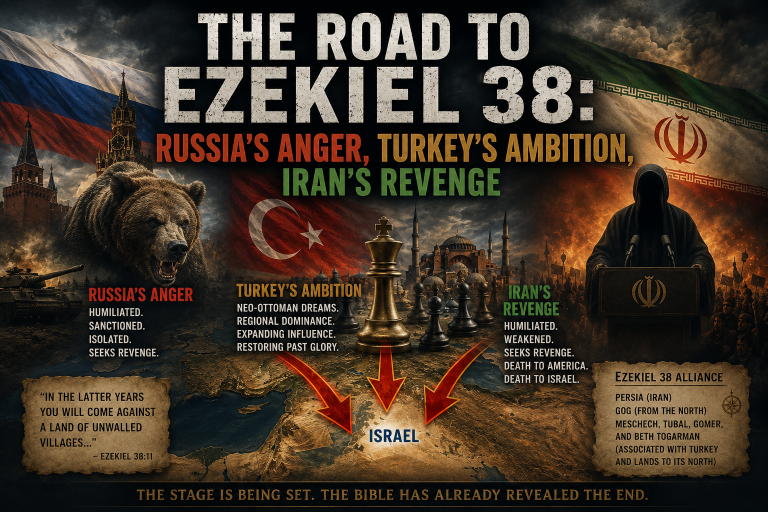
More than 2,600 years ago, the prophet Ezekiel described a future military coalition that would one day march against Israel in what many believe will be one of history’s defining end-times conflicts. The nations specifically named include Persia–universally recognized as modern-day Iran–along with Magog, Meshech, Tubal, Gomer, and Beth Togarmah, territories that many conservative Bible scholars associate primarily with modern-day Turkey and regions to its north.
The coalition is led by Gog, who comes from “the uttermost parts of the north,” a description that has led many prophecy teachers to associate the leader with Russia or lands under its influence, while acknowledging that faithful scholars hold differing views on some of the geographical identifications.
Whatever one’s conclusion regarding every ancient place name, one fact is difficult to ignore: Iran is clearly represented in the prophecy, Turkey appears prominently through several of the listed peoples according to many scholars, and Russia has long been viewed by many prophecy teachers as the coalition’s leading power.
Remarkably, these three nations have spent much of the past decade drawing closer together diplomatically, economically, and militarily, while simultaneously becoming increasingly hostile toward Israel and, in varying degrees, toward the Western alliance.
The prophecy goes on to describe this coalition launching a massive invasion against Israel.
For decades, many prophecy teachers envisioned Iran as one of the alliance’s dominant military powers.
But perhaps current events suggest another possibility.
What if Iran no longer serves as the coalition’s primary military force?
What if, instead, it becomes an eager junior partner seeking revenge alongside stronger regional powers?
One nation increasingly fits that description.
Turkey.
Under President Recep Tayyip Erdoğan, Turkey has steadily transformed from being viewed primarily as a dependable NATO ally into a nation pursuing far greater regional ambitions. Many geopolitical analysts describe Erdoğan’s vision as a form of neo-Ottomanism–an effort to restore Turkish influence across lands once ruled by the Ottoman Empire.
Those ambitions are no longer merely theoretical.
Turkey has expanded military operations into Syria and Iraq, increased its influence in Libya, strengthened its alliance with Azerbaijan in the Caucasus, projected naval power across the eastern Mediterranean, and built one of the world’s most successful drone industries. Erdoğan increasingly presents Turkey not simply as another regional power, but as a natural leader of the Muslim world.
His rhetoric toward Israel has become equally aggressive.
He has repeatedly accused Israel of genocide, compared Israeli leaders to history’s worst dictators, questioned Israel’s legitimacy, and positioned himself as one of the loudest defenders of the Palestinian cause. Turkish officials continue escalating their criticism of Israel while expanding Ankara’s diplomatic and military influence throughout the region.
Perhaps most remarkable is the irony that despite these increasingly hostile positions, the United States appears prepared to move forward with the sale of advanced fighter aircraft and modernization packages that would significantly strengthen one of NATO’s largest air forces. While intended to preserve alliance cohesion, such sales would also enhance the military capabilities of one of Israel’s most outspoken regional critics.
Viewed through the lens of Ezekiel 38, the picture becomes increasingly intriguing. If Iran has been significantly weakened while Turkey’s regional ambitions continue to grow, one can easily envision Ankara assuming a much more prominent leadership role than many prophecy students once imagined.
Meanwhile, another major player continues moving in a direction that deserves careful attention.
Russia.
The war in Ukraine has consumed enormous Russian resources, but it has also deepened Moscow’s hostility toward the West. Every sanctions package, every shipment of Western weapons, every intelligence-sharing operation, and every drone strike inside Russian territory reinforces the Kremlin’s conviction that this is no longer simply a war with Ukraine–it is a broader confrontation with NATO itself.
President Vladimir Putin has repeatedly framed the conflict as an existential struggle against a West determined to weaken Russia and diminish its place in the world. Whether one agrees with that assessment is beside the point. It is the worldview shaping Russian strategic thinking.
History demonstrates that great powers rarely forget perceived humiliation.
If the Ukraine conflict eventually settles into an uneasy ceasefire, Russia is unlikely to emerge seeking reconciliation. More likely, it will seek opportunities to restore its influence, weaken Western dominance, and strengthen partnerships with nations that share its hostility toward the United States.
Iran already supplies Russia with drones and military technology, while military cooperation between Moscow and Tehran has expanded dramatically in recent years. Rather than drifting apart, the two nations appear to be drawing closer together.
Put these developments together and an unmistakable pattern begins to emerge.
Iran seeks revenge for humiliation.
Russia seeks restoration after years of confrontation with the West.
Turkey seeks to reclaim the influence of its Ottoman past.
Three nations.
Three different ambitions.
Yet all increasingly find themselves united by common adversaries–and all appear together in the pages of Ezekiel 38.
None of this proves that Ezekiel 38 is about to occur.
Scripture does not give us a prophetic countdown clock, and Christians should resist the temptation to declare every headline as the immediate fulfillment of biblical prophecy.
At the same time, believers are commanded to watch.
What we are witnessing today is a geopolitical landscape that increasingly resembles the alignments Ezekiel described nearly 2,600 years ago.
Iran nursing its wounds while longing for revenge.
Turkey pursuing regional leadership while growing increasingly hostile toward Israel.
Russia becoming more isolated from–and more antagonistic toward–the Western world.
These developments do not guarantee that Ezekiel 38 will unfold tomorrow.
But they do make the coalition described by the prophet appear far less difficult to imagine than it did only a decade ago.
For Christians, the proper response is neither panic nor sensationalism.
It is readiness.
Jesus repeatedly instructed His followers to remain spiritually awake, recognizing the signs of the times while faithfully carrying out the work He has entrusted to His Church.
The world’s alliances will continue to shift.
Empires will rise and fall.
Wars will begin and end.
Hatreds will simmer until they eventually erupt.
Yet behind every headline stands a sovereign God who declared the end from the beginning. History is not spiraling out of control–it is unfolding according to His perfect plan.
Iran may indeed have gone from bad to worse.
And if these geopolitical trends continue, the stage for the coalition described in Ezekiel 38 may be becoming clearer with each passing year.
America 250: They Can’t Celebrate What They’re Trying To Erase
For generations, Americans have been told to celebrate diversity, honor every culture, and preserve the stories that shaped the nation. Yet when it comes to Christianity–the single greatest influence on America’s founding and development–many of the same voices suddenly insist that history be edited, minimized, or investigated.
That contradiction was on full display this week.
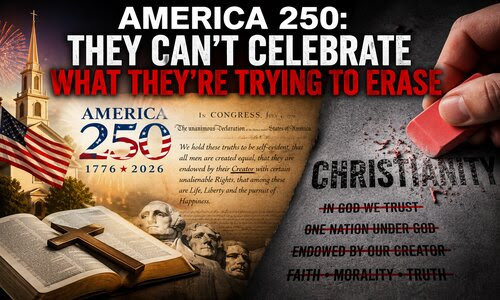
Democratic Rep. Adelita Grijalva vowed that if Democrats regain control of the House, they will investigate the prominent inclusion of Christianity in America’s 250th birthday celebrations organized under President Donald Trump.
Think about that for a moment.
As America approaches one of the most significant anniversaries in its history, the concern is not crime, debt, border security, or international threats. It is whether Christianity might receive too much recognition in telling the story of America’s founding.
That says far more about modern politics than it does about American history.
The exchange began when MSNBC guest anchor Luke Russert suggested that the Freedom 250 celebrations reflected ” Christian nationalism” and implied that Christianity was somehow “hijacking” America’s story. Grijalva agreed and said congressional investigations would likely follow if Democrats win back the House.
The irony is difficult to miss.
Those criticizing Christianity often appeal to history–until history becomes inconvenient.
No serious historian argues that the United States was founded as a theocracy. There was no American equivalent of the Church of England. The Constitution wisely prohibited establishing a national church, preventing government from controlling religious belief.
But acknowledging that truth is not the same as pretending Christianity played little or no role in shaping America.
The Declaration of Independence appeals four separate times to God or divine authority. It proclaims that human beings are “endowed by their Creator with certain unalienable Rights.” That statement is not merely poetic language. It is the philosophical foundation of American liberty.
If rights come from government, government can remove them.
If rights come from God, government exists to protect them–not invent them.
That revolutionary concept separated the American experiment from much of the world’s political philosophy.
Many of the Founders held differing theological views. Some were deeply orthodox Christians. Others leaned toward deism. But virtually all recognized that biblical morality provided the ethical foundation necessary for a free republic.
John Adams famously wrote that America’s Constitution was made “only for a moral and religious people.” George Washington repeatedly spoke of Providence guiding the nation and warned that religion and morality were indispensable supports for political prosperity. Benjamin Franklin called for prayer during the Constitutional Convention.
These are not fringe quotations. They are central figures expressing ideas that shaped the nation’s founding culture.
America’s legal traditions likewise reflect biblical influence. The concepts of equality before the law, the dignity of every individual, objective moral standards, charity, forgiveness, covenant, justice, and personal responsibility all bear unmistakable marks of the Judeo-Christian worldview that dominated colonial America.
The first colleges in America–including Harvard University, Yale University, and Princeton University–were founded primarily to educate ministers and promote Christian learning. The Great Awakenings profoundly shaped American culture, encouraging literacy, civic responsibility, abolition movements, charitable institutions, and missionary efforts that transformed communities.
One cannot tell America’s story honestly while pretending Christianity was merely an incidental footnote.
Perhaps that is what makes this debate so revealing.
Notice what critics are not saying.
They are not arguing that historical facts are inaccurate.
Instead, they object to those facts receiving public attention.
There is an important difference.
Celebrating Christianity’s contribution is not the same as forcing anyone to become a Christian. Recognizing history is not establishing a state religion. Teaching that biblical ideas influenced America’s founders does not violate the First Amendment any more than acknowledging Greek philosophy influenced Western civilization.
History is history.
The First Amendment guarantees freedom of religion–not freedom from ever hearing about religion.
In fact, the very freedom that allows critics to denounce Christianity publicly exists because America’s founders rejected governments that controlled religious belief. Many early settlers crossed the Atlantic fleeing religious persecution. They did not come to erase faith from public life; they came so government could no longer dictate it.
That distinction has been increasingly blurred in modern political discourse.
Today, many activists appear comfortable celebrating virtually every religious and cultural tradition except Christianity. Public institutions enthusiastically recognize countless identities and belief systems, yet displays acknowledging Christianity often generate lawsuits, accusations of extremism, or now, apparently, promises of congressional investigations.
One must ask why.
Could it be that Christianity is treated differently because it remains the faith most closely associated with America’s historic identity?
If every historical reference to Christianity is labeled “Christian nationalism,” then honest discussions about America’s past become nearly impossible.
The term itself has become so broadly applied that it increasingly functions as a political weapon rather than a meaningful description. Loving one’s country, appreciating its Christian heritage, or acknowledging biblical influence on the Founders does not automatically constitute some dangerous political ideology.
It constitutes historical literacy.
America’s 250th birthday should not become another battlefield in the culture war.
It should be an opportunity for Americans to rediscover the ideas that made this nation exceptional: that rights come from God, that every person possesses inherent dignity, that liberty requires virtue, and that government exists under higher moral authority rather than above it.
Those principles did not emerge in a philosophical vacuum.
They grew from a civilization profoundly shaped by Christianity.
That heritage does not diminish Americans of other faiths–or of no faith at all. It simply tells the truth about where the nation came from.
A mature nation does not investigate its history because it is uncomfortable.
It studies it.
It preserves it.
And on milestone anniversaries like America’s 250th birthday, it celebrates it.