
Bible Prophecy, Signs of the Times and Gog and Magog Updates with Articles in the News
The Child Safety Trojan Horse: Digital IDs Are Coming
Around the world, governments are increasingly moving to restrict children’s access to social media, pornography, and other online content. On the surface, the goal seems noble. Most parents agree that children should not have unrestricted access to explicit material, predatory online communities, or social media platforms that have been linked to anxiety, depression, and other mental health concerns.
The problem is not necessarily the goal.
The problem is the method.
What is unfolding across Britain, Canada, Australia, France, and other nations may ultimately become one of the most significant battles over privacy, free speech, and digital freedom in the coming decade.
Because there is one unavoidable reality: to verify someone’s age online, you must first verify who they are.
And that is where the danger begins.
Britain’s Labour government recently announced plans to force major technology companies such as Apple and Google to implement age verification systems designed to prevent children from accessing pornography and even from taking or sharing nude photographs. Prime Minister Keir Starmer has argued that technology companies already possess the tools necessary to accomplish this and should be required to deploy them.
At first glance, many parents will applaud the effort.
Who wants children exposed to pornography?
Who wants minors sending explicit images?
Who wants online predators targeting vulnerable teenagers?
These are legitimate concerns.
Yet critics warn that the solution being proposed could require something unprecedented: population-wide identity verification to access large portions of the internet.
Civil liberties groups have sounded the alarm that age verification cannot function without collecting some form of identifying information. Whether it is a government-issued ID, facial recognition scan, biometric age estimation, passport verification, driver’s license confirmation, or digital identity credential, the end result is largely the same.
The internet begins to lose its anonymity.
Instead of simply visiting a website, citizens may increasingly be required to prove who they are before being allowed access.
Supporters insist that such systems would only confirm age and would not permanently store identities.
History suggests otherwise.
Governments rarely surrender powers once they obtain them.
Throughout history, emergency powers, surveillance authorities, and security measures introduced for one purpose often expand into entirely different areas over time. What begins as child protection can quickly become misinformation monitoring. What begins as pornography restrictions can evolve into content restrictions. What begins as age verification can become identity verification for nearly everything online.
This phenomenon is often referred to as “mission creep.”
And there are already signs of it emerging.
Britain’s Online Safety framework not only contemplates age verification but also includes provisions that could require platforms to scan private communications for prohibited material. Critics argue that such measures threaten end-to-end encryption, one of the last remaining tools protecting private communications from government surveillance.
Signal, one of the world’s leading encrypted messaging platforms, has repeatedly warned that creating government-approved backdoors into encrypted systems is technically impossible without creating vulnerabilities that can eventually be exploited by hackers, criminals, foreign governments, or malicious actors.
The fundamental problem is simple.
There is no such thing as a surveillance system that only the “good guys” can access.
Every database becomes a target.
Every digital credential becomes valuable.
Every identity system eventually creates opportunities for abuse.
Canada is now moving in a similar direction.
The proposed Safe Social Media Act would prohibit social media accounts for children under 16 while creating a new Digital Safety Commission tasked with overseeing compliance. Age verification would become a central component of enforcement.
Australia has already moved aggressively in this direction, reporting millions of accounts removed following its under-16 social media ban.
France, Spain, Denmark, South Korea, Brazil, Indonesia, Thailand, and other nations are considering similar restrictions.
Viewed individually, each proposal may appear reasonable.
Viewed collectively, however, they reveal something much larger.
A global framework is emerging in which access to information increasingly requires proof of identity.
For decades, the internet functioned much like a public square. Citizens could read, research, discuss, and debate without first presenting identification papers.
That model is gradually disappearing.
The next generation internet increasingly resembles an airport security checkpoint.
Before you enter, you must prove who you are.
Before you speak, you may need credentials.
Before you access information, your identity may be verified.
And once that infrastructure exists, governments gain tremendous leverage.
A future administration could require age verification for political content deemed “harmful.”
Another could require identity verification before posting comments.
Another could restrict access to certain viewpoints, news sources, or controversial topics.
The technology itself is neutral.
The question is who controls it.
Christians should pay particular attention to these developments.
The Bible repeatedly warns about the dangers of centralized systems of control. While age verification laws are not the fulfillment of prophecy, they contribute to a broader technological environment where access, participation, commerce, and information become increasingly dependent upon digital credentials and government-approved verification systems.
That trend deserves scrutiny.
Children absolutely need protection online.
Parents need better tools.
Platforms should be held accountable when they knowingly expose minors to harmful content.
But societies must also be careful not to sacrifice liberty in pursuit of safety.
Because history teaches a consistent lesson.
The greatest threats to freedom rarely arrive announcing themselves as threats.
They usually arrive carrying promises of security.
Turkey’s Ottoman Dreams And Ezekiel’s Warning
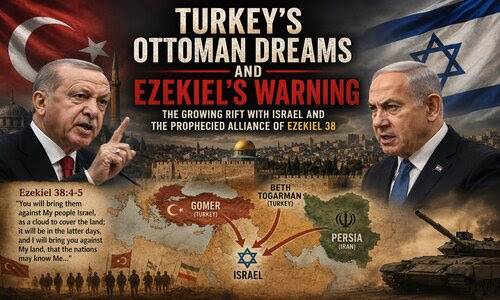
The war of words between Turkey and Israel is becoming increasingly difficult to ignore. What was once a tense diplomatic relationship has evolved into something far more confrontational, with Turkish leaders openly speaking about Jerusalem, threatening Israel, and positioning themselves as champions of the Islamic world against the Jewish state.
This week, the rhetoric reached another alarming level.
Turkey’s Interior Minister Mustafa Çiftçi openly declared his hope that one day Turkey would witness the “liberation of Jerusalem” just as it had supposedly witnessed the “liberation” of Damascus, Aleppo, and Karabakh. He even expressed a desire to become governor of Jerusalem for a day, declaring that lands once controlled by the Ottoman Empire would one day return to Turkish sovereignty.
For Israelis, these comments were not viewed as harmless political theater. They were interpreted as a direct challenge to Israel’s sovereignty and a revival of old Ottoman ambitions.
Israel’s response was swift and sharp.
Foreign Minister Gideon Sa’ar reminded Turkey that “the corrupt Ottoman Empire is gone. Forever.
Defense Minister Israel Katz went even further, declaring that Jerusalem is not Constantinople and that Israel is not some crumbling medieval kingdom waiting to be conquered. Jerusalem, he emphasized, has been the capital of the Jewish people for 3,000 years and will remain Israel’s capital.
Behind the exchange lies a much larger geopolitical story.
For years, Turkish President Recep Tayyip Erdoğan has increasingly embraced a neo-Ottoman vision of Turkey’s role in the Middle East. While modern Turkey was founded by Mustafa Kemal Atatürk as a secular republic following the collapse of the Ottoman Empire after World War I, Erdoğan has steadily moved the nation back toward Islamic nationalism.
Many analysts believe Erdoğan sees Turkey not merely as a regional power but as the natural leader of the Sunni Muslim world.
That helps explain Turkey’s growing involvement in Syria, Libya, Azerbaijan, Lebanon, and Gaza.
It also helps explain why Jerusalem occupies such an important place in Turkish political rhetoric.
For nearly 400 years, from 1516 until 1917, Jerusalem was under Ottoman control. The city’s loss remains a symbolic wound for many Islamists who view the collapse of the Ottoman Empire as one of the great tragedies of Islamic history.
Today, some Turkish politicians openly speak as though history can be reversed.
But rhetoric about Jerusalem is only one part of the story.
This week Erdoğan also warned that Israeli military actions in Syria and Lebanon threaten Turkey itself. He declared that Turkey’s security extends beyond its own borders into Aleppo, Damascus, and Beirut. He further warned that Turkey would respond forcefully if Turkish or Turkish-Cypriot interests were threatened.
Such statements reveal a growing willingness by Ankara to project military and political influence far beyond its borders.
At the same time, Israel increasingly views Turkey’s support for Hamas and its close relationship with Islamist movements across the region as a direct threat.
The result is a rapidly deteriorating relationship between two of the most powerful militaries in the Middle East.
For students of Bible prophecy, however, these developments carry an additional layer of significance.
The Bible foretells a future coalition of nations that will one day march against Israel.
Ezekiel 38 describes an alliance led by “Gog of the land of Magog” that includes Persia, Gomer, and Beth Togarmah.
Most prophecy scholars identify Persia as modern Iran.
The names Gomer and Beth Togarmah have long been associated with regions that correspond largely to modern-day Turkey.
This is one of the reasons many prophecy watchers have paid such close attention to Turkey’s transformation over the past two decades.
For much of the twentieth century, Turkey was one of Israel’s strongest regional partners. It was secular, Western-oriented, and even maintained military cooperation with the Jewish state.
Yet today’s Turkey looks very different.
Under Erdoğan, anti-Israel rhetoric has become commonplace. Turkish leaders regularly accuse Israel of aggression while simultaneously defending Hamas and other Islamist causes. The relationship has shifted from partnership to hostility.
Meanwhile, Iran and Turkey increasingly find themselves aligned on key regional issues despite their historic rivalries.
Neither nation currently appears capable of leading a successful military campaign against Israel by itself. Iran’s regional proxy network has suffered significant setbacks and she has been significantly weakened after attacks by the United States and Israel. These attacks may even be part of the reason she would reach out to other nations to help bring down Israel. With Hezbollah weakened and Hamas devastated she has few regional partners left to call upon.
Yet Ezekiel does not describe the condition of these nations today.
It describes a future alignment
The remarkable thing is not that Turkey and Iran currently have disagreements. The remarkable thing is that Scripture predicted thousands of years ago that these nations would ultimately find themselves on the same side of a future confrontation involving Israel.
Whether that alliance forms in the near future or decades from now remains unknown.
What is becoming increasingly clear, however, is that Turkey’s trajectory is moving away from the secular vision of Atatürk and toward a far more assertive Islamic identity.
That shift has profound implications for the Middle East.
It also serves as a reminder that the geopolitical landscape surrounding Israel continues to evolve in ways that many Bible students find strikingly familiar.
The headlines coming out of Ankara and Jerusalem this week may seem like another diplomatic spat. But beneath the rhetoric lies a deeper struggle over history, sovereignty, religion, and regional power.
And for those watching the prophetic stage, Turkey’s increasingly hostile posture toward Israel is one development that cannot be easily dismissed.
The Ottoman Empire may never return. But the alliances foretold by Ezekiel appear to be moving closer into focus with each passing year.
Parents Remain Essential To Instilling Authentic Faith In Next Generation

With the rate of religious practice among young people in the U.S. at levels significantly below older generations, concerns are growing over a likely future America of diminished church attendance and a higher proportion of morally ungrounded citizens. A new report released last week identifies ways that parents can help mitigate a continued decline in religious practice by passing their faith on to their children.
According to data compiled by the Pew Research Center last December, Americans in the youngest age bracket (18-30) surveyed the lowest of any other age bracket in response to four questions about faith, including the percentage identifying with a religion (57%), those that pray daily (32%), those that say religion is “very important in their lives” (33%), and those who attend religious services at least monthly (tied for second lowest at 31%).
“While belief has not disappeared, it has become more individualized and less connected to church life,” write sociologists Jesse Smith and Jane Lankes Smith, who authored the report “Passing the Torch: How Faith Moves Across Generations” published by the Institute for Family Studies (IFS) and Communio. “As a result, many religious communities now face a sustained pattern of generational decline rather than temporary fluctuation, raising concerns for churches and church members alike about the long-term vitality of their congregation.
The authors go on to note, “Research consistently shows that families are the single most important factor in whether children adopt and maintain faith into adulthood.” They argue that regular church attendance when children are young is key to attendance as adults, observing that “when parents reported attending church weekly while raising their children, a predicted 26% of their children did the same in their 30s and 40s, compared to only 12% whose parents were not weekly attenders.”
Additionally, they highlight data showing that “when parents identified religion as being very important in their lives, nearly two-thirds of their children were predicted to say the same as adults, compared to less than half of those whose parents did not affirm the high importance of religion.” What’s more, “parents who prayed daily had a 47% chance of having children who did the same as adults, compared to less than one-third when parents did not pray daily.”
Another key aspect identified by the report is the importance of parents regularly discussing faith amid their daily lives. The authors point out that many Christian parents in today’s culture have tended to shy away from emphasizing religious discussion with their kids for fear of pushing them away from the faith by “jamming it down their throats.”
But “according to the data, efforts to pass on the faith are more often undermined not by parents laying it on too thick, but by taking too light a touch,” they highlight. Since Christianity is rarely uplifted and often denigrated in modern society, Smith and Lankes Smith urge parents to “set a tone in the household where talk of religion is normal and to prepare for the hard theological or moral conversations, especially as their kids get older.”
The strength of the marriage of the mother and father was identified as another key factor in children’s faith formation. “Parents in troubled marriages are likely to have more difficulty coordinating the time and effort needed for effective faith formation,” the authors explained.
“When children see loving, harmonious marriages preached at church but witness marital strife at home, this creates cognitive dissonance that makes Christianity harder to internalize.” Data analyzed in the report showed more faith-related conversations with their kids happening per week and a higher probability of their kids praying daily with couples who reported being in happy and satisfying marriages.
But faith transmission cannot rest solely upon the shoulders of moms and dads, the report noted. Smith and Lankes Smith also underscored that an engaged church community is similarly integral to forming the faith of children. They write that pastors must minister to families by offering ongoing religious education to parents (not just to children), expand marriage ministries, create space for community, and invest in youth ministry. This will foster congregational involvement for both parents and adolescents, which “is linked to higher levels of faith commitment when children reach adulthood.”
Experts like Family Research Council Senior Fellow Joseph Backholm say that the IFS/Communio report further proves the principle that faith is primarily passed on through lived witness, not merely through words and exhortations.
“These results seem to communicate that children are watching their parents’ lives and deciding whether they like what they see,” he told The Washington Stand. “If we enjoy being with our parents, and believe their marriage is something we’d like to have ourselves, it makes sense that we’d be more interested in what they tell us about the purpose of life and what we should believe. Of course, the gospel is true despite the fact that people are hypocrites, but there’s little doubt that a life in which actions match words is more compelling to those who are watching. That includes our children.”