
Bible Prophecy, Signs of the Times and Gog and Magog Updates with Articles in the News
UFO Files About To Be Released By White House – How Should The Church Respond?
A wave of viral claims about secret government briefings with Christian leaders regarding UFOs has been partially walked back after a prominent pastor apologized for conflating his own interpretation with comments made by a sitting U.S. congressman during a private call with religious leaders.
Larry Ragland, senior pastor of Solid Rock Church in Birmingham, Alabama, issued a public clarification after a viral clip suggested he had attributed statements to Rep. Eric Burlison, R-Mo., implying that the upcoming government disclosure of UFO files could include claims that extraterrestrials created humanity and that Christianity itself was invented by non-human intelligence.
In the original viral clip, Ragland described a “very well-known congressman from Missouri” allegedly warning pastors in a private discussion that future disclosure narratives could involve beings presenting themselves as humanity’s creators, with claims that God, Jesus, and the Bible were human inventions seeded by non-human entities.
However, Rep. Burlison quickly pushed back on those interpretations, stating publicly that he does not know the origins of unidentified aerial phenomena and that his participation in the discussion was limited to encouraging Christians to ground their worldview in Scripture rather than speculation.
“I do NOT know what the strange objects in the skies are and I certainly do NOT know their origins,” Burlison wrote on X, adding that he was invited to briefly join a theological discussion and could not account for all claims made within the broader meeting. He emphasized that his comments centered on the importance of biblical literacy and discernment, particularly if future disclosure events occur.
Ragland later issued an apology, acknowledging that he had blended his own interpretation with what was actually said, clarifying that Burlison did not make the claims attributed to him.
Even as that specific narrative has been corrected, broader discussions among pastors, online ministries, and political figures continue to circulate, fueling ongoing debate about government transparency, UFO disclosure, and how the church should respond to the possibility of non-human intelligence.
The video’s have led to many important questions about how Christians should respond if society increasingly embraces a worldview centered around extraterrestrial explanations for spiritual realities.
That question is no longer fringe.
Over the last several years, belief in UFOs and non-human intelligence has surged dramatically in mainstream culture. Hollywood, social media, podcasts, military testimony, and even government language have normalized the topic in ways unimaginable twenty years ago.
The timing of such discussion among the Christian community could not be more important as the White House is expected to begin releasing the long-awaited UFO files on Friday – months after President Trump ordered top administration officials to get the ball rolling on the secretive intel. It is expected large amounts of information will be released each week for several successive weeks although it is unclear just what information will be released.
We also have the summer release of Steven Spielberg’s new UFO movie, Disclosure Day on June 12, exploring global reaction to the revelation that aliens are real. This will further fuel the fire over this issue and so it important to have a Biblical understanding of this issue as people see this movie and it becomes a topic of conversation.
For many Christians, the concern is not merely about strange objects in the skies. It is about worldview.
Could modern society eventually reinterpret biblical supernatural events through a purely extraterrestrial lens?
Could demons become “interdimensional beings”? Could angels become “advanced intelligences”? Could spiritual deception eventually be reframed as cosmic enlightenment?
Many Christian thinkers have wrestled with these questions for years.
The late Christian scholar Chuck Missler often argued that UFO phenomena may involve spiritual deception rather than extraterrestrial civilizations. Christian researchers like Gary Bates and Joe Jordan have similarly suggested that many alleged alien encounters bear striking similarities to occult experiences, sleep paralysis events, demonic oppression, and spiritual manifestations described throughout church history.
Many Christians acknowledge that the Bible already prepares believers for massive end-times deception. Scripture repeatedly warns about “lying signs and wonders,” deceiving spirits, and false narratives powerful enough to mislead many. Jesus Himself warned that deception in the last days would become so persuasive that even “the elect” could be shaken.
That does not mean Christians should panic every time a blurry video appears online.
Nor does it mean believers should embrace every conspiracy theory circulating on social media.
In fact, one of the biggest dangers surrounding this current controversy may be fear-driven sensationalism itself. Viral speculation can quickly become spiritually unhealthy when Christians become more obsessed with hidden government meetings than prayer, Scripture, discernment, and the Gospel.
At the same time, dismissing every concern outright may also be unwise. History shows governments do hide information. Intelligence agencies do conduct psychological operations. And cultural narratives do shape public belief systems over time.
Christians therefore face a delicate challenge: remain discerning without becoming paranoid.
The church does not need to fear disclosure — whether it involves advanced technology, unexplained aerial phenomena, or future revelations we cannot yet anticipate. Christianity has survived empires, scientific revolutions, world wars, and centuries of philosophical attacks. The existence of unexplained phenomena would not suddenly erase the resurrection of Christ or invalidate Scripture.
But Christians should recognize that the spiritual battle over truth is real.
Because the larger issue may not be whether UFOs exist at all.
The larger issue may be whether society increasingly seeks supernatural explanations without God, spirituality without repentance, and cosmic wonder without Christ.
And that is precisely why discernment matters now more than ever.
The Pastors Who Want To Rewrite Christianity
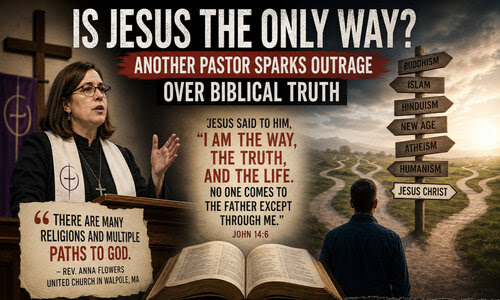
For generations, Christians have faced criticism from outside the Church. But increasingly, some of the sharpest attacks on foundational Christian doctrine are coming from inside the pulpit itself. The latest example comes from United Church of Christ pastor Anna Flowers of the United Church in Walpole, Massachusetts, who recently declared that the biblical teaching that Jesus is the only path to salvation “makes no sense.”
Just weeks ago, many Christians were stunned when Yvette Flunder, senior pastor of the City of Refuge United Church of Christ in Oakland, criticized portions of the Bible as discriminatory and suggested Christians should effectively “rip out” verses they dislike and replace them with a so-called “Third Testament.” Now, another minister has stepped forward with a message that directly contradicts one of Christianity’s most central claims: that salvation comes through Jesus Christ alone.
Flowers argues that when Jesus declared in John 14:6, “I am the way, the truth and the life,” He was not speaking literally. According to her, Christianity is simply one authentic spiritual path among many. In her view, there are multiple roads to God, and moral or ethical living — regardless of belief — is enough to secure eternity.
At first glance, that message sounds compassionate, modern and inclusive. In an age that celebrates tolerance above nearly everything else, the idea that “all paths lead to God” is emotionally appealing. It removes tension. It eliminates offense. It allows every worldview to coexist without conflict.
But there is one major problem: it directly contradicts Scripture.
Jesus did not say He was “a” way. He said He was “the” way. The distinction matters. The apostles reinforced the same message repeatedly. In Acts 4:12, Peter boldly declared, “There is no other name under heaven given among men by which we must be saved.” Christianity has always stood apart because of this exclusive claim — not out of arrogance, but because truth by nature is exclusive.
A Christian comedian once mocked the idea of universalism with a simple illustration: if you want to fly to New York, you cannot simply board any random plane and assume every route leads to the same destination. Truth matters. Direction matters. The plane matters. Yet increasingly, some pastors are preaching a spiritual version of exactly that confusion — assuring people that sincerity is enough regardless of what they believe.
Flowers attempted to defend her theology by arguing that Jesus taught believers to love and care for their neighbors, including those of other faiths. That part is absolutely true. Christians are called to show compassion, kindness and mercy to all people. But somewhere in modern progressive theology, a dangerous leap has occurred: from loving non-believers to declaring that belief itself no longer matters.
That is not Christianity. It is moral relativism wrapped in spiritual language.
The heart of the Gospel has never been that humanity can earn heaven through good behavior. In fact, Scripture repeatedly teaches the opposite. The Bible declares that salvation is not achieved through works, morality or personal goodness, because no human being is perfect. Christianity teaches that mankind needs redemption precisely because human goodness is insufficient.
Yet the belief Flowers promotes reflects the growing theology of modern culture: be kind, be tolerant, be ethical, and heaven will sort itself out in the end. It is a message that removes the necessity of repentance, the cross and even Christ Himself.
And that raises an uncomfortable question: if there are many valid paths to God, then why did Jesus need to die at all?
If morality alone saves people, then the crucifixion becomes unnecessary. The Gospel becomes optional. Christianity becomes merely one inspirational philosophy among thousands. The cross is reduced from the centerpiece of human redemption to little more than a symbolic gesture.
This is why these debates matter.
Many Christians watching these developments are increasingly alarmed not simply because of theological disagreements, but because confusion from spiritual leaders carries enormous consequences. When pastors publicly dismiss or reinterpret foundational teachings of Scripture, many believers — especially younger Christians — begin to question whether anything in the Bible can truly be trusted at all.
The issue is not whether Christians should love people of different beliefs. They should. The issue is whether pastors have the authority to rewrite doctrines that have stood at the center of Christianity for 2,000 years.
Flowers holds respected academic credentials, including a Master of Divinity from Candler School of Theology at Emory University, and she has served in ministry for years. But credentials do not determine truth. Throughout history, many highly educated theologians have drifted from biblical orthodoxy while claiming to improve or modernize the faith.
The growing trend inside some progressive churches appears clear: doctrines that offend modern culture are being softened, reinterpreted or abandoned altogether. Sin becomes misunderstanding. Repentance becomes self-discovery. Salvation becomes universal. And Jesus becomes not Savior, but simply one spiritual teacher among many.
But Christianity without the uniqueness of Christ is no longer Christianity at all.
Christians should not respond with hatred or personal attacks. They should pray for Flowers and others embracing similar teachings. But they should also recognize the seriousness of what is happening. A church that loses confidence in the authority of Scripture eventually loses the Gospel itself.
And once a church no longer believes Jesus meant what He said, it becomes difficult to know what — if anything — remains sacred anymore.
Hamas Is Humiliating Trump’s ‘Board of Peace’
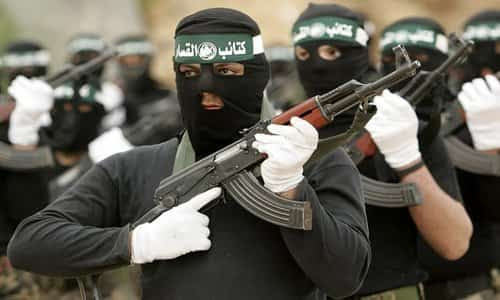
Six months after US President Donald J. Trump unveiled his ambitious ceasefire and reconstruction plan for the Gaza Strip, the Iran-backed Hamas terrorist group remains more armed, entrenched, and openly defiant than ever.
Far from disarming, the Islamist group now controls roughly half the Gaza Strip and much of its population, while making a mockery of Trump’s “Board of Peace” initiative and the international mediators sponsoring it.
It is now clear that the Trump administration’s strategy was based on a misguided assumption that Hamas (a theocratic terror regime like Iran’s) could somehow be persuaded through negotiations, incentives, and diplomatic pressure to voluntarily surrender its weapons and abandon its jihadist ideology.
The exact opposite has happened. Hamas not only rejected disarmament, but also used the ceasefire periods to solidify control, regroup politically and militarily, and humiliate the people negotiating with them.
According to Palestinian and Israeli sources, talks between Hamas and representatives of the “Board of Peace,” headed by former United Nations official Nickolay Mladenov, recently reached a dead end in Cairo after Hamas again rejected the central demand of Trump’s 20-point plan: total disarmament.
“No one was surprised six months ago, and no one is surprised today that Hamas refuses to disarm,” an Israeli source familiar with the negotiations told i24 News.
Indeed, no one should be surprised.
Expecting Hamas to disarm voluntarily is like expecting ISIS or Al-Qaeda to renounce jihad (holy war) and become peaceful political movements.
Hamas’s weapons are not merely military tools; they are the foundation of its ideology, identity, and power. Asking Hamas to hand over its weapons is essentially asking the group to sign its own death warrant.
Hamas leaders themselves are not hiding their position. Recently, an unnamed Hamas official declared bluntly that his group “will not accept disarmament.” Another insisted that the issue of weapons could only be discussed within the framework of a future Palestinian state and broader political arrangements.
Hamas, in other words, is clearly saying: no disarmament now, no disarmament later, no disarmament ever.
Yet, despite these repeated rejections, the “Board of Peace” continues its embarrassing efforts to negotiate with Hamas over the surrender of its weapons. The entire spectacle has become surreal. Instead of confronting Hamas with meaningful consequences, the international mediators appear to be pleading with the terrorist group to cooperate.
What happened to all the deadlines, ultimatums and threats issued by Trump and his administration over the past year? What happened to the repeated warnings that Hamas would face devastating consequences if it refused to disarm?
So far, Hamas has paid no meaningful price for its defiance.
On the contrary, Hamas seems to interpret the continued negotiations as a sign of weakness and desperation. Every new round of talks in Cairo reinforces Hamas’s belief that the international community lacks either the will or the courage to confront it decisively.
The mediators, especially Qatar, Egypt and Turkey — all of which maintain direct channels with Hamas and present themselves as key brokers in the negotiations — also deserve scrutiny. These countries, unsurprisingly, are not exerting serious pressure on Hamas to disarm.
Qatar has spent years funding the Hamas-controlled Gaza Strip while hosting the terror group’s leaders in luxury hotels in Doha. Turkey openly supports Hamas politically and ideologically. Egypt periodically pressures Hamas on border-security issues, yet still treats it as a legitimate political actor rather than as a terrorist group committed to Israel’s destruction.
If these mediators truly wanted to disarm Hamas, they possess significant leverage. The reality is that none of them appear genuinely committed to dismantling Hamas militarily or politically.
Meanwhile, Hamas continues to exploit the negotiations to buy time.
Reports indicate that Hamas may be willing to discuss only limited, phased restrictions on certain heavy weapons while retaining light weapons and preserving its core military infrastructure. This is not disarmament. It is a tactical maneuver designed to preserve Hamas’s rule while extracting concessions from Israel and the international community.
Hamas reportedly seeks reciprocal Israeli withdrawals and additional humanitarian and economic benefits for partial limitations on some of its weapons. Hamas wants all the advantages of remaining armed while receiving the benefits of reconstruction and international legitimacy. The current negotiations in Cairo are fundamentally detached from reality.
Islamist groups and regimes do not surrender because of diplomatic persuasion. Hezbollah did not lay down its weapons after becoming part of the Lebanese political system. The Taliban in Afghanistan did not moderate after negotiations with the US. Iran’s regime has not abandoned its nuclear weapons program or its revolutionary ideology despite decades of diplomacy and sanctions relief. Hamas is no different.
For Hamas, armed “resistance” is not negotiable: it is the group’s very reason for existence. Disarmament would mean losing control over the Gaza Strip, losing its ability to intimidate rivals, and losing the ideological narrative that sustains it: jihad until Hamas replaces Israel with an Islamist state.
Hamas leaders are also apparently worried that disarmament would expose their members to revenge attacks from rival clans and angry civilians inside the Gaza Strip. Hamas leaders understand that many Palestinians blame their organization for bringing catastrophe upon the Gaza Strip through its October 7, 2023 invasion of Israel, which started the war.
This is why Hamas will never voluntarily surrender its weapons or power.
The failure of Trump’s Gaza plan is now becoming increasingly difficult to hide. The “International Stabilization Force” envisioned under the peace plan has not materialized. Funding commitments remain incomplete. The technocratic Palestinian committee meant to govern the Gaza Strip is dysfunctional.
Most importantly, Hamas remains armed and in control.
The continued failure to enforce disarmament damages US credibility throughout the Middle East. America now appears unable to impose its own conditions even after using repeated threats and ultimatums to Hamas. America’s allies are watching closely, as are Iran and its other terror proxies.
Trump’s “Board of Peace” should stop humiliating itself by chasing fantasies about Hamas moderation. The longer the negotiations continue without results, the stronger Hamas appears — and the weaker the US appears.