Bible Prophecy, Signs of the Times and Gog and Magog Updates with Articles in the News
Scandalous: Why Is A Church Promoting a UNFORGIVEN Sin called Assisted Suicide?
The story out of Richmond, British Columbia should stop every Christian in their tracks–not because it is surprising, but because it confirms a troubling trajectory that has been building for years.
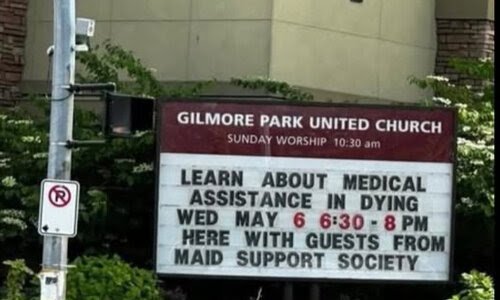
A church–a church–planned to host a speaker promoting what is politely branded as “MAID” (Medical Assistance in Dying), but what is, in plain terms, assisted suicide. The event, scheduled for May 6 at Gilmore Park United Church, was quietly canceled after public backlash. No clear explanation. No public repentance. Just silence.
And that silence speaks volumes.
Because the real scandal is not that the event was canceled. It’s that it was ever scheduled in the first place.
When a Church Forgets What Life Is
Christianity, at its core, is built on the sacredness of life. From Genesis to Revelation, life is not treated as disposable, conditional, or subject to personal convenience. It is God-given, God-breathed, and God-owned.
So how does a church arrive at a place where it invites someone to advocate for ending that life?
MAID is often wrapped in soft language–“compassion,” “dignity,” “choice.” But strip away the branding, and the reality is stark: it is the intentional ending of a human life. There is no theological framework within historic Christianity that can reconcile this with the commandment, “You shall not murder,” or with the belief that suffering, while painful, is not meaningless.
Yet here we are.
A congregation not merely tolerating this worldview, but platforming it.
A Nation Sliding Further Down the Slope
Canada’s expansion of MAID is not theoretical–it is measurable, accelerating, and deeply alarming.
Since legalization in 2016, the number of Canadians who have died through assisted suicide has risen dramatically year after year, placing Canada on track to become the first modern nation to surpass 100,000 euthanasia deaths in less than a decade.
The scale of the program is staggering. In 2024 alone, 16,499 Canadians died through MAiD–about 5.1 percent of all deaths in the country, meaning roughly one out of every twenty deaths in Canada now occurs through assisted suicide.
At the current pace–about 45 assisted deaths every day–Canada is expected to pass the 100,000 mark around the June anniversary of the law’s passage.
Let that settle in.
And the push is not slowing down. Advocates continue to push for broader eligibility: not just terminal illness, but chronic conditions. Not just physical suffering, but mental health struggles. Not just adults, but–eventually–consenting minors.
This is not a stable endpoint. It is a moving line.
And when a church begins hosting conversations that normalize this trajectory, it is no longer standing apart from the culture–it is actively participating in its moral collapse.
Even the Faithful Are Not Spared
Perhaps one of the most chilling recent accounts comes from a Catholic priest in Canada who revealed he was offered MAID–not once, but twice–despite clearly stating his identity as a priest and his moral opposition to such actions.
Think about that.
A man devoted to preserving life, to shepherding souls, to upholding the sanctity of God’s creation–offered death as a solution.
Twice.
If that does not reveal how deeply embedded this mindset has become within the medical system, what will?
And if the broader culture is drifting this far, the role of the church should be to stand firm–not to drift alongside it.
The United Church of Canada: A Long Pattern
To understand how this moment became possible, you have to look at the broader theological direction of the United Church of Canada.
This is not an isolated incident. It is the fruit of decades of doctrinal drift.
The denomination has long embraced positions that depart from historic Christian teaching, including:
– Support for abortion rights, framing it as a matter of personal autonomy rather than moral gravity.
– Full affirmation of LGBTQ+ identities and same-sex marriage, including ordination of openly gay clergy.
– Active promotion of transgender ideology, including affirming gender transition as compatible with faith.
– Rejection of biblical inerrancy, treating Scripture as a human document open to reinterpretation rather than the authoritative Word of God.
At each step, the justification has been similar: compassion, inclusion, modern relevance.
But taken together, the pattern is unmistakable.
When a church begins to redefine Scripture, it eventually redefines sin. When it redefines sin, it redefines morality. And when morality becomes fluid, nearly anything can be justified–including, it seems, the endorsement of assisted suicide.
A Social Club Wearing Sacred Clothing
What remains, then, is something that resembles Christianity in form but not in substance.
There are hymns, sermons, and community gatherings. There is language about love and justice. There is a desire to “do good” and be seen as compassionate.
But without a firm foundation in biblical truth, it becomes something else entirely–a spiritualized social club, offering emotional comfort without moral clarity.
It is a version of Christianity that asks nothing, challenges nothing, and ultimately stands for nothing.
And that is precisely why it can host an event promoting something as serious as assisted suicide without recognizing the contradiction.
The Deeper Danger
The real danger is not just one canceled event in one Canadian church.
It is the normalization of a worldview where life is negotiable.
Where suffering is something to eliminate rather than endure.
Where death is presented not as an enemy, but as a solution.
And most troubling of all–where the church, which should be the last line of moral resistance, becomes a participant in that narrative.
A Line That Must Be Drawn
There are moments in history when institutions reveal what they truly believe–not through statements, but through actions.
This was one of those moments.
A church chose to invite a speaker to promote assisted suicide. Only public backlash stopped it. Not internal conviction. Not theological clarity. External pressure.
That should concern anyone who still believes the church is meant to be a light in the darkness–not a mirror reflecting it.
Because if the place that is supposed to defend life begins to question its value, then the question is no longer about one event.
It is about how far we have already fallen–and how much further we are willing to go.
The USA Experienced The Driest First Three Months Of A Year In U.S. History
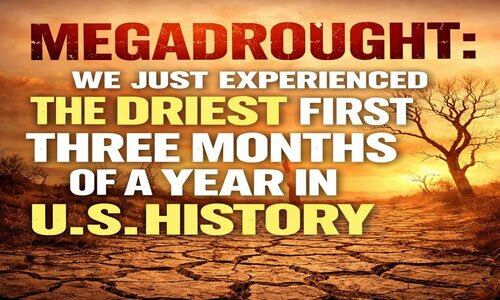
January, February and March were insanely dry. In fact, in all of U.S. history conditions have never been so dry during the first three months of the year. Just think about that for a moment. Not even during the Dust Bowl days of the 1930s were conditions this dry. Many were hoping that 2026 would be the year when our multi-year drought would finally break. Needless to say, that hasn’t happened.
Scientists are telling us that the southwestern U.S. is in the midst of the worst multi-year drought in at least 1,200 years. We really are experiencing a “megadrought”, and this is something that experts such as Steve Quayle and Dane Wigington have been talking about for a long time. Unfortunately, it appears that our seemingly endless “megadrought” has gone to an entirely new level in 2026.
If it simply doesn’t rain, there is not much that farmers and ranchers can do.
Right now approximately 63 percent of the continental United States is experiencing at least some level of drought, and the first quarter of this year was one for the record books…
Winter wheat is dying in Kansas fields that should be green by now. Ranchers in New Mexico are selling cattle they cannot afford to feed. Reservoir levels along the Colorado River system are dropping weeks ahead of the season when mountain snowmelt is supposed to refill them. Across roughly 63% of the contiguous United States, drought rated moderate to exceptional on the federal scale has taken hold, and the first three months of 2026 were the driest the nation has recorded in 131 years of continuous measurement.
This isn’t just a crisis.
This is catastrophic.
It appears that the winter wheat crop in the U.S. is going to be a disaster.
At this stage, more than 81 percent of the Southern Plains is experiencing drought…
Heading into the harvesting season for the key winter wheat crop, much of the western side of the U.S. Plains are locked in drought. Over 81% of Southern Plains is experiencing some form of drought, according to the latest data from the U.S. Drought Monitor. Nearly 20% of the region is experiencing either “extreme” or “exceptional” drought.
Only 30% of U.S. winter wheat is in either good or excellent condition as of the start of this week, according to the most recent weekly Crop Progress report from the Department of Agriculture. By comparison, 49% of the crop was good-or-excellent at this point last year.
The situation is particularly dire in the state of Oklahoma.
Last year, the state produced 101.1 million bushels of red winter wheat.
Thanks to the drought, it is being projected that the state will produce less than half of that total this year…
At the 2026 Oklahoma Grain and Feed Association meeting, crop scouts, extension specialists, and grain elevator representatives painted a sobering picture of this year’s hard red winter wheat crop. Their estimates say the 2026 crop is roughly half the size of the previous two years, with production projected at 48.9 million bushels compared to 101.1 million bushels in 2025. The outlook is based on an average yield of 23.93 bushels per acre across an expected 2.043 million harvested acres, highlighting the significant downturn facing Oklahoma wheat producers.
When there is a lot less wheat to go around, prices will go up.
It is simply a matter of supply and demand.
One farmer that grows winter wheat in Kansas is saying that his farm has only had a quarter of an inch of precipitation since last fall…
Southwest Kansas farmer Gary Millershaski says his area has only received a quarter-of-an-inch of precipitation since last fall. “For us to get a 30-bushel crop, you’ve really got to be optimistic and believe in prayer. That’s a fact.”
He has done everything right, but the sky has been silent.
What is he supposed to do?
So far in 2026, Chicago wheat futures are up about 30 percent…
Chicago wheat futures have gained nearly 30% since the start of the year — the biggest gain among row crop futures — due to the combination of U.S. drought, global fertilizer shortages and a looming El Niño.
If this crisis in the Middle East is not resolved, this will only be just the beginning.
Once upon a time, the U.S. was absolutely swimming in wheat, but now we are moving into a time when it will be considered a “luxury grain”.
Of course beef is already considered to be a “luxury meat”.
When I was growing up, my mother would feed us beef constantly because it was so inexpensive.
But now beef prices have skyrocketed, and some of the prices that we are seeing at the meat counters in our grocery stores are absolutely absurd.
I never thought that I would see beef prices get this high.
But this is the reality that we are living in now.
And it appears that beef prices will continue to remain elevated because the size of the U.S. cattle herd is the smallest that it has been since 1951…
The US cattle herd remained the smallest since 1951 at the start of the year, in the latest signal that consumer beef prices will remain near records.
There were about 86.2 million cattle and calves in the US as of Jan. 1, the US Department of Agriculture said in a Friday report. The tally is nearly unchanged from 2025, providing no relief to the ongoing cattle shortage.
The lack of improvement comes as ranchers keep selling animals to slaughter amid high beef demand, rather than retaining the animals to grow their herds. The downsizing — which began years prior when ranchers shrunk their herds due to high production costs and droughts — has sent consumer beef prices to all-time highs.
It is really hard to feed cattle when conditions are bone dry.
Sadly, they could get even drier in the months ahead…
Meanwhile, there’s a 62% chance of the world’s climate shifting from neutral to El Niño between June and August, according to NOAA’s Climate Prediction Center forecast. The European Center for Medium-Range Weather Forecasts said that this El Niño could be the strongest on record, with peak intensity hitting in October.
El Niño typically results in hot and dry weather in many growing areas, including the U.S. Corn Belt and in Australia. With fertilizer supplies thin, this may further compound production losses for world wheat.
We are being told that we could soon be experiencing a “super El Niño”, and meteorologist Ryan Maue is warning that the long-term forecast for the second half of this year is “off the charts” with extreme temperatures on the horizon.
I have been repeatedly warning my readers that global weather patterns are going nuts, and I was not exaggerating one bit.
We really are facing a historic long-term crisis with no end in sight.
As I discussed last week, for the upcoming season U.S. farmers are planting the fewest acres of wheat that we have seen since records began in 1919.
In 1919, there were 104 million people living in the United States.
Today, there are 341 million people living in the United States.
It doesn’t take a genius to figure out that we have a major problem on our hands.
Many of us have been warning about this crisis for years, and now we really have reached a breaking point.
The Dangerous Illusion: When A Handful of Stocks Carry The Entire Market – The Stock Market Controlled by Social Media

There’s a quiet tension beneath the surface of today’s booming stock market–one that most investors don’t see when they open their 401(k) statements and celebrate another day of gains. The S&P 500 continues to notch record highs, projecting strength, resilience, and confidence. But look closer, and a more fragile reality emerges: this rally is being driven not by the many, but by the very few.
In fact, the market’s surge increasingly resembles a narrow bridge supported by a handful of pillars. And if even one begins to crack, the consequences could ripple across nearly every investor in America.
A Rally Built on a Thin Foundation
Recent market data reveals a striking imbalance. Nearly 40% of the S&P 500’s total value is concentrated in just ten companies–an unprecedented level of dominance. Even more concerning, market breadth–the number of stocks actually participating in the rally–has sharply declined.
In April, only 23% of companies in the index outperformed it, one of the weakest readings in decades. Meanwhile, the median stock remains about 13% below its highs. This is not the picture of a healthy, broad-based rally. It is, as some strategists have described, “disturbingly narrow.
Much of the growth is being powered by mega-cap technology and semiconductor firms, including Nvidia, Alphabet Inc., Intel, and Advanced Micro Devices. These companies are delivering real earnings growth, unlike the speculative names of the late 1990s–but their outsized influence introduces a different kind of risk.
When a single company like Nvidia can account for more than 10% of the index’s monthly gains, the market stops being a reflection of the economy and becomes a reflection of a trend.
Echoes of the Dot-Com Bubble
For seasoned investors, this environment feels eerily familiar.
During the Dot-com bubble, a small cluster of tech stocks drove massive gains, masking underlying weakness across the broader market. Eventually, reality caught up. Many of those high-flying companies collapsed, and the broader market followed.
Today, the comparison is not perfect–today’s leaders are profitable and deeply embedded in the global economy. But the structural similarities are hard to ignore. Narrow leadership, stretched valuations, and investor overconfidence are all present once again.
History offers a sobering reminder: even dominant companies can fall. Cisco Systems was once the crown jewel of the internet age. After the bubble burst, its stock plunged nearly 80% and never returned to its peak. The lesson isn’t that today’s giants will collapse–but that concentration risk has consequences.
The “Everyone Owns the Same Stocks” Problem
Perhaps the most underappreciated danger isn’t just concentration at the index level–it’s concentration across portfolios.
Through retirement accounts, index funds, and investment apps, millions of Americans are effectively holding the same handful of stocks. What appears to be diversification is often an illusion. Owning an S&P 500 index fund may feel broad, but if nearly half of its value is tied to ten companies, the reality is far different.
This creates a critical vulnerability: when everyone owns the same assets, market stability depends on continuous buying. But what happens when sentiment shifts?
As one strategist put it, if everyone is already “long” the same stocks, where do new buyers come from when prices begin to fall?
That question strikes at the heart of systemic risk. In a downturn, selling can become crowded, fast, and self-reinforcing. Without sufficient buyers to absorb the pressure, declines can accelerate rapidly–turning a correction into a cascade.
Sector Overlap and Domino Effects
The risks are amplified by sector concentration. Many of the top-performing companies sit within the same industries–technology, communications, and semiconductors. This creates overlapping exposure across portfolios.
A disruption in one area–say, a slowdown in AI spending or stricter regulation–could impact multiple companies simultaneously. Because these firms are so heavily weighted, the effects would extend far beyond a single sector.
This interconnectedness turns isolated risks into systemic ones. It’s not just about one company missing earnings–it’s about the possibility of a chain reaction.
Why This Matters Now
Markets can remain imbalanced longer than expected. Optimism around artificial intelligence, strong earnings from mega-cap firms, and years of easy monetary policy have fueled the current rally. But conditions are shifting.
Interest rates are higher. Inflation pressures persist. Global growth is uneven. Yet valuations remain elevated, and investor positioning remains crowded.
Historically, periods of narrowing breadth have often preceded market drawdowns. Analysis suggests that after sharp declines in breadth, the S&P 500 has experienced average drawdowns of around 10% within the following year. That’s not a prediction–it’s a warning pattern.
The Bigger Picture: Fragility Behind Strength
What makes this moment so deceptive is how strong everything appears on the surface. Index levels are high. Corporate profits are solid. Investor confidence remains elevated.
But strength built on concentration is inherently fragile.
It’s the financial equivalent of a skyscraper supported by a few central beams instead of a distributed foundation. It may stand tall–but it is far more vulnerable to shock.
A Market at a Crossroads
None of this guarantees an imminent crash. Markets evolve, and today’s leaders may continue to grow. Some strategists even argue that narrow rallies can broaden over time if economic conditions improve.
But the risks are real–and increasingly visible.
The current market structure leaves little margin for error. A stumble in a few key companies could reverberate across the entire system, impacting retirement accounts, institutional portfolios, and everyday investors alike.
The lesson is not panic–it’s awareness.
Because when everyone owns the same stocks, the market stops being a diversified ecosystem and becomes a crowded trade. And crowded trades don’t unwind slowly.
They break all at once.