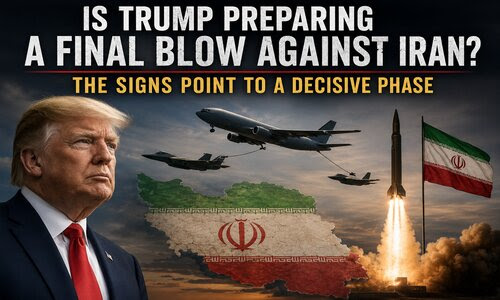
Is Trump Preparing A Final Blow Against Iran? Signs Point To A Decisive Phase
Wars rarely end by drifting quietly into history. More often, they conclude with one side deciding the cost of prolonging the fight has become greater than the risk of one final, overwhelming push.
That possibility is increasingly being discussed regarding the conflict with Iran.
No one outside the White House, the Pentagon, or Israel’s war cabinet knows precisely what President Donald Trump intends to do next. But recent military movements, diplomatic warnings, and strategic realities have fueled growing speculation that Washington may be preparing for a decisive phase designed not simply to punish Iran–but to end the conflict on terms favorable to the United States and its allies.
Whether that happens remains uncertain. Yet several developments suggest something larger could be unfolding.
One of the strongest indicators has been the reported movement of dozens of U.S. aerial refueling tankers into the region. Such aircraft dramatically extend the range and endurance of combat aircraft, enabling sustained long-range bombing campaigns rather than isolated strikes.
At the same time, the U.S. State Department has issued heightened security cautions warning Americans abroad that pro-Iranian groups could target U.S. interests should tensions escalate further.
Taken individually, these developments may not prove anything.
Taken together, they suggest planners are preparing for the possibility of a much larger confrontation.
The Political Clock Is Ticking
Military strategy and politics often move together.
If the Trump administration believes the conflict must ultimately be settled militarily, there are obvious incentives to do so sooner rather than later.
A prolonged war stretching toward the midterm elections would almost certainly create political complications.
Oil prices remain extraordinarily sensitive to every missile fired near the Strait of Hormuz. Continued instability threatens inflation, gasoline prices, financial markets, and consumer confidence–all issues that voters notice immediately.
A decisive military outcome, if successful, could remove much of that uncertainty.
An inconclusive conflict, on the other hand, risks months of economic volatility with no guarantee of improved security.
That does not mean military action is inevitable. It simply means the political calendar may favor resolving the conflict before it becomes an extended war of attrition.
The Pause Hasn’t Solved The Core Problems
Even after periods of reduced fighting, the strategic issues remain largely unresolved.
Iran continues demonstrating an ability to threaten shipping around the Strait of Hormuz. Questions also remain regarding the status of portions of Iran’s enriched uranium stockpile and underground nuclear infrastructure.
Simply pausing operations does not eliminate those realities.
From Washington’s perspective, unfinished objectives often become future crises.
A Modern “Shock And Awe”?
Anyone who remembers the opening days of the Iraq War remembers the phrase “Shock and Awe.”
That campaign sought to overwhelm an opponent through speed, precision, and sustained strikes that crippled command structures before organized resistance could fully respond.
Military technology has advanced dramatically since 2003.
Today’s version would likely rely far more heavily on stealth aircraft, drones, electronic warfare, cyber operations, long-range precision weapons, and real-time intelligence than massive armored columns.
Whether such an operation occurs remains speculative.
But the reported positioning of aerial refueling assets naturally raises questions because those aircraft are most valuable during sustained air campaigns rather than brief demonstrations of force.
If anyone has watched the recent film *Pressure*, they’ll appreciate another factor that rarely enters public discussion: weather. Military planners don’t simply ask whether they *can* launch an operation–they ask when environmental conditions give them the greatest advantage. Weather has shaped countless battles throughout history, and it still does today.
How Would Iran Respond?
This may be the greatest unknown.
Many analysts believe Iran’s conventional military has already suffered significant damage.
That does not mean Iran lacks dangerous options.
Instead of matching American military strength directly, Tehran could rely on asymmetric retaliation.
Possible scenarios include:
* Terror attacks against U.S. or Israeli interests overseas.
* Activation of sleeper networks already positioned abroad.
* Cyberattacks on financial institutions or critical infrastructure.
* Missile and drone strikes against regional energy facilities.
* Continued attacks on commercial shipping.
* Attempts to widen the conflict through regional proxy groups.
Ironically, terrorism–the tactic most associated with Iran’s regional network–has thus far remained more limited than many initially expected. That could reflect capability constraints, strategic restraint, or simply a decision to reserve those options for a larger confrontation
The Leadership Mystery
Another uncertainty surrounds Iran’s decision-making itself.
Various intelligence assessments have suggested unusual uncertainty within Tehran’s leadership following months of conflict. Some observers have even speculated about internal power struggles or a quiet leadership transition taking place behind closed doors.
If true, that presents its own dangers.
History shows that leadership uncertainty can make wars more–not less–dangerous.
Fragmented command structures increase the risk of miscalculation.
Competing factions sometimes escalate conflicts precisely because no single leader fully controls events.
If Israeli intelligence is still attempting to determine exactly who is making the final decisions inside Tehran, that alone illustrates how fluid the current situation may be.
Will The Entire “Axis” Enter The Fight?
Another question concerns Iran’s regional partners.
Could Hezbollah launch a full-scale northern war?
Could Hamas dramatically expand operations?
Will the Houthis intensify attacks in the Red Sea?
All remain possibilities.
Yet each organization has already paid significant military costs over the past year and faces its own domestic and operational constraints. While limited attacks remain likely, a fully coordinated regional offensive would represent a major escalation carrying enormous risks for every participant.
That possibility cannot be dismissed–but neither should it be assumed.
Could There Be A Ground Operation?
While air power can produce enormous destruction, history reminds us that bombing campaigns alone do not always achieve political objectives.
Could the United States eventually consider some form of limited ground operation?
Most military observers remain skeptical, at least in the near term.
Southern Iran’s extreme summer heat creates enormous logistical challenges for any amphibious landing or sustained ground campaign. Heat affects troops, equipment, maintenance schedules, and operational tempo.
For that reason, some analysts believe that if a ground component were ever contemplated, seasonal conditions alone would likely push such planning well beyond the current summer–and perhaps even beyond the midterm elections.
Air operations, however, face far fewer environmental constraints and could be expanded much sooner.
The Coming Days May Be Critical
The Middle East has entered one of its most unpredictable periods in years.
Additional U.S. military assets continue moving into the region.
Security warnings for Americans overseas remain elevated.
Iran continues demonstrating an ability to threaten regional stability while key questions surrounding its nuclear program remain unanswered.
Political pressure for a durable outcome continues to build.
Whether these developments culminate in negotiations or in a dramatically expanded military campaign remains unknown.
But history suggests one consistent lesson: prolonged wars rarely remain static. They either move toward settlement–or toward escalation.
If the current indicators reflect preparation rather than precaution, the next phase could look very different from what the world has witnessed so far. It could resemble a modern version of “Shock and Awe”–not necessarily identical in execution, but similar in its objective of delivering overwhelming force intended to end the conflict quickly.
If that moment arrives, the consequences will extend far beyond Iran and Israel. Global energy markets, regional alliances, terrorism, international security, and geopolitical stability could all be reshaped by what happens next.
The next few days may tell us whether the current pause is the beginning of peace–or simply the calm before a much larger storm.
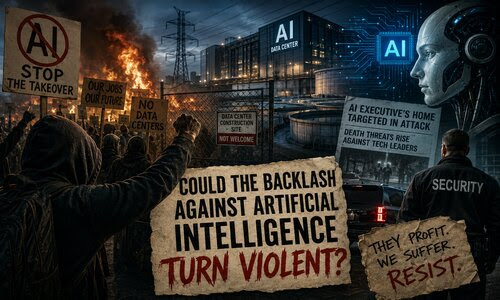
Could The Backlash Against Artificial Intelligence Turn Violent?
The warning signs are no longer hypothetical.
An alleged attempted firebombing of OpenAI CEO Sam Altman’s home. Death threats against executives at Anthropic. Online manifestos calling for the killing of AI leaders. Security teams escorting tech executives with armed protection. Threat-monitoring firms reporting a dramatic surge in violent rhetoric aimed at artificial intelligence companies and their massive data centers.
Just a few years ago, this would have sounded like science fiction.
Today, it is becoming reality.
Artificial intelligence is advancing at breathtaking speed, promising medical breakthroughs, scientific discoveries, economic growth, and productivity gains unlike anything seen since the Industrial Revolution. But for a growing number of people, AI represents something far different–a direct threat to their jobs, their communities, and perhaps even the future of human society.
That growing divide is creating one of the most significant cultural and political battles of the coming decade.
Fear Is Fueling The Backlash
To dismiss AI critics as simply anti-technology would be a mistake.
Many of their concerns are legitimate.
Entire professions are already being transformed. Writers, programmers, graphic designers, customer-service representatives, legal researchers, translators, accountants, and even medical professionals are discovering that AI can now perform work that once required years of education and experience.
History tells us new technologies eventually create new industries and new opportunities.
It also tells us the transition can be painful.
When people believe their livelihoods are disappearing, they rarely celebrate progress. As Palantir CEO Alex Karp recently observed, tell someone their job is about to disappear, and “people go for the pitchfork.”
That may sound dramatic, but history offers plenty of examples. The Luddites of nineteenth-century England destroyed textile machinery they believed threatened their livelihoods. They failed to stop industrialization, but they demonstrated a timeless truth: when people feel technology is taking away their future, some eventually attack the technology itself.
The Data Center Wars
The conflict isn’t only about jobs.
It is increasingly about the enormous infrastructure required to power artificial intelligence.
Modern AI data centers consume staggering amounts of electricity and water. Proposed facilities have sparked opposition from residents worried about strained water supplies, increased electricity demand, environmental impacts, loss of farmland, and neighborhoods transformed by sprawling industrial campuses.
Some communities are also pushing back against rising property values fueled by tech investment, fearing they’ll be priced out of the very places they’ve called home for generations.
To AI companies, these facilities represent the foundation of tomorrow’s economy.
To many residents, they represent billion-dollar corporations consuming local resources while ordinary people bear the costs.
Those competing visions are setting the stage for increasingly bitter political battles.
A New Technology Divide
Supporters see AI as humanity’s next great leap forward.
They envision faster medical discoveries, safer transportation, personalized education, greater productivity, and economic growth that could improve billions of lives.
Critics see something else entirely.
They worry about mass unemployment, deepfake deception, surveillance, concentrated corporate power, autonomous weapons, and a future where humans become increasingly dependent on machines they neither understand nor control.
Neither side is entirely wrong.
AI is likely to produce extraordinary benefits while also creating extraordinary disruption.
The problem is that both are likely to happen at the same time.
Could The Conflict Escalate?
Most opposition to AI will remain peaceful.
But history reminds us that major technological revolutions rarely unfold without resistance.
Today it’s death threats and Molotov cocktails.
Tomorrow it could be sabotaged data centers, blocked construction projects, damaged power infrastructure, or organized campaigns designed to halt AI expansion altogether. Around the world, infrastructure projects–from pipelines to power plants–have become flashpoints for years of protests and, in some cases, vandalism. There is little reason to assume AI facilities will be immune.
Imagine entire regions losing thousands of white-collar jobs over just a few years. Imagine AI companies simultaneously announcing record profits while building massive campuses that consume local land, water, and electricity.
The ingredients for a long-term political movement–and perhaps a far more confrontational one–are already visible.
Some have even begun asking a once-unthinkable question: could AI someday contribute to a form of civil conflict?
That should not be understood as a prediction. There is no evidence society is on the brink of armed conflict over artificial intelligence.
But technological revolutions have repeatedly intensified existing social and political divisions. If millions of people conclude that AI has permanently eliminated their careers while concentrating wealth and power into the hands of a few companies, resentment could grow into something far larger than today’s isolated acts of violence.
Ironically, the conflict would never truly be humans versus robots.
It would be humans versus other humans, divided over what kind of civilization they want to build–and whether AI should define it.
More Than A Technology Debate
For Christians, this debate is about more than innovation.
Scripture consistently reminds us that human ingenuity is a gift, but also that wisdom must guide how every tool is used. Technology itself is neither righteous nor evil. The moral question has always been the human heart directing it.
Artificial intelligence may become one of the greatest tools humanity has ever created. It may also become one of the greatest sources of social disruption our generation has ever experienced.
The AI revolution is almost certainly coming.
The real question is not whether the technology will change civilization–it will. The question is whether society adapts, regulates, and benefits from that change, or whether fear, anger, and economic upheaval fuel an escalating backlash against those building it.
Every great technological revolution has created both winners and losers.
Artificial intelligence may create them faster than any revolution before it.
If that happens, the battle over AI may no longer be fought primarily in corporate boardrooms or legislative chambers–but in neighborhoods, at construction sites, and perhaps even in the streets.