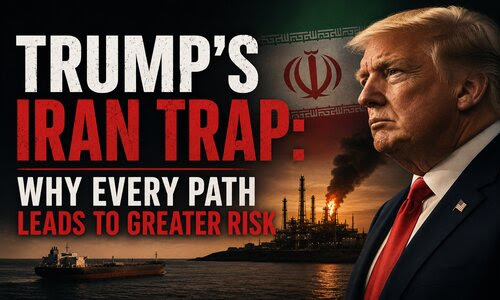
Trump’s Iran Trap: Why Every Path Leads To Greater Risk
Donald Trump may command the world’s most powerful military, but today he faces an enemy that understands something equally powerful: time.
Iran no longer needs to defeat America on the battlefield. It only needs to make every available option so politically, economically and militarily painful that Washington hesitates. If that is Tehran’s strategy, it may already be working.
Over the past several weeks, President Trump has repeatedly signaled that military action remained on the table, only to pause again as negotiations resumed. On the surface, the decision appears understandable. Iran has already demonstrated its willingness to disrupt maritime traffic and threaten one of the world’s most important energy corridors. But military planners fear something far worse than the current standoff.
The real nightmare scenario is not simply more interference with shipping through the Strait of Hormuz. It is a coordinated Iranian campaign against the oil fields, refineries, export terminals, pipelines and energy infrastructure of America’s Gulf allies.
Such attacks would not merely slow the movement of oil–they could temporarily cripple the Gulf’s ability to produce and export it altogether. The result could be one of the largest energy shocks the modern world has experienced in decades, sending oil prices sharply higher, reigniting inflation, rattling financial markets and placing enormous strain on economies already burdened by debt and slowing growth.
That is the real trap confronting the White House.
Every Option Carries A Price
Rarely does a president face a foreign policy decision where every available path carries significant consequences.
If Trump authorizes a major military operation, Iran’s retaliation would likely extend well beyond attacks on American military bases. Tehran has repeatedly warned that Gulf nations assisting U.S. military operations could see their own energy infrastructure become targets. Oil fields, refineries, export terminals, pipelines, desalination plants and electrical facilities across Saudi Arabia, the United Arab Emirates, Bahrain and other neighboring states could suddenly find themselves on the front lines.
That distinction is critical.
Closing or disrupting the Strait of Hormuz creates a transportation crisis.
Destroying or severely damaging Gulf energy infrastructure creates a production crisis.
One delays oil deliveries.
The other reduces the world’s ability to produce millions of barrels of oil each day.
The difference is enormous.
Unlike a tanker waiting for safe passage, a destroyed refinery cannot simply resume operations overnight. Damaged export terminals take time to repair. Pipeline networks require reconstruction. Production lost from major oil fields cannot always be immediately replaced elsewhere, particularly when global spare production capacity is limited.
The consequences would ripple through nearly every sector of the global economy.
Oil prices could surge dramatically. Gasoline and diesel prices would climb. Airlines, trucking companies and manufacturers would face soaring operating costs. Inflation–which many central banks have spent years trying to bring under control–could return with renewed force. Stock markets would likely react sharply, consumer confidence could weaken, and nations already struggling with high debt and slowing economic growth could once again find themselves confronting recession.
In other words, what begins as a military conflict in the Persian Gulf could quickly become a global economic crisis affecting families thousands of miles from the battlefield.
These are not theoretical concerns. They are precisely the kinds of scenarios military planners are attempting to prevent.
Iran’s Most Powerful Weapon May Not Be Its Missiles
Iran cannot match America’s conventional military strength.
It doesn’t have to.
Instead, Tehran may be pursuing something far more effective.
Its greatest strategic weapon may be the fear of what a wider conflict would do to the global economy.
Threaten the Strait of Hormuz.
Threaten Gulf oil infrastructure.
Threaten commercial shipping.
Threaten regional energy production.
Suddenly, military decisions are no longer measured solely by battlefield success. They become measured by gasoline prices, inflation, financial markets, insurance costs and political consequences back home.
If an adversary can convince its opponent that the economic consequences of military action are simply too costly, overwhelming military superiority begins to lose some of its advantage.
That should concern every American–not only in this conflict, but in future confrontations with other adversaries.
Can America Fight On An Election Calendar?
Every president must weigh military decisions alongside domestic realities.
No responsible commander-in-chief ignores the possibility of American casualties, economic disruption or broader regional escalation.
But America’s adversaries understand those realities too.
Iran knows elections matter.
It knows rising gasoline prices matter.
It knows public opinion matters.
If Tehran believes it can influence Washington’s decision-making simply by threatening economic chaos, then it has identified a strategic pressure point extending far beyond this conflict.
The danger is that America’s military calendar begins following its political calendar while Iran continues following its strategic one.
The Window Of Opportunity Will Not Stay Open Forever
History repeatedly demonstrates that military opportunities rarely remain available indefinitely.
Whether confronting terrorist organizations, rogue regimes or expanding military powers, delays often allow adversaries to rebuild capabilities that previously had been degraded.
That does not automatically mean military action is always the correct answer.
It does mean postponement carries costs of its own.
Every additional week potentially allows Iran to repair infrastructure, relocate military assets, improve air defenses, replenish missile and drone inventories, harden underground facilities and further disperse sensitive capabilities. Even if only some of those efforts succeed, any future military campaign could become significantly more difficult than it would be today.
The tragic irony would be discovering that the war everyone hoped to avoid has simply become larger, longer and more expensive.
What Does Victory Actually Look Like?
Before deciding when to act, Washington must answer an even more important question.
What exactly is victory?
Is success reopening the Strait of Hormuz?
Ending uranium enrichment?
Destroying Iran’s missile production?
Preventing future nuclear capability?
Ending support for terrorist proxies?
Changing the regime’s behavior?
Or replacing the regime altogether?
Each objective requires a different strategy.
Without a clearly defined end state, military victories can become temporary while diplomatic agreements become little more than pauses between future crises.
Diplomacy is valuable when it produces lasting, verifiable security. But diplomacy that merely postpones confrontation without fundamentally reducing the threat risks becoming a strategy of delay rather than a strategy of peace.
The Real Danger
Trump’s critics argue he is waiting too long.
His supporters argue he is wisely trying to avoid a regional war that could devastate the global economy.
Both perspectives recognize genuine risks.
But perhaps the greatest danger lies somewhere in between.
What if Iran has successfully maneuvered the United States into a position where every available option carries unacceptable consequences?
Strike now, and Tehran may attempt to ignite an economic firestorm by targeting the energy infrastructure that powers much of the world.
Wait longer, and Iran gains additional time to recover, adapt, strengthen its military capabilities and prepare for the next confrontation.
That is what makes this more than a military dilemma.
It is a strategic trap.
History shows that windows of military opportunity do not remain open forever. They close as enemies rebuild, disperse assets, adapt tactics and prepare for the next phase of conflict.
Trump’s challenge is no longer simply deciding whether to strike Iran.
It is deciding whether today’s economic risks are greater than tomorrow’s strategic risks.
Because if diplomacy ultimately fails–and Iran emerges stronger while the world’s dependence on Gulf energy remains unchanged–the next decision facing the White House may be even more dangerous than the one it faces today.
Iran no longer has to defeat America on the battlefield. It only has to convince America that the cost of defeating Iran has become too high.
If that is Tehran’s strategy, then every day of delay raises one unsettling question:
Is America running out of options–or running out of time?
Canada’s Military Just Silenced God: What Happens When A Nation Erases Faith
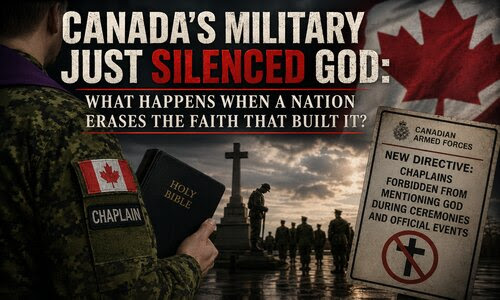
Canada has long prided itself on being a nation of tolerance, diversity, and freedom. Yet one of its latest military directives raises a troubling question: How tolerant is a society that increasingly excludes Christianity from public life?
The Canadian Armed Forces has reportedly issued guidance instructing military chaplains to avoid using religious-specific language–including references to God–during public ceremonies and official events. The irony is difficult to ignore. Chaplains exist precisely because they are ministers of faith. Asking them to leave God out of public prayers is rather like asking a physician to avoid mentioning medicine.
Even more striking is the fact that Canada’s own national anthem still asks God to “keep our land glorious and free.” Apparently, the nation may sing about God, but those officially appointed to provide spiritual care are increasingly discouraged from speaking His name.
This is about far more than military protocol. It reflects a profound shift in how Canada understands its own history, identity, and future.
The Faith That Helped Build A Nation
Modern Canada did not emerge in a spiritual vacuum.
For centuries, Christian missionaries established many of the country’s earliest schools, hospitals, and charitable institutions. Churches played a central role in caring for the poor, educating children, and building communities across an often harsh and unforgiving landscape.
The nation’s constitutional foundations also reflected this heritage. Canada’s Constitution Act, 1982 begins with the declaration that “Canada is founded upon principles that recognize the supremacy of God and the rule of law.” Whether every Canadian today personally embraces Christianity is beside the point. The country’s legal and moral framework openly acknowledged that rights ultimately came from a higher authority than the state.
That understanding has enormous implications.
When governments recognize God, they implicitly recognize limits on their own power. Human rights are viewed as inherent–not merely privileges granted by politicians. Freedom of conscience, freedom of worship, and freedom of speech become protected because they are understood to flow from something greater than government itself.
When that foundation is gradually removed, rights become increasingly vulnerable to the shifting priorities of whoever happens to hold political power.
Christians Have Always Served Canada
The irony of this directive becomes even sharper when considering the sacrifices Christians have made in Canada’s defense.
Thousands of Canadian soldiers who stormed the beaches of Normandy, fought through Europe, or served in Korea, Afghanistan, and countless peacekeeping missions carried Bibles in their packs and prayed before entering battle.
Military chaplains have stood beside wounded soldiers, comforted grieving families, buried the dead, and offered hope in humanity’s darkest moments. They have ministered during wars, natural disasters, and national tragedies. Their role has never been simply ceremonial–it has been deeply spiritual.
Many soldiers sought them precisely because they wanted someone willing to speak honestly about God, eternity, forgiveness, courage, and hope.
Now those same chaplains are increasingly expected to provide spiritual care while carefully avoiding the very faith that defines their calling.
Neutrality Or Secular Preference?
Supporters of these policies often argue they promote neutrality in an increasingly diverse military.
But genuine neutrality treats all beliefs equally.
What increasingly appears to be happening across much of the Western world is not neutrality but the elevation of secularism into the preferred public worldview. Religious expression is welcomed only so long as it remains private and invisible.
Ironically, a military chaplain can often discuss mindfulness, resilience, mental wellness, or personal values with little controversy. Mentioning God during an official ceremony, however, becomes problematic.
That is not neutrality.
It is selective exclusion.
A truly pluralistic society should have enough confidence to allow chaplains to pray according to their own faith while recognizing that participation remains voluntary.
Instead, diversity increasingly seems to mean every belief is welcome–except the one that historically shaped the nation itself.
Forgetting Our Foundations
History offers countless examples of civilizations that eventually forgot the very values that enabled their success.
Western civilization’s concepts of human dignity, forgiveness, equality before the law, compassion for the vulnerable, and individual worth were profoundly influenced by centuries of Christian teaching.
One need not be a churchgoer to acknowledge this historical reality.
Removing every visible reminder of Christianity from public institutions does not create historical accuracy. It creates historical amnesia.
Future generations may eventually conclude that Canada’s freedoms somehow appeared spontaneously, disconnected from the moral convictions that inspired many of the nation’s founders, reformers, soldiers, and citizens.
That would be a profound misunderstanding of history.
A Warning Beyond Canada
Christians should view this story as more than simply another culture-war headline.
It illustrates how rapidly societies can move from celebrating religious liberty to restricting religious expression in the name of inclusivity.
The issue is not whether every Canadian shares the Christian faith.
The issue is whether Christians remain free to publicly express the beliefs that motivated generations to serve, sacrifice, and build the nation.
Military chaplains are not political activists. They are shepherds called to care for those facing some of life’s greatest hardships. If they cannot openly speak about God during the very ceremonies where comfort, hope, remembrance, and sacrifice are being honored, one has to ask what role society believes faith should still play.
Canada’s anthem continues to ask God to keep the nation “glorious and free.”
The greater question now is whether Canada still wants Him to be part of its public life at all.
History suggests that nations are rarely strengthened by forgetting the faith that helped build them. More often, they lose not only their memory but eventually the freedoms that memory helped preserve.