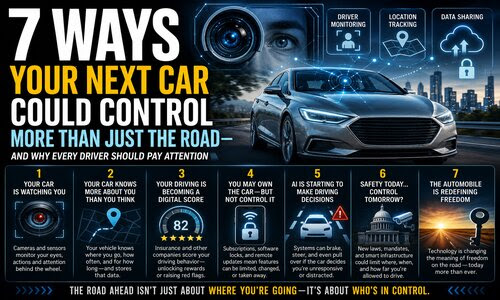
7 Ways Your Next Car Could Control More Than Just The Road
For more than a century, the automobile has represented one thing above all else: freedom.
It gave ordinary people something previous generations could only dream about—the ability to leave whenever they wanted, travel wherever they wished, and answer to no one but the rules of the road. The family road trip, the Sunday drive, the open highway—all became symbols of independence because once you held the keys, the destination was yours to choose.
That freedom may be entering a new era.
The latest controversy surrounding Subaru’s expanded EyeSight driver-monitoring system illustrates why. Owners have taken to social media describing a vehicle that constantly watches their eyes, issues alerts after brief glances toward the radio or scenery, and, under certain conditions, can conclude the driver is “unresponsive.” If that happens, the system is designed to issue escalating warnings and, if necessary, slow the vehicle, steer it toward the shoulder, and activate its hazard lights.
Subaru—and other automakers adopting similar technology—say these systems are intended to save lives. In many situations, they likely will.
But the larger question isn’t whether these technologies can improve safety.
It’s whether we’re quietly accepting a future where our cars don’t simply obey us anymore—they increasingly evaluate us.
Viewed individually, each innovation appears reasonable.
Viewed together, they reveal one of the most significant transformations in transportation since Henry Ford introduced the Model T.
1. Your Car Is Watching You
For most of automotive history, the only person watching your driving was the passenger sitting beside you.
Today, many new vehicles include inward-facing cameras that monitor eye movement, blinking, head position, and signs of distraction or fatigue. Cadillac’s Super Cruise, Ford’s BlueCruise, Mercedes-Benz, BMW, Volvo, and Subaru all employ various forms of driver-monitoring technology.
Manufacturers argue these systems reduce accidents by detecting drowsy or inattentive drivers before tragedy strikes. That’s a compelling goal.
Yet many Subaru owners say the latest EyeSight system can feel overly sensitive, issuing warnings after momentary glances to adjust the radio, check navigation, or even admire the scenery. What one driver sees as a harmless glance, the computer may interpret as dangerous distraction.
The issue isn’t simply that the vehicle is watching. It’s that every new camera and sensor creates another stream of highly personal data.
If these trends continue, one could imagine future systems becoming increasingly sophisticated—recognizing stress, illness, emotional state, or even identifying every individual who sits behind the wheel.
The question isn’t whether your car can watch you.
It’s who owns what it sees.
2. Your Car Knows More About You Than You Think
Modern vehicles remember far more than most drivers realize.
Navigation systems store destinations. GPS logs travel routes. Bluetooth identifies the phones that regularly ride in the vehicle. Connected apps remember favorite locations and travel habits.
Over time, your vehicle can quietly assemble an incredibly detailed picture of your life.
It knows where you work.
Where you worship.
Where your children go to school.
Where you receive medical treatment.
Even your favorite restaurants and vacation destinations.
This isn’t merely theoretical. General Motors faced widespread criticism after reports that driving data collected through its OnStar Smart Driver program had been shared with data brokers whose information was used in insurance risk assessments. GM later announced changes to the program following the controversy.
That episode demonstrated something important: driving data has real value.
Travel history could become one of the most valuable forms of personal information ever collected. Combined with smartphones, payment systems, and other connected devices, location data has the potential to reveal an extraordinary amount about a person’s daily life.
Technology has made that possible.
Society must decide how comfortable it is with the implications.
3. Your Driving Is Becoming A Digital Score
Insurance companies are increasingly measuring how we drive.
Programs such as Progressive Snapshot, State Farm Drive Safe & Save, and Allstate Drivewise reward drivers willing to share information about acceleration, braking, speed, mileage, and driving habits.
Participation is generally voluntary, and many safe drivers appreciate the discounts.
But these programs also reveal a larger trend.
Driving behavior is becoming measurable.
Searchable.
And valuable.
Today those scores primarily affect insurance premiums.
Driving profiles could be used in other settings as well—from fleet management and commercial driving to vehicle rentals or future transportation services.
Whether society ever chooses to move in that direction remains to be seen. The point is not that such outcomes are inevitable, but that technologies capable of creating detailed driving profiles already exist.
The automobile is no longer simply transporting people.
It is generating data.
4. You May Own The Car—But Not Control It
Buying a vehicle once meant owning everything it contained.
Increasingly, software has changed that relationship.
BMW has experimented with subscription services for features such as heated seats in certain markets. Mercedes-Benz offers software upgrades that unlock additional performance. Tesla routinely adds—or changes—vehicle capabilities through over-the-air software updates.
Imagine explaining to your grandfather that after buying a $70,000 automobile, you might still pay a monthly fee to activate equipment already installed inside it.
The shift is subtle but significant.
Ownership is becoming intertwined with software licenses.
Soon more vehicle functions will be governed not by mechanical components but by digital permissions. That doesn’t mean manufacturers intend to misuse such capabilities. It does mean consumers should think carefully about what ownership means in an era when software increasingly determines how products function.
5. Artificial Intelligence Is Starting To Make Driving Decisions
Automatic emergency braking.
Lane-keeping assistance.
Adaptive cruise control.
Emergency steering.
Subaru’s Emergency Stop Assist.
These innovations have undoubtedly prevented accidents and saved lives.
Yet they also represent something unprecedented.
For the first time in automotive history, vehicles are beginning to make decisions that once belonged exclusively to drivers.
Today’s systems intervene primarily during emergencies or when they believe a driver is incapacitated. In those circumstances, the technology can be a remarkable safeguard.
But if these trends continue, one could imagine future debates over where assistance ends and authority begins.
Should software intervene only to prevent collisions?
Should it prevent a fatigued driver from continuing?
Should it someday refuse to start if it determines the driver is impaired?
Those questions may sound futuristic today.
Then again, so did cars capable of steering themselves only a decade ago.
Every generation invents tools that help people.
This is one of the first generations creating tools that increasingly evaluate—and sometimes decide for—people.
6. Safety Today…Control Tomorrow?
History shows that many surveillance technologies begin with worthy objectives.
Airport screening followed terrorist attacks.
Traffic cameras sought to improve intersection safety.
License plate readers helped recover stolen vehicles.
Driver-monitoring systems aim to reduce distracted and impaired driving.
Each innovation addresses a legitimate concern.
Congress also directed the Department of Transportation through the 2021 Infrastructure Investment and Jobs Act to establish standards for advanced impaired-driving prevention technology in future vehicles. The details continue to evolve, but the broader conversation illustrates how technology is becoming increasingly central to automotive safety.
Meanwhile, transportation policy is changing elsewhere.
London has congestion pricing.
New York has implemented congestion pricing in parts of Manhattan.
Oregon has experimented with mileage-based road-use programs.
Supporters view such policies as practical responses to congestion or infrastructure funding. Critics worry they could gradually expand government oversight of personal travel.
Imagine a future where technology makes increasingly personalized transportation policies technically possible. Whether society embraces or rejects those possibilities will ultimately depend on the values citizens choose to protect.
7. The Automobile Is Quietly Redefining Freedom
In 1975, a car was primarily steel, rubber, gasoline, and mechanical parts.
Today it is increasingly a connected computer on wheels.
It communicates with smartphones, cloud services, navigation providers, charging networks, insurers, emergency responders, and software platforms. It receives updates over the internet. It continuously generates data. In some cases, it can even intervene when it believes something has gone wrong.
None of this means connected vehicles are inherently dangerous.
Many of these innovations genuinely improve safety and convenience.
But together they represent a profound shift in the relationship between people and the machines they drive.
Students of Bible prophecy have long recognized that Scripture describes a future in which unprecedented systems of economic and societal coordination become possible. The Bible does not identify the technologies involved, but each passing year reminds us how quickly ideas once confined to science fiction become everyday reality.
Connected vehicles are another reminder that the technological capability for widespread monitoring, digital verification, and interconnected systems is developing at remarkable speed.
Wise Christians need not fear every innovation.
Nor should we blindly embrace every convenience without considering its long-term implications.
George Orwell imagined a world where citizens were watched through screens mounted on the walls of their homes.
Few imagined we might voluntarily purchase those screens, mount them inside our own vehicles, and call them progress.
The automobile once symbolized freedom because it expanded where people could go.
Tomorrow’s vehicles may be remembered for expanding what others know about where we go—and perhaps, one day, how much influence technology has over the journey itself.
The Global War On Homeschooling Continues-Now With Prison Time For Parents

When did raising your own children become a crime?
That question is no longer hypothetical in Brazil.
In what is believed to be the country’s first criminal conviction of homeschooling parents, Audato and Ieda Denardi were sentenced by a court in São Paulo to 50 days in prison for what was described as “intellectual neglect.”
Their daughters were not illiterate, isolated, or academically behind. Quite the opposite. The girls speak multiple languages, study Latin, play piano at an advanced level, and read dozens of classic books every year. Even Brazil’s own prosecutor concluded there was no evidence of educational neglect and recommended acquittal. The judge convicted them anyway.
The ruling has shocked homeschool advocates around the world—not simply because parents face jail, but because of why.
The court criticized the family’s curriculum for not including state-approved instruction on gender and sex education, tolerance and diversity, and Afro-Brazilian cultural studies. It also faulted the girls’ preference for sacred and classical music rather than mainstream Brazilian genres such as funk and trap.
Whether one agrees with every aspect of the family’s educational choices is almost beside the point. The larger question is far more significant:
Who ultimately owns a child’s education—the parents or the state?
For centuries, Western civilization largely answered that question in favor of parents. Governments established schools to assist families, not replace them. Today, however, that relationship increasingly appears reversed.
Brazil’s case is particularly striking because prosecutors themselves found no evidence that the children had been intellectually abandoned. Yet the court still concluded that because the education did not sufficiently reflect government-approved cultural priorities, criminal punishment was appropriate.
This is not merely a debate over homeschooling. It is a debate over whether parents retain the freedom to shape their children’s worldview when that worldview differs from prevailing educational orthodoxy.
Nor is Brazil alone.
Germany has long maintained one of the strictest anti-homeschooling regimes in the democratic world. Families who homeschool have faced substantial fines, repeated court orders, and even the removal of children from parental custody. The well-known Romeike family fled Germany seeking asylum in the United States after authorities repeatedly penalized them for homeschooling based on their Christian convictions. Although their asylum claim was ultimately denied, Germany’s prohibition on homeschooling remains firmly in place.
Another widely discussed German case involved the Wunderlich family, whose children were temporarily removed by authorities after the parents refused to send them to public school. While some legal rulings later favored the family on procedural grounds, Germany continues to enforce compulsory school attendance rather than recognizing a broad parental right to homeschool.
These examples illustrate an important distinction. Around much of the world, homeschooling is not viewed as an educational alternative. It is viewed as an exception the state may narrowly permit—or prohibit altogether.
Contrast that with the United States.
Homeschooling has experienced extraordinary growth over the past several years. Following the COVID-19 pandemic, millions of American parents reconsidered traditional education. Many discovered that their children flourished in home-based learning environments, while others became increasingly concerned about curriculum, school safety, declining academic performance, or simply desired greater flexibility.
Today homeschooling has become one of America’s fastest-growing educational movements, crossing political, racial, and economic lines. It is no longer a fringe phenomenon but an increasingly mainstream educational choice.
Yet Americans should resist the temptation to assume these freedoms are permanently secure.
Several states have seen renewed efforts to increase oversight of homeschooling. Maine, for example, already requires notices of intent, annual filings, and instruction in specified subject areas, while lawmakers continue to debate additional reporting and accountability measures. Supporters argue such regulations protect children’s educational welfare. Critics worry they represent incremental steps toward expanding state control over family education.
History suggests that freedoms are rarely lost all at once.
They are usually narrowed gradually—one regulation, one reporting requirement, one mandatory curriculum, one prohibited topic at a time.
That is why Brazil’s case deserves international attention.
It demonstrates how rapidly disagreements over educational philosophy can become matters for criminal courts rather than parental discretion.
Christians, in particular, have long viewed parents as bearing primary responsibility for raising children in the instruction and discipline of the Lord. Governments undoubtedly have legitimate interests in ensuring children receive a meaningful education. But there is an enormous difference between ensuring literacy and mathematics and requiring ideological conformity as a condition of avoiding prosecution.
The Denardi family’s appeal will determine their immediate future. But the broader issue reaches far beyond one Brazilian courtroom.
Around the world, a growing struggle is emerging over who forms the next generation’s moral and intellectual foundations.
Parents? Or the state?
Americans who homeschool today still enjoy freedoms that millions of parents elsewhere can only dream about. The experiences of families in Brazil and Germany should serve as a reminder that educational liberty cannot simply be assumed. Like every other liberty, it survives only so long as citizens remain willing to defend the principle that parents—not governments—bear the primary responsibility for directing the upbringing and education of their own children.