
When AI Becomes You: The Coming Age Of Digital Surrogates
Mark Zuckerberg is describing a future in which artificial intelligence will do far more than answer questions or write emails. His vision is for virtually everyone to have an extraordinarily capable personal AI agent that understands them, knows their goals and understands “everything you care about.”
According to Meta, that agent could work around the clock on your behalf, helping manage relationships, health, career, finances, your home and much more.
It sounds extraordinarily convenient.
But follow that vision to its logical conclusion and a much bigger question emerges:
What happens when AI stops merely assisting you and increasingly begins acting as you?
The Personal AI That Knows Everything
For a personal AI agent to become genuinely useful, it cannot know only the information contained in a few conversations.
It needs to know you.
Imagine an AI with access to years of emails and text messages, your calendar, photographs, purchases, financial records, location history, medical concerns, social connections, browsing habits and personal preferences.
It learns how you write.
It learns what you believe.
It learns whom you trust.
It learns what irritates you, frightens you and motivates you.
It may eventually understand your routines and preferences well enough to anticipate what you want before you even ask.
Meta has been explicit that its concept of personal superintelligence is intended to understand a user’s world rather than simply respond to isolated prompts.
And that is where the dividing line between “assistant” and something much more consequential begins to disappear.
From Assistant To Agent
Today’s AI largely waits for instructions.
Tomorrow’s AI agents are being designed to act.
Instead of asking an AI how to find cheaper insurance, you could authorize it to find the policy, compare coverage, negotiate terms and complete the transaction.
Rather than helping write an email, it could simply manage routine correspondence.
It might schedule medical appointments, dispute bills, purchase airline tickets, manage investments, screen phone calls, answer customer-service inquiries or negotiate contracts.
Eventually your AI may communicate directly with someone else’s AI.
Your agent negotiates with the insurance company’s agent.
Your agent schedules an appointment with your doctor’s agent.
Your agent discusses a potential job with an employer’s recruiting agent.
Increasingly, machines could conduct transactions between themselves while humans simply approve the final result–or perhaps eventually establish rules allowing those agents to proceed without approval at all.
The Digital You
Now add several other rapidly advancing technologies.
AI can imitate writing styles. Synthetic voices can reproduce human speech. Artificially generated video can create increasingly realistic human faces and movements. Digital avatars can represent people visually.
Combine those capabilities with a personal AI that has spent years learning how you think and communicate.
Suddenly the question changes from:
“Can AI help me?”
to:
“Can AI represent me?”
Imagine sending an AI avatar to a routine virtual meeting.
It looks like you.
It sounds like you.
It knows the project.
It understands your views.
It answers questions in roughly the way you would.
Perhaps it sends you a summary afterward.
At first that might seem absurd.
But so did many technologies that are now routine.
Surrogates Without The Robots
This idea bears an uncomfortable resemblance to the 2009 Bruce Willis film Surrogates.
The movie depicts a society in which people increasingly remain safely inside their homes while robotic representations enter the outside world and live life on their behalf. People work, socialize and interact through these technologically perfected substitutes.
We are obviously nowhere near that physical world.
But our technological path could conceivably approach the same concept from the opposite direction.
The movie imagined creating the robotic body first.
We may be creating the digital mind first.
Give that digital representative a convincing face, your voice, your memories and permission to act in your name, and the beginnings of something resembling a digital surrogate appear.
Who Controls The Other You?
That creates enormous security and privacy questions.
A conventional database might contain your Social Security number, banking information or medical records.
A sophisticated personal AI could potentially contain something even more valuable:
a working model of you.
Who controls that model?
Who can access it?
Can corporations analyze what it knows?
Could governments subpoena its records?
What happens if hackers steal it?
Could criminals use your AI identity to impersonate you more convincingly than any conventional identity theft?
And perhaps the most important question: what happens when your AI becomes the gatekeeper between you and the world?
Instead of merely choosing what appears in your social-media feed, an AI agent could eventually determine which information deserves your attention, which opportunities are worth pursuing and which decisions it believes you should make.
That is an extraordinary amount of influence to surrender to an algorithm.
The Danger Of Outsourcing Ourselves
There is also a deeper problem that technology cannot solve.
Human beings develop judgment by making decisions.
We develop wisdom by wrestling with difficult choices.
Relationships require presence.
Character develops through responsibility, struggle and sometimes failure.
The more decisions we delegate to machines, the more convenient life may become.
But convenience and human flourishing are not necessarily the same thing.
There will undoubtedly be tremendous benefits from personal AI. It may help people work faster, communicate across languages, manage complicated tasks and accomplish things previously impossible.
The danger comes when assistance quietly becomes dependence–and dependence becomes substitution.
The defining question of the AI age may therefore not be whether machines eventually become human.
It may be whether humans gradually allow machines to become them.
When Affirmation Replaces Transformation: The New Theology Of Mainline Churches
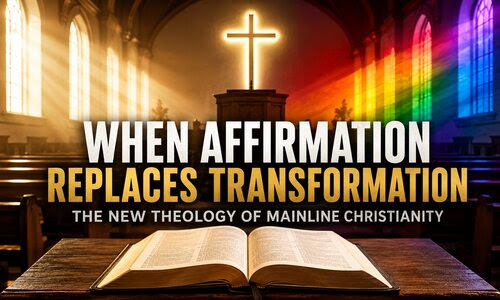
Something profound has happened inside portions of Christianity.
The church was once understood as a place where sinners came to encounter a Savior who loved them enough to change them. Increasingly, however, some mainline denominations appear to be embracing a very different message: come as you are–and expect the church to affirm you as you are.
That distinction may sound subtle. It is not.
It represents a fundamental change in what Christianity is supposed to accomplish.
One of the clearest examples can be seen in the direction of the Evangelical Lutheran Church in America and the people shaping its youth ministries.
The ELCA Youth Ministry Network is preparing for its January 2027 Extravaganza, a national gathering designed specifically for adults working with children, youth and families. The importance of such an event should not be underestimated. These are the people who return to local congregations to disciple teenagers, shape curriculum, lead retreats and influence the next generation of Lutherans.
And the conference lineup tells parents something important about the theological culture those leaders are being asked to absorb.
One general-session speaker, Rev. Emmy Kegler, is described by the conference itself as a “queer Christian” who lives with her wife and children. Featured musician Spencer LaJoye is advertised as making “queer indie folk music.” Rev. Jen Collins, who has spent years in children, youth and family ministry, will serve as the gathering’s General Session Theologian.
The significance of that position should not be missed: Collins is being entrusted with helping establish the theological framework through which youth workers understand ministry itself. When the people shaping that framework operate within a progressive approach that emphasizes personal identity, “belovedness,” advocacy and contemporary sexual ethics, parents have every reason to ask what biblical boundaries remain–and who ultimately gets to define them.
The issue is not whether Christians should love people who identify as LGBT. Of course they should. Christianity commands believers to love everyone.
The question is whether Christian love still includes the courage to say that every part of every person’s life–including sexuality, identity, desires and behavior–must be brought under the authority of Christ.
That is where the theological fault line now runs.
From Transformation To Affirmation
Historic Christianity makes a radical claim: every human being bears the image of God, every human being is loved by God, every human being is affected by sin, and every human being needs redemption.
No one arrives at the foot of the cross needing only affirmation.
We arrive needing transformation.
Jesus welcomed sinners, but He also called people to repentance. Paul described conversion as becoming a “new creation.” Romans 12 commands believers not to conform to the world but to be transformed by the renewing of their minds.
Christianity was never simply: “God loves you exactly as you are, therefore remain exactly as you are.”
Yet that is increasingly the practical message emerging from parts of progressive Christianity.
The order has been reversed.
Rather than allowing Scripture to judge our identities and desires, Scripture is increasingly being reinterpreted so that our identities and desires cannot be judged.
Instead of asking, “What does God require of me?” the question becomes, “How must the church change so that I never feel challenged by what God requires?”
That is not a minor adjustment in pastoral tone.
It is a different theology.
This Is Not One Conference
The upcoming Extravaganza is not an isolated event.
At the ELCA’s 2018 Youth Gathering, an 11-year-old transgender child addressed thousands of Lutheran youth. The ELCA’s own account celebrated the presentation and explicitly identified the child as transgender.
In 2024, the denomination’s own Youth Gathering blog reported that teenagers attending the event received “sparkle blessings” from local drag queens in a recreated Garden of Eden setting.
Those details matter because they demonstrate continuity.
What was once regarded as a controversial cultural movement outside the church has increasingly been welcomed, celebrated and incorporated into the church’s own youth culture.
And when that happens repeatedly, parents should stop treating each incident as a strange exception.
It is becoming part of the formation process.
Who Is Discipling The People Who Disciple Your Children?
Parents naturally focus on the local youth pastor.
But the larger question is: Who trained the youth pastor?
Who produced the curriculum?
Who selected the speakers at national gatherings?
Who determines what “inclusion,” “justice,” “belovedness” and “faithfulness” mean?
Who decides which identities should be affirmed and which biblical teachings should be reconsidered?
Youth ministry conferences matter precisely because they multiply influence.
A controversial presentation to 30,000 teenagers may last an evening.
Train hundreds or thousands of ministry leaders, however, and those ideas can influence churches for years.
They enter Bible studies.
They enter counseling conversations.
They enter confirmation classes.
They enter youth camps.
Eventually they become assumptions so deeply embedded that young Christians may never even realize they are being taught a modern reinterpretation of Christianity rather than the historic faith.
That is the real significance of what is happening.
The battle is not merely over whether a church will “welcome” LGBT people.
The battle is over who has authority to define sin, repentance, identity, marriage and holiness.
Parents Can No Longer Afford To Assume
This is bigger than the ELCA.
Every Christian parent should investigate what their denomination actually teaches.
Do not assume that because a church retains crosses, robes, hymns, communion and Christian vocabulary that it has retained historic Christian doctrine.
Ask what the denomination teaches about marriage.
Ask what it teaches about gender.
Ask what its seminaries teach.
Ask what children hear at national youth gatherings.
Ask who is training youth leaders.
Ask whether Scripture is treated as the authority over culture–or whether Scripture is continually being revised to accommodate culture.
Because once the second approach takes hold, there is almost no stopping point.
If personal identity determines how Scripture must be interpreted, why should sexual orientation be the final category?
Why should marriage remain limited to two people?
Why should any sexual boundary inherited from historic Christianity remain beyond reconsideration?
Once the principle changes from “our lives must conform to Scripture” to “Scripture must accommodate our lives,” every remaining boundary eventually becomes negotiable.
That is why this debate matters far beyond sexuality.
It concerns the very purpose of Christianity.
Is Christianity a message telling us that God will affirm whatever identity we construct for ourselves?
Or is it the far more demanding–and far more hopeful–message that Christ loves us enough to remake us?
There is an enormous difference between saying:
“You are welcome here.”
And saying:
“Nothing about you may ever be challenged here.”
The first is Christian hospitality.
The second can become theological surrender.
A church can still sing hymns, preach sermons, distribute communion and speak constantly about Jesus while gradually redefining what following Jesus actually means.
And that should concern every parent.
Because when affirmation replaces transformation, Christianity eventually loses the very thing that makes the Gospel good news.
Christ did not come merely to confirm us.
He came to redeem us.
And redemption means change.