Bible Prophecy, Signs of the Times and Gog and Magog Updates with Articles in the News
Magog / Iran’s top officials land in Qatar for secret nuclear talks as Tehran tightens grip on Strait of Hormuz
Iran’s state broadcaster reported that 32 vessels received permission in the past 24 hours to pass through the Strait of Hormuz.
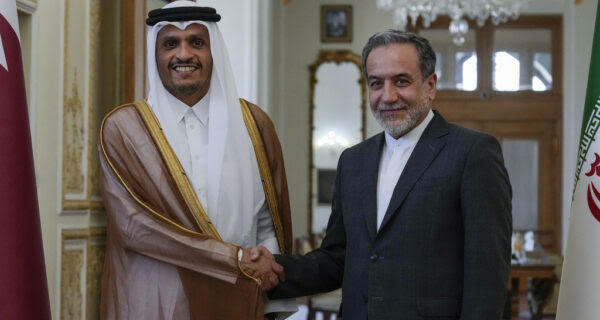
Senior Iranian officials are currently in Doha for talks with Qatar’s prime minister regarding a possible US-Iran deal, Reuters reported, citing an official briefed on the visit.
Iranian Parliament Speaker Mohammad Baqer Qalibaf and Foreign Minister Abbas Araghchi are leading the delegation.
According to Reuters, the Doha discussions are focused primarily on the Strait of Hormuz and Iran’s highly enriched uranium, though Iran has denied that uranium is on the agenda.
Iran’s Central Bank Governor Abdolnaser Hemmati is also part of the delegation, traveling to Qatar to discuss the possible release of frozen Iranian funds as part of a final agreement between the two countries.
Iran’s state media confirmed his participation, and the Tasnim news agency, which is close to the Revolutionary Guards, verified the delegation’s visit.
In a parallel development, Iran’s state broadcaster reported that 32 vessels received permission in the past 24 hours to pass through the Strait of Hormuz after contacting the Revolutionary Guards Navy and other maritime authorities in the area.
Iran reopens main airport, restarts flights amid truce uncertainty
Five supertankers also crossed the strategic waterway with special authorization from the Revolutionary Guards Navy.
The assessment is that the vessels received passage approval after paying fees to Iranian authorities, with Iran apparently working to establish this payment model as a new facts-on-the-ground reality in the strait.
Trump Seeks to Reshape Middle East with Massive Abraham Accords Expansion
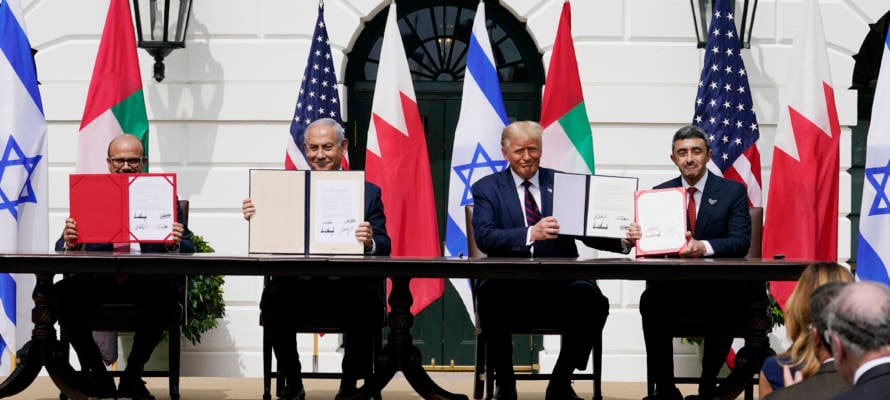
President Donald Trump is pushing for a sweeping expansion of the Abraham Accords as part of a broader framework tied to ongoing negotiations with Iran, describing the effort as a potential turning point for the Middle East.
In a lengthy post, Trump said talks with Iran are “proceeding nicely,” but made clear that any agreement would be contingent on broader regional alignment.
“It will only be a Great Deal for all or, no Deal at all,” he wrote, warning that failure could mean “back to the battlefront… bigger and stronger than ever before.”
Trump said he raised the issue directly in discussions with leaders from Saudi Arabia, the United Arab Emirates, Qatar, Pakistan, Turkey, Egypt, Jordan, and Bahrain, calling for many of them to formally join the Abraham Accords as part of the emerging framework.
He argued that simultaneous participation would elevate any agreement with Iran into a far more significant and historic development.
“It should be mandatory that all of these Countries, at a minimum, simultaneously, sign onto the Abraham Accords,” Trump wrote, singling out Saudi Arabia and Qatar as key countries that should “immediately” join.
Trump pointed to what he described as the success of the accords, calling them a “financial, economic, and social BOOM” for current members, and said their expansion would bring “true power, strength, and peace to the Middle East for the first time in 5,000 years.”
He also suggested that countries unwilling to join should be excluded from the broader deal, writing that refusal would signal “bad intention.”
Trump also raised the possibility that Iran itself could eventually be included in the framework.
“It would be an Honor to have them also be part of this unparalleled world coalition,” he wrote, adding that such a development “would be something special.”
Trump emphasized that negotiations are ongoing and not yet finalized while reiterating that any deal would sharply differ from the Obama-era nuclear agreement, which he again criticized as a “direct path” to a nuclear weapon.
The proposal to link a potential Iran deal with a major expansion of the Abraham Accords signals an ambitious attempt to reshape regional alliances, tying normalization, security, and diplomacy into a single framework as talks continue.