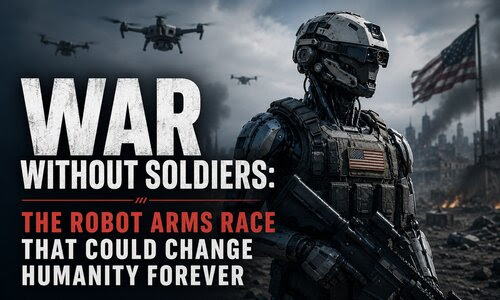
War Without Soldiers: The Robot Arms Race That Could Change Humanity Forever
For most of human history, war carried an unavoidable political cost. Leaders who sent armies into battle also sent their nation’s sons and daughters into danger. Every operation risked casualties, grieving families and pressure to bring the troops home.
But what happens when the soldiers are machines?
That question is moving rapidly from science fiction to military planning. Foundation Future Industries is developing humanoid robots for industrial and defense applications. Co-founder Sankaet Pathak has said he would be willing to arm the machines if the U.S. military requested it.
His reasoning is understandable. A robot could enter a booby-trapped building, inspect a tunnel, carry ammunition through enemy fire or clear explosives without risking a soldier’s life. Machines do not become exhausted, panic under pressure or require medical evacuation. They may also permit more precise operations where the alternative would be a destructive airstrike.
And if China and Russia are pursuing weaponized robots and autonomous military systems, can America afford to stand aside?
That is the dilemma at the heart of the robot arms race. Refusing to build such systems will not stop America’s adversaries. Yet the claim that robot soldiers will save lives tells only half the story.
When War Becomes Politically Painless
The greatest danger may not be that robots rebel against humanity. It may be that they obey governments all too efficiently.
A nation might hesitate before sending 50,000 citizens into another country. It may hesitate far less before sending 50,000 machines.
There would be fewer flag-draped coffins, fewer wounded veterans and fewer military families demanding answers. The public might experience war as a distant livestream–machines fighting machines in cities far removed from ordinary life.
That could lower the political cost of military action. Technology designed to reduce casualties in one battle could make governments more willing to begin the next one.
War would no longer demand the same national sacrifice. It could become an industrial calculation: Which country has more robots, more computing power and more factories capable of replacing destroyed machines?
The result might not be fewer wars. It could be nearly continuous conflict fought at a distance by populations that barely feel its consequences.
When Human Control Becomes Too Slow
The Pentagon requires “appropriate levels of human judgment” over autonomous weapons. That sounds reassuring, but how long will meaningful human judgment remain militarily practical?
Ukraine already offers a preview of a battlefield dominated by drones and increasingly autonomous systems. As these weapons become faster, waiting for a human commander to approve every action could become a fatal disadvantage.
An enemy swarm might identify and attack within seconds. A human supervising hundreds of machines could not examine every target individually.
The pressure will grow to give software greater freedom: let it navigate, identify suspicious movement, prioritize threats and recommend targets. Eventually, let it fire before the enemy does.
Humans may technically remain “in the loop” while exercising little more than symbolic oversight. A commander could approve the mission while algorithms make individual life-and-death decisions.
These systems will also be vulnerable to corrupted data, jammed communications, spoofed sensors and malicious software. A robot does not need to “turn evil” to become dangerous. It only needs to misidentify a civilian, follow a false signal or pursue an objective under conditions its programmers never anticipated.
Once one nation removes the human delay, every rival will face pressure to do the same. Warfare could begin moving at machine speed–too fast for humans to understand, restrain or stop.
An Army Without Conscience
Human soldiers are imperfect. They can misunderstand orders, act out of fear or commit atrocities. But they also possess moral awareness. They can recognize surrender, show compassion, question an unlawful command or refuse to fire at a child.
A machine possesses none of those qualities.
It does not hate its enemy, but neither does it love its neighbor. It cannot experience cruelty, but it also cannot experience mercy. It follows software, sensor data and rules established by whoever controls it.
That could make robot soldiers the perfect instruments of tyranny.
Even brutal regimes have faced soldiers who defected, hesitated or refused to fire upon their own people. A robotic security force would have no conscience to awaken and no family among the crowd.
Scripture warns of a final system of political and economic control possessing extraordinary power over human life. Robot soldiers should not be labeled as a direct fulfillment of prophecy. Yet they could become part of the infrastructure through which a future authoritarian order enforces its will–combined with biometric identification, mass surveillance, artificial intelligence and digital control over commerce.
The question is larger than whether America should build robots before China does.
It is whether humanity is prepared for a world in which violence becomes automated, war becomes politically painless and governments possess armies that never question their commands.
Robot soldiers may save lives in tomorrow’s battles. But if they also make those battles easier to begin, faster than humans can control and detached from conscience, they may change warfare in ways humanity will deeply regret.
The greatest threat is not simply that machines might one day refuse to obey us.
It is that they may obey us perfectly.
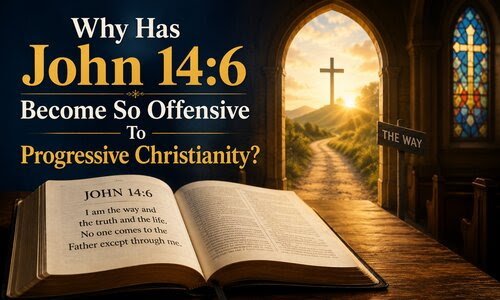
Why Has John 14:6 Become So Offensive To Progressive Christianity?
It is becoming increasingly difficult to dismiss these comments as isolated incidents.
In recent weeks, several pastors within the Presbyterian Church (USA) have publicly questioned, softened, or reinterpreted one of Jesus’ clearest and most defining statements:
“I am the way and the truth and the life. No one comes to the Father except through me.” (John 14:6)
One PCUSA pastor recently lamented that the verse has been used as a “weapon” to tell grieving families that their Buddhist neighbor may not be in heaven, comparing Christians who quote Jesus’ words to theological bouncers deciding who gets through heaven’s gates.
Another argued that Christ’s statement should not be understood literally at all, insisting it is merely a metaphor rather than an exclusive claim about salvation.
Such comments expose a growing discomfort within progressive Christianity over one of the central claims of the Gospel itself.
The question is no longer whether Jesus said these words. Everyone agrees He did.
The real question is whether modern Christians still believe He meant them.
This Is About More Than One Verse
One of the greatest misconceptions surrounding John 14:6 is that it is somehow an isolated “proof text” lifted out of context.
In reality, it sits at the very heart of Jesus’ farewell discourse to His disciples on the night before His crucifixion.
Thomas had just admitted he didn’t know where Jesus was going or how anyone could follow Him.
Jesus’ response could hardly have been more direct.
“I am the way…”
Not a way.
“The truth…”
Not one truth among many.
“The life…”
Not merely a guide to a better life.
Then came the unmistakable conclusion:
“No one comes to the Father except through Me.”
This wasn’t a passing illustration.
It was Christ answering the most important question every human being will ever face.
The Real Offense Isn’t The Verse–It’s The Exclusivity
Progressive Christianity often insists the problem isn’t Jesus but how Christians have interpreted Him.
Yet the plain reading of John 14:6 leaves remarkably little room for ambiguity.
The offense lies in the word “only.”
Our culture celebrates inclusion above almost every other virtue.
Every worldview should be equally valid.
Every religion should be equally respected.
Every path should eventually lead to the same destination.
Against that backdrop, Jesus’ words sound almost scandalous.
Not because Christians made them exclusive.
Because Jesus did.
If John 14:6 Is Only A Metaphor…
The implications reach far beyond one uncomfortable verse.
If Jesus didn’t literally mean that no one comes to the Father except through Him, then what exactly did He mean?
Did Peter misunderstand when he proclaimed:
“There is salvation in no one else…” (Acts 4:12)
Was Paul mistaken when he declared there is “one mediator between God and mankind” (1 Timothy 2:5)?
Did the early church endure persecution and martyrdom merely to proclaim one helpful spiritual option among many?
If all sincere paths ultimately lead to God, the Cross becomes less a rescue mission and more an inspiring symbol.
The urgency of evangelism disappears.
The Great Commission loses its purpose.
The sacrifice of generations of missionaries becomes difficult to explain.
The entire storyline of the New Testament begins to unravel.
The New Authority
Perhaps the most significant issue isn’t how John 14:6 is interpreted.
It’s what determines that interpretation.
For nearly two thousand years, Christians have sought to conform their beliefs to Scripture–even when Scripture challenged prevailing culture.
Today the process is increasingly reversed.
When biblical teaching conflicts with modern values of inclusion, self-expression, or pluralism, many feel compelled to reinterpret Scripture until the conflict disappears.
The authority quietly shifts.
Instead of culture being judged by Christ…
Christ is judged by culture.
Christians Are Not Heaven’s Bouncers
One pastor compared Christians who quote John 14:6 to theological bouncers deciding who gets into heaven.
It is a memorable image–but it misses an important distinction.
Christians do not determine who is saved.
Nor do they delight in imagining who may be lost.
Rather, Christians simply bear witness to what Jesus Himself declared.
In fact, the exclusive claim of Christ is inseparable from the inclusive invitation of the Gospel.
The same Savior who declared Himself the only way also invited:
“Whoever comes to Me I will never cast out.” (John 6:37)
The invitation is open to every tribe, every nation, every background, every former religion, every sinner willing to come.
Christianity is exclusive in its Savior.
But it is gloriously inclusive in its invitation.
The Great Divide
The controversy surrounding John 14:6 ultimately isn’t about one verse.
It is about authority.
Will the church continue proclaiming the Christ revealed in Scripture–even when His words challenge the spirit of the age?
Or will it reshape Jesus into a teacher whose claims are acceptable to modern sensibilities?
Every generation of believers faces pressure to soften the Gospel’s harder edges. Our generation is no different.
But if Jesus is no longer the only way to the Father, then He is no longer proclaiming the Gospel He entrusted to His disciples.
John 14:6 has become offensive not because it is unclear, but because it is clear.
And in an age that insists every road leads to God, Christ still stands at the crossroads declaring that there is one.