NEWS MANNA –
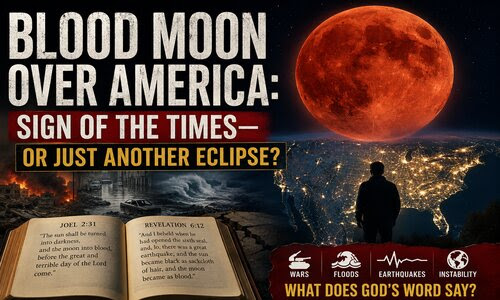
Blood Moon Over America (The Eagle Wings) : Sign Of The Times – Or Just Another Eclipse?
Wars are raging, nations are threatening nations, extreme weather and devastating floods are striking communities around the world, and earthquakes continue to shake populated regions. Political instability is spreading, geopolitical tensions are rising, and millions increasingly sense that the world has entered a period of unusual turbulence.
And now, on Thursday night, millions of Americans will look up and watch the moon turn red.
Beginning on the evening of August 27 and continuing into the early hours of August 28, Earth’s shadow will move across the moon in one of the deepest partial lunar eclipses most Americans will ever see. At precisely 12:12 a.m. Eastern Time, the eclipse will reach its maximum, with approximately 96 percent of the lunar surface covered and only a thin sliver remaining illuminated.
As the eclipse deepens, much of the moon could take on shades of copper, orange and blood red. Nearly one billion people across the United States, Canada and Latin America are positioned to see the entire eclipse, weather permitting, making this far more than an obscure astronomical event visible only from some distant corner of the world.
Under ordinary circumstances, it would simply be a spectacular night in the heavens. But these aren’t ordinary times, and whenever the moon turns blood red against the backdrop of war, natural disasters and geopolitical upheaval, Christians understandably begin thinking about Bible prophecy.
We’ve Heard This Language Before
Thousands of years before anyone used the modern phrase “blood moon,” the prophet Joel wrote, “The sun shall be turned into darkness, and the moon into blood, before the great and the terrible day of the Lord come” (Joel 2:31). The Apostle Peter repeated those words in Acts 2, connecting the imagery of the heavens with the prophetic Day of the Lord.
Then there is the unmistakable language of Revelation 6:12: “And I beheld when he had opened the sixth seal, and, lo, there was a great earthquake; and the sun became black as sackcloth of hair, and the moon became as blood.”
Jesus Himself warned that the period surrounding His return would be accompanied by extraordinary celestial events, declaring in Luke 21:25 that there would be “signs in the sun, and in the moon, and in the stars.”
So when millions of Americans walk outside Thursday night and see a reddish moon hanging over the nation, the question is inevitable: Are we witnessing a sign of the times–or just another eclipse?
The answer requires biblical discernment rather than either sensationalism or dismissal.
This Blood Moon Isn’t Revelation 6
There is nothing scientifically mysterious about why Thursday’s moon will appear red. During a lunar eclipse, Earth passes between the sun and moon, while Earth’s atmosphere filters the sunlight passing through it. Shorter blue wavelengths scatter more easily, while more red and orange light continues through the atmosphere and reaches the lunar surface–the same basic phenomenon responsible for brilliant red sunsets.
Astronomers can predict eclipses far into the future, which means this eclipse didn’t suddenly appear in response to today’s wars, earthquakes or political crises. Christians have repeatedly made the mistake of assigning specific prophetic significance to eclipses, comets, planetary alignments and other astronomical events, only to watch predicted dates come and go without the expected prophetic fulfillment.
Biblical watchfulness should never become prophetic sensationalism. Yet there is an opposite mistake that deserves just as much caution: becoming so determined not to sensationalize prophecy that we begin ignoring what prophecy actually says.
The Bible really does say that extraordinary signs are coming in the heavens.
Look At The World Around Us
Consider the setting in which this blood moon is appearing. The Russia-Ukraine war continues to produce massive drone and missile attacks, conflicts across the Middle East have repeatedly threatened wider escalation, and other parts of the world remain trapped in devastating wars and humanitarian crises.
At the same time, destructive floods, droughts, wildfires and extreme weather continue to affect populations across the globe. Earthquakes regularly remind us how quickly the ground beneath entire cities can become unstable, while political and economic uncertainty is adding another layer of anxiety for populations already wondering what comes next.
None of these individual developments proves that we have reached the final fulfillment of biblical prophecy. Wars, earthquakes, floods and eclipses have all occurred throughout human history, and Christians should resist the temptation to point to every headline and declare that a specific prophecy has been fulfilled.
But Jesus did tell His followers to pay attention to the larger pattern.
In Matthew 24, Christ spoke of wars and rumors of wars, nation rising against nation, famines, pestilences and earthquakes. He compared these developments to birth pains, an especially significant analogy because birth pains are not defined merely by their existence but by the way they eventually become increasingly difficult to ignore as the moment of delivery approaches.
That is why the most important question may not be, “Is Thursday’s blood moon prophetic?” The better question is whether we are paying attention to the larger picture developing around us.
The Blood Moon Isn’t The Prophecy–But It Reminds Us Of One
Revelation 6 describes something vastly more dramatic than Thursday night’s eclipse. There is a great earthquake, the sun becomes black, the moon becomes like blood, stars fall from heaven, and the heavens themselves appear to recede.
Whatever the precise physical mechanisms behind those future events, Scripture portrays something unmistakable and terrifying. Humanity will not need to debate on social media about whether something unusual has occurred; the scale of the events described will make that obvious.
Thursday night’s eclipse isn’t that event, but imagine standing outside shortly after midnight and watching almost the entire moon become darkened and reddish. For a brief moment, millions of people will see something that visually resembles imagery God placed in His Word thousands of years ago.
That should make us think–not speculate wildly, set dates or declare that the sixth seal has been opened, but seriously consider what Scripture says is ultimately coming.
Because one day the passages Christians have studied for generations will cease to be merely prophetic descriptions of the future.
Keep Looking Up
There is something strangely appropriate about millions of people stepping outside Thursday night and raising their eyes toward the heavens. Our attention is normally directed everywhere else–to our phones, politics, money, entertainment, work and the endless stream of crises filling our screens–but for one night, millions will simply look up.
Those words should mean something special to Christians.
After describing the extraordinary events that would eventually unfold upon the earth, Jesus told His followers in Luke 21:28, “And when these things begin to come to pass, then look up, and lift up your heads; for your redemption draweth nigh.”
Thursday night’s blood moon may simply be an eclipse, and we don’t need to turn every unusual event in the heavens into a prophetic declaration. But neither should ordinary explanations for individual events blind us to the extraordinary picture Scripture tells us will eventually emerge when the appointed time arrives.
So Thursday night, take a moment to look up. Admire God’s creation, remember what Scripture says is ultimately coming, and remain watchful in a world where the headlines increasingly remind us how quickly circumstances can change.
The blood moon over America may not itself be the sign. But against the backdrop of the times in which we are living, it provides a powerful reminder of why Jesus told His followers to watch for the signs of the times.
The Coming Education Crisis: Welcome To The Age Of Artificial Education
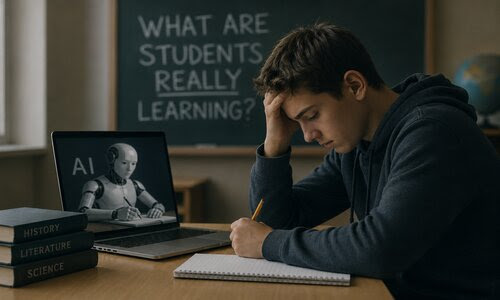
School has just started–or is about to start–in many parts of America, and over the next several months we may discover just how deeply artificial intelligence has changed the next generation of students. By virtually every early warning sign, the news is not encouraging.
For the past few years, educators have worried primarily about students using ChatGPT and other AI systems to cheat. Would teenagers have AI write their essays? Would college students use it to complete homework? Could professors determine whether an assignment was actually written by the person whose name appeared at the top?
Those problems haven’t disappeared, but an even more troubling question is emerging: If artificial intelligence increasingly does the work required to earn an education, what exactly does an education certify anymore?
For generations, a diploma theoretically demonstrated that a student had learned how to read difficult material, research a subject, organize information, solve problems, construct an argument and communicate ideas. Artificial intelligence potentially disrupts that entire arrangement.
A student can now ask AI to summarize the book he didn’t read, explain the historical event he didn’t study, solve the problem he didn’t understand, construct the argument he didn’t develop and write the paper he never really thought about. The final product might look excellent, but who was actually educated?
The Struggle Was The Education
This is where the AI revolution is forcing educators to confront an uncomfortable reality: the difficult part of education was never an inconvenience technology needed to eliminate. The difficult part was the education.
Students struggle to find the right words because doing so teaches them how to communicate. They wrestle with conflicting evidence because that teaches them how to evaluate information. They rewrite paragraphs because rewriting forces them to clarify what they actually believe.
Cognitive psychologist Ronald Kellogg has described writing as a technology for thinking. Writing isn’t simply transferring fully formed thoughts onto paper. Very often, we discover what we think while attempting to explain it. Remove that struggle and you may remove part of the thinking.
Research from MIT has provided an unsettling glimpse of what that could mean. Researchers studying essay writers found that participants using large language models demonstrated substantially weaker brain connectivity than those writing without technological assistance. AI users also had greater difficulty accurately recalling or quoting what they had supposedly written.
The researchers cautioned against drawing sweeping conclusions from one study, but the findings raise an obvious question parents and educators cannot afford to ignore: What happens when millions of children routinely outsource the mental exercises their developing minds are supposed to be practicing?
Imagine sending a teenager to the gym every afternoon but allowing a robot to lift the weights for him. The weights still went up, but nobody would expect the teenager to become stronger. Something remarkably similar may be happening academically.
Schools Are Already Retreating
Schools and universities increasingly recognize that something has changed. Some educators are returning to handwritten assignments, oral examinations, restricted devices and supervised testing because instructors need some reliable way of determining what students themselves actually know.
Princeton University provides a striking example. For more than a century, its famous Honor Code allowed students to take examinations without faculty proctors. In 2026, faculty voted to begin proctoring in-class examinations amid concerns about modern forms of cheating, including generative AI and electronic devices.
Individual courses are going further. Some professors prohibit AI precisely because they want students to develop the ability to reason through problems themselves. That gets to the heart of the issue: an AI system can produce an impressive answer that a student may be completely incapable of explaining.
And that creates a much bigger problem than cheating.
What Does The Diploma Mean?
Suppose a student completes high school and college while routinely using AI to research, outline, compose, edit and solve assignments. That student may graduate with impressive grades, but what abilities actually belong to the graduate and what abilities belonged to the machine?
Employers may eventually begin asking the same question.
A college degree traditionally functions partly as a signal that someone has demonstrated a certain level of competence. But that signal becomes weaker if employers cannot determine how much of the graduate’s academic performance was AI-assisted.
Ironically, the AI revolution could therefore produce a return to decidedly old-fashioned methods of proving competence. Employers may increasingly rely upon supervised testing, live problem-solving, in-person writing, technical demonstrations and extensive interviews.
Instead of trusting a diploma or résumé, employers may essentially say: Don’t tell me what your credentials say you can do. Show me what you can actually do while I’m watching.
Education could then face an extraordinary credibility crisis. Americans have spent decades debating whether college degrees justify their soaring price. Artificial intelligence introduces another question entirely: What exactly are universities certifying?
The Consequences Go Far Beyond School
Today’s students will eventually become tomorrow’s doctors, engineers, teachers, journalists, lawyers, pastors, military officers, business executives and government leaders. Those professions require far more than access to information. They require judgment.
A doctor must evaluate competing possibilities. A lawyer must recognize weaknesses in an argument. An engineer needs to understand why something works rather than merely obtain an answer. A pastor must wrestle carefully with Scripture rather than simply request an instant interpretation from an algorithm.
The danger isn’t that artificial intelligence knows too much. It is that human beings may gradually decide they don’t need to know very much because a machine will always be available to provide the answer.
We could conceivably create the most information-rich and technologically empowered generation in history while simultaneously producing one of the most intellectually dependent.
Christians Should Pay Attention
None of this means Christians should reject artificial intelligence. AI can assist research, explain difficult concepts, improve communication and provide capabilities that would have seemed impossible only a few years ago. The question is whether AI remains a tool that assists human thought or becomes a substitute for it.
Scripture repeatedly calls believers to wisdom, understanding and discernment. Christians are instructed to test what they hear and distinguish truth from error. Those abilities cannot simply be outsourced to an algorithm.
Parents therefore need to ask more than whether their child’s school permits ChatGPT. Can their children still read something difficult and explain it? Can they defend an opinion, identify a weak argument, write coherently without assistance and solve a problem when AI isn’t available?
Perhaps most importantly, can they determine what they actually believe before asking an algorithm what they should believe?
As students return to classrooms this fall, America is conducting an educational experiment on an enormous scale. Artificial intelligence can provide our children with more information and more answers than any previous generation possessed, but education was never simply about obtaining answers. It was about developing human beings capable of finding, understanding and evaluating them.
If we lose that distinction, we may eventually produce beautifully written assignments, impressive transcripts and expensive degrees while quietly discovering that something essential disappeared along the way.
We will have perfected artificial education–and forgotten to educate the human mind.