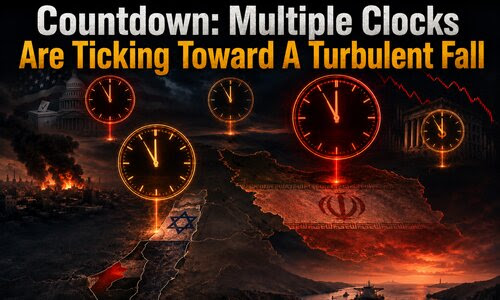
Countdown: Multiple Clocks Are Ticking Toward A Turbulent Fall
The world is watching several countdown clocks right now-and some of them may reach zero at almost exactly the same time.
From Iran to Gaza, from oil markets to U.S. elections, the final months of 2026 are shaping up to be unusually volatile. None of these pressure points guarantees a wider war or economic crisis. But taken together, they create a dangerous convergence that could make this fall one of the most consequential periods in years.
The first clock is ticking in Iran.
Iranian officials have warned that if their demands are not met within the coming weeks, Tehran could shift from its current posture toward something far more aggressive against the United States and Israel.
That threat matters because the confrontation is no longer confined to nuclear negotiations. It now touches the Strait of Hormuz, oil exports, sanctions, American naval forces, regional proxy groups and the possibility of renewed Israeli military action.
If diplomacy collapses, the next step may not be another round of negotiations.
It could be escalation.
And that brings us to the second clock.
Hamas is also facing a deadline.
Jared Kushner’s recent meeting with Hamas has reportedly centered on a limited window for the terrorist organization to disarm. The message appears increasingly clear: Hamas has a chance to give up its weapons voluntarily, but if it refuses, Israel may eventually receive broader American backing to resume large-scale military operations.
A 60-to-90-day timetable takes that deadline directly into the heart of the fall.
That means two of the most explosive conflicts in the Middle East could be approaching decisive moments at roughly the same time.
Iran has a clock.
Hamas has a clock.
Israel is watching both.
And Washington is involved in each.
That alone would be enough to make the coming months dangerous. But there are other clocks running too.
The third is economic.
Americans who do not closely follow financial markets may wonder why events thousands of miles away should matter to them.
The answer is oil.
Any serious disruption involving Iran or the Strait of Hormuz could quickly push energy prices higher. Higher oil prices do not simply mean more expensive gasoline. Transportation costs rise. Shipping costs rise. Airlines pay more for fuel. Businesses pass those costs along to consumers.
Food, travel, manufactured goods and everyday household expenses can all become more expensive.
At the same time, inflation pressures can keep interest rates higher for longer, making mortgages, car loans and credit cards more painful.
In other words, a military crisis in the Middle East can eventually arrive at your kitchen table.
That economic pressure creates yet another countdown: America’s midterm elections.
November is approaching fast, and the political stakes are enormous.
The White House could soon face several competing pressures at once: voters angry about inflation and high borrowing costs, Americans concerned about another prolonged conflict, pro-Israel voters demanding decisive action against Hamas, and growing pressure to confront Iran if Tehran becomes more aggressive.
That raises a critical question.
Will Washington become more cautious as Election Day approaches–or more willing to demonstrate strength?
Either path carries risks.
And then there is the clock nobody can see.
The history of the Middle East is filled with wars that did not begin according to anyone’s timetable.
A missile kills American troops.
A tanker is attacked.
A senior leader is assassinated.
A terror attack changes Israeli calculations overnight.
A strike on Gulf oil infrastructure sends markets into panic.
A military commander misreads the intentions of another country.
One unexpected event can erase months of diplomacy in a matter of hours.
That may be the greatest danger of all.
We are entering a period in which multiple parties are issuing threats, establishing deadlines and preparing for what happens if diplomacy fails.
And when several clocks are ticking at once, the risk is not simply that one reaches zero.
It is that one explosion sets all the others in motion.
For Christians watching these developments, the words of Jesus in Matthew 24 are difficult to ignore: “You will hear of wars and rumors of wars.”
We are watching international diplomacy increasingly conducted through threats, ultimatums and countdowns toward military action.
Iran warns that patience is running out.
Hamas is being told its time to disarm is limited.
Israel is preparing for the possibility that diplomacy fails.
Washington is balancing war, economics and elections.
Markets are watching oil.
And everyone is watching everyone else.
No one can say with certainty what the fall will bring.
Perhaps diplomacy will hold.
Perhaps Hamas will disarm.
Perhaps Iran will step back from confrontation.
But the number of pressure points now converging should give us pause.
The clocks are ticking.
And the closer they move toward zero, the smaller the margin becomes for mistakes.
Israel Won’t Let Turkey Become The New Iran In Syria
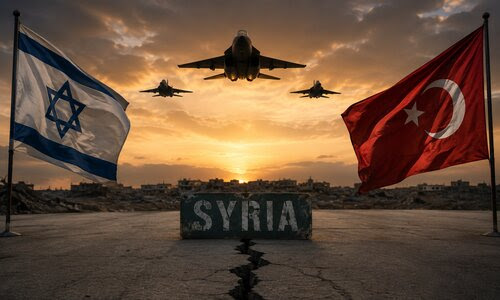
For years, Israel’s greatest concern in Syria was Iran.
Iranian forces, weapons depots, missile infrastructure and supply routes to Hezbollah gradually transformed Syria into a potential forward operating base against the Jewish state. Israel responded with hundreds of airstrikes designed to prevent that military infrastructure from becoming permanently entrenched.
But Syria has changed.
Iran’s influence has been dramatically weakened following the fall of Bashar al-Assad. Yet the power vacuum has not remained empty.
Turkey is moving in.
That is what makes Israel’s latest strike on Syria far more significant than another bombing raid.
Early Tuesday, Israeli aircraft struck the Abu al-Duhur military airbase in northwestern Syria, hitting the runway and storage facilities eight times, according to Syrian state media. No casualties were reported. Israel later acknowledged that the purpose of the attack was to prevent Turkish forces from deploying at the base.
The message to Ankara was difficult to miss:
Israel will not allow Syria to become a Turkish military platform on its northern frontier.
From Iran To Turkey
Turkey has become one of the principal foreign supporters of Syria’s government under President Ahmed al-Sharaa.
Ankara has been training Syrian forces, helping rebuild government institutions and infrastructure, and providing military and diplomatic support. Turkish officials have also been involved in efforts to rehabilitate Syria’s military capabilities.
That includes the Abu al-Duhur airbase.
The facility, roughly 70 kilometers from the Turkish border, has largely been out of service as a dedicated military airfield since 2013. But reports indicate Turkey had begun helping rehabilitate the facility as Ankara expands its influence inside Syria.
Israel apparently decided not to wait and see what came next.
According to the Israeli prime minister’s office, Syria was on the verge of violating what Israel described as an understanding to maintain the existing security situation by permitting Turkish troops to deploy at the airfield.
Israel did not bomb a fully operational Turkish military installation.
It bombed the infrastructure before Turkey could establish one.
Israel’s New Red Line
That reflects an increasingly important principle in Israeli security thinking: dangerous military capabilities are far easier to stop before they become operational.
October 7 demonstrated the potential price of allowing hostile forces to build military infrastructure while relying upon deterrence to contain their intentions.
Israel appears increasingly unwilling to make that gamble.
A runway can be repaired.
An airbase can be rebuilt.
But once Turkish aircraft, troops, radar systems or sophisticated air-defense systems are stationed there, striking the facility becomes dramatically more dangerous.
Turkey is not Iran.
It possesses NATO’s second-largest military and remains a member of the Western alliance. A direct Israeli attack on Turkish forces could therefore produce consequences far beyond Syria.
That is precisely why Israel may believe it must establish the boundaries now.
The deeper concern is not simply Turkish soldiers.
It is control of Syrian airspace.
Turkey has reportedly been involved in efforts to rebuild Syrian air defenses, including radar infrastructure. Israeli officials fear that an expanded Turkish air-defense presence could eventually restrict Israel’s ability to operate freely over Syria.
For Israel, freedom of action over Syria has been central to preventing weapons transfers, missile deployments and hostile military entrenchment.
Any foreign power capable of closing that airspace would fundamentally alter Israel’s security environment.
How Close Could This Have Come To Something Bigger?
Perhaps the most troubling detail emerged after the strike.
U.S. envoy Tom Barrack revealed that Turkey had not been warned that Israeli aircraft were approaching the area. Turkish forces observed the aircraft traveling north toward Turkish territory and could reasonably have prepared a military response.
Barrack said cooler heads prevented the situation from deteriorating further.
Washington is now working to establish a stronger deconfliction mechanism between Israel, Turkey and Syria precisely to prevent a future incident from becoming an accidental military confrontation.
That tells us how serious the emerging situation has become.
Israel and Turkey are not at war.
Neither government appears eager to begin one.
But their strategic interests inside Syria are moving increasingly close to one another.
Turkey wants influence over the emerging Syrian state and appears determined to help rebuild its military capabilities.
Israel wants a weakly militarized Syria that cannot threaten its northern border or restrict Israeli operations.
Those objectives may eventually prove impossible to reconcile.
Erdogan’s Expanding Reach
For years, President Recep Tayyip Erdogan has pursued a much more assertive Turkish role across the former Ottoman sphere.
Syria now offers Ankara an extraordinary opportunity.
Iran has retreated. Russia’s influence has diminished. Assad is gone. A government friendly to Turkey controls Damascus.
From Ankara’s perspective, this is a historic opening to establish Turkey as the dominant outside power shaping Syria’s future.
From Jerusalem’s perspective, that creates an entirely different question:
Did Israel spend years preventing Iran from turning Syria into a military front only to watch another increasingly hostile regional power occupy the vacuum?
That question will shape Israeli strategy for years to come.
A Region Taking A Familiar Shape
For Christians who watch Biblical prophecy, Turkey’s expanding regional role will inevitably attract attention.
Many interpreters of Ezekiel 38 associate several of the ancient regions named in the prophetic coalition against Israel with territory found within and surrounding modern Turkey.
Prophecy watchers should pay attention to such movements.
Turkey is extending its military influence southward.
Iran remains deeply hostile toward Israel.
Syria is being reconstructed after regime collapse.
And Israel finds itself increasingly surrounded by powerful regional actors whose relationships with the Jewish state are deteriorating.
The strategic map of the Middle East continues to rearrange itself in ways that would have seemed extraordinary only a few years ago.
Israel spent the previous decade making one principle unmistakably clear to Iran:
Syria will not become your military base against us.
This week, Turkey may have discovered that the same red line applies to Ankara.