
Barna: Christians Are Using AI More Than Most Americans
In what some might find surprising, Christians are tapping into artificial intelligence (AI) more than other Americans, with many even trusting it to foster “spiritual growth” within their lives, according to new data from Barna Research.
The Big Picture
Barna’s latest research on faith and AI found that “practicing Christians are outpacing nearly every population segment on AI adoption, including pastors.” Yet even within Christian circles, a clear contrast exists between how the average Christian uses AI compared to pastors.
“Pastors understand that AI is out there,” said Daniel Copeland, Barna’s vice president of research, “but they’re not immersed in it the way their engaged congregants may be. The danger for pastors is underestimating just how normal AI is for the people around them. For most practicing Christians, AI isn’t for occasional use. It’s already woven into how they work, learn and make decisions.
Zoom out and “ask people yes-or-no whether they use AI, and the average pastor and the average American look about the same,” Copeland added. “It’s frequency of use [is] where the difference actually shows up.”
The data shows that 44% of practicing Christians say they use AI “very often” or “often” in their personal lives. Among U.S. adults as a whole, that figure drops to 31%, with only 29% of non-practicing Christians reporting the same. And it’s not just for personal use—26% of U.S. adults across the nation and 39% of practicing Christians use AI often or very often at work.
How Christians Are Using AI
While many practicing Christians say they trust AI to support spiritual growth, most turn to it for far more ordinary purposes. As the researchers put it, “everyday tasks: look something up, learn how to complete a task, get advice on a decision, catch up on the news, sharpen a piece of writing.” Questions related to faith, “like interpreting Scripture or seeking spiritual guidance, show up much further down the list.”
Still, nearly half of the practicing Christian participants said they would trust AI to help with spiritual growth. Approximately one-third report having “turned to AI for spiritual guidance or Bible-related questions in the past month.” Even among those who have sought their pastors’ help in navigating AI, only 12% of pastors believe they are equipped to offer such guidance.
Barna’s own report asked pressing questions: “Where does that leave church leaders, when one-third of practicing Christians want their pastor’s perspective on AI yet most pastors don’t yet feel prepared to give it? Do pastors need to become technology experts to keep up with their congregants?”
The Barna Group determined that “pastors don’t need to become AI experts” in order to tend to their flock. “The questions people already bring to AI, about Scripture, relationships, their own struggles, often surface before they ever reach a pastor. Christian leaders who pay attention gain a clearer view of where people are stuck, and one more reason to keep showing up in person for exactly those moments.”
And as Copeland put it, “the better move is for pastors to double down on what they already do well: teaching people how to engage Scripture, building real relationships, making space for analog discipleship. That’s what people can lean on when AI gives them an answer that’s incomplete, misleading or just wrong.”
A Soft Warning
Robert Maginnis, retired U.S. Army lieutenant colonel, author of 15 books and senior fellow for National Security at the Family Research Council, has written extensively on the topic of AI as it pertains to Christians. Referring to Barna’s latest data, Maginnis told Decision that “the numbers describe a church that has outrun its shepherds.”
He explained how the research reveals an “inversion” of how many practicing Christians are reportedly using AI for personal use versus the number of pastors—which is a much smaller percentage. “That inversion,” Maginnis argued, “is a discipleship problem before it is a technology problem. Christians are not primarily consulting AI about Scripture or theology. The danger is quieter: AI is becoming the first place they turn to gather information, learn a skill, make a decision, or sharpen an argument. Those daily habits shape the mind long before anyone labels the question ‘spiritual.’”
But there remain a large number of Christians who do trust AI with their spiritual development. And yet, Maginnis warned, “AI is ultimately someone else’s understanding … packaged as an immediate and authoritative answer. Scripture warns, ‘Trust in the LORD with all thine heart; and lean not unto thine own understanding’ (Proverbs 3:5).”
In an ever-technologically advanced world, Maginnis is less concerned about Christians and pastors utilizing tools such as AI and more concerned about allowing those tools to be used without discernment. As he argues in his book AI for Mankind’s Future, “the church does not need to master every new technology before its members do. It must form Christians who can test what technology tells them. A congregation fluent in AI but untrained in Biblical discernment is not prepared for the world now taking shape.”
An Ongoing Trend, Not a New One
In related research released in May, Barna found that among practicing Christians, AI was increasingly becoming a “spiritual authority.” At the same time, the research noted that “the Christians most open to AI are often the same ones most unsettled by it.”
That data showed roughly 61% of respondents would “completely or somewhat” trust AI with achieving financial stability, while 56% said the same for mental and physical well-being. Additionally, 56% said “they would trust AI with feeling happy and content with life,” 54% with “understanding and expressing one’s true self” and “having a sense of meaning or purpose,” and 53% with “building meaningful relationships with others.”
Many of those same respondents viewed AI advice as just as credible as guidance from a pastor. Copeland described the findings as “confounding” data. “Christians say they trust AI with spiritual growth, and a meaningful share say its spiritual guidance is as trustworthy as a pastor’s—yet large majorities are simultaneously concerned about AI misinterpreting Scripture, replacing God, or undermining the role of spiritual leaders,” he said.
“The use case and the underlying fear are both present, and they’re pointing in different directions.”
Barna researchers had concluded in May that Christians’ rapid embrace of AI has outpaced any settled conviction about its proper place in the life of faith. Many are “extending trust and registering fear in the same breath.” Fast forward to July, and that tension is not something the latest data resolves. Rather, it confirms how widespread it has become.
Canada Is Building A Surveillance State In The Name Of Human Rights
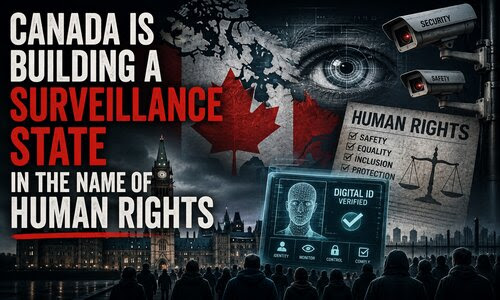
If someone proposed a law giving government broad authority to monitor online speech, verify citizens’ identities before accessing digital platforms, compel technology companies to remove “harmful” content, and punish citizens for expressing ideas deemed unacceptable by government-appointed regulators, most Canadians would likely reject it outright.
But history suggests that free societies rarely surrender their liberties overnight. Instead, governments tend to expand their authority gradually. One law protects children. Another combats hate. Another fights misinformation. Another strengthens national security. Each proposal appears reasonable when viewed on its own. Collectively, however, they can begin to reshape the relationship between citizens and the state.
That is why Canada’s growing legislative push into digital regulation deserves careful attention. Civil liberties advocates, privacy experts, and free speech organizations have increasingly warned that the country is constructing something larger than a collection of unrelated laws. They argue Canada is gradually building the legal and technological infrastructure needed to monitor digital activity, regulate online expression, and expand government oversight of public discourse.
For generations, human rights were understood primarily as protections that limited government power. Freedom of speech, freedom of religion, freedom of conscience, due process, and privacy existed to safeguard individuals from state interference. Governments were expected to defend those liberties–not determine when they could be suspended.
Increasingly, however, that understanding appears to be changing. Rights are no longer viewed solely as freedoms government must protect, but as claims government must actively enforce–even if doing so requires limiting someone else’s liberty. Protecting one person’s dignity may involve restricting another person’s speech. Preventing harm may require expanded surveillance. Promoting inclusion may justify compelling certain forms of expression while discouraging others.
Whether viewed as progress or cause for concern, this represents a profound shift in the philosophy of individual rights.
That shift is increasingly reflected in public policy.
Recent legislative proposals and enacted laws in Canada have expanded government involvement in regulating online platforms, retaining digital communications data, creating new digital safety regulators, strengthening oversight of online content, and exploring age-verification systems that could require users to verify their identities before accessing portions of the internet. Supporters argue these measures are necessary to protect children, combat online exploitation, reduce extremist content, and make digital spaces safer.
Those are legitimate public policy goals. Yet critics argue that, taken together, these initiatives are also constructing something else: the infrastructure through which governments can exercise unprecedented influence over digital life.
History offers an important lesson. Effective censorship rarely begins with banning speech. It begins with identifying who is speaking.
Age verification increasingly requires identity verification. Identity verification increasingly relies upon biometric information, facial recognition, government-issued credentials, or centralized digital authentication. Anonymous participation becomes more difficult. Metadata retention enables authorities to reconstruct digital activity long after conversations have ended. Regulatory bodies gain expanding authority to determine what content should remain online and what should be removed.
Individually, each measure may appear modest. Collectively, they establish capabilities that previous generations of governments simply did not possess.
Technology has fundamentally transformed the nature of governmental power.
A century ago, censorship often meant banning newspapers or confiscating printed materials. Today it can involve algorithmic suppression, account suspensions, search-result manipulation, payment processor restrictions, internet blocking, or artificial intelligence capable of monitoring billions of online interactions in real time. Modern censorship is often subtle enough that many citizens never realize it has occurred.
Perhaps the most significant transformation, however, is cultural rather than technological.
Every generation elevates certain values above others. Previous generations placed extraordinary emphasis on liberty, personal responsibility, and robust public debate–even when that meant tolerating speech many considered offensive or wrong. Increasingly, modern governments place greater emphasis on safety, inclusion, psychological well-being, and protection from harm.
These are worthwhile objectives. Every civilized society should seek to protect children, reduce violence, and defend vulnerable people. The more difficult question is whether every worthy objective justifies expanding state authority.
How much freedom are citizens willing to surrender if every new restriction is presented as making society safer?
Recent legal battles over compelled speech, parental rights, religious liberty, and gender identity demonstrate why many civil liberties advocates believe this question deserves greater attention. High-profile disputes involving psychologist Jordan Peterson, former British Columbia school trustee Barry Neufeld, and the series of human rights complaints brought by Jessica Yaniv have highlighted growing tensions between freedom of conscience and expanding interpretations of anti-discrimination law.
Regardless of where one stands on those individual controversies, they illustrate a broader trend. Questions once settled through public debate are increasingly being decided through administrative tribunals, regulatory agencies, and human rights commissions rather than through the free exchange of ideas. Increasingly, these bodies are asked not simply to determine whether laws have been broken, but to decide which beliefs and expressions are acceptable within public life.
That institutional shift may ultimately prove more significant than the outcome of any single case.
Nor is this conversation unique to Canada.
Across the United Kingdom, Australia, much of Europe, and increasingly within parts of the United States, lawmakers are advancing remarkably similar proposals. Governments speak of combating hate speech, preventing misinformation, protecting children online, regulating artificial intelligence, and strengthening digital safety. The language varies, but the underlying direction often looks familiar: greater oversight of digital communication combined with expanded governmental authority over the flow of information.
Canada may simply be further along that path than many of its democratic peers.
None of this means Canada has become an authoritarian nation. Nor does it suggest every piece of legislation is inherently misguided or every concern raised by government is illegitimate. Democratic societies have both the right and responsibility to address genuine threats facing their citizens.
But history also teaches that governments rarely accumulate extraordinary powers all at once. They do so gradually, often with broad public support and the promise of solving real problems. Each new authority appears limited. Each new regulation seems reasonable. Only in hindsight does the larger pattern become visible.
Canadians–and indeed citizens throughout the Western world–should therefore wrestle with several uncomfortable questions. At what point does protecting citizens begin to require monitoring them? When does combating harmful speech become controlling legitimate dissent? And who ultimately decides where those lines should be drawn?
These are not merely Canadian questions. They are questions every modern democracy will increasingly face as technology gives governments powers previous generations could scarcely imagine.
The debate unfolding in Canada is ultimately about far more than one country’s legislation. It is about whether institutions created to preserve liberty can gradually evolve into mechanisms that monitor, regulate, and restrict it–always in the name of safety, always in the name of human rights, and always one reasonable step at a time.