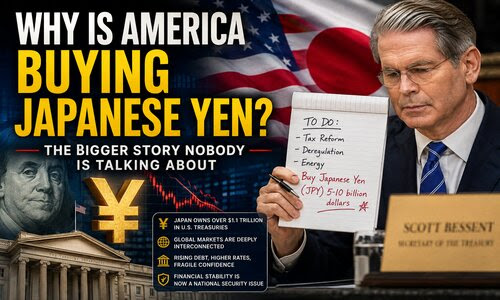
Why Is America Buying Japanese Yen? The Bigger Story Nobody Is Talking About
A single photograph from President Donald Trump’s recent Cabinet meeting may have revealed more about the state of the global financial system than months of carefully worded statements from central bankers.
Captured by Reuters, the image showed Treasury Secretary Scott Bessent’s handwritten to-do list. Among the notes was one line that immediately caught the attention of economists: “Buy Japanese Yen (JPY) 5-10 billion dollars.” Reuters later confirmed the authenticity of the image, bringing an otherwise private discussion into public view.
On its face, it seems like an obscure financial detail. Why should the average American care whether the U.S. Treasury is considering buying Japanese currency?
Because that simple note points to a much larger story–one that exposes how interconnected, fragile, and dependent today’s global financial system has become.
A Currency Purchase Is Never Just A Currency Purchase
Governments do not normally intervene in foreign exchange markets without good reason. While central banks routinely monitor currencies, coordinated intervention is relatively rare and is usually reserved for periods of unusual market stress or when officials believe excessive volatility threatens broader financial stability.
The United States has intervened alongside allies before, but seeing the Treasury Secretary contemplating billions of dollars in yen purchases is a reminder that financial markets are no longer operating in isolated national silos.
When policymakers begin discussing direct currency intervention, it usually means they are concerned about consequences that extend well beyond exchange rates.
Why The Japanese Yen Matters To Americans
At first glance, Japan’s currency seems like someone else’s problem.
It isn’t.
Japan remains one of America’s closest allies and one of the largest foreign holders of U.S. Treasury securities, owning well over $1 trillion in American government debt. That means the financial health of Japan is deeply connected to the financial health of the United States.
If Japan experiences severe financial instability, the ripple effects would not stay in Tokyo.
They could influence:
– U.S. mortgage rates
– Retirement accounts
– Stock markets
– Federal borrowing costs
– Consumer confidence
Most Americans never think about the Japanese yen. Yet events unfolding halfway around the world can eventually affect what they pay for a home loan or how much their retirement portfolio is worth.
The Hidden Danger Of Global Debt
The bigger issue is not the yen itself.
It is debt.
For decades, governments around the world have accumulated extraordinary amounts of sovereign debt while benefiting from historically low interest rates.
That environment is changing.
As rates rise globally, governments face rapidly increasing borrowing costs.
The United States now spends enormous sums simply servicing its national debt.
Japan faces its own challenges with one of the highest government debt-to-GDP ratios in the developed world.
Europe continues to wrestle with sluggish growth while attempting to manage inflation and energy costs.
Each country has different circumstances, yet all share one common problem:
The modern financial system has become increasingly dependent on confidence.
Confidence that governments can continue borrowing.
Confidence that currencies will remain stable.
Confidence that investors will continue buying sovereign debt.
When officials begin discussing interventions to stabilize major currencies, it suggests preserving that confidence has become an increasingly important policy objective.
Financial Wars Are Replacing Traditional Ones
Much attention today focuses on military conflicts in the Middle East, Ukraine, or the Pacific.
Yet another battle is quietly taking place.
Instead of tanks and aircraft, governments increasingly wield:
– tariffs
– sanctions
– reserve currencies
– export controls
– interest rates
– currency intervention
Economic leverage has become a strategic weapon.
The freezing of Russian reserves following the invasion of Ukraine demonstrated that financial systems themselves can become geopolitical battlegrounds.
Trade disputes between the United States and China have likewise shown that economic competition increasingly resembles strategic conflict.
Currency intervention belongs within that larger picture.
America Cannot Ignore Its Creditors Forever
One uncomfortable reality has become harder to dismiss.
The United States depends heavily on investors–both domestic and foreign–to finance its growing debt.
Japan has long been among America’s largest creditors.
That does not mean Japan controls American policy or that some dramatic liquidation of Treasury holdings is imminent. Financial relationships are far more complex than that.
But it does illustrate an important truth.
As America’s debt grows larger, maintaining confidence among those willing to finance that debt becomes increasingly significant.
The larger the debt burden becomes, the more sensitive markets become to shifts in confidence, interest rates, or investor behavior.
That is not a prediction of collapse.
It is simply how debt markets work.
Extraordinary Measures Becoming Ordinary
Perhaps the most striking aspect of the Reuters photograph is not the potential intervention itself.
It is how increasingly extraordinary actions have become almost routine.
Only a generation ago, many of today’s financial tools would have seemed remarkable.
Massive quantitative easing.
Emergency lending facilities.
Coordinated global central-bank actions.
Trillions of dollars in pandemic stimulus.
Repeated market interventions.
Now the possibility of purchasing billions of dollars of foreign currency barely generates headlines.
Each intervention may be justified on its own merits.
But together they reveal a financial system requiring ever-greater management simply to maintain stability.
That should cause thoughtful observers to ask an important question:
Are we solving problems–or merely postponing them?
Confidence Is The World’s Most Valuable Currency
Gold has value.
Oil has value.
Factories produce value.
But modern fiat currencies ultimately depend upon something less tangible:
Confidence.
Confidence that tomorrow’s dollar will still buy goods.
Confidence that governments will honor their obligations.
Confidence that central banks remain capable of maintaining stability.
History reminds us that confidence can erode gradually–then suddenly.
That does not mean America is standing on the edge of financial collapse.
It does mean that increasingly frequent interventions suggest policymakers recognize vulnerabilities that many ordinary citizens never see.
The Reuters photograph offered an unusually candid glimpse behind the curtain.
What appeared to be an ordinary handwritten reminder may instead reveal how much effort now goes into preserving stability in a financial system carrying unprecedented debt and facing mounting geopolitical uncertainty.
A Biblical Perspective
Scripture repeatedly warns against placing ultimate trust in wealth, political power, or human institutions.
“Some trust in chariots and some in horses, but we trust in the name of the Lord our God” (Psalm 20:7).
The Bible does not tell us when today’s financial order will change.
But it does remind us that every earthly kingdom and every economic system is temporary.
Whether the current monetary order lasts another five years or another fifty, one lesson remains timeless: nations that continually rely on debt, financial engineering, and extraordinary intervention are building on a far less secure foundation than they often imagine.
The Treasury Secretary’s handwritten note was a reminder that behind the headlines–and behind the confidence markets depend upon–leaders are working harder than ever simply to keep the world’s financial machinery running.
And that may be the biggest story nobody is talking about.
How Gender Ideology Is Rewriting The Meaning Of Child Abuse

For generations, child abuse was understood in clear and tragic terms: physical violence, sexual abuse, abandonment, or severe neglect. Today, however, a growing ideological movement is attempting to redefine abuse itself. In some cases, a parent’s refusal to affirm a child’s transgender identity is no longer viewed as a moral or religious conviction–it is increasingly portrayed as psychological harm.
A lawsuit filed against Oregon’s Department of Human Services (ODHS) has brought that troubling trend into the spotlight.
The case centers on a Christian family whose teenage daughter identified as transgender. After the parents rejected gender affirmation based on their biblical convictions and sought to expose their daughter to alternative viewpoints, state officials concluded they had caused “mental injury.”
Their daughter was removed from the home, and the parents were later placed on a child abuse registry. The family has now filed a federal lawsuit, arguing that state officials violated their constitutional rights to direct the upbringing of their child while targeting them for their religious beliefs.
Regardless of how the courts ultimately rule, the case raises a question that reaches far beyond one Oregon family:
When does disagreement become abuse?
The New Definition Of Harm
The heart of this controversy is not simply transgender ideology. It is the expanding definition of what government considers “harm.”
Children frequently become upset with parents. They dislike discipline, curfews, restrictions on dating, limits on social media, and countless other parental decisions. Parents routinely challenge their children’s beliefs because that is part of raising them into mature adults.
But if emotional distress caused by disagreement is itself labeled “mental injury,” nearly any parent who teaches unpopular moral convictions could someday find themselves under government scrutiny.
That represents a dramatic shift from protecting children against abuse to protecting children from ideas they find emotionally uncomfortable.
A Broader Ideological Shift
The Oregon lawsuit is not an isolated event. Across North America and Europe, parents who decline to affirm a child’s self-declared gender identity increasingly find themselves at odds with schools, medical professionals, and government agencies.
Some states have enacted laws making it easier for minors to access gender-related services without parental involvement. School districts have faced criticism for withholding information from parents regarding students’ gender identities. In Canada and parts of Europe, legal and professional standards surrounding gender affirmation have also moved in directions that concern many religious families.
Taken together, these developments suggest something much larger than a single custody dispute. They reflect a growing worldview in which affirmation is viewed as compassion, while disagreement–even when rooted in sincere religious conviction–is increasingly treated as emotional harm.
Competing Views Of Human Identity
At its core, this conflict is not political–it is theological.
Christianity teaches that God intentionally created humanity male and female and that our identity is ultimately received from our Creator rather than self-defined. Gender ideology, by contrast, teaches that internal feelings determine identity and that society has a moral obligation to affirm those feelings.
These worldviews cannot both be true.
As governments, schools, and professional organizations increasingly embrace one worldview, those who hold the other inevitably face growing pressure.
The concern for many Christian parents is not merely that they disagree with prevailing cultural norms, but that disagreement itself is increasingly portrayed as dangerous.
The Science Is Shifting
Ironically, this ideological push comes as several countries have become more cautious about pediatric gender medicine.
The United Kingdom’s independent Kass Review concluded that the evidence supporting many pediatric gender interventions is remarkably weak. Sweden and Finland have also narrowed the use of medical interventions for minors while emphasizing psychological evaluation.
As parts of Europe move toward greater restraint, some American institutions appear to be moving in the opposite direction by treating skepticism itself as harmful.
That contradiction should prompt careful reflection rather than ideological certainty.
History Offers A Warning
Throughout history, governments promoting sweeping social revolutions have often sought greater influence over children’s moral formation.
Whether under communist regimes, authoritarian governments, or other ideological movements, one recurring pattern emerges: parental authority gradually gives way to state-approved values.
No one is suggesting today’s America is equivalent to those regimes. But history reminds us that when governments begin deciding which beliefs parents may teach their children, fundamental freedoms are placed at risk.
The issue is no longer merely who educates children. It becomes who owns the moral authority to shape them.
The Chilling Effect On Christian Families
Perhaps the greatest danger is not the number of families directly affected but the fear such cases create.
Christian parents may begin asking themselves difficult questions.
Can I teach my child what Scripture says about sex and gender?
Can I recommend biblical counseling instead of gender affirmation?
Could someone interpret my religious convictions as emotional abuse?
When families begin censoring their own beliefs out of fear of government intervention, religious liberty has already begun to erode.
The Oregon lawsuit will eventually be decided in court, but the larger cultural battle is already underway. It asks a profound question that every Christian parent should consider:
Who ultimately has the authority to shape a child’s understanding of truth–parents guided by their faith, or a government increasingly committed to enforcing ideological conformity?
For Christians, Scripture leaves little ambiguity. Parents are entrusted by God with the responsibility to raise their children according to His truth, even when that truth stands in opposition to the spirit of the age.
If biblical convictions can increasingly be redefined as “mental injury,” then the battle is no longer simply about transgender ideology–it is about whether Christian parents remain free to faithfully raise their own children according to their conscience and the Word of God.