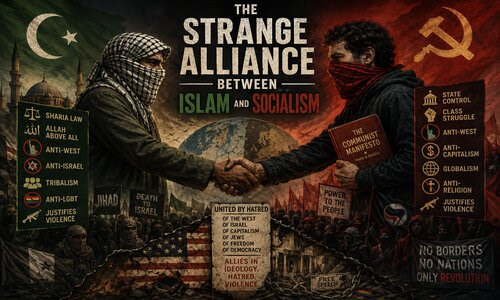
The Strange Alliance Between Islam (Light Green Horse) And Socialism (Red Horse)
One of the things that is perplexing and often a topic of conversation is this new American-Western European alliance or absorption of Islam and Marxism-socialism-communism. In other words, people who identify as radical Muslims, often in their alliance, include people who are traditional Western Marxists, and it doesn’t seem possible for a variety of ways.
There’s a lot of antitheses. Do we really believe that these upscale people in blue enclaves in the United States who declare themselves socialist and are voting for people like Zohran Mamdani, or Ilhan Omar, or Rashida Tlaib, who are proud, and active, and often fervent Muslims, tolerate gays? Do you really believe if you said, “I am gay, and I’m proud of it, and I want to announce that in Saudi Arabia,” you wouldn’t be in trouble?
Do you really believe that if you went to Iran and said, “I want to repeal all the sodomy laws,” you wouldn’t be in trouble?
Or if you went, let’s say, to Egypt and you said, “I wanna have a trans, sexual support group,” you wouldn’t be in trouble? Do you really believe that upscale, independent women in Western cities, maybe unmarried, professional, doesn’t that bother them a little bit when they ally themselves with radical Muslims who tell them that, as far as men go, their dream is going to an Islamic heaven and having the sexual use as if they’re almost tools of 72 virgins?
Does that go well with a book editor in Manhattan or the head of an NGO in Denver? I don’t think so.
Another thing that’s quite different is Islam believes in Allah, and that’s it. All other people who are non-believers are doomed to hell, and the duty is to spread worship, loyalty, fealty to the Muslim Allah.
But throughout the history of socialism and Marxism and communism, all of them agree on one thing, that religion is really the opiate of the masses. They feel that class struggle is harmed or negated by people who believe in a God.
Another thing that’s very different is Marxists believe in the state control of the means of production, and socialists believe that this–there can be private property, but mostly the utilities, the railroads, the steel companies, most all of the muscles of a society are owned also by the state.
But they believe in a commission, a committee, a chairman. They don’t believe that one exercises power through royalty or succession, although most communist and Marxist states, which we see in North Korea and we see in Iran, they’re very similar in some ways. But, in the Arab world, monarchy is pretty much de rigueur, as we see in the Gulf states.
But Marxism says, “No, we don’t believe in kings. We overthrow them.” That was what the revolutions of 1848 were about. That’s what the French Revolution was about. That’s basically what the Bolsheviks were trying to get rid of an imperial dynastic tsar. So, that’s another antithesis.
Another thing is the Arab world is based on tribalism, that your first loyalty goes to people who look like you, speak a dialect of Arabic like you, and have a local or regional affinity, a proximity to you.
That’s always been the challenge of the modern Arab nation or state. How do you include people from seven, 10, 15, 20 different tribes who have fought each other for centuries and only come together when coerced to, for example, under the Ottoman Empire?
But Marxism is very different. Your first allegiance is not to people who look like you.
It’s to the global proletariat, the oppressed, the Comintern. Socialists believe that they have more in common with people in Europe who are fellow socialists than they do with rich people or, or people who are devoutly religious in their own country.
So tribalism is part of Islam’s foundation. Globalism is central to the socialist or the communist or the Marxist.
However, all of that said, someone’s going to say, “Well, Victor, they’re alike. They have a coalition. Zohran Mamdani is a hardcore Marxist, and he’s a hardcore Islamicist, and so is Ilhan Omar, and so are almost all the people in Dearborn, Michigan, it seems like, and so are these new socialist candidates that are popping up like flowers everywhere in blue cities and urban areas.”
So, what’s the similarities? One, they hate Western civilization. They can’t stand the values of Western civilization, free speech, religious opportunity, market capitalism, etc. They both hate that and Islam has been, has been at war with the West since the seventh century, and it’s fought Westerners not just in the Crusades, but all through the history of the Byzantine Empire, all through the history of Europe and North Africa.
And when [Osama] bin Laden said the great tragedy was that Islam lost its hold in Europe, what he was basically talking about was the Battle of Tours and the stopping of the Islamic movement northward into Europe. They, of course, have, in the Quran and its related apocrypha, there’s a lot of hatred of Jews.
They hate Israel with a passion. So do Marxists, socialists. I’m not sure why they do, given the creation of Israel was based on a kibbutz system, which is socialistic in nature, and many of the original generation who settled in Israel even before World War II came there as dissidents from Eastern Europe and Russia, and they believed in a socialist future.
But that’s all ancient history now. As of now, what draws Muslims to the new left-wing hardcore socialist and communist, and what draws them to include rather antithetical Muslims into their movement, they hate Israel with a passion, and they hate Jews.
There’s another, similarity. They hate capitalism.
They do not believe that a person should have freedom of opportunity to start his own business, to make a profit. In the Islamic world, interest is frowned upon officially. Not that the Gulf states are run … The Gulf states are run on hypercapitalism, but officially they find, euphemisms and mechanisms to get around prohibitions in the Quran for hypercapitalism or laissez-faire capitalism.
And of course, capitalism is the main enemy of Zohran Mamdani and others who feel it’s unfair, it doesn’t share the wealth. They believe in the message not of the Americans, “Give me liberty or give me death,” a revolution to ensure political freedom, but a holistic, totalitarian, three-hundred-and-sixty-degree revolution of fraternity egalitarianism.
In other words, we’re not just going to give people freedom to speak. We don’t want them to have freedom to speak. We want to make them equal on the back end by the use of government coercion.
Both of them hate democracy then. They don’t like the people voting because, in the Arab world or the Muslim world, there will be people who object to the role of women, especially in the modern age, or the role that intolerance for sexual minorities or the intolerance shown Christians.
And so, they will object, and they wouldn’t want to express that objection. That’s taboo. And we know from the history of socialism, they say they believe in free speech, but very quickly socialists try to outlaw it, and when they become communists, they kill for it.
Trump’s Gaza Peace Breakthrough: A Warning When They Say Peace And Safety
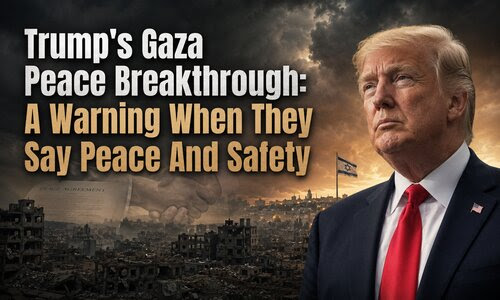
President Donald Trump has now used one of the Bible’s most prophetically charged phrases twice in connection with his efforts to reshape the Middle East.
After announcing a preliminary agreement with Iran in June, Trump wrote, “This Great Deal will bring Peace and Security to the whole Region.” Regional hostilities subsequently resumed, demonstrating how quickly sweeping declarations of peace can outrun events on the ground.
Now Trump has announced what he calls a historic agreement for the complete disarmament of Hamas and every other armed group in Gaza.
“This is a monumental step toward lasting PEACE and SECURITY,” Trump declared.
For students of Bible prophecy, those words immediately recall the warning of 1 Thessalonians 5:3:
“For when they shall say, Peace and safety; then sudden destruction cometh upon them.”
That does not mean Trump’s agreement fulfills this passage. Christians should not force every peace initiative into a prophetic timetable. But Scripture repeatedly warns that the most dangerous moment may come when the world believes Israel’s enemies have finally been contained.
Has Hamas Really Agreed To Surrender?
Trump describes the agreement as a milestone in implementing his existing 20-point Gaza plan. Hamas and other terrorist groups would surrender their weapons in phases, Israel would withdraw as disarmament progresses, international forces would enter Gaza, and a technocratic Palestinian government would assume control.
Yet the details are less reassuring than the headline.
Hamas has made implementation conditional upon Israel fulfilling its obligations. Other accounts describe weapons being catalogued, stored or transferred to a Palestinian body rather than immediately destroyed under Israeli supervision.
There is a vast difference between destroying Hamas’s weapons and storing them. There is also a difference between dismantling Hamas and moving its fighters into a new Palestinian police force.
Hamas has floated a ten-year truce in which its weapons could be frozen while it retained what it calls the Palestinian “right to resist.”
That may not be disarmament.
It may be strategic patience.
Ten years would give Gaza time to rebuild. It could also give Hamas time to restore its influence inside schools, mosques, charities, political organizations and security institutions.
Can An Ideology Be Disarmed?
Even if every rocket and rifle were collected tomorrow, the ideology that produced October 7 would remain.
Hamas is not merely an army. It is an Islamist movement whose influence reaches into religion, education, media, social services and government.
Weapons can be confiscated. Tunnels can be demolished. Commanders can be eliminated.
But an ideology must be defeated.
Any new Palestinian administration would have to reject Hamas’s theology of violence, condemn the atrocities of October 7, remove terrorist indoctrination from schools and prevent Hamas operatives from controlling the police and civil service.
Otherwise, Hamas could disappear as an official government while remaining the power behind it.
That would not be peace.
It would be camouflage.
Who Is Guaranteeing Israel’s Security?
Trump credited Egypt, Qatar and Turkey with helping bring about the latest agreement.
Turkey refuses to classify Hamas as a terrorist organization. Qatar has hosted Hamas’s political leadership for years.
These governments may genuinely want the fighting to end. That does not mean their definition of peace matches Israel’s definition of security.
For them, peace may primarily mean an Israeli withdrawal, Palestinian political control and an end to Israeli military action.
For Israel, peace must mean that another October 7 can never happen.
This multinational structure also carries a striking prophetic parallel.
Daniel 9:27 says a coming ruler will “confirm a covenant with many” for one week, commonly understood by many prophecy scholars as a period of seven years.
The Hebrew wording translated “confirm” can carry the sense of making something strong, enforcing it or causing it to prevail. That leaves open an important possibility: the coming ruler may not necessarily create an entirely new treaty. He could strengthen, guarantee or impose an arrangement already in existence. Different translations render the expression as confirming, strengthening or making a firm covenant.
That is significant because Trump is not presenting the Hamas announcement as a completely new peace plan. He calls it a major milestone in implementing the 20-point framework that was already established.
This is not Daniel’s covenant as there are too many missing pieces.
But the pattern is instructive.
An existing agreement is elevated by a powerful leader, supported by numerous nations, protected by international forces and presented as the answer to Israel’s security crisis.
Revelation 17 adds another dimension. It describes ten kings who receive authority with the beast and then surrendertheir power and authority to him.
Many prophecy scholars connect this global ruler with the prince who confirms the covenant in Daniel 9.
Scripture does not explicitly say that the ten kings negotiate Daniel’s covenant. Nor is Trump’s present Board of Peace a ten-nation coalition. We should not manufacture a numerical fulfillment where one does not exist.
Nevertheless, the emerging architecture is remarkable: a central figure chairs an international body, national leaders lend their influence to the arrangement, and a previously negotiated framework is strengthened and implemented across the region.
It offers a plausible picture of how a future covenant “with many” could operate.
Israel Dwelling Securely
Ezekiel 38 describes Israel living securely before the great invasion associated with Gog and Magog.
The present agreement does not mean Ezekiel’s war is imminent. But it helps us imagine how the conditions could eventually arise.
Hamas is declared disarmed. International troops enter Gaza. Israeli soldiers withdraw. Foreign governments guarantee the agreement. Billions of dollars pour into reconstruction. World leaders announce that the threat has finally disappeared.
The danger is Israesl becomes convinced its enemies have been permanently contained.
October 7 demonstrated what can happen when deterrence, advanced technology and assumptions about an enemy’s intentions create a false sense of security.
Daniel 8:25 provides another sobering parallel. It describes a coming ruler who, in the King James wording, “by peace shall destroy many.”
His weapon is not only military force. It is deception operating under the appearance of security.
Jeremiah similarly warned of leaders crying, “Peace, peace,” when there was no peace. Ezekiel condemned false prophets who promised peace while covering a dangerously unstable wall with whitewash.
The biblical pattern is clear: peace built upon deception eventually collapses.
Peace Must Be Proven
Christians should welcome genuine peace. The end of Hamas’s brutal rule would benefit Israelis and Palestinians alike.
But biblical discernment requires recognizing the difference between peace and an intermission.
Every weapon must be destroyed. Every tunnel must be neutralized. Hamas fighters must not be absorbed into the new Palestinian police force. The new government must reject Hamas’s ideology, and Israel must retain the freedom to act when violations occur.
Most importantly, Hamas must not be allowed to survive under a new name or behind a civilian façade.
The most dangerous words in the Middle East may not be open threats of annihilation.
They may be assurances that the threat has disappeared.