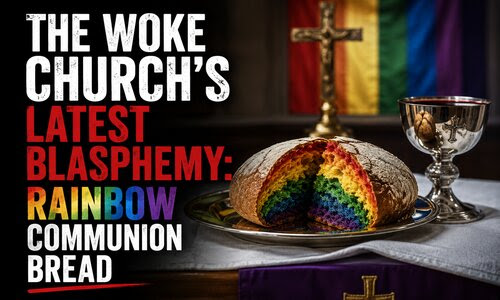
The Woke Church’s Latest Blasphemy: Rainbow Communion Bread
Imagine walking into church on Sunday morning. The pastor lifts the communion bread, and instead of the familiar loaf symbolizing Christ’s broken body, it has been dyed in the colors of the rainbow. Before a word is preached, one of Christianity’s most sacred ordinances has already become a cultural statement.
That wasn’t a hypothetical.
Christ Episcopal Church in Dayton recently used rainbow-colored communion bread during a Pride celebration, explaining that the colorful bread was intended to celebrate and include its LGBTQ members.
The reaction was swift. For many Christians, the issue wasn’t whether churches should welcome everyone—they should. The deeper question was whether the Lord’s Table should ever become a platform for promoting any cultural or political movement, regardless of the cause.
For nearly 2,000 years, Communion has occupied a unique place in Christian worship. On the night before His crucifixion, Jesus took ordinary bread, broke it, and gave it extraordinary meaning. “This is My body, which is given for you. Do this in remembrance of Me.”
From that moment forward, the bread pointed in only one direction—to the cross.
Its purpose has never been to celebrate our identity, affirm our causes, or reflect the values of the surrounding culture. It exists to proclaim the sacrifice of Jesus Christ until He comes again.
That is why this controversy reaches far beyond one church in Ohio.
Every generation faces pressure to reshape Christianity around the values of its age. Yet those changes rarely begin with someone openly rejecting Scripture. They usually begin much more subtly. A sacred symbol is reimagined. A long-held practice is given a new emphasis. A biblical truth is reframed to better fit contemporary expectations.
By the time doctrine changes, the symbols have often already paved the way.
Throughout Scripture, God repeatedly warned Israel against adapting His worship to mirror the surrounding culture. Again and again His people attempted to blend the worship of the true God with the customs, symbols, and priorities of neighboring nations. The result was never spiritual renewal—it was compromise.
The modern church faces a similar temptation.
The issue here is not food coloring.
The issue is what the rainbow represents.
For decades, the rainbow has unfortunately become the universally recognized symbol of the LGBTQ movement. Using that symbol on communion bread inevitably shifts the focus from Christ’s sacrifice toward a contemporary social cause. Whether intended or not, the symbolism changes the message.
Communion stops speaking exclusively about Christ and begins speaking about us.
That should concern Christians regardless of where they stand on countless political debates.
After all, if communion bread can be redesigned to celebrate Pride, what principle prevents another church from redesigning it to promote climate activism, immigration advocacy, nationalism, racial politics, or whichever cause dominates tomorrow’s headlines?
Once sacred symbols become vehicles for cultural messaging, every movement eventually wants a seat at the Lord’s Table.
History demonstrates just how seriously Christians have treated Communion. Entire councils, theological debates, and even martyrdoms centered on preserving the integrity of Christian worship.
They understood something our generation is in danger of forgetting: sacred things lose their meaning when we continually repurpose them to communicate something else.
Supporters of rainbow communion often argue that Jesus welcomed everyone.
That is absolutely true.
Jesus welcomed tax collectors, prostitutes, adulterers, thieves, religious hypocrites, and every other kind of sinner.
But He never confused welcome with affirmation.
His invitation was always accompanied by transformation.
To the woman caught in adultery He declared, “Neither do I condemn you; go, and from now on sin no more.”
Grace and truth walked together.
Unfortunately, many churches today seem increasingly willing to separate them.
Rather than calling people to surrender every area of life to Christ, some now reshape Christian teaching so people can keep those parts of life Scripture calls them to lay down. The result is a faith that becomes progressively less about dying to self and increasingly about affirming self.
Communion reminds us of exactly the opposite.
The cross confronts every one of us.
It confronts the proud, the greedy, the immoral, the dishonest, the self-righteous, and every sinner in between. No one approaches the Lord’s Table because they have been affirmed. We approach because we have been forgiven.
Every believer comes carrying sins that must be confessed, desires that must be surrendered, and a Savior they desperately need.
None of us comes to Communion to celebrate our identity.
We come to lay our identity at the feet of Christ.
That includes every Christian, regardless of which temptations they struggle with. The Gospel does not single out one category of sinners while excusing another. It calls every one of us to repentance because every one of us needs redemption.
This is why the larger trend unfolding across parts of the modern church deserves careful attention.
Churches rarely abandon biblical truth in one dramatic moment. More often they slowly redefine words, reshape symbols, soften uncomfortable teachings, and gradually adjust worship until Christianity begins reflecting the culture more than it reflects Christ.
The rainbow-colored communion bread in Dayton may seem like a small gesture. But symbols have always mattered in Christianity. That is precisely why Jesus chose bread and wine in the first place. They were never arbitrary. They pointed unmistakably to His broken body and His shed blood.
The Church has a sacred responsibility to preserve that message—not update it.
Christians are called to welcome every person who walks through the church doors. We are called to love our neighbors, extend grace, and proclaim the hope of the Gospel without partiality.
But loving people does not require rewriting the symbols Christ Himself established.
The bread should remind us of His broken body.
The cup should remind us of His shed blood.
And when believers leave the Lord’s Table, the image fixed in their hearts should never be the cause of the day, the politics of the moment, or the colors of a cultural movement.
It should be Calvary.
Because the Lord’s Table was never designed to point us toward ourselves.
It was always meant to point us to Christ.
The Robot Navy Has Arrived: America’s Sea Drone Strike Is Glimpse Of Future War
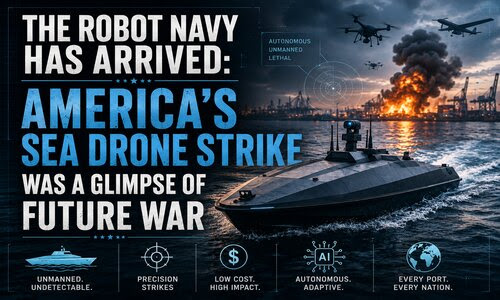
While headlines focused on the target of America’s recent strike against an Iranian port, military planners around the world were likely paying closer attention to something else entirely: the weapon that delivered it.
The United States didn’t simply attack a strategic facility. It publicly demonstrated that autonomous sea drones are no longer experimental concepts or futuristic prototypes. They have become operational weapons capable of striking valuable targets with precision while keeping human operators safely out of harm’s way.
If aerial drones transformed warfare over the past two decades, sea drones may be about to do the same for the world’s oceans.
The idea isn’t entirely new. Ukraine stunned military analysts by using inexpensive unmanned surface vessels to damage or destroy multiple Russian warships in the Black Sea. A nation with virtually no conventional navy forced one of the world’s largest fleets to retreat from its dominant position. The lesson was unmistakable: technological innovation can outweigh traditional military advantages.
Now the United States has signaled that it, too, is embracing this new era of naval warfare.
For generations, sea power has been measured by aircraft carriers, destroyers, submarines, and cruisers. Nations spent decades and trillions of dollars building fleets designed to project strength across the globe. Those ships remain formidable, but they now face a growing challenge from autonomous vessels that cost only a tiny fraction of the price.
The economics alone should command attention.
A billion-dollar warship may be forced to defend itself against a drone costing a few hundred thousand dollars—or less. Worse still, defenders may launch sophisticated interceptor missiles costing millions of dollars to destroy a target that is almost disposable by comparison.
That is not a sustainable equation.
Yet the greatest danger isn’t a single drone.
It’s a swarm.
Imagine not one autonomous boat approaching a naval base, but one hundred. Some travel on the surface. Others move beneath the water. Overhead, aerial drones provide surveillance while electronic warfare systems jam communications. Artificial intelligence helps coordinate the attack, adjusting routes in real time as defenses respond.
Even the most advanced naval defenses can become overwhelmed when forced to engage dozens or hundreds of simultaneous threats arriving from multiple directions.
This is where the conversation shifts from today’s headlines to tomorrow’s reality.
Military planners increasingly recognize that future wars will not be fought solely by soldiers, sailors, pilots, and Marines. They will also involve fleets of autonomous machines operating across land, sea, air, and under the ocean. Human operators will increasingly supervise battles rather than personally fight every engagement.
That reality changes political calculations as well. A nation can undertake riskier missions when it knows no crew members will become prisoners of war or casualties if an unmanned vessel is destroyed. The threshold for military action may become lower simply because the human cost appears smaller.
The implications stretch far beyond Iran.
Every major port in the world—from Norfolk and Pearl Harbor to Haifa, Singapore, and Yokosuka—must now consider how to defend against autonomous maritime threats. Commercial shipping lanes, energy terminals, bridges, offshore infrastructure, and naval bases all become potential targets in ways that were difficult to imagine only a decade ago.
History has repeatedly shown that the most devastating attacks often come from threats nations failed to take seriously.
Before December 7, 1941, many believed America’s geographic isolation and powerful fleet provided sufficient protection. Pearl Harbor shattered that illusion.
Before September 11, 2001, few imagined commercial airliners becoming strategic weapons capable of changing history.
Today another military revolution is quietly unfolding.
The danger is not simply that sea drones exist. The danger is assuming they will remain a niche capability confined to today’s regional conflicts. History suggests otherwise. Once a military innovation proves effective, others quickly copy it, refine it, and deploy it on a larger scale.
A future “Pearl Harbor 2.0” may not begin with bombers appearing over the horizon. It could begin with hundreds of autonomous vessels—some above the water, others below—moving silently toward ports, fuel depots, naval bases, bridges, and critical infrastructure before anyone fully recognizes what is happening.
That is no longer the stuff of science fiction. It is a capability being developed in real time.
The lesson of Pearl Harbor was never simply that America needed a bigger navy. It was that nations must recognize new forms of warfare before an adversary exploits them. Those who prepare only for yesterday’s battles often pay a terrible price tomorrow.
For Christians, these developments are another reminder that the world continues to move toward an era of rapidly accelerating technology, where innovation can be used for both tremendous good and profound destruction. Scripture reminds us that wars and rumors of wars will continue, but it also calls believers to be discerning about the times in which they live.
Ignoring revolutionary technologies because they seem novel or unlikely has never been a winning strategy. The nations that adapt will shape the future. Those that fail to recognize the changing character of warfare may discover—too late—that history has a way of repeating itself in forms no one expected.