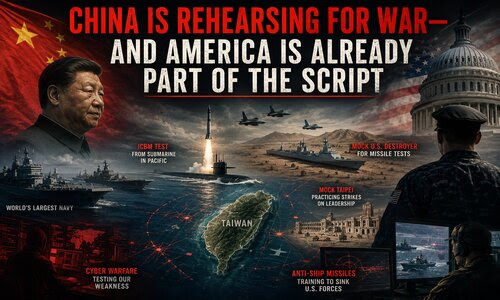
The Dragon VS The Eagle Wings – China Is Rehearsing For War-And America Is Already Part Of The Script
For years, many Americans have viewed rising tensions over Taiwan as a distant geopolitical dispute–something happening on the other side of the Pacific with little bearing on daily life. But recent military developments suggest that China is no longer merely preparing to defend its interests. It is openly rehearsing how to defeat America’s military should a conflict erupt.
That should get our attention.
In just the past year, China has accelerated military activities that paint a troubling picture. It recently conducted a rare intercontinental ballistic missile (ICBM) launch into the Pacific from a nuclear-powered submarine–the first such publicly known submarine-based test in roughly four decades and only the second long-range Pacific demonstration in modern history.
Although the missile reportedly carried a dummy warhead, the message was unmistakable: China wants the world to know its nuclear deterrent is becoming increasingly mobile, survivable, and capable of reaching targets across the globe.
At nearly the same time, newly released satellite imagery revealed China constructing yet another replica of a U.S. Navy Arleigh Burke-class destroyer deep in the Taklamakan Desert. This wasn’t built for tourism or propaganda. Analysts believe it is another target used to refine China’s anti-ship missile capabilities.
In other words, Beijing isn’t simply talking about defeating American warships–it is practicing.
And it isn’t stopping there.
Over recent years, China has also built mock versions of Taiwan’s Presidential Office, government buildings, and city streets for military exercises. These facilities allow the People’s Liberation Army (PLA) to rehearse urban assaults, command seizures, and precision strikes against Taiwan’s political leadership.
Military planners often say armies fight the way they train.
China is training for Taiwan.
A Navy Built for More Than Defense
China now possesses the world’s largest navy by number of warships, with well over 370 battle force ships and submarines–a number expected to continue growing. While the United States still enjoys advantages in global reach, carrier aviation, and combat experience, China’s naval expansion has been breathtaking.
Over the past year alone, Beijing has continued commissioning advanced destroyers, frigates, amphibious assault ships, and nuclear-powered submarines while expanding its aircraft carrier program. The sea trials of its next-generation carrier, *Fujian*, represent another milestone. Unlike China’s earlier carriers, *Fujian* employs electromagnetic catapults similar to those used by the U.S. Navy, allowing heavier aircraft and more efficient launch operations.
China has also dramatically expanded its coast guard and maritime militia–civilian-looking vessels that increasingly serve strategic military purposes by harassing Philippine, Vietnamese, and Taiwanese ships without technically triggering open warfare.
These are not isolated developments.
They form part of a comprehensive strategy.
Why Now?
Timing matters.
China’s economy has slowed considerably compared to the explosive growth that fueled its rise over the past two decades. Domestic challenges–from youth unemployment to real estate instability–have increased pressure on Beijing’s leadership.
History shows governments facing internal difficulties sometimes emphasize external threats to rally national unity.
At the same time, President Xi Jinping has repeatedly declared that “reunification” with Taiwan cannot be postponed indefinitely. U.S. intelligence officials have stated that Xi has instructed the PLA to be capable of conducting an invasion of Taiwan by 2027–not that war is inevitable by then, but that the military should be ready if ordered.
Readiness requires rehearsal.
The missile tests.
The mock American warships.
The simulated Taiwanese government buildings.
The massive naval exercises surrounding Taiwan.
These pieces fit together.
Taiwan Isn’t “Their Problem”
Many Americans understandably ask: Why should we care?
Because if Taiwan falls, the consequences won’t stay in Asia.
Taiwan manufactures roughly 90% of the world’s most advanced semiconductors. Those tiny chips power nearly everything–smartphones, automobiles, hospital equipment, artificial intelligence systems, financial networks, military hardware, and electrical infrastructure.
Disruption to Taiwan’s semiconductor industry would ripple through the global economy almost immediately.
Beyond economics lies credibility.
The United States has spent decades building alliances throughout the Indo-Pacific. Japan, South Korea, Australia, and the Philippines all rely upon American security commitments. If China successfully seized Taiwan without meaningful resistance, allies across the region would inevitably question whether America’s security guarantees still carry weight.
That uncertainty could trigger a regional arms race–or encourage other authoritarian powers to pursue territorial ambitions of their own.
The Testing Never Stops
China’s military pressure rarely makes front-page news because much of it happens incrementally.
Nearly every week, Chinese aircraft cross Taiwan’s air defense identification zone.
Chinese naval vessels circle the island.
Cyberattacks probe Taiwanese infrastructure.
Spy balloons, underwater cables, satellite surveillance, electronic warfare, and increasingly sophisticated artificial intelligence are becoming integral parts of Beijing’s strategy.
Each operation gathers intelligence.
Each exercise identifies weaknesses.
Each test conditions the world to accept a slightly higher level of aggression than before.
This is sometimes called the “boiling frog” strategy–not one dramatic act, but a steady escalation that gradually normalizes behavior once considered extraordinary.
Christians Should Watch Carefully
Scripture does not tell believers to panic over headlines, but it does repeatedly instruct us to remain watchful and discerning. Jesus warned that nations would rise against nations and that increasing global instability would characterize the period leading to His return.
Whether today’s events ultimately lead to a Taiwan conflict remains unknown. Wise leaders can still preserve peace through strength, diplomacy, and deterrence.
But pretending these military preparations are merely symbolic would be dangerously naïve.
China isn’t simply building ships.
It is building options.
It isn’t merely testing missiles.
It is testing resolve.
And every replica warship in the desert, every missile launched into the Pacific, every carrier launched to sea, and every simulated attack on Taiwan sends the same unmistakable message:
Beijing is preparing for a conflict it hopes never comes–but intends to be ready if it does.
The question is whether the free world is preparing with the same seriousness.
When Every Smart Item on you becomes a Tracking Device
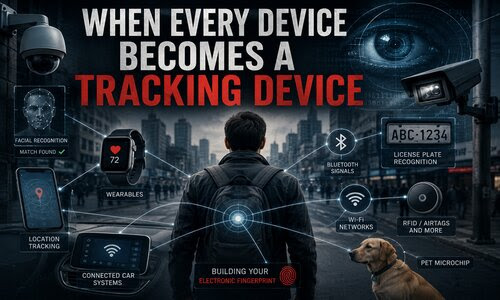
When Every Device Becomes A Tracking Device – There was a time when leaving home meant leaving a trail only if someone happened to see you. Today, without ever touching your phone, sending a text, or making a call, you may already be broadcasting your location to dozens of nearby sensors.
And now, a new surveillance technology promises to stitch all those electronic breadcrumbs together.
It is called SignalTrace, and while its name may be unfamiliar today, the technology behind it offers a revealing glimpse into where modern surveillance is heading. Developed by global defense and security giant Leonardo, SignalTrace is designed to help law enforcement identify not merely vehicles, but the people traveling inside them.
Rather than relying solely on license plates, it correlates the unique wireless signals emitted by smartphones, Bluetooth devices, vehicle systems, RFID tags, tire-pressure monitoring sensors, and other electronic devices to create what the company describes as an “electronic fingerprint.”
Unlike Hollywood hacking scenes, the system is not reading your text messages or listening to your phone calls. Instead, it collects the identifiers constantly emitted by many of the wireless devices we carry every day. Individually, those signals reveal very little. But together they create a remarkably distinctive signature—one that can potentially be associated with a specific vehicle, tracked over time, and recognized again and again.
In many ways, SignalTrace represents the next evolution of automated license plate readers. Those systems were originally introduced to identify stolen vehicles and locate wanted criminals. Few objected. Catching dangerous offenders seemed a reasonable use of technology.
But surveillance technologies rarely remain confined to their original purpose.
Over the past two decades, governments have quietly assembled an increasingly interconnected web of digital observation. Security cameras became high-definition networks. License plate readers expanded from isolated police departments into nationwide databases. Smartphones evolved into constant sources of location information. Facial recognition became capable of identifying individuals within seconds. Financial transactions, online activity, and digital identities have become increasingly centralized.
Each advancement was introduced independently, usually accompanied by assurances that it would only be used for limited, legitimate purposes.
Yet taken together, they paint a very different picture.
SignalTrace is noteworthy not simply because of what it can do today, but because of what it represents. It seeks to bridge the gap between vehicles and occupants, allowing investigators to associate recurring collections of electronic devices with specific people rather than merely tracking a license plate. A car can change owners. A license plate can be replaced. But the combination of your smartphone, smartwatch, wireless earbuds, vehicle electronics, and other nearby devices creates a much more persistent digital signature.
The technology itself is impressive.
The broader implications are sobering.
Artificial intelligence has dramatically accelerated those implications. A decade ago, even if governments collected billions of data points, making sense of them required enormous human effort. Today, AI systems can rapidly analyze vast quantities of information, identify recurring patterns, uncover associations, and reconstruct what security professionals call a “pattern of life.”
Imagine asking a computer:
Who regularly visits this church?
Which vehicles consistently travel together?
Who attended a political rally and then met with certain individuals afterward?
Which electronic fingerprints appeared near a crime scene multiple times over six months?
These are precisely the kinds of questions modern AI excels at answering.
Supporters rightly point out that such capabilities could solve crimes, locate missing persons, dismantle trafficking networks, and improve public safety. There is no doubt these technologies possess legitimate investigative value.
The concern has never been whether surveillance tools can be used for good.
History demonstrates they often can.
The concern is whether governments consistently resist expanding their use once the infrastructure exists.
Experience suggests otherwise.
Whether it was counterterrorism authorities following the attacks of September 11, expanding license plate databases, or the growing use of facial recognition, surveillance powers have often broadened beyond their original scope over time. Civil liberties organizations have repeatedly warned that technologies introduced for exceptional circumstances frequently become normalized for routine investigations.
That phenomenon has a name: mission creep.
The question Christians—and indeed all citizens—should be asking is not simply whether today’s officials can be trusted. It is whether every future Government , every future administration, and every future bureaucracy should inherit an infrastructure capable of reconstructing nearly every movement, association, and relationship of ordinary citizens.
Technology itself is morally neutral.
The same tools that locate kidnapped children could also be used to identify political dissidents. The same systems that help solve violent crimes could one day reveal where citizens worship, which rallies they attend, what organizations they support, or whom they regularly meet.
That is why safeguards matter before capabilities become routine.
For Christians, these developments also serve as a reminder that the technological foundations for unprecedented governmental oversight are no longer the stuff of science fiction. Scripture describes a future in which economic activity, identification, and governmental control become deeply intertwined on a global scale. SignalTrace illustrates how rapidly the technological infrastructure capable of comprehensive tracking is being assembled.
One invention rarely changes the world overnight.
Rather, history advances one seemingly reasonable innovation at a time.
A license plate reader there.
A facial recognition database.
A digital ID.
An AI analytics engine.
An electronic fingerprint.
Individually, each appears manageable. Collectively, they form something previous generations could scarcely have imagined—a society in which anonymity steadily disappears and nearly every movement leaves a searchable digital trail.
Perhaps that is why the title of Leonardo’s latest system is so revealing.
The vehicle was never really the destination.
The destination was always the person.
And in a world filled with connected technology, every device is quietly becoming a tracking device.
Preach what we Tell you or Get NO FUNDING

Government Funding Comes With A Price: Surrender Your Christian Beliefs – You can believe the Bible… just don’t act like you believe it.
That increasingly appears to be the government’s definition of religious freedom.
Across America, Christians are repeatedly assured that no one is trying to take away their faith. They are free to attend church, own a Bible, pray before meals, and believe whatever they wish. Religious liberty, we’re told, is alive and well.
But there is an increasingly important condition attached to that promise.
Believe what you want—as long as those beliefs don’t shape how you live, how you run your business, how you educate your children, or how your institutions operate.
Faith is tolerated… until it becomes visible.
The moment biblical convictions influence hiring decisions, codes of conduct, school policies, or public life, the government increasingly steps in and says, “Not like that.”
That troubling reality was reinforced once again by a recent federal appeals court ruling involving Bangor Christian School in Maine.
The court ruled that while the school is free to teach biblical beliefs regarding sexuality and gender, families cannot benefit from Maine’s tuition assistance program unless the school complies with the state’s LGBT nondiscrimination policies. The judges rejected the school’s argument that requiring it to abandon conduct consistent with its beliefs violated its constitutional right to freely exercise its religion.
Think carefully about what that means.
The court essentially acknowledged that Christians may hold biblical beliefs—but ruled those beliefs need not be accommodated when they are actually put into practice.
But what exactly is Christianity if not a faith that is lived?
Jesus never called His followers simply to agree with Him intellectually. He called them to obey Him. Scripture repeatedly teaches that genuine faith transforms both belief and behavior. Christianity has never been confined to Sunday worship services or private opinions. It shapes every aspect of life—including how Christians educate their children and operate their schools.
Separating belief from conduct fundamentally misunderstands the very nature of religious freedom.
Imagine telling an environmental organization it may believe in protecting forests but cannot refuse to participate in logging. Or telling a vegetarian society it may promote vegetarianism but must serve meat at its official events.
The belief becomes meaningless if it cannot influence conduct.
Yet that is precisely the direction many governments now appear to be heading with Christianity.
Supporters of Maine’s policy argue that the rules are neutral because every school must follow them equally. But “equal” treatment does not always produce equal outcomes.
A secular private school that already embraces the state’s gender ideology sacrifices nothing by complying with these requirements. A Christian school committed to biblical teaching faces a completely different reality. It must either violate deeply held religious convictions or lose access to a public benefit available to others.
That is not neutrality.
It is pressure.
The state is effectively saying, “You may remain Christian—but only if your Christianity never conflicts with our ideology.”
Perhaps even more revealing were the comments made by Maine Attorney General Aaron Frey after the U.S. Supreme Court’s 2022 decision in Carson v. Makin. Although the Supreme Court ruled that parents could not be excluded from Maine’s tuition assistance program simply because they chose a religious school, Frey insisted Bangor Christian School should still remain ineligible because its biblical views on sexuality and gender were, in his words, “inimical to a public education.”
That statement should concern every American.
Not because everyone agrees with Bangor Christian School’s beliefs, but because it reflects a growing assumption that historic Christianity itself is somehow incompatible with participation in public life.
Notice the double standard.
Governments celebrate diversity when it comes to race, ethnicity, language, culture, gender identity, and sexual orientation. Society is constantly reminded that differing viewpoints strengthen democracy.
But increasingly, one viewpoint seems exempt from that celebration.
Traditional biblical Christianity.
Christian schools are expected to accommodate the moral convictions of the surrounding culture, while the surrounding culture is never expected to accommodate theirs.
Universities require faculty to support institutional values.
Advocacy organizations hire people who believe in their mission.
Political groups openly expect ideological agreement from employees.
No one considers that unusual.
But when Christian schools ask teachers and staff to uphold biblical standards that have been part of Christian teaching for two thousand years, those same convictions are increasingly described as discrimination.
That is a remarkable shift.
The debate is no longer simply about preventing discrimination.
It is about determining which belief system will ultimately define society’s moral boundaries.
History shows that governments rarely begin by outlawing religion altogether. Instead, they regulate it. They attach conditions to funding, accreditation, licensing, and participation in public programs. One requirement follows another until religious institutions face an increasingly difficult choice: remain faithful to Scripture or receive the benefits available to everyone else.
The pressure is subtle.
But it is real.
And it grows with every court ruling that tells Christians they may believe whatever they want—as long as they don’t organize their lives around those beliefs.
For Christians, this should not come as a surprise. Jesus warned His followers that obedience to Him would often place them at odds with the world. The apostles themselves declared, “We ought to obey God rather than men.”
That principle has not changed.
Religious liberty was never intended to protect only those beliefs that happen to align with the prevailing political or cultural consensus. It exists precisely to protect the beliefs that challenge it.
The question facing America is becoming increasingly clear.
Will Christian schools remain free to operate as genuinely Christian institutions?
Or will they simply be permitted to keep the name “Christian” while government officials dictate which biblical convictions they are allowed to practice?
Because in the end, a faith that may be believed but not lived is not genuine religious freedom at all.