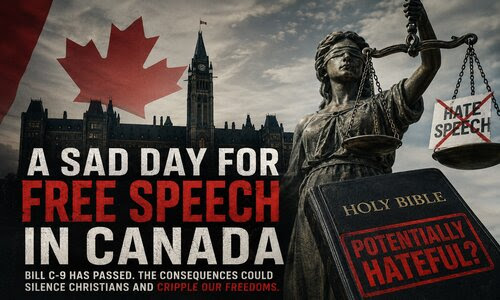
Bill C-9 Changes Everything For Canadian Christians
There are laws that change tax rates. There are laws that adjust budgets. And then there are laws that quietly alter the relationship between citizens and the state.
Bill C-9 belongs in that second category.
Supporters describe the legislation as a necessary step to combat hatred and protect vulnerable groups. The bill expands Canada’s hate-crime and hate-propaganda laws and introduces new measures designed to address hate-motivated conduct. On the surface, many Canadians may see little reason for concern.
But buried within the legislation is a change that has many Christians, civil liberties advocates, and free speech defenders sounding the alarm.
For decades, Canada’s Criminal Code contained a defense that protected the good-faith expression of opinions on religious subjects and religious texts in certain hate-promotion cases. Bill C-9 removes that protection.
Supporters argue the change closes a loophole that could potentially be abused to justify genuine hatred. Critics see something very different. They warn that Parliament has removed an important safeguard that helped protect religious expression, leaving future courts and prosecutors with greater authority to determine where legitimate religious teaching ends and criminal hate promotion begins.
Whether those concerns ultimately prove justified remains to be seen.
But one thing is certain: a legal protection that existed yesterday no longer exists today.
That should concern every Canadian who values freedom of conscience and freedom of speech.
After all, who gets to decide what constitutes hate?
Most Canadians would agree that direct threats, harassment, intimidation, and incitement to violence should not be protected. But modern hate speech laws rarely remain confined to those categories. Increasingly, they venture into the territory of ideas, beliefs, moral convictions, and religious teachings that others find offensive.
That is where many Christians see trouble ahead.
For generations, churches have openly preached what the Bible teaches about marriage, sexuality, gender, sin, repentance, and salvation. Those teachings have not changed.
Society has.
What many Canadians regarded as mainstream moral beliefs only a few decades ago are now viewed by some activists as discriminatory, exclusionary, or harmful. That raises a question that would have seemed almost unimaginable a generation ago:
Could biblical teaching someday become the subject of a criminal hate-promotion complaint?
Supporters of Bill C-9 insist such concerns are exaggerated. They point out that Canada still recognizes freedom of religion and freedom of expression.
Perhaps they are right.
But laws are not judged solely by how they are intended to be used today. They must also be judged by how they could be applied tomorrow.
The concern is not what happens next week.
The concern is what becomes possible next week.
What happens when a complaint is filed over a sermon discussing Romans 1?
What happens when a Christian school teaches the biblical definition of marriage?
What happens when a pastor preaches that repentance involves turning away from sinful behavior?
What happens when biblical teachings on sexuality are viewed by activists as harmful or discriminatory?
Before Bill C-9, there was a specific statutory defense available in certain cases involving religious expression.
Now there is not.
That reality alone guarantees that future courts—not Parliament—will increasingly be asked to draw those lines.
History offers a clear warning. The definition of “hate” rarely remains fixed. What one generation considers a legitimate moral belief, the next generation may consider offensive. What was once regarded as common sense can suddenly be branded harmful. The target keeps moving.
That is precisely why free speech protections were created in the first place—not to protect popular opinions, but to protect controversial ones.
No one needs legal protection to say what everyone already agrees with.
The true test of freedom is whether citizens can express views that others dislike.
Unfortunately, Canada has been moving steadily in the opposite direction for years.
Across the country, citizens have faced investigations for comments made online. Human rights tribunals have increasingly become battlegrounds for ideological disputes. Pastors, activists, educators, and ordinary Canadians have learned that expressing certain views can carry growing professional, financial, and legal risks.
Bill C-9 represents another step down that road.
For Christians, the concern is especially serious because the Gospel itself is inherently offensive to the spirit of the age.
Scripture teaches that all people are sinners.
Scripture calls people to repentance.
Scripture challenges human desires and behaviors.
Scripture claims that truth exists independent of popular opinion.
None of those ideas sit comfortably within a culture increasingly focused on subjective identity and personal autonomy.
The Christian message has always challenged prevailing cultural norms.
The prophets offended kings.
The apostles offended religious authorities.
Jesus Himself offended both political and religious leaders.
The Gospel was never designed to fit neatly within the cultural consensus of any generation.
That is why freedom of speech and freedom of religion are inseparable.
The moment government gains greater authority to determine which moral truths may be publicly expressed, religious liberty becomes vulnerable as well.
Perhaps the worst fears surrounding Bill C-9 will never materialize.
Canadians should certainly hope that is the case.
But hope is not a safeguard.
History suggests that powers granted to government rarely remain confined to their original purpose. Definitions evolve. Boundaries shift. New precedents emerge. Future governments often use powers in ways their predecessors never imagined.
And once precedent is established, recovering lost freedoms becomes far more difficult than defending them beforehand.
For that reason alone, Bill C-9 should concern far more than Christians. It should concern every Canadian who values the right to speak, debate, persuade, disagree, and proclaim what they believe to be true.
Because when governments gain greater authority over speech, the question is rarely whether that authority will be used.
The question is where the line will eventually be drawn.
And who will find themselves standing on the wrong side of it.
That is why many Canadians view the passage of Bill C-9 not as a victory for freedom, but as a warning.
A warning that Canada may be moving one step closer to a future where certain opinions remain protected—not because they are true, but because they are approved.
Rainbow Pastors Want Christians To Repent For Upholding The Bible
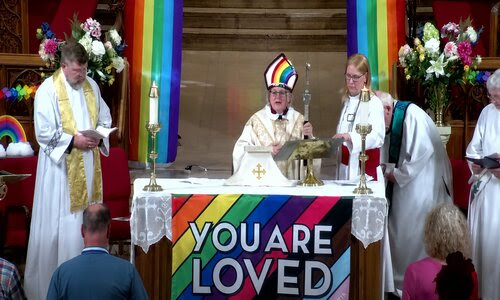
There are moments when a single church service captures just how dramatically some denominations have drifted from historic Christianity. A recent sermon delivered by Anglican Bishop Susan Bell appears to be one of those moments.
For many Christians watching clips and photos from the service, the first thing that stood out was not the sermon itself but the overwhelming symbolism on display. Rainbow imagery dominated the sanctuary. A massive rainbow arch framed the stage. Rainbow banners were prominently displayed. Even Bishop Bell’s ceremonial bishop’s hat—known as a mitre—featured rainbow colors.
The symbolism was unmistakable.
What was once God’s covenant sign to humanity following the flood has increasingly been transformed into the primary symbol of the modern LGBTQ movement. While many Christians disagree with that cultural appropriation, what made this service particularly striking was not merely the presence of rainbow imagery. It was the message being proclaimed beneath it.
During the service, congregants were led in prayers of repentance for excluding LGBTQ individuals from spiritual leadership positions, for what was described as transphobia, and for conversion therapy. In effect, the church was calling people to repent for upholding biblical teachings that Christians have affirmed for nearly two thousand years.
Think about how extraordinary that is.
Historically, Christian repentance has involved turning away from sin and returning to obedience to God. The biblical pattern is consistent from Genesis to Revelation. Whether the issue was idolatry, sexual immorality, greed, pride, or unbelief, God’s people were called to repent when they departed from His commands.
In this service, however, the concept of repentance appeared to be turned upside down.
Instead of calling people to repent for violating God’s standards, worshippers were encouraged to repent for maintaining them.
That reversal reveals one of the central conflicts facing many Western churches today. The debate is no longer simply about how to minister to people struggling with sexual identity issues. The debate is increasingly about whether Scripture itself should retain authority when its teachings conflict with contemporary cultural values.
For centuries, Christians understood that love and affirmation were not synonymous. Parents love their children without affirming every choice they make. Pastors love their congregations while still warning them about sin. Jesus Himself perfectly embodied both grace and truth.
When Jesus encountered sinners, He welcomed them. He ate with them. He showed compassion toward them. But He never redefined sin in order to make people feel accepted.
His message repeatedly included the call to “repent.”
That is why many Bible-believing Christians find services like this deeply troubling. They do not object because they hate LGBTQ individuals. They object because they believe the church is abandoning its responsibility to proclaim biblical truth.
Every person should be welcomed into a church.
The church should welcome those struggling with pride, greed, adultery, pornography, drunkenness, same-sex attraction, gender confusion, anger, or any other sin. No one is beyond the reach of God’s grace.
But welcoming someone into a church is not the same as affirming every belief or behavior they bring with them.
A hospital welcomes sick people because they need healing. It would be absurd for a hospital to celebrate disease rather than treat it. Likewise, Christians have historically understood the church as a place where people encounter God’s transforming power.
The goal is not affirmation. The goal is transformation.
The issue of so-called conversion therapy illustrates this distinction.
There have undoubtedly been cases where harmful or coercive practices were carried out under that label. Christians should reject any abusive methods that violate human dignity. Yet much of what critics now classify as conversion therapy simply involves biblical counseling, prayer, discipleship, and encouraging believers to bring their desires and behavior into submission to Christ.
At its core, Christianity has always taught that all believers are called to change.
The drunkard must change.
The thief must change.
The adulterer must change.
The liar must change.
And yes, every person struggling with sexual sin is called to change as well.
The Christian message has never been, “Come as you are and stay as you are.”
It has always been, “Come as you are and allow Christ to transform you.
Perhaps the most tragic aspect of services like this is that they leave people with the impression that God has changed His mind. Yet Scripture repeatedly declares that God does not change. Human culture changes. Political movements change. Social trends change. Public opinion changes.
God’s Word does not.
The irony is difficult to miss. Christians who continue to uphold historic biblical teachings are increasingly being portrayed as the ones who need to repent. Yet from a traditional Christian perspective, the greater danger lies in repenting of obedience itself.
When churches begin apologizing for proclaiming what Scripture teaches, they cease functioning as prophetic voices to the culture and instead become echoes of it.
The church’s mission is not to mirror society’s latest moral revolution. Its mission is to faithfully proclaim the truth of God’s Word, whether that message is popular or unpopular.
The rainbow in Scripture was never a symbol of human pride. It was a symbol of God’s mercy.
Perhaps that is the rainbow the church should be pointing people toward once again.
Get Ready For The Day Your Entire Digital Life Is Exposed

Every week seems to bring news of another major cyberattack, another data breach, another company scrambling to explain why sensitive information has fallen into the wrong hands.
For years, we have been warned about the dangers of living our lives online. Yet most people still assume that their private messages, search histories, financial records, medical information, and personal conversations will remain hidden behind digital walls. Increasingly, that assumption looks dangerously outdated.
The rise of artificial intelligence is changing the cybersecurity landscape at breathtaking speed. While AI offers incredible benefits, it is also handing cybercriminals powerful new tools capable of finding vulnerabilities, writing malicious code, and launching attacks faster than ever before.
The result is a digital arms race that may ultimately expose just how much of our lives have been quietly stored, tracked, and archived over the past two decades.
Recent reports paint a troubling picture. Cybersecurity experts warn that AI-powered attacks are dramatically increasing in both frequency and sophistication. According to data cited by industry analysts, hackers are now exploiting software vulnerabilities in a matter of weeks rather than years. What once took hundreds of days now often takes less than two months.
Former Yahoo and Facebook security chief Alex Stamos recently summarized the situation bluntly: “Companies are getting hacked every single day.”
Think about what that means.
Every email you have sent. Every website you have visited. Every social media message. Every online purchase. Every banking transaction. Every search query. Every embarrassing mistake. Every secret struggle.
Much of it exists somewhere on a server.
For years, technology companies have encouraged consumers to place more of their lives online. Cloud storage became normal. Digital wallets became convenient. Online health portals became essential. Social media became a record of our personal histories.
Now imagine what happens if increasingly powerful AI systems enable criminals to penetrate databases that were previously considered secure.
The nightmare scenario is not merely identity theft. It is the exposure of entire digital lives.
A future breach may not simply reveal your credit card number. It could reveal your private conversations, personal struggles, medical history, political opinions, financial records, location history, photographs, and years of internet activity.
That possibility should concern everyone.
Yet while the technical implications are frightening, there is also a deeper lesson hidden beneath the headlines.
The growing reality of digital transparency serves as a powerful reminder of a spiritual truth that Scripture has taught for thousands of years.
Human beings have always assumed they could hide certain things.
We hide our thoughts.
We hide our habits.
We hide our compromises.
We hide our secret sins.
But the Bible repeatedly reminds us that nothing is truly hidden from God.
In Numbers 32:23, Moses delivered a warning that still echoes today: “Be sure your sin will find you out.”
Jesus reinforced this principle in Luke 12:2-3:
“There is nothing concealed that will not be disclosed, or hidden that will not be made known. What you have said in the dark will be heard in the daylight.”
Long before cloud computing, artificial intelligence, or social media, God was reminding humanity that secrecy is often temporary.
The uncomfortable reality is that many people live as though there are two versions of themselves.
There is the public version—the one presented to family, coworkers, church members, and friends.
Then there is the private version—the one that exists behind closed doors, hidden browser tabs, anonymous accounts, private messages, and secret habits.
Technology is increasingly making that distinction harder to maintain.
The digital age is creating a world where past actions can be preserved indefinitely and exposed unexpectedly.
But Christians should not need the threat of a data breach to motivate integrity.
Our standard is higher than avoiding public embarrassment.
Our goal should be holiness.
Character is not measured by how we behave when others are watching. Character is measured by how we behave when we believe no one is watching.
The reality, of course, is that Someone always is.
God sees what no surveillance system can see. He knows what no hacker can uncover. He understands motives, thoughts, desires, and intentions that never make their way into a database.
That truth should not merely frighten us—it should encourage us.
Because the same God who sees everything is also the God who offers forgiveness through Jesus Christ.
The answer is not to live in fear of exposure. The answer is to live in such a way that exposure becomes less frightening.
As AI reshapes cybersecurity and makes digital secrets increasingly vulnerable, perhaps the greatest lesson is not technological but spiritual.
The future may bring a catastrophic leak that exposes millions of people’s private histories.
But long before hackers, algorithms, or artificial intelligence existed, God was already calling humanity to live with integrity in both public and private.
In an age when nothing online appears truly secure, that message may be more relevant than ever.