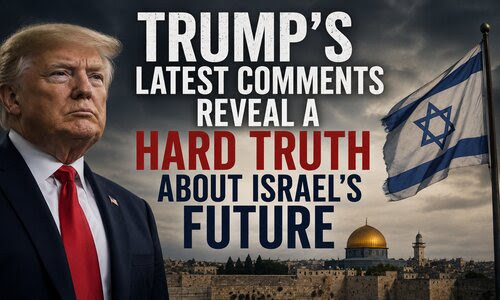
Trump’s Latest Comments Reveal A Hard Truth About Israel’s Future
President Donald Trump has long been regarded as one of the strongest supporters of Israel ever to occupy the White House.
His recognition of Jerusalem as Israel’s capital, the relocation of the U.S. embassy, recognition of Israeli sovereignty over the Golan Heights, and support during some of Israel’s most challenging moments earned him widespread admiration among Israelis and evangelical Christians alike.
That is why many Christian supporters of Israel were surprised by a series of recent comments regarding Israel’s war against Hezbollah in Lebanon.
Speaking about the conflict, Trump criticized Israel’s military operations, saying that “Israel is fighting Hezbollah too long, and too many people are being killed.”
He went on to suggest that Israel’s approach was excessive, stating, “You don’t have to knock down an apartment house every time you’re looking for somebody. There are a lot of people in those apartment houses and they’re not all Hezbollah.”
Trump also revealed that he had privately expressed dissatisfaction with Israeli strikes in Beirut.
“I did not like that, I let them know that,” he said, referring to one attack that he described as “too much.”
Perhaps most surprising was his suggestion that Syria could potentially deal with Hezbollah more effectively.
“I suggested to Israel to let Syria take care of Hezbollah,” Trump said. “If Israel can’t do the job without killing everyone else, he’ll do the job, Syria will do the job.”
He further stated that Israeli Prime Minister Benjamin Netanyahu “has to be more responsible with respect to Lebanon” and added, “I’m not happy with the way Israel has handled themselves with Lebanon, and with Hezbollah.”
Yet it was another remark that generated perhaps the most concern among many evangelical supporters of Israel.
“Israel would have been blown up a long time ago, had I not gotten involved,” Trump declared. Elsewhere he stated, “Without me, there would be no Israel.”
To be fair, there is a practical truth behind some of these comments.
The United States has been Israel’s most important ally for decades. American military aid, intelligence cooperation, diplomatic support, and strategic deterrence have undoubtedly strengthened Israel’s ability to defend itself.
President Trump’s own policies also contributed significantly to Israel’s security position in the region.
But there is a vast difference between acknowledging America’s importance and suggesting that Israel’s existence depends upon any single political leader.
For Christians who understand God’s covenant relationship with Israel, that distinction matters.
Israel’s survival did not begin with Donald Trump.
Nor did it begin with America.
Israel survived Egypt, Assyria, Babylon, Persia, Greece, Rome, the Islamic caliphates, the Crusades, centuries of exile, the Holocaust, and repeated attempts by neighboring nations to destroy it.
Why?
Because Scripture presents Israel’s preservation as an act of divine faithfulness rather than geopolitical luck.
God has often used nations and leaders as instruments of protection. America may very well be one of those instruments.
But instruments are not the source.
God is.
That is why statements suggesting that Israel would not exist without a particular leader make many Christians uncomfortable. They unintentionally place human accomplishment in a position Scripture reserves for God alone.
Beyond the theological concerns lies a practical one.
Trump’s comments regarding Lebanon reflect a growing frustration within portions of the American political establishment regarding Israel’s military campaign against Hezbollah.
Yet critics often ignore a reality that Israeli military planners have dealt with for decades.
Hezbollah intentionally embeds itself among civilians.
Its weapons are hidden in neighborhoods.
Its fighters operate near schools.
Its command infrastructure is woven into apartment complexes, mosques, hospitals, and civilian districts.
This is not an accident. It is a deliberate military strategy.
When Israel strikes these targets, international headlines frequently focus on the destruction while paying less attention to why those military assets were located there in the first place.
The uncomfortable reality is that Hezbollah benefits from civilian casualties because they increase diplomatic pressure on Israel.
Israel did not place rockets in apartment buildings.
Israel did not establish missile depots beside schools.
Israel did not choose to use civilians as shields.
Hezbollah did.
And history has repeatedly demonstrated what happens when these networks are left intact.
They rebuild.
They rearm.
And eventually they attack again.
The suggestion that Syria could somehow replace Israel as the force responsible for containing Hezbollah raises additional questions.
The current Syrian leadership may present a different face than the Assad regime, but many of its leaders emerged from Islamist backgrounds deeply hostile toward Israel. Reports continue regarding pressure against Druze communities and other minorities.
Why should Israel assume Syria’s interests align with its own?
More importantly, why should anyone believe Syria would be more committed to dismantling Hezbollah than Israel itself?
What may be emerging is a reality that Bible students have anticipated for decades.
America still supports Israel.
But America’s interests are not always identical to Israel’s interests.
Washington increasingly seeks stability, ceasefires, and conflict reduction.
Israel seeks survival.
Sometimes those goals overlap. Sometimes they do not.
For Christians, this moment serves as an important reminder.
Political leaders come and go. Alliances shift. Governments change.
But God’s covenant promises do not.
The Bible predicts a future in which Israel becomes increasingly isolated from the nations around her. It describes a world that eventually turns against Jerusalem rather than defending it.
Whether today’s developments represent part of that trend remains to be seen.
But one lesson is already clear.
Christians can appreciate political leaders who support Israel.
They can be grateful for allies.
They can celebrate wise policies.
But they should never confuse God’s instrument with God’s sovereignty.
Because according to Scripture, when Israel ultimately stands alone, it will not be Washington that saves her.
It will be God.
Australian Parents Are Being Told How To Pray For Their Children
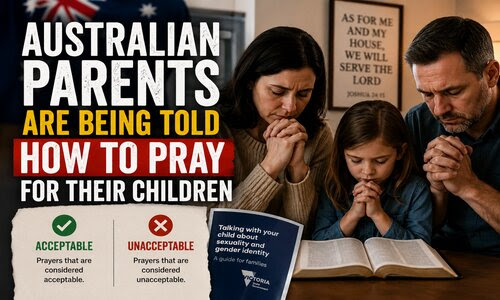
Imagine sitting down with your son or daughter, bowing your head in prayer, and wondering whether the government would approve of the words you are about to speak.
That may sound like something from a dystopian novel. Yet in the Australian state of Victoria, government guidance is now telling parents which prayers for their children are considered acceptable—and which are not.
The guidance, issued as part of the state’s approach to sexuality and gender identity, insists that people who identify as LGBTQA are not “sick or broken” and do not need to be “fixed.” It then reassures parents that they remain free to share their beliefs and values with their children.
But there is a catch.
According to the guidance, some forms of prayer may be considered harmful. The government has even outlined examples of prayers it considers acceptable and unacceptable.
Prayers for guidance, peace, reassurance, and reminders of God’s love are permitted.
Prayers asking God for a change in desires, for strength not to act on attractions, discussions of repentance, or prayers encouraging celibacy are not.
Pause and consider what that means.
This is no longer merely a debate about sexuality or gender identity. It is a debate about authority. Who gets the final say in the spiritual formation of a child—parents, God, or the state?
For Christians, the answer has always been clear.
God never intended parents to be mere providers of food, shelter, and education. He entrusted them with something far greater: the spiritual formation of the next generation.
In Deuteronomy 6, parents are commanded to teach God’s truth diligently to their children—to talk about it at home, on the road, in the morning, and at night. The family was designed to be the primary place where faith is taught, nurtured, and passed on.
That biblical responsibility does not disappear when a government agency publishes new guidance.
Yet what is happening in Victoria should concern believers far beyond Australia’s borders.
The issue is not simply whether one agrees with the government’s position. The larger concern is the growing belief throughout much of the Western world that governments should play an increasing role in determining which religious beliefs may be expressed, taught, or practiced.
The language is almost always the same: safety, inclusion, harm prevention, and protection. These goals may sound noble, but they often come with a hidden assumption—that the state has the authority to decide which moral convictions are acceptable and which are not.
Parents are told they have rights, but only within government-approved boundaries.
Churches are told they have freedom, but only if their teachings align with prevailing cultural values.
Christians are told they can practice their faith, but increasingly they are expected to do so quietly and without challenging the assumptions of the age.
History teaches that whoever shapes the next generation shapes the future. That is why the battle for children has become one of the defining struggles of our time.
The pressure comes through schools, media, technology, entertainment, legislation, and now, in some cases, guidance about family prayer itself.
Australia may simply be showing the rest of the Western world where these debates are heading.
For Christian parents, the challenge is not to respond with fear but with conviction. God has not delegated the responsibility of discipling children to bureaucrats, politicians, or cultural influencers. He has entrusted that responsibility first to mothers and fathers.
And that is why this story matters.
Because the real question is not whether governments can recommend what parents should say to their children.
The real question is whether parents will surrender a role that God Himself gave them.
The battle for the next generation is no longer on the horizon.
It has already arrived at the family dinner table.