Bible Prophecy, Signs of the Times and Gog and Magog Updates with Articles in the News


THERE WILL BE WARS AND RUMORS OF WAR = JESUS CHRIST


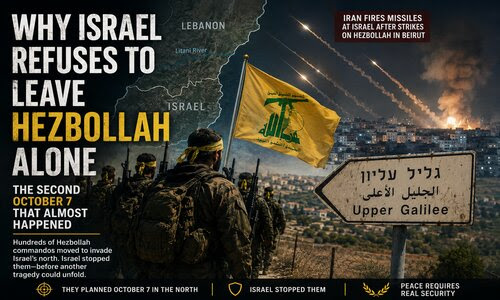
Why Israel Refuses To Leave Hezbollah Alone: Preventing Another October 7
As President Trump works to preserve a fragile peace process with Iran, the Middle East once again finds itself on the edge of a wider war.
Over the past 24 hours, Iran launched another round of missile attacks against Israel following Israeli strikes on Hezbollah targets in Beirut, threatening to unravel weeks of diplomatic efforts aimed at stabilizing the region. Israel has now retaliated destroying numerous Iranian targets across the country. Trump continues pushing for a broader agreement that could reduce tensions between Israel, Iran, and their respective allies, but the latest violence highlights a reality many outside observers fail to understand.
For Israel, the Hezbollah problem cannot simply be negotiated away.
To many diplomats, Hezbollah is merely one piece of a larger regional puzzle. To Israel, Hezbollah represents an existential threat sitting directly on its northern border–a threat that Israeli intelligence believes recently came within moments of carrying out a second October 7.
That context is critical to understanding why Israel continues to push aggressively against Hezbollah positions in Lebanon despite international pressure, ceasefire discussions, and ongoing peace negotiations. Israeli leaders are not simply fighting today’s battles. They are attempting to ensure that a nightmare they believe was narrowly avoided can never happen again.
The reason is chilling.
According to recent reports, hundreds of Hezbollah’s elite Radwan Force fighters moved toward Israel’s northern frontier during the recent conflict, advancing south of the Litani River as Israel was focused on confronting Iran. Their operational plan was reportedly known as “Conquer the Galilee”–a large-scale cross-border assault intended to overwhelm Israeli border communities, seize hostages, and inflict mass civilian casualties in a manner strikingly similar to Hamas’ October 7 massacre.
This was not a theoretical exercise.
For years, Hezbollah openly trained for precisely such an operation. Videos released by the group showed commandos storming mock Israeli villages. Senior Hezbollah leaders repeatedly boasted about one day “liberating the Galilee.” The Radwan Force, named after Hezbollah military commander Imad Mughniyeh, was specifically created as an elite assault force capable of penetrating Israeli territory and conducting offensive operations.
Following Hamas’ October 7 attack, Israeli intelligence began taking these threats far more seriously.
Then came reports that Hezbollah fighters were actually moving toward the border.
Fortunately for Israel, this time intelligence systems worked.
The IDF reportedly identified the infiltration in real time and launched operations that eliminated the attackers before they could reach a single Israeli community. The commander allegedly involved in planning the assault, Ahmed Ali Balout, was later killed in an Israeli strike in Beirut.
Had the operation succeeded, the consequences would have been catastrophic.
The physical casualties alone could have rivaled or exceeded those of October 7.
Many of Israel’s northern communities are smaller, more isolated, and located only minutes from the Lebanese border. A coordinated infiltration involving hundreds of trained commandos could have produced multiple simultaneous massacres, hostage-taking operations, and prolonged battles inside civilian neighborhoods.
But the psychological impact may have been even greater.
October 7 shattered one of Israel’s most deeply held assumptions–that its intelligence apparatus, technological superiority, and border defenses could prevent a mass infiltration attack.
A second successful invasion only months later would have completely destroyed public confidence.
Imagine the message it would have sent.
The south was attacked.
Then the north was attacked.
Entire communities would have questioned whether any border region could ever be secure again.
For a nation as small and interconnected as Israel, that type of trauma would reverberate for generations. Every family knows someone serving in the military. Every community is connected through networks of friends and relatives. A second October 7 would not simply have been another terrorist attack–it would have been a profound psychological blow to the very idea that Israel could protect its citizens.
This explains why Israel’s campaign against Hezbollah goes far beyond retaliation for rockets.
Israel’s objective is prevention.
For years, United Nations Resolution 1701 called for Hezbollah forces to remain north of the Litani River, approximately twenty miles from Israel’s border. The resolution was intended to create a buffer zone and reduce the likelihood of direct conflict.
In practice, Hezbollah steadily violated the agreement.
Weapons stockpiles expanded.
Observation posts appeared along the frontier.
Tunnels were constructed.
Elite Radwan units positioned themselves closer and closer to Israeli communities.
Many Israeli officials now believe those years of inaction helped create the conditions that nearly allowed a second October 7 to unfold.
That lesson has profoundly shaped Israeli military thinking.
The old strategy of deterrence has been replaced by a strategy of denial.
Rather than merely threatening retaliation after an attack occurs, Israel increasingly seeks to remove the capability for such attacks to happen in the first place.
This is why Israeli operations have focused heavily on dismantling Hezbollah command structures, eliminating Radwan Force leaders, destroying weapons depots, and pushing Hezbollah fighters farther north.
Critics often view these actions solely through the lens of current military operations.
Israel views them through the lens of what almost happened.
Every Radwan commander removed today may represent an attack prevented tomorrow.
Every weapons depot destroyed may eliminate the tools needed for a future massacre.
Every mile Hezbollah is pushed away from the border increases the difficulty of launching another “Conquer the Galilee” operation.
This reality also helps explain why Hezbollah remains central to any broader peace arrangement involving Iran.
Even if Trump succeeds in negotiating some form of ceasefire or regional understanding, Israel is unlikely to accept a situation where a heavily armed Iranian proxy remains positioned directly along its northern border with the capability to launch another large-scale ground invasion.
From Jerusalem’s perspective, peace agreements are only meaningful if they address the threats that could shatter that peace tomorrow.
October 7 changed Israel permanently.
The assumptions that guided security policy for decades were shattered in a single day.
The belief that hostile forces could be contained through diplomacy alone evaporated.
The willingness to tolerate heavily armed enemies operating a few miles from civilian communities disappeared.
Whether one agrees with every aspect of Israel’s strategy or not, understanding this reality is essential to understanding the conflict itself.
Israel is not simply fighting the last war.
It is trying to prevent the next one.
And according to recent reports, that next war nearly began when Hezbollah’s fighters moved toward the border with plans to bring October 7 to the Galilee.
This time, Israeli intelligence stopped them.
The question now hanging over every ceasefire discussion, every peace proposal, and every diplomatic initiative is whether the conditions that nearly allowed it to happen will be removed permanently–or whether the region is merely waiting for another opportunity for history to repeat itself.
Madness: Church Committees Protest Requirement That Clergy Be Monogamous
A denomination that spent years revising its teaching on sexuality is now discovering that once biblical authority is untethered from church doctrine, there is no obvious place to stop.
That is the real story behind the current debate in the Presbyterian Church (U.S.A.). The denomination, which has already affirmed same-sex marriage and ordained openly gay clergy, is now considering a proposal known as CON-10 that would require ordained ministers to be in monogamous sexual relationships. The proposal is aimed at stopping polyamory and polygamy, arguing that multi-partner relationships create power imbalances, emotional harm, and spiritual confusion.
What should be a straightforward affirmation of historic Christian teaching has instead become a controversy. Three official church advisory committees have criticized the proposal. One committee warned that requiring monogamy could “risk harm.”
Another argued that the measure reinforces systems of privilege. A third suggested the denomination should continue studying “diverse understandings of relationships.” Outside activist groups have gone further, describing the proposal as backward and hosting educational events on “faithful polyamory.”
The irony at the center of the dispute
The striking feature of this debate is not that a secular institution is questioning monogamy. It is that a church is struggling to defend it.
For nearly two thousand years, Christian teaching on marriage was remarkably consistent: sexual intimacy belongs within a covenant union between one man and one woman, marked by fidelity and exclusivity. Whatever disagreements Christians have had on other issues, the expectation that church leaders model sexual faithfulness has been foundational.
Yet the current debate frames even the requirement of monogamy as potentially oppressive. According to the committee statements, asking clergy to live within clear sexual boundaries may reinforce shame or regulate private lives in harmful ways.
But this raises an unavoidable question: if a church cannot tell its pastors that they must be sexually faithful to one spouse, what moral standard can it still meaningfully uphold?
The logic of endless revision
Supporters of the proposal argue that polyamory creates practical and pastoral problems. Multiple romantic partnerships often involve unequal commitments, competing loyalties, financial complications, and emotional instability. Even many secular relationship experts acknowledge the difficulties of sustaining multiple intimate relationships over time.
But the deeper issue is theological. Once the church treats historic sexual ethics as flexible, every remaining boundary becomes negotiable. The arguments now being used against monogamy requirements sound familiar because they echo the language used in earlier debates over sexual morality: traditional standards are said to cause harm, exclude people, or reflect cultural privilege rather than divine revelation.
That is why critics of the denomination see this controversy as a warning rather than an isolated dispute. They argue that abandoning Scripture as the final authority inevitably turns moral questions into political negotiations. What was once a matter of obedience becomes a matter of committee process, social analysis, and competing claims of identity.
Why leadership standards matter
The proposal is specifically about ordained leadership. Churches routinely require leaders to meet standards that go beyond what is expected of the surrounding culture. Ministers are entrusted with teaching, counseling, and spiritual authority. Their lives are meant to be examples of the faith they proclaim.
In that context, requiring monogamy is not an unusual intrusion into private life. It is a minimal expectation of sexual fidelity. The New Testament repeatedly links church leadership with moral character, self-control, and faithfulness in family life. Historic Christian traditions have understood those qualifications as applying not only to doctrine but also to conduct.
That is why many observers find the committee objections so startling. The debate is not over whether pastors should be celibate, or whether they should abstain from exploitative relationships. It is over whether they should be limited to one partner.
A denomination at a crossroads
The Presbyterian Church (U.S.A.) will vote on the proposal at its General Assembly. Whatever the outcome, the controversy exposes a deeper struggle within the denomination: whether biblical teaching sets the agenda for the church, or whether the church continually rewrites its moral framework in response to cultural pressure.
For conservative Christians, the answer is clear. Marriage is not a social experiment to be endlessly redefined. It is a covenant instituted by God, ordered toward fidelity, permanence, and exclusivity. Church leaders should not merely affirm that standard in theory; they should embody it in practice.
That is why many believers are watching this debate with disbelief. A church once known for proclaiming the authority of Scripture is now arguing over whether monogamy should be expected of its clergy. The fact that official church committees can describe such a requirement as potentially harmful reveals how far the conversation has shifted.
The tragedy is not that a church is debating polyamory. The tragedy is that defending monogamy now requires a formal proposal at all.
Christians who care about biblical authority should pray not only for the outcome of this vote, but for a broader recovery of confidence in Scripture. Without that foundation, every moral boundary eventually becomes negotiable, and every historic doctrine becomes subject to revision. The current controversy is less a beginning than a symptom of a much longer journey away from the church’s historic understanding of marriage and sexual ethics.
And if monogamy itself is now controversial, the question facing the denomination is no longer where the line should be drawn. It is whether any line grounded in biblical authority remains.
Drag Show Invasion: From High School Graduation Parties To Dog Shows

There was a time when graduation celebrations were fairly predictable. Students gathered with friends, received awards, signed yearbooks, took photos, and looked ahead to the next chapter of life. Parents and community volunteers organized post-graduation events designed to keep teenagers safe, entertained, and away from alcohol or dangerous behavior.
Today, however, something very different is happening.
At McMinnville High School in Oregon, graduating seniors attending a “Safe and Sober Grad Night” celebration were treated to Drag Queen Bingo hosted by Portland drag performer Poison Waters and other drag entertainers. According to promotional material, the event featured performances, humor, and special guest appearances as part of the evening’s activities.
The obvious question many parents are asking is simple: Why?
What exactly does drag performance have to do with academic achievement, graduation, or celebrating the successful completion of high school?
Graduation events are not random variety shows. Every element included in such celebrations sends a message about what a school community chooses to honor, promote, and normalize.
When drag performances become a featured attraction at a high school graduation celebration, many families understandably wonder why this particular form of entertainment is being elevated and presented to students as an appropriate centerpiece of the evening.
The issue is not merely whether drag performers have a right to exist or perform. In a free society, adults are free to attend whatever entertainment they choose.
The issue is why drag activism increasingly appears determined to insert itself into spaces that traditionally had nothing to do with it.
Schools. Libraries. Community festivals. Children’s story hours. Church events. Family gatherings.
Again and again, Americans are told that these performances are not simply an optional form of adult entertainment but something that should be incorporated into mainstream public life.
Many parents are growing weary of being told that questioning this trend makes them intolerant.
After all, if drag is simply entertainment, why does it seem to require constant promotion in institutions that exist primarily to educate children or serve families?
The trend extends far beyond schools.
This year, Denver Pride held its first Dog Drag Show, featuring dogs dressed in wigs, costumes, and elaborate drag-themed outfits while participating in a parade-style event.
The images quickly spread online as another example of a culture increasingly obsessed with turning everything into a political or ideological statement.
Even more fundamentally, many people asked a question that should be obvious: What do the dogs get out of this?
Animals have no understanding of Pride Month, drag culture, gender ideology, or political activism.
The costumes are not for the benefit of the pets.
They are for the benefit of the humans.
At some point society should be willing to ask whether every institution, every celebration, every hobby, and even every pet-related event must be transformed into another vehicle for ideological messaging.
The deeper issue is not really about drag queens or dogs.
It is about cultural saturation.
Americans are increasingly encountering the same themes in entertainment, advertising, education, sports, corporate marketing campaigns, government programs, and even religious institutions.
Many people feel they cannot escape it.
Those concerns are often dismissed as irrational or hateful, but they reflect a genuine frustration with a culture that appears unwilling to leave any space untouched.
When parents send their children to a graduation celebration, they expect the focus to be on the students.
When dog owners attend a pet event, they expect the focus to be on the animals.
When churchgoers attend worship services, they expect the focus to be on God.
Yet increasingly these institutions become platforms for advancing social and political causes that have little connection to their original purpose.
Perhaps that is why so many Americans are beginning to push back.
The debate is no longer merely about whether drag performances should exist. That question has largely been settled.
The new question is whether every public institution must become a stage for them.
Many families are concluding that there is a significant difference between tolerating something in society and actively promoting it everywhere.
Graduation celebrations should celebrate graduates.
Dog shows should celebrate dogs.
Churches should proclaim their faith.
Not every event needs to become another chapter in an ongoing culture war.
The growing backlash suggests that a substantial portion of the public believes those distinctions still matter.