Bible Prophecy, Signs of the Times and Gog and Magog Updates with Articles in the News
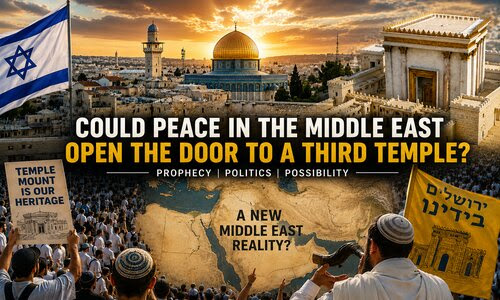
Could Peace In The Middle East Open The Door To A Third Temple?
The stones beneath Jerusalem are speaking again.
For decades, the Temple Mount was treated as a place too volatile to touch politically, spiritually, or prophetically. Jewish prayer there was heavily restricted, Jewish religious presence was intentionally minimized, and most Israelis avoided even ascending the mount altogether. But something has changed in recent years — and especially since the horrors of October 7th.
A growing wave of religious Zionism is sweeping across Israel as many Jews rediscover their Biblical identity, their covenant history, and their connection to the very place where the First and Second Temples once stood.
And with that rediscovery comes a renewed longing for the Temple itself.
That longing is no longer confined to fringe activists. It is becoming increasingly visible in Israeli society, politics, and public demonstrations. Temple Mount flags are appearing during Jerusalem Day celebrations. More politicians are intentionally visiting the mount. Rabbis are openly discussing preparations for future Temple worship. One rabbi recently even proposed establishing a synagogue on the Temple Mount itself as a step toward eventual restoration.
Rabbi Shmuel Eliyahu recently called on Prime Minister Benjamin Netanyahu and Israeli leadership to establish a synagogue directly on the Temple Mount as a first step toward expanded Jewish worship there. Speaking opposite the mount during Jerusalem Day events, Eliyahu declared that the Islamic structures currently standing there are tied to Israel’s exile and insisted that a future Jewish Temple will one day rise again.
To many secular observers, these developments may appear symbolic or political. But to students of Bible prophecy, they may represent something far more significant.
At the center of this growing movement is the long-standing “status quo” arrangement governing the Temple Mount — a fragile and controversial framework that has existed since Israel recaptured eastern Jerusalem during the Six-Day War in 1967.
After Israel regained control of the Old City and the Temple Mount, then-Defense Minister Moshe Dayan made the historic decision to leave administrative authority over the mount in the hands of the Jordanian Islamic Waqf. Israel retained overall security control, but Muslims would continue managing religious affairs at the site.
The arrangement was designed to prevent a wider religious war.
Under this unwritten “status quo,” Muslims were permitted to worship freely on the mount, while Jews and Christians could only visit during limited hours and were forbidden from conducting visible acts of worship. Jews could not pray audibly, bow, carry Torah scrolls, blow shofars, or openly engage in religious rituals on Judaism’s holiest site.
In theory, Israel’s 1967 Protection of Holy Sites Law guarantees freedom of access and worship for all religions. In practice, however, Jewish worship on the Temple Mount has remained heavily restricted for decades.
For years, most Jews accepted this arrangement — either out of political caution or rabbinical concerns regarding ritual purity. The Temple Mount became primarily a destination for foreign tourists while observant Jews often prayed below at the Western Wall instead.
But that reality is changing rapidly.
The recent arrest of 13 Jewish activists attempting to bring the Biblically mandated Shavuot bread offering onto the Temple Mount is only the latest sign of growing pressure against the status quo. According to reports, the activists breached security barriers carrying two loaves of leavened bread meant to fulfill the Biblical Shtei HaLechem offering described in Leviticus 23:17. Authorities quickly arrested them before the ritual could be completed.
Temple activists have been arrested several times in the past for attempts to bring Passover sacrifice-related items onto the mount.
These incidents are not isolated acts of religious extremism. They reflect a broader movement that increasingly believes Jews should fully reclaim worship rights at the site of the ancient Temples.
And the movement is growing.
More Jews are ascending the Temple Mount today than at any point in modern Israeli history. Organized Jewish tours now occur regularly. Religious activists openly advocate for expanded prayer rights. Israeli National Security Minister Itamar Ben-Gvir has repeatedly visited the mount and publicly called for ending restrictions on Jewish prayer there — triggering outrage across the Muslim world.
Prime Minister Benjamin Netanyahu continues insisting the status quo remains unchanged. Yet many observers recognize that gradual change is already underway. What once seemed politically impossible is increasingly becoming normalized.
Recent reports have added even more fuel to speculation that major changes surrounding the Temple Mount may eventually be considered. According to a report by Middle East Eye, discussions have allegedly taken place involving figures connected to the Trump administration and Israeli leadership regarding possible changes to Jordan’s long-standing custodianship over the Al-Aqsa Mosque compound.
The report claimed that a future arrangement could potentially reduce the authority of the Jordanian-backed Islamic Waqf and replace it with a new administrative framework tied more closely to Israel — one that could significantly expand Jewish prayer rights at the site and even reimagine the compound as a “multi-faith center.”
Middle East Eye cited unnamed American, Jordanian, Palestinian, Gulf Arab, and Western sources in its reporting. However, after publication, a U.S. official reportedly denied that Washington was actively working to remove Jordan from its custodial role, calling the claims “totally false.”
Still, regardless of whether such proposals are presently active, the mere fact that reports of this nature are now circulating publicly demonstrates how dramatically the conversation surrounding the Temple Mount has shifted in recent years. Ideas that once would have been dismissed outright are increasingly entering mainstream political and diplomatic discussion.
And this raises a larger prophetic question:
Could these developments eventually lead to the construction of a Third Temple?
For Christians who study Biblical prophecy, this question matters immensely because Scripture repeatedly points to a future Jewish temple existing in the last days. The prophet Daniel describes a coming desecration of the temple by the Antichrist. Jesus Himself referenced this future “abomination of desolation” in Matthew 24. The Apostle Paul wrote that the “man of sin” would one day sit in the temple of God proclaiming himself to be God.
A functioning temple is central to many end-times prophecies.
For decades, skeptics dismissed such ideas as impossible. The Temple Mount is home to the Islamic Dome of the Rock and Al-Aqsa Mosque — among the holiest sites in Islam. The political consequences of altering the site seemed unthinkable.
Yet the Middle East has repeatedly shown that what once appeared impossible can suddenly become reality.
The Abraham Accords dramatically reshaped regional politics. Open normalization between Israel and Arab nations would have been nearly unimaginable just years earlier. Now discussions are growing about expanding those agreements further once regional conflicts — including an end to the war with Iran — into some form of negotiated framework that could include the entire region. President Trump has already said this is on the table in the weeks ahead once peace with Iran is reached.
Could a future peace arrangement include religious concessions involving the Temple Mount?
Some Temple activists believe a Third Temple could potentially be constructed beside the Dome of the Rock rather than directly replacing it. Others believe archaeological evidence suggests the historic Jewish temples may have stood slightly north or south of the current Islamic structures, leaving room for coexistence.
Whether such proposals are realistic remains deeply debated. But the fact they are now being discussed openly at all is remarkable.
And perhaps that is the real story here.
The Temple Mount is no longer a dormant issue buried in ancient history. It is re-emerging as one of the most spiritually and geopolitically explosive subjects in the world. The push to change the status quo is accelerating. Religious Zionism is growing stronger. The desire for Jewish worship on the mount is intensifying. And the idea of a future temple — once considered fantasy — is steadily moving into mainstream discussion.
To Christians, this is not merely about politics or archaeology. It is about watching history move closer to the prophetic framework laid out thousands of years ago in Scripture.
The Temple Mount remains the most contested piece of real estate on earth because it sits at the intersection of God’s promises, human conflict, and future prophecy.
And events there may ultimately shape the final chapters of human history itself.
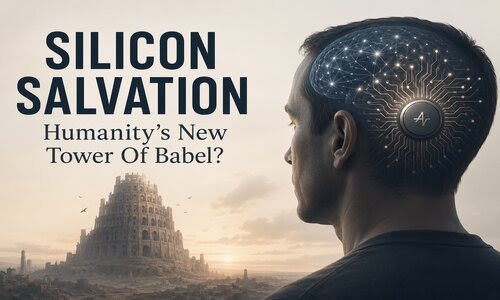
Silicon Salvation: Humanity’s New Tower Of Babel?
For thousands of years, humanity has pursued the same dangerous dream: to transcend its limitations without God.
From the Tower of Babel in Genesis to today’s race toward artificial intelligence, brain-computer interfaces, and digital immortality, mankind continues chasing the ancient temptation first whispered in the Garden of Eden: “You shall be as gods.”
What once sounded like science fiction is now openly discussed by some of the world’s most influential technology leaders. Elon Musk continues advancing brain-computer interface technology through Neuralink while warning about the dangers of uncontrolled AI. Meanwhile, Silicon Valley increasingly speaks in language that sounds less scientific and more spiritual.
Terms like “superintelligence,” “mind uploading,” “digital consciousness,” and “human enhancement” are no longer fringe concepts. Billionaires, researchers, and futurists openly discuss conquering death, transcending biology, and creating a post-human future.
That should make people pause.
For most of history, humanity accepted certain realities as unavoidable:
death,
weakness,
suffering,
aging,
limited intelligence.
Those limitations reminded mankind that we are not gods.
Now technology increasingly promises to erase them.
Across Silicon Valley, billions are being poured into anti-aging research, AI-assisted medicine, genetic engineering, and life-extension technologies. Some futurists speak about death itself as if it were merely a technical problem waiting to be solved.
Others go even further, envisioning a future where human consciousness can somehow be uploaded into machines, allowing a person to continue existing digitally after biological death.
Whether scientifically possible or not, the pursuit itself reveals something profound: humanity is once again searching for immortality apart from God.
That is not merely scientific ambition. It is spiritual ambition.
Artificial intelligence also represents mankind’s attempt to transcend intellectual limits. AI systems already outperform humans in many forms of analysis, pattern recognition, prediction, and information processing. Increasingly, society looks to algorithms for guidance on everything from investing and healthcare to morality and decision-making.
In many ways, AI is becoming a new source of authority.
People now ask AI:
how to think,
how to vote,
how to parent,
how to invest,
even how to understand spirituality itself.
The temptation will only grow stronger if AI becomes integrated directly into the human brain through neural interfaces. Imagine instant knowledge, enhanced memory, emotional regulation, or AI-assisted cognition connected to the mind itself.
The appeal would be enormous because it promises something humanity has always desired: expanded power and expanded knowledge.
Again, the parallels to Genesis are striking.
The temptation in Eden was not simply rebellion. It was the promise of elevated consciousness: “You shall be as gods, knowing good and evil.”
At the same time, the transhumanist movement increasingly portrays the human body itself as flawed hardware needing upgrades. Some openly describe biology as obsolete and argue humanity must evolve beyond its natural limitations through technology.
This radically changes how society views human identity.
Historically, faith emphasized humility, dependence on God, spiritual transformation, and redemption. Transhumanism increasingly emphasizes self-directed evolution, engineered perfection, and technological salvation.
One worldview seeks eternal life from God.
The other increasingly seeks it from machines.
That is why the comparison to the Tower of Babel resonates so deeply.
In Genesis 11, humanity united under one vision to build a tower reaching toward heaven, not to glorify God, but to glorify itself. Scripture says they sought to “make a name” for themselves. It was mankind unified through pride, ambition, and collective knowledge.
Today, the parallels are difficult to ignore.
Modern civilization is increasingly unified through global technology platforms, artificial intelligence, digital currencies, biometric identification, and surveillance systems. AI already shapes what billions of people see, believe, and consume every day. The next frontier now appears to be the human mind itself.
The concerns are no longer theoretical.
If neural interfaces eventually connect human thought to AI systems, privacy itself could fundamentally change. Today, companies collect your searches, purchases, location, and conversations. Tomorrow, could emotional states, impulses, or thought patterns become data as well?
The idea sounds extreme — until one remembers how quickly society normalized smartphones, social media surveillance, facial recognition, and algorithmic manipulation.
Convenience has become one of the most powerful forces in human history.
And many Christians see prophetic warning signs emerging alongside these technological advances. The Bible describes a future global system involving centralized control, economic regulation, deception, and the monitoring of buying and selling. For centuries, skeptics mocked such ideas as impossible.
Now the technological framework is visibly emerging before our eyes.
That does not mean every new technology is evil. Brain chips themselves are not automatically the “mark of the beast,” and Christians should avoid sensationalism. Medical breakthroughs that help suffering people can be genuine blessings.
But wisdom requires recognizing patterns.
Humanity increasingly places its hope in technological salvation rather than spiritual redemption. The modern Tower of Babel is not built with bricks and mortar. It is being constructed through servers, satellites, algorithms, neural networks, and perhaps eventually, the human mind itself.
The deeper issue may not simply be the technology, but the spirit behind it.
At what point does mankind stop using technology as a tool and begin using it as a substitute for God?