Bible Prophecy, Signs of the Times and Gog and Magog Updates with Articles in the News
When The Bible Becomes ‘Hate Speech’: A Wake Up Call For Christians
There are moments in a nation’s history when a law reveals far more than legal intent. It exposes the moral direction of a country. This week may prove to be one of those moments for Canada.
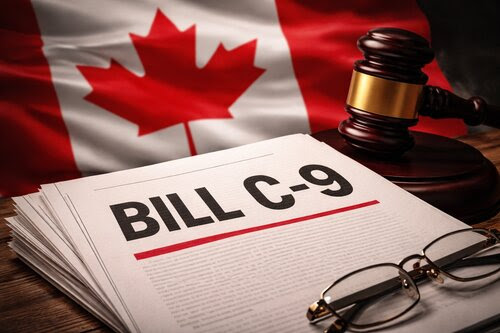
The passage of Bill C-9 through the House of Commons is not just another legislative development buried in the churn of parliamentary procedure. It is a flashing warning sign. For many Christians across Canada, it feels like something deeper is being put on trial — not merely “hate,” as the bill is framed, but biblical conviction itself.
Canadian MPs passed Bill C-9, the so-called “Combatting Hate Act,” in a 186-137 vote, sending it to the Senate after fierce opposition from Conservatives, the NDP, and the Green Party. Critics say the legislation removes long-standing safeguards that protected religious expression, particularly the ability to discuss or quote Scripture in good faith on contested moral issues.
Even the Canadian Conference of Catholic Bishops warned that removing the religious-text defense could create a “chilling effect” on clergy, educators, and believers who fear traditional biblical teaching could be interpreted as hate.
And that is exactly the concern.
This is not ultimately about whether Christians should be hateful — they should not. The Gospel is not a license for cruelty. Christians are commanded to speak the truth in love, not with contempt. But modern governments increasingly do not distinguish between hatred and disagreement, between abuse and belief, between malice and moral conviction. That is where this becomes dangerous.
Because once a government begins to treat historic Christian teaching as socially harmful by default, the path ahead becomes disturbingly clear.
What happens when a pastor preaches from Romans 1? What happens when a Christian school teaches that marriage is between one man and one woman? What happens when a youth leader tells a confused teenager that God created humanity male and female? What happens when a parent, counselor, or Christian teacher takes a biblical stand on sexuality or gender in a culture that increasingly considers such views beyond the pale?
For generations, those beliefs were not considered radical. They were mainstream Christian doctrine. Today, they are being recast as suspicious, intolerant, or even dangerous.
That is the real issue with bills like this. They often arrive wearing the language of compassion, safety, and public order. But once written into law, they can become tools for selective punishment. The text of a law may speak in broad terms, but its enforcement is often shaped by ideology, bureaucracy, activist pressure, and the political mood of the moment. Christians do not need to imagine a future where biblical speech is stigmatized — they are already living in the early stages of it.
And no, this does not mean every sermon will suddenly become a criminal case. That would be too simplistic. The greater threat may be subtler and, in some ways, more effective: self-censorship.
That is how freedom often dies in modern democracies — not first with prison cells, but with silence.
Silence from churches afraid of complaints. Silence from Christian teachers afraid of losing jobs. Silence from parents afraid of school boards. Silence from ministries afraid of being investigated, deplatformed, defunded, or dragged through expensive legal battles. When the state creates enough ambiguity around what can be said, many people stop saying anything at all.
And if Christians can no longer freely proclaim what Scripture teaches about sin, repentance, identity, marriage, and salvation, then the Gospel itself begins to be fenced in by the state.
That is not a small matter.
Christianity is not merely a private spirituality built around vague kindness. It is a truth claim. It declares that Jesus Christ is Lord, that all people are called to repent, and that God — not government, not culture, not popular consensus — defines what is good, holy, and true. That means Christianity will inevitably collide with any political system that demands moral conformity to state-approved beliefs.
And that collision now appears to be intensifying in Canada.
None of this means Christians should respond with panic or rage. But they should respond with clarity.
The church has survived emperors, censorship, exile, mockery, and persecution before. It can survive Parliament too. But survival is not the same as passivity. This is a moment for Christians in Canada to understand what is at stake and refuse to be intimidated into theological surrender.
Because once believers begin softening the Bible to remain legally comfortable, they are no longer defending religious liberty — they are negotiating away truth.
There is also a broader national cost here. A society that criminalizes or suppresses deeply held religious conviction is not becoming more tolerant. It is simply replacing one moral framework with another and using state power to enforce it. That is not pluralism. That is coercion dressed in modern language.
A free nation must allow its citizens to say things the ruling class finds offensive, especially when those beliefs are rooted in centuries-old religious tradition and expressed without violence or malice. If Canada loses that principle, Christians will not be the only ones eventually affected. Once governments gain the power to police moral speech, the circle of forbidden opinion rarely stays small.
Today it may be biblical teaching on marriage and gender.
Tomorrow it may be something else entirely.
This is why so many believers are not merely disappointed by Bill C-9 — they are deeply troubled by what it represents. It is not just a policy disagreement. It is another signal that biblical Christianity is increasingly being treated not as a protected faith, but as a problem to be managed.
And Christians should not ignore that.
The bill now heads to Canada’s rubber-stamp Senate for review — a chamber filled largely with unelected, Liberal-appointed senators who hold immense power without ever facing voters, making the outcome feel all but predetermined.
The question now is whether the church will bend with that pressure — or stand.
Because a Gospel that cannot speak clearly is not being protected.
It is being contained.
A Church Chasing Relevance Has Lost Its Reason To Exist
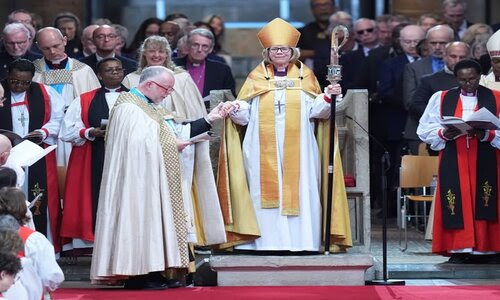
The installation of Sarah Mullally as Archbishop of Canterbury was supposed to project dignity, history, and hope. Instead, it exposed, once again, just how far the Church of England has drifted from biblical Christianity — and why so many believers now view the institution less as a church and more as a fading religious bureaucracy desperately trying to keep up with the age.
Sarah Mullally became the 106th Archbishop of Canterbury and the first woman ever to hold the office, in a ceremony staged with all the grandeur of Anglican tradition and all the theological confusion of modern liberal Protestantism.
That contradiction lies at the heart of the problem. The Church of England still dresses itself in the robes of historic Christianity, still speaks in the language of apostolic continuity, still places its leaders in ancient chairs and surrounds them with centuries-old ritual — yet increasingly empties those symbols of their original meaning. It wants the authority of tradition while simultaneously rejecting the authority that tradition was supposed to preserve: the Word of God.
Dame Sarah Mullally’s supporters will frame this as a triumph of progress, inclusion, and “representation.” That is precisely the issue. In Scripture, the Church is never told to organise itself around representation politics or cultural symbolism. It is told to order itself according to God’s revealed will. For many Bible-believing Christians, this installation was not a breakthrough but a public declaration that the Church of England now believes cultural validation matters more than biblical fidelity.
And if anyone doubted the direction of travel, the ceremony itself made it unmistakably clear.
Reports from the service noted a carefully choreographed display of multicultural and ecumenical inclusivity: prayers in Urdu, music in Xhosa, and broad gestures toward the Church’s global and interfaith-facing identity. Even a Bible reading was delivered by the Roman Catholic Archbishop of Westminster, while Mullally wore the episcopal ring once given to Michael Ramsey by Pope Paul VI — a deeply symbolic gesture for anyone who understands the theological fault lines of the Reformation.
To some, those details will seem harmless, even beautiful. But to many evangelicals and Protestants who still care about doctrinal clarity, they signal something far more troubling: a church more interested in theatrical unity and institutional image than in truth. Biblical unity is not built on shared ceremonies, symbolic accessories, or carefully managed optics. It is built on shared submission to the truth of God. When a church begins to confuse pageantry with faithfulness, decline is not far behind.
Then there was the ceremony’s internal symbolism — arguably even more revealing than its ecumenical flourishes.
A particularly striking feature of the day was the prominent role played by the Dean of Canterbury, the Very Rev. David Monteith, who formally helped lead the cathedral proceedings surrounding the archbishop’s transition and installation. Canterbury Cathedral itself has openly noted his senior role in the cathedral’s governance and ceremonial life, and it was Monteith who previously oversaw the formal election process that moved Mullally toward this office.
Why does that matter? Because Monteith’s own appointment was controversial among orthodox Anglicans precisely because he is in a same-sex civil partnership, something publicly acknowledged by Canterbury Cathedral at the time of his appointment.
That fact should not be mentioned as a cheap personal jab, but it is profoundly relevant to the theological symbolism of the moment. For conservative Christians, the ceremony was not merely about a woman being installed as Archbishop of Canterbury. It was also another visible reminder that the Church of England’s senior leadership culture has become increasingly detached from historic Christian sexual ethics and increasingly comfortable showcasing that detachment at the very center of Anglican life.
That is why so many believers no longer see these events as isolated controversies. They see a pattern.
A female archbishop. A cathedral establishment comfortable elevating leaders in same-sex partnerships. An institution that has spent years bending over backward to signal modernity while simultaneously collapsing in moral authority. This is not about one personality or one ceremony. It is about a church hierarchy that appears far more concerned with elite approval than with repentance, holiness, and the proclamation of the Gospel.
And while all of this was unfolding, the shadow of scandal still hung over the day.
Mullally’s inaugural message included solemn words about abuse, victims, and the Church’s failures — words that, in themselves, were necessary and right. She spoke of truth, compassion, justice, and action. But those phrases now land in a church environment where trust has already been badly shattered. Her predecessor, JustinWelby, resigned under heavy criticism over his handling of abuse-related failures, and Mullally now inherits an institution still deeply damaged by its safeguarding crisis.
That is another reason why the triumphalism surrounding this installation rings hollow. The Church of England is not in a season that calls for self-congratulation. It is in a season that calls for sackcloth and ashes. It does not need another carefully branded “historic first.” It needs repentance, courage, and a willingness to stop lying to itself about why it has become so spiritually anemic.
And that brings us to the larger issue: relevance.
The modern Church of England elite keeps behaving as if the great crisis of our age is that Christianity might appear too narrow, too traditional, too doctrinal, too male, too old, too Western, or too certain. So it keeps remodeling itself to look more palatable to a post-Christian culture. But that strategy has failed for decades. It has not produced renewal. It has produced collapse.
Britain is not starving for a more fashionable church. Britain is starving for truth.
Young people are not ultimately searching for a more curated liturgy or a more “inclusive” ecclesiastical brand. They are asking the deepest questions human beings can ask: Why am I here? What is truth? What is wrong with the world? Is there judgment? Is there forgiveness? Is there hope beyond death? The answer to those questions will never be found in institutional reinvention. They will only be found in Jesus Christ and the unchanging authority of His Word.
That is why this ceremony felt so empty to so many Christians watching from the outside. It had grandeur, symbolism, and history. But it lacked the one thing that could have made it matter: unmistakable submission to Christ above the spirit of the age.
If the Church of England truly wanted to be relevant, it would stop chasing relevance.
It would preach repentance instead of self-expression. Holiness instead of accommodation. Obedience instead of aspiration. Christ instead of cultural applause.
Until then, ceremonies like this will continue to make headlines — and continue to prove just how spiritually irrelevant the Anglican establishment has become.
Pentagon planning for extended ground operation in Iran

The US Defense Department is reportedly drafting plans for weeks of ground combat in Iran as thousands of Marines arrive in the region.
The United States Defense Department has drafted plans for a possible ground campaign in Iran that could last for weeks, even as President Donald Trump has not yet decided whether to authorize any such escalation, according to American officials familiar with the deliberations.
In a report published by The Washington Post, officials speaking on condition of anonymity said that the plans under consideration do not involve a full-scale invasion, but instead rely on limited operations such as raids by Special Operations forces and conventional infantry units.
Officials said the preparations have been underway for weeks and are intended to give Trump a wide range of military options as the war enters a potentially more dangerous phase.
Any US ground operation in Iran would inevitably expose American forces to major risks, including Iranian drones, missiles, ground fire and improvised explosives. Among the scenarios reportedly being discussed inside the administration are the seizure of Kharg Island, Iran’s main oil export hub in the Persian Gulf, and raids on coastal military sites near the Strait of Hormuz, with the aim of destroying weapons that threaten commercial and military shipping.
Satellite imagery shows heavy damage at Khamenei compound
The White House has emphasized that planning does not mean a final decision has been made. Press secretary Karoline Leavitt said it is the Pentagon’s job to prepare options for the commander in chief, while emphasizing that Trump has not committed to a course of action.
The administration’s messaging in recent days has been decidedly mixed.
On the one hand, Trump and senior administration officials have suggested that the war may be nearing its end and signaled interest in negotiating a ceasefire.
On the other, American officials have warned that the United States could sharply intensify its response if Tehran refuses to abandon its nuclear ambitions and threats against the US and its allies.
Secretary of State Marco Rubio said Friday that the conflict is not expected to become prolonged and argued that Washington can achieve its goals without deploying ground troops.
Trump himself said earlier this month that he was not planning to send troops into Iran, while adding that he would not publicly disclose such a move in advance if he were.
Despite the ambiguous public stance of US officials, the American military presence in the region has grown.
Thousands of additional personnel have arrived in recent weeks, including the 31st Marine Expeditionary Unit, a force of roughly 2,200 sailors and Marines with the capacity to conduct rapid assault missions.