
Bible Prophecy, Signs of the Times and Gog and Magog Updates with Articles in the News
AI Prophets: Could AI Become The Oracle Of The Beast System?
Every civilization has had its oracles.
In ancient Greece, kings traveled to Delphi to consult the Oracle of Apollo. In Babylon, rulers relied on astrologers and diviners to interpret signs in the heavens. Pharaoh’s court included magicians and wise men who claimed insight into mysteries beyond human understanding.
Humanity has always longed for a voice that could answer life’s most difficult questions: What should we do? Where is the world headed? Who can guide us through uncertainty?
Today, that voice may be emerging from an unexpected place–not from temples or altars, but from servers, algorithms, and neural networks.
Artificial intelligence.
What began as a technological tool to process data and automate tasks is rapidly evolving into something far more influential. Millions now interact with AI systems daily, asking questions about finances, relationships, medical concerns, and personal struggles. Increasingly, they ask about morality, purpose, and spiritual meaning.
For a generation accustomed to instant answers, artificial intelligence is beginning to feel like a trusted counselor–always available, always responsive, and seemingly capable of answering anything.
Yet this raises profound questions. If billions begin relying on machines for wisdom, what happens to traditional spiritual authority? What happens to truth itself?
For students of Bible prophecy, an even deeper question emerges: could artificial intelligence eventually function as a kind of global oracle–an authority offering guidance and moral instruction for the world?
The possibility may sound futuristic, but the cultural groundwork is already being laid.
The Rise of Digital Counsel
Artificial intelligence has quietly entered one of the most personal areas of human life: decision-making. AI-powered chatbots assist users with everything from writing emails to navigating emotional struggles. Many people now seek advice about relationships, career decisions, and mental health from these systems.
Surveys show a growing number of young adults say they are just as comfortable asking artificial intelligence for spiritual advice as they are asking clergy. For many, consulting AI has become second nature.
Part of the appeal is convenience. Artificial intelligence is always available. It answers instantly and offers responses without embarrassment or judgment. In an increasingly isolated society where trust in institutions is declining, digital guidance can feel comforting.
But convenience alone does not explain the deeper shift.
When people begin seeking answers from algorithms instead of spiritual authorities, the cultural understanding of wisdom begins to change. Authority gradually migrates from scripture and tradition to technology and data.
The Bible reminds us that wisdom has a specific source:
“The fear of the Lord is the beginning of knowledge, but fools despise wisdom and instruction.” (Proverbs 1:7)
True wisdom begins with reverence for God. Yet in a world shaped by technological solutions, many now look first to machines rather than the Creator for answers.
Artificial intelligence may not intentionally replace spiritual authority, but its growing influence has the potential to reshape how society seeks truth.
Religion Meets the Algorithm
Artificial intelligence is not only answering spiritual questions–it is beginning to enter religious environments themselves.
Some churches have experimented with AI-assisted sermon preparation or biblical research tools. These systems can organize thoughts and analyze large amounts of information quickly, functioning much like digital commentaries.
Yet the line between assistance and authority can become dangerously thin.
In Japan, researchers created a robotic Buddhist monk capable of delivering sermons and answering questions about spiritual philosophy. The project was intended to help temples cope with declining clergy numbers, but it illustrates how easily machines can begin filling roles once reserved for spiritual leaders.
Elsewhere, experimental AI chatbots trained on religious texts now provide automated responses to theological questions. Some users consult them as if they were digital pastors.
These developments raise an important question: if machines begin shaping religious instruction, who shapes the machines?
Algorithms are trained on datasets compiled by human developers. The perspectives embedded within those datasets inevitably influence the answers AI provides. If artificial intelligence becomes a widespread source of spiritual instruction, those controlling the technology may indirectly influence how millions interpret faith and morality.
The apostle Paul warned Timothy that a time would come when people would abandon sound doctrine and seek teachers who tell them what they want to hear (2 Timothy 4:3).
The Rise of AI Spirituality
What makes this trend particularly striking is how quickly it is evolving from curiosity into something resembling digital spirituality.
Some people already interact with AI systems as if they were spiritual guides, asking questions about the meaning of life, destiny, and the nature of the universe. Others use AI-generated responses as affirmations or meditations.
In certain circles, artificial intelligence is even described using language once reserved for divine attributes. It is praised for its vast knowledge, constant availability, and ability to process enormous amounts of information instantly.
Scripture reminds us that humanity has always been prone to replacing the worship of the Creator with devotion to created things. Paul wrote that people “changed the glory of the incorruptible God into an image made like corruptible man” (Romans 1:23).
Throughout history, idols have taken many forms. Sometimes they were carved from wood or stone. Today, they may be constructed from silicon and code. The danger is not that artificial intelligence possesses divine qualities–it does not–but that people may begin treating it as if it does.
This fascination reflects an ancient temptation: the pursuit of hidden knowledge apart from God. From the Garden of Eden onward, humanity has been drawn to the promise of secret insight. The serpent tempted Eve with the words, “you will be like God, knowing good and evil” (Genesis 3:5).
Artificial intelligence may simply provide a new vehicle for that same deception. Because AI responses appear intelligent and articulate, users can easily forget that the machine does not truly understand the questions being asked. It merely analyzes patterns in data and generates likely responses. Yet the interaction can feel personal and insightful.
As developers create AI companions capable of remembering conversations and simulating empathy, the line between tool and guide may continue to blur.
Jesus warned that the last days would be marked by widespread deception: “Take heed that no one deceives you” (Matthew 24:4).
Authority Without Accountability
Another concern emerging from algorithmic authority is accountability.
When a pastor teaches falsely, he can be confronted. When a political leader makes harmful decisions, the public can demand answers. Human authority carries responsibility. Artificial intelligence exists in a gray area where responsibility becomes difficult to trace.
If an algorithm denies someone a loan, makes a faulty medical recommendation, or shapes public opinion through biased outputs, who is responsible? The developer? The corporation? The government? Or the machine itself?
As decision-making becomes increasingly automated, responsibility becomes blurred while the authority of the system expands.
The prophet Jeremiah warned, “Cursed is the man who trusts in man and makes flesh his strength, whose heart departs from the Lord” (Jeremiah 17:5).
Artificial intelligence may never be worshiped in the way ancient idols were, but if people begin trusting its judgments above all other sources of wisdom, the effect may be similar.
Spiritual authority would no longer come primarily from scripture. It would come from code.
The Allure of a Digital Oracle
The appeal of such a system is understandable. Humanity has always struggled with uncertainty. Moral questions are complex, and ethical dilemmas require careful thought. Artificial intelligence appears to eliminate that struggle.
Ask a question, and an answer appears instantly. The response sounds polished and authoritative. For people accustomed to instant information, the experience can be persuasive.
Over time, the speed and confidence of AI responses may create the impression that the machine possesses genuine wisdom. Yet confidence is not the same as truth.
Proverbs reminds us:
“Trust in the Lord with all your heart, and lean not on your own understanding; in all your ways acknowledge Him, and He shall direct your paths” (Proverbs 3:5-6).
Artificial intelligence can generate language, but it cannot guide a human life according to divine wisdom. The ancient world consulted oracles in temples. The modern world may consult algorithms on smartphones.
The Prophetic Implications
Revelation describes a powerful world leader known as the Beast and another figure often called the False Prophet, who persuades the world to follow him.
One intriguing element involves the “image of the beast.”
“He was granted power to give breath to the image of the beast, that the image of the beast should both speak and cause as many as would not worship the image of the beast to be killed” (Revelation 13:15).
For centuries, interpreters debated what this meant. Some imagined a statue brought to life through supernatural power. Others interpreted the image symbolically. Yet in a technological age, the description takes on new possibilities.
Artificial intelligence already generates speech, interacts with users, and responds to questions. Combined with global communication networks, an advanced system could theoretically address billions of individuals simultaneously.
Scripture does not identify artificial intelligence as the mechanism behind the image of the beast, but modern technology demonstrates how rapidly the tools for global persuasion are developing.
The Global Scale of AI Influence
Artificial intelligence also operates on an unprecedented scale.
Throughout history, influential leaders shaped the beliefs of nations, but their reach was limited by geography. AI faces no such limitations. Through smartphones, computers, and connected devices, AI systems already interact with billions of people daily. Digital assistants guide research, businesses rely on algorithmic analytics, and educational platforms use AI to personalize instruction. The result is a world increasingly shaped by algorithms.
Daniel once prophesied that in the last days “many shall run to and fro, and knowledge shall increase” (Daniel 12:4).
Artificial intelligence represents the next stage in that expansion. Machines now organize and present enormous amounts of information to humanity. If such systems become trusted sources of guidance, their influence could surpass that of any institution in history.
A Tool or a Master?
Artificial intelligence itself is not inherently evil. Technology is simply a tool.
Throughout history, innovations have brought enormous benefits, and AI has already contributed to advances in medical research, disaster response, and scientific discovery. The real issue lies in how humanity chooses to use the technology. Will artificial intelligence remain a servant of human wisdom? Or will society gradually surrender authority to machines?
History shows that powerful technologies often reshape society in ways people never anticipated.
The True Source of Wisdom
From a biblical perspective, the rise of artificial intelligence should encourage discernment rather than fear.
Jesus warned that the last days would be marked by powerful deception: “Take heed that no one deceives you” (Matthew 24:4).
Artificial intelligence can shape narratives and influence how people interpret events, potentially amplifying misleading ideas in an already information-saturated world.
For that reason, believers must remain anchored in scripture rather than shifting cultural authorities. The Bible reminds us that genuine wisdom cannot be manufactured by human ingenuity. Artificial intelligence can process vast amounts of data, but it cannot understand the human soul. It cannot offer forgiveness, redemption, or eternal hope.
The psalmist wrote:
“Your word is a lamp to my feet and a light to my path” (Psalm 119:105).
That light does not come from algorithms. It comes from the Word of God.
Humanity may build astonishing machines, yet no algorithm will ever replace the wisdom that comes from the Creator. And in a world filled with digital voices competing for authority, remembering that truth may matter more than ever.
Finland Just Showed The Christian World What To Expect From Hate Speech Laws
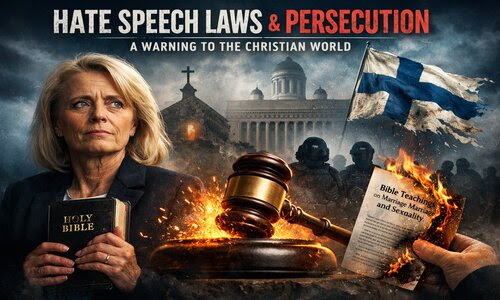
We recently warned readers about what is unfolding in Canada with Bill C-9. At the time, many likely saw it as just another distant political fight — troubling, yes, but still theoretical. Now Finland has shown the Christian world exactly what these laws look like when they are fully unleashed.
This is what “hate speech” laws become in practice.
Not a shield against violence.
Not a guardrail against chaos.
Not a narrow tool used only against genuine threats.
They become a weapon against Christians who dare to say out loud what the Bible says plainly.
And if Democrats ever regain full power in the United States and continue down the path of criminalizing dissent under the language of “harm,” “inclusion,” and “safety,” Christians should not fool themselves into thinking America is somehow exempt. The same legal logic now devouring Europe and Canada would be imported here as quickly as activist judges, bureaucrats, and cultural institutions could manage it.
Finland has just handed the West a warning — and many still won’t hear it.
After a seven-year legal ordeal, former Finnish Interior Minister Päivi Räsänen was found guilty by Finland’s Supreme Court for “hate speech” over a Christian pamphlet written more than two decades ago. Think about that for a moment. A 22-year-old publication — written long before the current sexual ideology had become untouchable state dogma — was dragged back into court and treated like contraband.
That alone should send a chill through every Christian, pastor, ministry, publisher, and church leader in the Western world.
Because once a government decides that biblical morality can be reclassified as “harm,” there is no real limiting principle left.
Räsänen was acquitted on one charge related to her 2019 social media post quoting Scripture, but convicted over a 2004 church booklet defending the biblical understanding of sex and marriage. In an astonishing act of state censorship, the court ordered the material removed from public access and destroyed.
Destroyed.
That word matters.
Because this is no longer just about debate. This is no longer about “coexistence.” This is about erasing ideas that the progressive state finds intolerable.
And the most frightening part is how openly arbitrary the ruling appears to be.
Räsänen’s own lawyer, Matti Sankamo, warned that the consequences of this case could extend far beyond one pamphlet or one politician. In his view, the ruling now opens the door for “any booklet or pamphlet or writing, within twenty years ago,” to potentially be reexamined and criminalized in Finland. That means old sermons, archived ministry resources, forgotten church publications, faith-based teaching materials, and decades of Christian writing may now sit under a cloud of legal uncertainty.
That is how free societies begin to rot from the inside.
Not all at once.
Not with dramatic headlines at first.
But through the quiet creation of a legal atmosphere where everyone knows the state can come back later and punish what was once perfectly lawful speech.
This is precisely why hate speech laws are so dangerous. They are never truly about protecting society from obvious evil. They are about creating vague moral categories that can be expanded whenever those in power decide they no longer want to tolerate dissent.
And as one member of Räsänen’s legal team pointed out, that danger is now impossible to ignore.
What stood out most in this case was just how subjective these laws really are. Over the course of seven years, multiple judges reviewed the same material — and came to radically different conclusions. Three district court judges acquitted her on all charges. Three appeal court judges acquitted her on all charges. And even at the Supreme Court level, the court was split.
That means this was never some obvious criminal offense.
It was a political and ideological judgment disguised as law.
In total, only a tiny minority of judges across the entire legal process found this decades-old Christian pamphlet worthy of criminal punishment — yet that was enough to produce a conviction, a fine, and the destruction of published material. That should terrify anyone who still believes “hate speech” laws are safely limited or fairly applied.
Because what does this really mean?
It means judges can now go through Christian writing line by line and effectively declare:
You may say this sentence.
You may not say that one.
This phrase is acceptable.
That phrase is criminal.
That is not freedom of speech.
That is ideological licensing.
It is the state assuming the role of moral editor over Christian truth claims.
And once that standard is accepted, every believer should understand what comes next. Today it is a pamphlet. Tomorrow it is a sermon clip. Then a youth curriculum. Then a Christian school statement of faith. Then a pastor’s social media post. Then a conference message. Then perhaps even a Bible study handed out in the wrong context to the wrong offended person.
This is how speech control expands: one “reasonable” case at a time until the boundaries of acceptable belief are drawn not by Scripture, not by conscience, and not by liberty — but by activists and courts.
That is why this case matters so much more than one fine in Finland.
It is a warning shot to every Christian nation still naïve enough to believe that “Western democracy” automatically protects biblical conviction.
It does not.
Not when the ruling class no longer believes freedom exists to protect truth, but only to protect approved narratives.
And yet, in the middle of all of this, Päivi Räsänen has shown something increasingly rare in the modern West: courage without bitterness.
Despite years of prosecution, police interrogations, public smears, and the possibility of criminal penalties, she has not emerged defeated in spirit. In fact, one of the most powerful parts of this entire saga is that she refuses to describe it as meaningless suffering.
She said she is “very convinced that this process has not been in vain,” and shared that she has received “thousands and thousands of messages” from people who were encouraged by the case — people who were driven to read the Bible, to pray, and even to come to Christ.
That is remarkable.
The Finnish state intended this prosecution to silence Christian witness. Instead, it gave Räsänen a larger platform to proclaim the Gospel.
And her response to this ruling may be the most powerful line of all.
Dangers Of Event Manipulation As Trading On Everything Becomes Reality
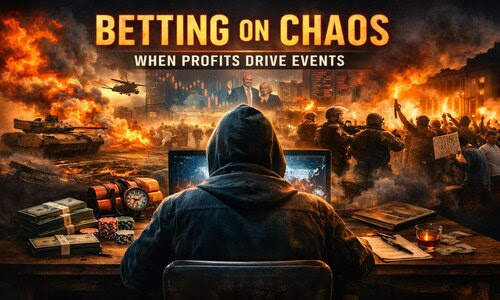
We are entering an era where more and more of real life can be turned into a tradable event — war, political collapse, resignations, sanctions, unrest, military strikes, economic panic, leadership changes, and national emergencies. Not every platform allows the most explicit forms of betting on violence or death. Some do impose restrictions. But that should not reassure anyone too much.
Because the real danger is not just what can be bet on directly.
It is what can be financially incentivized indirectly.
And once enough money is attached to fragile events, the temptation is no longer only to predict what happens next.
It becomes the temptation to help make it happen.
That is a very different kind of threat. And if society keeps normalizing this trend, it will not just create a new class of speculators. It could create a new class of people who see crisis, instability, and even bloodshed as opportunities to engineer profit.
That is not a small ethical concern.
That is a civilizational warning sign.
Most people hear about prediction markets or political betting and think first of the obvious danger: insider trading. That concern is completely legitimate. If someone has advance access to military plans, government decisions, criminal investigations, election strategy, or corporate actions, and then uses that information to place bets before the public knows, that is corruption in one of its purest forms.
It is not clever.
It is not innovation.
It is monetized secrecy.
And there is already enough suspicious behavior surrounding some of these markets to make it impossible to dismiss the concern. Strange timing. Unusually well-placed trades. Massive wagers appearing before major geopolitical developments. Patterns that make ordinary people wonder whether some traders are simply lucky — or whether they are seeing things the public cannot.
That alone is serious.
But it may not even be the worst part.
Because the more dangerous issue is not just insider information.
It is event manipulation.
That is where this story becomes much darker.
Even if a platform does not allow a blunt market asking whether a leader will be assassinated or whether a terrorist attack will occur, it may still allow markets built around adjacent outcomes: whether a leader will be removed from office, whether a ceasefire will collapse, whether a military strike will happen before a certain date, whether a government will fall, whether a national emergency will be declared, or whether unrest will spread.
That distinction may satisfy lawyers.
But it does not remove the moral hazard.
Because if someone can make a fortune when a fragile event breaks one way instead of another, then suddenly there is a financial incentive attached to instability itself.
And that changes human behavior.
If a person stands to gain millions from a war expanding, what might they be tempted to leak, provoke, distort, or encourage?
If someone is heavily positioned on whether a politician resigns or is forced out, what kinds of pressure, blackmail, rumor campaigns, or manufactured scandals become more attractive?
If a market pays out on whether a ceasefire collapses, how long before bad actors begin seeing diplomacy not as a goal — but as an obstacle to their trade?
If contracts can be built around unrest, sanctions, panic, shortages, or political upheaval, then suddenly disorder itself starts acquiring a market value.
That is where this becomes poisonous.
Because a system like this does not merely reward foresight.
It can begin rewarding sabotage.
That is not an exaggeration. It is how incentives work.
For years, society has understood that money can corrupt sports. We have seen point-shaving scandals, fixed outcomes, manipulated officiating, and players willing to compromise integrity when enough cash was on the table. Why? Because whenever an event becomes financially valuable, pressure builds around the event itself.
Now take that same corrupting principle and apply it not to a basketball game — but to an election.
Or a war.
Or a leadership crisis.
Or a public panic.
Or a geopolitical standoff between nuclear powers.
That is what makes this new world so dangerous. It extends the logic of gambling and speculative finance into areas that are not supposed to be turned into monetized entertainment or tradable opportunities.
And the pool of people who could be tempted by that incentive is much larger than most people realize.
It is not just spies and generals.
It could be campaign staffers. Bureaucrats. Corporate insiders. Political operatives. Contractors. Journalists. Social media manipulators. Hackers. Activists. Ideologues. Foreign intelligence assets. Anonymous online networks. Disgruntled insiders. Opportunists with access.
In a world where almost any major event can be transformed into a contract, anyone with proximity to disruption becomes a potential participant in a market-driven incentive structure.
A leaked memo can become a payday.
A strategic rumor can become a payday.
A manipulated video can become a payday.
A hacked email can become a payday.
A delayed statement can become a payday.
A staged incident can become a payday.
A panic-triggering lie can become a payday.
That is not healthy market innovation.
That is moral decay with a price chart.
And perhaps the most disturbing part is how casually all of this is being discussed in some circles. It is often framed as just another frontier of information efficiency — a smarter way to forecast the future, aggregate sentiment, or price probabilities.
That sounds sophisticated.
But it misses the central danger completely.
There is a major difference between observing reality and financially incentivizing its collapse.
A thermometer measures a fever.
It does not create one.
But if enough people can get rich when the fever gets worse, eventually some of them will be tempted to spread the infection.
That is the problem.
Markets are not morally neutral when they begin placing cash rewards on instability. They shape behavior. They influence what people tolerate. They create incentives that did not exist before. And when enough money is involved, those incentives do not stay theoretical for long.
That is why this issue cannot be dismissed as merely a niche concern for finance people, crypto traders, or online gamblers. It is much bigger than that.
This is about whether society is willing to allow war, collapse, unrest, and political breakdown to become just another speculative asset class.
It is about whether we are comfortable living in a world where some people do not merely fear disaster — but quietly need it.
That is the road we are drifting toward.
And if we do not draw clearer moral and legal lines, we may eventually discover that the most dangerous thing about betting on major events was never just that some people could profit from knowing what would happen next.
It was that sooner or later, some people would decide they would rather be the reason it happened.