Bible Prophecy, Signs of the Times and Gog and Magog Updates with Articles in the News
Trump’s Board Of Peace Explained: Many Layers, One Huge Risk For Israel
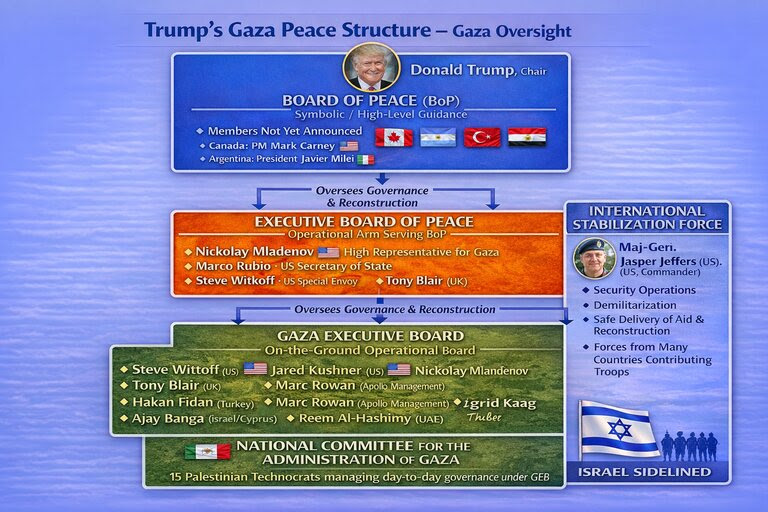
President Donald Trump’s Gaza peace initiative has entered a complex new phase, with multiple overlapping boards and committees designed to oversee governance, reconstruction, and security in the Strip. While Trump chairs the symbolic Board of Peace (BoP), operational authority is divided among a formally announced Executive Board of Peace, the Gaza Executive Board (GEB), and the local technocratic government, the National Committee for the Administration of Gaza (NCAG).
The structure is intricate, but understanding the hierarchy is critical to assessing its implications–particularly for Israel, which is effectively sidelined in decisions over Gaza.
Board of Peace (BoP) – Symbolic / Umbrella Body
Trump chairs the BoP, which provides overarching strategic guidance for Gaza’s postwar governance. This board is largely symbolic, intended to lend legitimacy and oversight to the US-led peace plan. Its official membership has not yet been fully revealed, but multiple world leaders have hinted acceptance, including Canadian Prime Minister Mark Carney, Argentina’s President Javier Milei, Turkey’s President Recep Tayyip Erdoğan, and Egypt’s President Abdel Fattah al-Sisi.
The BoP is meant to supervise the overall peace initiative, providing high-level direction while leaving day-to-day execution to subordinate boards. According to the White House, BoP will oversee diplomacy, infrastructure, development, and economic strategy across Gaza. Participation reportedly comes with a $1 billion buy-in, signaling the high stakes of influence within this symbolic body.
Executive Board of Peace – Operational Arm Serving BoP
Beneath the BoP sits the Executive Board of Peace, a formally announced operational body that executes the strategic directives of BoP. Its members include:
Nickolay Mladenov – High Representative for Gaza
Marco Rubio – United States Secretary of State
Steve Witkoff – United States Special Envoy to the Middle East
Jared Kushner – Donald Trump’s son-in-law
Tony Blair – Former Prime Minister of the United Kingdom
Marc Rowan – CEO of Apollo Global Management
Ajay Banga – President of the World Bank
Robert Gabriel Jr. – American political advisor
This board functions as the executive engine for the BoP, overseeing portfolios critical to Gaza’s stabilization, investment, reconstruction, and international coordination. Unlike BoP, the Executive Board of Peace is fully operational, managing the flow of decisions and linking strategic guidance with local governance.
Gaza Executive Board (GEB) – On-the-Ground Operational Board
The Gaza Executive Board is distinct from the Executive Board of Peace. This board operates on the ground in Gaza and manages day-to-day governance, reconstruction, and service delivery. Its members overlap with the Executive Board of Peace but include key international figures from countries historically critical of Israel:
Steve Witkoff – United States Special Envoy to the Middle East
Jared Kushner – Donald Trump’s son-in-law
Hakan Fidan – Turkey’s Minister of Foreign Affairs
Ali Al Thawadi – Qatar’s Minister for Strategic Affairs
Hassan Rashad – Director of Egypt’s General Intelligence Directorate
Tony Blair – Former Prime Minister of the United Kingdom
Marc Rowan – CEO of Apollo Global Management
Reem Al-Hashimy – Minister of State for International Cooperation of the United Arab Emirates
Nickolay Mladenov – High Representative for Gaza
Yakir Gabay – Businessperson
Sigrid Kaag – United Nations’ Special Coordinator for the Middle East Peace Process
The GEB works directly with the NCAG, coordinating reconstruction, service delivery, and stabilization programs across Gaza. It effectively bridges the High Representative’s office and local governance structures.
National Committee for the Administration of Gaza (NCAG) – Local Palestinian Technocrats
At the base of the hierarchy sits the NCAG, a technocratic body led by Dr. Ali Shaath, a seasoned Palestinian administrator. The NCAG includes 15 members (one woman) with clear portfolios: trade, economy, telecom, agriculture, health, education, finance, water, municipal affairs, women’s affairs, land, judiciary, and security.
The NCAG is intended to manage Gaza’s day-to-day operations once Hamas is rolled back, providing expertise in governance and service delivery. It functions under the guidance of the GEB and the High Representative, making it a critical but subordinate component of the governance framework.
International Stabilization Force (ISF) and Civil-Military Coordination Center (CMCC)
Security in Gaza is managed by the ISF, commanded by Maj.-Gen. Jasper Jeffers (US), responsible for demilitarization and safe delivery of aid. The CMCC, based in Kiryat Gat, Israel, coordinates humanitarian aid with over 50 countries, the IDF, US Central Command, and NGOs. Both entities operate in support of GEB and NCAG, ensuring stability during reconstruction.
Implications for Israel
This structure places Israel at a disadvantage. Countries historically critical of Israel, particularly Turkey and Qatar, have direct influence over Gaza’s operational governance through the GEB. The Executive Board of Peace, acting on BoP directives, also includes international members with influence over reconstruction and investment priorities.
Historically, UN agencies such as UNRWA have faced infiltration and operational challenges, raising concerns that international oversight could create similar risks. Israel’s strategic control over Gaza is effectively minimized, while foreign actors gain authority over governance, security, and humanitarian aid.
Prophetic Perspective
From a biblical standpoint, these developments echo warnings in Scripture about the nations aligning against Israel. Zechariah 12:3 states: “All the nations of the earth will come against Jerusalem.” The layered governance structure of BoP, Executive Board of Peace, GEB, NCAG, ISF, and CMCC illustrates how modern geopolitical structures can formalize international pressure against Israel.
While the initiative is framed as a peace and reconstruction effort, the combination of symbolic, operational, and local boards ensures Israel has limited input, leaving it largely on the sidelines of decisions that directly affect its security and interests.
5 Years Hard Labor Sentence For Defending The Faith Online
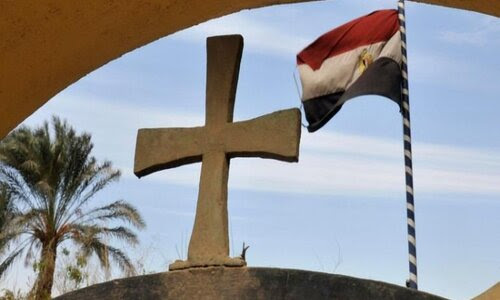
In January 2026, Augustinos Samaan, a 37-year-old Coptic Christian and scholar of comparative religion, was sentenced to five years of hard labor in Egypt — not for committing a crime, but for defending his faith.
Through his YouTube channel, with over 100,000 subscribers, Samaan peacefully discussed Christian beliefs, countered anti-Christian narratives, and sought to educate rather than provoke. Yet the government saw his faith as a threat and his online presence as a crime.
Samaan’s arrest was swift and brutal. Masked officers stormed his home in the early morning hours, confiscating his books, laptop, and personal papers. He was accused of “joining a terrorist organization” and “spreading false news” before the charges were quietly altered to “contempt of religion.”
Even the legal process was designed to intimidate: he was tried without notifying his family or lawyers, and his defense has had no real access to the case files. Justice, in this instance, was little more than a performance — a warning to anyone daring to speak openly about their faith.
This case is not an isolated tragedy. Across Egypt and many other nations where Islam dominates public life, Christians face the daily reality of persecution, especially those who have left Islam or speak out in defense of their faith. Blasphemy and apostasy laws are wielded less as tools for maintaining harmony than as instruments to silence minority voices.
Expressing one’s beliefs peacefully, educating others, or challenging prevailing narratives can lead to harassment, imprisonment, and even death. Faith becomes an act of courage, each word spoken a quiet rebellion against fear.
Samaan’s ordeal is a reminder of how fragile religious freedom can be when it is conditional. On paper, Egypt’s constitution guarantees freedom of belief and expression. In practice, those rights are subordinated to laws protecting the majority faith, leaving minorities like the Copts vulnerable to discrimination and abuse. The result is a system where Christians must navigate not only societal prejudice but also a legal landscape that can punish them for existing.
The courage of people like Samaan cannot be overstated. He stands among countless others who refuse to hide their faith despite overwhelming pressure to conform or remain silent. His sentence is intended to break him, to send a message that defending Christianity is dangerous.
Yet, history shows that persecution rarely extinguishes belief — it often strengthens it. For every Christian silenced, there are countless more inspired to continue speaking, teaching, and living boldly in the light of their convictions.
Beyond the personal tragedy lies a global lesson. Samaan’s sentence challenges all of us to confront uncomfortable truths: Do we truly value religious liberty, or only when it is convenient? Are we willing to speak out when injustice occurs in nations tied to strategic alliances, economic interests, or political expediency? Faith, courage, and the right to express belief should never be conditional on geography or politics.
Augustinos Samaan’s story is more than a case of injustice in Egypt; it is a stark reminder of the ongoing struggle for freedom of conscience worldwide. Christians, particularly those who leave Islam or challenge dominant religious narratives, continue to pay a high price for their faith. And yet, even behind prison walls, the human spirit proves resilient. Faith persists where fear seeks to dominate. Courage shines in the shadows. And hope — though tested — refuses to be silenced.
Anti-Ice Mob Storms Sunday Service Shutting Down Worship
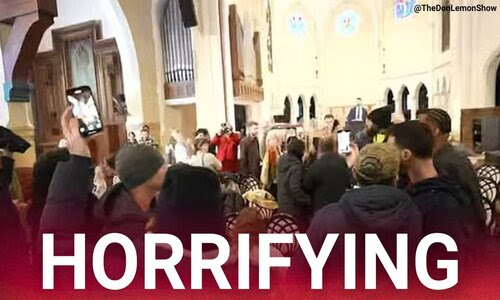
On Sunday, the unthinkable happened in St. Paul, Minnesota. Cities Church, a Southern Baptist congregation gathered for worship, was invaded by a mob of anti-ICE protesters, and choreographed for the camera by none other than former CNN anchor Don Lemon.
Chants of “ICE out!,” “Hands up, don’t shoot,” and “Justice for Renee Good!” pierced the sanctuary, shattering the peace of a holy place and terrifying parishioners who came to commune with God. This was not protest. This was desecration. And it is a warning to every Christian in America: sacred spaces are under attack, and we cannot stay silent.
The pretext for this intrusion was a pastor’s previous role as acting director of the St. Paul ICE field office–a role discussed publicly on C-SPAN last year. Yet the anger and aggression displayed by the mob went far beyond political disagreement. They came into a house of God with shouts and livestream cameras, treating a sanctuary as a stage for political theater.
Pastor Jonathan Parnell’s response was immediate and righteous: “Shame on you! Shame on you! This is a house of God!” His words were not just a rebuke–they were a stand for the sanctity of worship, for the spiritual safety of his flock, and for the principle that God’s house is inviolable.
Don Lemon, livestreaming the disruption, attempted to frame it as First Amendment protest. “This is what the First Amendment is about, the freedom to protest,” he said. But let’s be clear: freedom of speech does not give anyone the right to terrorize worshippers, to trample on sacred rituals, or to turn prayer into a spectacle for social media. This is not “uncomfortable protest.” This is moral assault.
The outrage extends beyond Christian sensibilities. ICE rightly condemned the intrusion, noting a dangerous trend: “Agitators aren’t just targeting our officers. Now they’re targeting churches, too. They’re going from hotel to hotel, church to church, hunting for federal law enforcement who are risking their lives to protect Americans.” And yet, in the midst of this chaos, the perpetrators seemed proud, emboldened by media coverage, blind to the fact that they crossed a line that should never, ever be crossed.
The federal government is taking the matter seriously. Harmeet Dhillon, assistant attorney general for the Civil Rights Division, confirmed that the DOJ is investigating potential violations of the federal FACE Act, which protects houses of worship from interference and intimidation. “A house of worship is not a public forum for your protest!” Dhillon said. “Nor does the First Amendment protect your pseudo-journalism of disrupting a prayer service. You are on notice!”
Let that sink in. The law itself recognizes that churches are sacred ground, protected from precisely this kind of mob action. And yet, here we are, witnessing a brazen assault on Christian worship, carried out on camera and celebrated in some media corners as “provocative journalism.” This is not journalism. This is intimidation. Several families with young children could be seen exiting the church in fear over the protests.
Spiritually and morally, what happened is unforgivable. Scripture teaches that God’s house is holy, a refuge for the faithful. The psalmist declares: “I was glad when they said unto me, let us go into the house of the Lord” (Psalm 122:1). What happened in St. Paul turned gladness into fear. Reverence into chaos. Worship into spectacle. Christians were made to feel unsafe in a place that should be their sanctuary.
This incident should serve as a clarion call to believers across America. We must stand firmly for the protection of churches, for the sanctity of worship, and for the right of pastors to lead without fear. We cannot remain quiet as mobs treat sanctuaries as stages for political rage. The line has been crossed. Our response must be loud, unyielding, and unapologetic.
To the Christians of St. Paul and beyond: Sunday should have been a day of prayer. It should have been a day of peace. Instead, it became a day of violation, intimidation, and moral outrage. We must say clearly, with one voice: this is wrong. This is unacceptable. And it will not be allowed to stand. The house of God is sacred. Our worship is sacred. And our God is watching.
Let this event serve as both warning and rallying cry: we must defend our churches, protect our pastors, and reclaim our sanctuaries. For in protecting the holy, we protect the faith itself–and remind the world that God’s house is not a place for mobs to play politics.