Bible Prophecy, Signs of the Times and Gog and Magog Updates with Articles in the News
The Calm Before What?
Inside
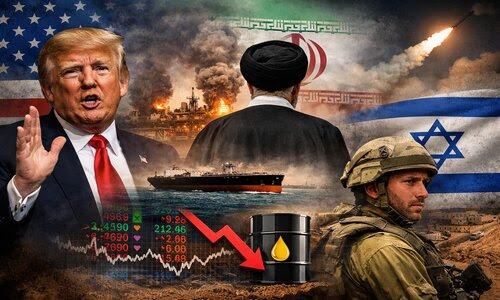
The Strategic Pause In The U.S.-Iran-Israel War
The conflict involving the United States, Israel, and Iran has entered a strange and unsettling phase. The missiles have not stopped. The threats have not softened. And yet, something has shifted. A pause. A hesitation. A flood of conflicting messages that leave even seasoned observers asking the same question: What is really happening behind the scenes?
At the center of the confusion is Donald Trump, who has claimed that “productive” talks with Iran are underway. But Tehran–particularly voices tied to the Islamic Revolutionary Guard Corps–has flatly denied any such discussions. Adding to the uncertainty, Iran’s supposed new leadership has yet to clearly present itself on the world stage. Reports and regional observers point to growing ambiguity about who is actually making decisions inside Iran right now.
That raises a critical question few are asking out loud: If talks are happening… who exactly is Trump talking to?
That contradiction is not a minor detail. It is a flashing warning sign that this conflict is no longer just about weapons–it’s about control, perception, and possibly confusion at the highest levels of power.
A War Fought on Two Different Levels
To understand this moment, you have to start with a hard truth: this is not a balanced war.
For the United States and Israel, the objectives are ambitious and definitive–cripple Iran’s nuclear program, dismantle its missile capabilities, and possibly even reshape the regime itself. For Iran, the goal may be far simpler: survive.
That difference changes everything.
A side that needs to win fights differently than a side that simply needs to endure. And history shows that regimes built on survival can absorb enormous punishment while still claiming victory. If even a fragment remains, they will say they stood their ground.
That makes this conflict far more complicated than a typical military campaign. There is no clear finish line–only thresholds of damage and perception.
The “Talks” That May–or May Not–Exist
Now to the most confusing piece of this puzzle: the supposed negotiations.
Trump has said discussions are happening and even delayed planned strikes on Iran’s energy infrastructure for five days to give diplomacy a chance. Iran insists there are no talks at all.
So which is it?
There are three realistic possibilities–and each carries serious implications:
1. Strategic Messaging (Most Likely)
This may be calculated signaling. By projecting diplomacy, the U.S. can cool markets, reduce global panic, and buy time to position military assets. A pause does not necessarily mean restraint–it may simply mean preparation.
2. Indirect Negotiations (Quiet but Real)
It’s entirely possible that talks are happening–but not directly. Backchannel diplomacy through intermediaries is common in this region. Public denial doesn’t mean private communication isn’t happening–it may simply mean neither side wants to appear weak.
3. Narrative Warfare (Perception Over Reality)
In modern conflict, perception can move faster than troops. A statement alone–true or not–can shift markets, influence allies, and pressure adversaries. Both sides may be shaping a story as much as a strategy.
The Global Stakes: Oil, Power, and Market Whiplash
At the heart of this crisis sits one of the most important chokepoints on Earth: the Strait of Hormuz.
Roughly a fifth of the world’s oil flows through it, which makes every headline, every threat, and every “announcement” matter far beyond the Middle East.
When news of potential talks broke, oil prices dropped sharply–an immediate signal that markets believed de-escalation might be coming. At the same time, equities surged, reflecting a sudden wave of optimism.
But here’s the problem: if those talks prove to be exaggerated, misleading, or outright false, prices could snap back just as quickly–if not more violently.
That kind of whiplash is dangerous.
Because when markets no longer trust the signals they’re receiving, instability becomes the norm. Volatility stops being a reaction and starts becoming a pattern. And in a world where energy prices influence everything from transportation to food, that instability doesn’t stay on Wall Street–it hits everyday life.
If no one knows what to believe, uncertainty itself becomes the most powerful force in the global economy.
Israel’s Uncomfortable Position
For Israel, this moment may be the most strategically dangerous of all.
Prime Minister Benjamin Netanyahu is caught between alliance and necessity. If the United States slows its posture, Israel faces a brutal choice:
Pause and risk appearing weak while attacks continue
Press forward and risk tension with Washington
Gamble on diplomacy that may not fully remove the threat
And there is another layer often overlooked: even if the direct conflict with Iran were to de-escalate, Israel’s fight is unlikely to end cleanly.
Groups like Hezbollah–Iran’s powerful proxy in Lebanon–could continue engaging Israel regardless of any broader agreement. That means Israel may find itself in a prolonged, multi-front conflict even after a “resolution” with Iran is declared.
Israel’s doctrine has always leaned toward decisive, preemptive action. A forced pause–especially one influenced externally–cuts against that instinct and increases the risk of long-term insecurity.
The Illusion of Certainty
It’s tempting to reduce this moment into clean scenarios:
Trump is playing a strategic game
Trump is backing down under pressure
Iran is preparing to concede
But real conflicts rarely follow clean scripts.
What we’re seeing instead is something far more complex: a layered struggle involving military positioning, economic pressure, political signaling, and psychological warfare–all happening at once.
And that’s why so many people feel uneasy right now.
What Comes Next
This pause will not last.
Either it breaks toward diplomacy–unlikely but possible–or it snaps back into escalation, potentially wider and more dangerous than before. The uncertainty around Iran’s leadership, the contradictions in messaging, and the continued positioning of forces all suggest that this is not a resolution–it’s an intermission.
For the United States, the challenge is balancing strength with global stability.
For Iran, it’s survival under pressure–and perhaps internal coherence.
For Israel, it’s deciding whether to wait–or act, knowing the threat may not disappear even if the headlines change.
Because in moments like this, the silence isn’t peace.
It’s positioning.
And what comes next may define far more than just the outcome of a war–it may define how wars like this are fought in the future.
Watched Behind the Wheel:
How Our Cars Are Becoming 24/7 Surveillance Machines

There was a time when getting behind the wheel meant freedom. The open road symbolized independence, privacy, and the simple ability to go where you wanted–without being watched. Today, that vision is quietly fading.
In its place, a new reality is emerging: one where your car is no longer just a machine, but a data-collecting, behavior-monitoring, algorithm-driven observer. And increasingly, it may not just watch you–it may decide what you’re allowed to do.
Recent reporting and federal policy developments tied to the Infrastructure Investment and Jobs Act reveal a growing push to embed advanced driver-monitoring systems into every new vehicle. Section 24220 of the law mandates the development of “advanced impaired driving technology,” designed to passively monitor drivers and prevent operation if impairment is detected.
On the surface, the goal sounds noble: reduce drunk driving deaths and improve road safety. But beneath that goal lies a far more complex–and unsettling–shift in how much of our personal lives are being tracked, analyzed, and potentially controlled.
At the heart of this transformation is artificial intelligence. Modern vehicles are increasingly equipped with inward-facing cameras, biometric sensors, and software capable of tracking eye movement, facial expressions, and even subtle behavioral patterns. These systems can determine whether you’re distracted, tired, or possibly impaired. Some proposals even include technology capable of detecting alcohol levels beneath the skin without requiring a breathalyzer.
Supporters argue this is a technological breakthrough. Human error, after all, is responsible for the vast majority of accidents. If AI can step in and prevent tragedy, why wouldn’t we embrace it?
But that argument assumes a level of trust that many Americans are no longer willing to give.
Because once your car is watching your face, tracking your movements, and analyzing your behavior, a critical question emerges: where does all that data go?
This isn’t hypothetical. Companies like Tesla and General Motors already collect vast amounts of vehicle data, from driving habits to location history. Insurance companies are increasingly offering–or pressuring drivers into–usage-based programs that monitor speed, braking, and time of travel. Drive too fast? Your premium goes up. Brake too hard? That’s another mark against you.
Now imagine that system expanded–and mandated.
Your car could track how fast you drive, how often you accelerate aggressively, how alert you appear, even how long your eyes drift from the road. It could log every trip you take, every stop you make, and every mile you drive. That data could be shared with insurers, manufacturers, or even government agencies, all under the banner of “safety” or “efficiency.”
And it doesn’t stop there.
Several states have already explored or implemented “mileage-based taxation”–a system that charges drivers per mile instead of per gallon of gas. On paper, it’s a response to declining gas tax revenues as electric vehicles become more common. In practice, it requires one thing: constant tracking of your vehicle’s location and movement.
The implications are enormous. A system designed to tax mileage could easily evolve into one that enforces driving limits, restricts travel in certain areas, or penalizes behavior deemed undesirable. Combine that with AI-driven monitoring, and your car begins to look less like personal property–and more like a regulated node in a larger surveillance network.
Even more concerning is the issue of control.
The language in the federal mandate doesn’t just call for monitoring–it calls for intervention. If a system determines that a driver is impaired, it may “prevent or limit motor vehicle operation.” That means your car could decide, in real time, whether you are allowed to drive.
What happens when the system is wrong?
Artificial intelligence is not infallible. False positives are a documented issue across AI systems, from facial recognition to behavioral analysis. A camera misreads your expression. A sensor misinterprets fatigue. An algorithm flags you incorrectly. In a high-speed environment, even a momentary misjudgment could have serious consequences.
Yet under these emerging systems, the machine’s judgment may override your own.
This is where the debate moves beyond safety and into something deeper: autonomy.
For generations, driving has been an expression of personal responsibility. You were accountable for your actions behind the wheel. Now, that responsibility is slowly being transferred to algorithms–systems designed, trained, and controlled by entities far removed from the individual driver.
And history offers a clear warning: once surveillance infrastructure is built, it rarely remains limited to its original purpose.
Data collected for safety can be repurposed for enforcement. Systems designed for assistance can evolve into tools of control. What begins as a well-intentioned effort to reduce accidents can gradually reshape the relationship between citizens, corporations, and the state.
None of this means safety doesn’t matter. It does. Reducing drunk driving and saving lives is a goal everyone can support. But the method matters just as much as the outcome.
Because when privacy is sacrificed in the name of security, it is rarely returned.
The question Americans must now grapple with is not whether technology can make driving safer–it can. The real question is whether we are willing to trade away our independence, our data, and ultimately our control, for that promise.
Once your car is watching you, tracking you, and deciding for you… are you still the one in the driver’s seat?
Pastors Leading the Sheep of a Deadly Cliff !
Unthinkable:
A Church Leader Funding Abortion With Adult Toy Sales

Stories like this are uncomfortable, even disturbing, and many in the Church would rather dismiss them as fringe or irrelevant. But that instinct–to bury our heads in the sand–is precisely what has allowed confusion, compromise, and contradiction to take root in places that once stood firmly on truth. If we are to be people of conviction, we must also be people of accountability. And that means confronting what is happening inside our own churches, no matter how painful it may be.
A recent controversy involving Gerlyn Henry, a self-described Anglican priestess serving in Scarborough, Ontario, has sparked outrage and disbelief among many Christians. Henry, who leads the Church of the Holy Wisdom, announced a partnership with Bellesa Boutique, an adult shop known for selling adult toys and related products. According to her own statements, she is distributing free adult items and gift cards through this collaboration. Even more troubling, she has pledged that proceeds from this partnership will be donated to Planned Parenthood, the largest abortion provider in the United States.
The facts alone are jarring. A clergy member–someone entrusted with teaching Scripture, shepherding souls, and upholding the moral teachings of the Christian faith–is openly promoting sexual products while financially supporting an organization that performs hundreds of thousands of abortions each year. For many believers, this is not merely a disagreement over secondary issues; it strikes at the heart of what the Church is called to represent.
Henry’s background adds further context. A graduate of Columbia Theological Seminary, she has previously drawn attention for progressive activism, including public statements on immigration policy and political slogans tied to global conflicts such as supporting Palestinian statehood over all of Israel. But this latest move goes beyond political expression. It represents a direct alignment with causes and industries that historic Christianity has consistently challenged–namely, the commodification of sexuality and the destruction of unborn life.
So the question must be asked: who bears the greatest responsibility for this kind of situation?
First, there is the individual leader. Gerlyn Henry cannot escape accountability for her own decisions. Scripture is clear that teachers will be judged more strictly (James 3:1), precisely because of the influence they wield. To actively promote behavior and institutions that contradict biblical teaching is not a matter of personal preference–it is a matter of spiritual leadership gone astray. Leaders are called not just to reflect culture, but to challenge it when it departs from truth.
However, it would be too easy–and ultimately incomplete–to stop there.
The congregation also plays a role. Churches do not exist in a vacuum; they are communities sustained by the participation and support of their members. When a congregation continues to attend, give, and affirm leadership that openly contradicts core Christian teachings, it sends a powerful message of approval or at least indifference. Silence, in this context, is not neutral. It becomes a form of consent. While not every attendee may agree with such actions, continued support without challenge raises serious questions about collective responsibility.
Yet perhaps the most significant failure lies at the institutional level. The broader Anglican Church–particularly its progressive branches–has increasingly struggled with questions of doctrinal authority and discipline. When there are no meaningful consequences for clergy who openly defy historic Christian teaching, it creates an environment where anything can be justified under the banner of inclusion or modern relevance. Church discipline, once considered a vital part of maintaining doctrinal integrity, has in many places been abandoned altogether.
This absence of accountability does not just affect one congregation or one leader. It shapes the culture of the entire denomination. It signals to both believers and the watching world that the Church no longer has clear convictions–or worse, that it no longer believes them to be important.
The result is confusion. And confusion, left unchecked, leads to erosion.
This story is not just about one priestess in Canada. It is a reflection of a broader crisis facing many parts of the modern Church: the tension between cultural acceptance and biblical fidelity. When the desire to be seen as relevant overtakes the call to be faithful, the Church risks losing its distinct voice altogether.
So where does that leave us?
It leaves us with a responsibility–individually and collectively–to examine what we are supporting, what we are tolerating, and what we are willing to confront. Accountability is not easy. It requires courage, humility, and a willingness to speak truth even when it is unpopular. But without it, the Church cannot fulfill its mission.
We cannot pretend these issues do not exist. We cannot dismiss them as isolated incidents. And we certainly cannot remain silent.
Because what is at stake is not just reputation–it is the very integrity of the Church itself.