
Are You Paying Attention? – 6 Nations Join Board Of Peace With More To Follow
In a televised address to the nation this week, President Trump boldly declared that “we now have peace in the Middle East,” framing the recent ceasefire and diplomatic progress with his ‘Board of Peace’ as a historic moment.
Something unusual is forming in the Middle East. Quietly, deliberately, and with unmistakable international weight, a coalition of nations has agreed–at least in principle–to sit on what is being called a Board of Peace. Its stated purpose is straightforward: to oversee the postwar management of Gaza and guide the region from fragile ceasefire toward something resembling stability. But history tells us that when global powers assemble around Jerusalem and its surrounding territories, the story is never merely administrative.
In a televised address to the nation this week, President Trump boldly declared that “we now have peace in the Middle East,” framing the recent ceasefire and diplomatic progress as a historic moment of reconciliation and stability. Whether one views this as political optimism or a milestone in real terms, the statement underscores the administration’s confidence in this coalition and highlights the symbolic weight of the Board of Peace–even as the practical challenges on the ground remain formidable.
At present, several key nations are understood to have committed to this board, including Egypt, Qatar, the United Arab Emirates, the United Kingdom, Italy, and Germany. Together, they represent regional leverage, European legitimacy, and diplomatic continuity. Their participation does not yet guarantee funding, troops, or long-term enforcement–but it does signal international buy-in. Symbolism matters in diplomacy. So does precedent.
The goal now is expansion. Additional seats are being quietly pursued, with Saudi Arabia at the top of the list. Riyadh’s inclusion would dramatically reshape the board’s influence, signaling Arab-world alignment behind a U.S.-led peace framework. Yet Saudi hesitation is telling. Gaza remains volatile. Hamas has not disarmed. Israeli forces continue to operate amid ceasefire violations. The Saudis appear unwilling to lend their authority until the endgame is clearer–and until the cost of participation is better defined.
Then there is Turkey.
Bringing Ankara into any peace structure presents an entirely different challenge. Turkey’s president has repeatedly issued inflammatory rhetoric toward Israel–language that goes well beyond diplomatic protest. At various points, he has spoken of marching on Gaza, mobilizing an “army of Islam,” and framing the conflict in explicitly religious and civilizational terms. Such statements are not easily brushed aside as domestic posturing. For Israel, Turkey’s involvement in postwar Gaza–especially in any security or stabilization role–is viewed as deeply destabilizing.
Yet pressure is mounting to find a workaround. One proposal being floated is symbolic inclusion: Turkey seated on the Board of Peace, but kept out of boots-on-the-ground command structures. Even this compromise is controversial. Peace is difficult enough without importing leaders whose rhetoric fuels the very fires diplomacy claims to extinguish.
But here is where the conversation becomes far more serious–and far more revealing.
While public attention remains fixed on the high-profile Board of Peace, real authority is quietly shifting elsewhere. A mid-level executive body is being assembled to manage the day-to-day realities of governance, security coordination, reconstruction, and political transition. This group will not make headlines. It will not hold grand summits. But it will shape outcomes.
And that is precisely why it deserves scrutiny.
Who sits on this executive board? What do they believe about sovereignty, borders, religion, and long-term regional order? What assumptions do they hold about Israel, about Palestinian governance, and about the role of international authority in the Holy Land? History shows that transformative agreements are rarely forged in public ceremonies. They are built in committee rooms, drafted by technocrats, and enforced by unelected administrators.
Alongside this executive layer is a proposed technocratic Palestinian governing body tasked with running Gaza’s daily affairs. Again, the question is not merely competence, but ideology. Administration without legitimacy collapses. Peace without moral clarity corrodes.
For those who watch the Middle East through the lens of Scripture, these developments carry unmistakable echoes.
The Bible speaks not of chaos alone, but of carefully constructed peace–agreements brokered by outside powers, covenants strengthened over time, arrangements that appear stabilizing before they unravel. The prophetic language of a covenant being confirmed suggests process, not sudden decree. It implies groundwork laid by one generation and ratified by another.
Is this current framework that covenant? No. Too many pieces are missing. Borders remain undefined. Jerusalem remains unresolved. The nations are not yet aligned. There is no singular, enforceable treaty–only mechanisms, boards, committees, and intentions.
But processes matter.
A peace architecture that normalizes international oversight of Gaza… a regional coalition accustomed to managing Israel-adjacent territory… a growing expectation that lasting stability must come from outside intervention–these are not end-times fulfillments. But they may be precursors.
Scripture cautions us not to rush the timeline. Daniel’s 70th week does not begin because diplomats gather or ceasefires hold. It begins when conditions align with precision. We are not there yet.
Still, the direction is worth watching.
Peace in the Middle East has never failed for lack of ambition. It fails when human authority overestimates its ability to reorder what Scripture says will ultimately be resolved only by divine intervention. Until then, the world will keep building boards, drafting plans, and declaring breakthroughs.
And believers would do well to watch–not with fear, but with discernment.
Because when the world says “peace and security,” history–and prophecy–tell us that vigilance matters more than applause.
SIGNS OF THE TIMES
Rehearsals of the 5th Trumpet
Scientists Sound The Alarm About 3 Major Fault Zones In The United States

Will 2026 be a year of great shaking for the United States? Coming into 2025, I thought that seismic activity would be a major global theme, and that has certainly turned out to be the case. This has been an extremely unusual year for earthquakes along the Pacific Ring of Fire, and volcanoes that have been dormant for ages are suddenly roaring to life all over the world.
Here in the United States, we have been experiencing lots and lots of little earthquakes, but thankfully we have not been hit by a really bad one yet. Will our luck run out in 2026?
According to the Daily Mail, the dozens of earthquakes that have been rattling the New Madrid fault zone since the middle of November are “renewing fears of a catastrophic natural disaster soon”…
A giant seismic zone in the heart of the US has seen dozens of tiny earthquakes break out in the last month, renewing fears of a catastrophic natural disaster soon.
Since mid-November, the US Geological Survey (USGS) has detected at least 38 low-level seismic events along the boundaries of the New Madrid Seismic Zone (NMSZ) in Arkansas, Kentucky, Missouri, and Tennessee.
The threat that the New Madrid fault zone poses should not be underestimated.
In a previous article, I discussed the series of catastrophic earthquakes that occurred along that fault zone in 1811 and 1812. Everyone agrees that they were the most powerful earthquakes in the entire history of the continental United States…
The New Madrid earthquakes were the biggest earthquakes in American history. They occurred in the central Mississippi Valley, but were felt as far away as New York City, Boston, Montreal, and Washington D.C. President James Madison and his wife Dolly felt them in the White House. Church bells rang in Boston. From December 16, 1811 through March of 1812 there were over 2,000 earthquakes in the central Midwest, and between 6,000-10,000 earthquakes in the Bootheel of Missouri where New Madrid is located near the junction of the Ohio and Mississippi Rivers.
In the known history of the world, no other earthquakes have lasted so long or produced so much evidence of damage as the New Madrid earthquakes. Three of the earthquakes are on the list of America’s top earthquakes: the first one on December 16, 1811, a magnitude of 8.1 on the Richter scale; the second on January 23, 1812, at 7.8; and the third on February 7, 1812, at as much as 8.8 magnitude.
Scientists tell us that it is just a matter of time before another great earthquake strikes this region.
Six years ago, the USGS determined that a magnitude 7.7 quake would shake major cities all over the Midwest…
In 2019, USGS scientists modeled what a 7.7 magnitude earthquake would look like if it erupted along the Arkansas-Tennessee border, in an area near Memphis.
The shockwaves of this hypothetical mega quake spread for hundreds of miles, reaching cities including Kansas City, Indianapolis, Louisville, and Birmingham.
Buildings in that area of the country are typically not constructed to withstand an event of that size, and so the USGS is projecting that hundreds of thousands of buildings would be damaged and the economic damage would run into the hundreds of billions of dollars…
Since this region is not well equipped to deal with a massive seismic event, studies of such an earthquake projected that a magnitude 7.7 earthquake would cause over 86,000 injuries or deaths, damage 715,000 buildings, and knock out power to 2.6 million homes.
That report, by the University of Illinois, Virginia Tech, and George Washington University, also estimated that the cost could hit $300 billion directly, with indirect costs due to lost jobs possibly taking the damage to $600 billion.
An earthquake like that could hit us at any time.
But when the “really Big One” finally arrives, it will be much, much worse than the USGS is anticipating.
Experts are also urging us to keep an eye on the Cascadia Subduction Zone.
We are being told that when it finally goes, “the Pacific Northwest could change in a matter of minutes”…
Beneath Cascadia’s forests and coastlines lies a 600-mile fault capable of producing a magnitude-9 earthquake. The last one struck in 1700, shaking the region for minutes and sending a massive tsunami all the way to Japan. Today, nearly 17 million people live on top of the same silent threat. Scientists warn that when it breaks again, the Pacific Northwest could change in a matter of minutes.
The reason why the Cascadia Subduction Zone is so dangerous is because it has the potential to produce “megathrust” earthquakes…
At depths shallower than around 30 km, the two plates of the CSZ are locked together by friction. Strain (deformation) slowly builds as the subduction forces continue to act upon the locked plates. Once the fault’s frictional strength is exceeded, the rocks slip past each other along the fault in a “megathrust” earthquake.
A large enough “megathrust” earthquake could cause a tsunami that is hundreds of feet high to violently slam into the west coast.
In such a scenario, the death toll would likely be cataclysmic.
So that is why any seismic activity in the region gets so much attention.
On Monday, a magnitude 2.9 earthquake not too far away from Seattle caused quite a stir…
Reports of a massive explosion in Washington state sent residents in the Pacific Northwest into a state of confusion Monday morning.
The US Geological Survey (USGS) sent out an alert just before 11.30am ET, warning that an explosion with the force of a magnitude 3.0 earthquake has just taken place near the town of Concrete.
USGS quickly retracted the false explosion warning and reclassified the seismic event as a magnitude 2.9 earthquake, less than 70 miles north of Seattle.
Scientists assure us that a “megathrust” earthquake along the Cascadia Subduction Zone is in our future.
And when it finally occurs, it could also trigger the San Andreas fault system…
Successfully predicting earthquakes sounds like a dark art.
However, new research hints it may be possible: Sediment cores extracted from the Pacific seafloor suggest that two major fault systems along the western coast of the United States and Canada might be partially synchronized. After an earthquake on the southern part of the Cascadia subduction zone, an earthquake soon after on the northern part of the San Andreas fault appears to occur roughly half of the time, the new findings reveal. These results, published in Geosphere, provide evidence of stress triggering, which has long been invoked to explain how activity on one fault might lead to activity on another nearby.
Fault zones persist across wide swaths of our planet, but the one that stretches onshore and offshore from California to British Columbia, Canada, is particularly complex. The vertical strike-slip San Andreas fault, in the south, intersects the Cascadia subduction zone off the coast of Northern California at a point known as the Mendocino Triple Junction.
When the San Andreas fault system finally rips wide open, the geography of the state of California will be permanently altered.
And it won’t just be Southern California that is affected.
Over the past couple of months, Northern California has been getting pummeled by literally hundreds of sizable quakes…
While California ranks second in the US in seismic activity, most quakes are small and go largely unnoticed. That has changed in recent weeks with two swarms impacting the Bay Area: one is east of San Francisco near San Ramon; the other is north of San Francisco near The Geysers.
Over the last 30 days, USGS has reported 1,470 earthquakes around The Geysers; in just the last 7 days, there have been 286. Most of these have been weak, with only 5 earthquakes rated a magnitude 2.0 or higher intensity over the last week. While the volume has been eyebrow raising, the intensity hasn’t.
The opposite has been the case near San Ramon. There, over the last 30 days, there have been 139 earthquakes reported by USGS; over the last 7 days, that number has been 25. But the intensity of these earthquakes have been greater, with 39 rated magnitude 2.0 or greater and 6 rated 3.0 or greater over the last 30 days.
This is definitely not normal.
San Ramon has been getting shaken so frequently that one social media user has compared it to “a massage chair”…
“Wee bit nervous,” one person wrote on Threads, adding that she planned to stock up on water and earthquake supplies.
“San Ramon is basically a massage chair today … but like, the stressful kind,” another person wrote on the social media site. “Dear Earth: we get it, you’re active. You can stop now.”
The Calaveras Fault is a major branch of the San Andreas fault system.
This is the fault that has been causing so much shaking in San Ramon lately, and it has the potential to produce very large earthquakes…
Historically, the southern half of the central segment of the Calaveras Fault has been the most seismically active segment of the fault.
It produced the 6.2 Morgan Hill earthquake in 1984. The 5.9 Coyote Lake earthquake in 1979 ruptured slightly to the south of these other earthquakes.
When you are driving your vehicle and one of those little warning signals on the dashboard lights up, what do you do?
Hopefully you take it to a mechanic or you fix it yourself.
Ignoring a warning signal like that is a really bad idea.
Similarly, the New Madrid fault zone, the Cascadia Subduction Zone and the San Andreas fault system have all been sending us lots of warning signals lately.
Sadly, it appears that most of the population will continue to ignore those warning signals until it is too late.
END OF NEWS ARTICLE
PASTOR DIRK SAYS
The 5th Trumpet is the Ring of Fire that will Erupt that will include Yellowstone that will Sort out Mystery Babylon aka California and Ocean states.
Read these Articles
GOG AND MAGOG UPDATE
Netanyahu ready to tell Trump of Israel’s plans to strike Iran / Magog

While there are concerns that Iran is also seeking to revive nuclear enrichment sites hit by U.S. bombers, Israeli officials believe missile production poses the most immediate danger.
Israeli Prime Minister Benjamin Netanyahu is preparing to brief President Donald Trump on renewed military options against Iran, driven by Israeli assessments that Tehran is accelerating the reconstruction of its ballistic missile program following strikes earlier this year, according to U.S. and Israeli sources cited by NBC.
Netanyahu is expected to raise the issue during a planned meeting with Trump at the president’s Mar-a-Lago residence on Dec. 29.
Israeli officials view Iran’s missile production and air defense recovery as a more urgent threat than its nuclear efforts, which they believe were significantly damaged during U.S. and Israeli operations in June.
According to people familiar with the plans, Netanyahu intends to argue that Iran’s expanding missile capabilities endanger not only Israel but also regional stability and U.S. interests.
He is expected to present a range of options that could include Israeli action alone or varying degrees of U.S. involvement, similar to proposals shared with Trump ahead of the June strikes.
Those operations, known as Operation Midnight Hammer, involved extensive U.S. air and naval assets targeting Iranian nuclear facilities.
At the time, the White House said the campaign had eliminated Iran’s nuclear capacity. “The International Atomic Energy Agency and Iranian government corroborated the United States government’s assessment that Operation Midnight Hammer totally obliterated Iran’s nuclear capabilities,” White House spokesperson Anna Kelly said. “As President Trump has said, if Iran pursued a nuclear weapon, that site would be attacked and would be wiped out before they even got close.”
Israeli officials now assess that Iran is repairing damaged missile infrastructure and attempting to restore advanced air defense systems struck in Israeli operations in April and October 2024.
While there are concerns that Iran is also seeking to revive nuclear enrichment sites hit by U.S. bombers, Israeli officials believe missile production poses the most immediate danger.
Trump, asked this week about a possible meeting with Netanyahu, said discussions had not yet been formally scheduled, though Israeli officials have publicly confirmed the Dec. 29 date.
The Israeli government declined to comment on the substance of the expected talks, and Iran’s mission to the United Nations did not respond to requests for comment.
Unusual air activity detected over Iran as Israeli officials warn Tehran preparing for new war
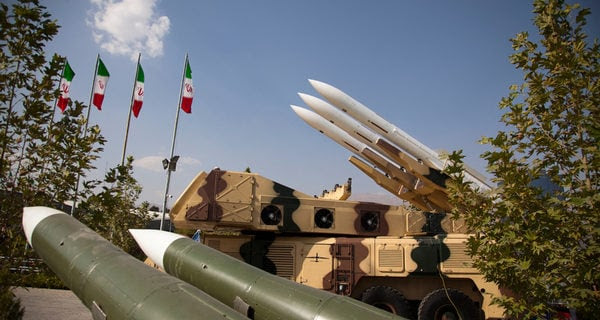
Iran’s paramilitary Islamic Revolutionary Guard Corps is conducting unusual activity, according to a report by Iran International.
In a report published on Saturday, the anti-regime outlet cited multiple sources which said that Western intelligence agencies are monitoring unusual air activity over Iran, including drone and missile activity, along with air defense unit operations on the ground.
Some sources speculated that the movements could be part of a military exercise, though the large scale of the activity has raised concerns.
The report comes amid concerns that Tehran is gearing up for a new round of fighting with Israel, including an expanded ballistic missile campaign against the Jewish state.
Israeli defense officials told Galei Tzahal radio on Sunday that Iran is rapidly working to restore both its defensive and offensive missile capabilities.
Iran, the officials said, is expanding its ballistic missile production operations and refurbishing existing storage facilities.
In addition, the officials warned, Tehran is working to rebuild its air defense network, which was heavily damaged during Israeli strikes in 2024 and further diminished during the June war.
The officials cited in the report emphasize that if and when a new war breaks out between Israel and Iran, it will be “harder and more complex” than the 12-day conflict.
Israeli Prime Minister Benjamin Netanyahu is reportedly planning to present to President Donald Trump several options for a new series of strikes on Iran during his visit to the US later this month.
Netanyahu is expected to meet with Trump at the president’s estate in Mar-a-Lago, Florida after Christmas.
The Israeli premier is expected to highlight Israel’s concerns over Iran’s expanded production of ballistic missiles, and then brief the president on various scenarios for Israeli attacks.