Bible Prophecy, Signs of the Times and Gog and Magog Updates with Articles in the News
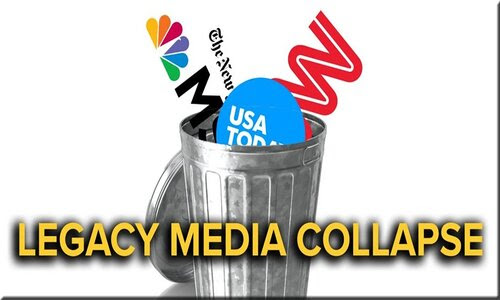
The Collapse Of Legacy Media And The Rise Of Alternative Voices
The ground beneath America’s information empire is shaking–and this time, the tremor isn’t coming from politicians, corporations, or foreign adversaries. It’s coming from the public itself. Trust, once the lifeblood of journalism, is draining at a historic pace.
A new survey from the Pew Research Center shows that 57% of Americans now have little or no confidence that journalists act in the public’s best interests. Even more striking, just 6% say they have a great deal of confidence. Numbers like these are not merely statistics; they are warning sirens echoing across a crumbling media landscape.
For decades, legacy media institutions held an almost sacred place in American civic life. Anchors were trusted voices. Newspapers were arbiters of truth. But the long arc of public opinion tells a different story. According to Gallup, trust in mass media has plummeted from roughly 70% in 1972 to just 28% today. That is not a dip–it is a collapse. Over fifty years, confidence has fallen by 42 percentage points, a generational unraveling of credibility. When belief disappears, authority soon follows.
The consequences are now visible in newsroom payrolls. Declining readership and digital disruption have hollowed out once-dominant institutions. Online traffic to the top 100 newspapers has dropped 45% in just four years. The impact is no longer theoretical. The The Washington Post recently laid off more than 300 journalists–about 30% of its workforce. NBC News and other major outlets have also slashed staff. These are not routine cost-cutting measures; they are structural contractions of an industry fighting for survival.
Critics of legacy media argue that these layoffs represent the last gasp of a fading empire–proof that audiences are abandoning traditional gatekeepers in favor of faster, rawer, and more independent sources of information. And there is truth to that claim.
The rise of alternative media has reshaped the modern information battlefield. Podcasts, livestream commentators, independent journalists, and social platforms now deliver news in real time, often from the scene itself. They are unfiltered, blunt, and frequently politically incorrect. For audiences weary of scripted talking points and perceived bias, that authenticity feels refreshing–even liberating.
Alternative media’s greatest strength is speed and proximity. A citizen with a phone can broadcast breaking news before a satellite truck even starts its engine. A niche analyst can dissect policy within minutes of its release. A whistleblower can reach millions without asking permission from an editor. In an age of instant communication, this decentralized model feels aligned with reality itself: messy, unscripted, and immediate.
But revolutions, especially information revolutions, carry hidden dangers.
The same openness that allows truth to travel freely also allows falsehood to spread unchecked. When anyone can publish, expertise becomes harder to distinguish from confidence. The result is an environment where viral credibility can outweigh factual accuracy. Some alternative voices are courageous truth-tellers. Others are opportunists chasing clicks, influence, or ideology. Without careful discernment, audiences risk replacing one flawed authority with another–only this time without editorial safeguards or professional accountability.
This is the paradox of our moment. Americans distrust traditional media because they believe it is biased or agenda-driven. Yet many turn to alternative sources that may have even fewer standards, less verification, and stronger personal agendas. Trust has not disappeared; it has simply migrated–from institutions to individuals. And individuals, unlike institutions, can vanish, pivot, or mislead without consequence.
The real lesson is not that legacy media is evil or that alternative media is heroic. It is that credibility must be earned, not assumed. Blind trust–whether placed in a famous anchor or a viral commentator–is always dangerous. Information shapes perception. Perception shapes belief. Belief shapes action. Whoever controls what enters our minds holds quiet influence over our decisions, our convictions, and ultimately our society.
Legacy media’s decline is real, measurable, and accelerating. But its collapse does not automatically guarantee a wiser public. A fragmented media world can either empower citizens–or confuse them. The difference depends on whether audiences become passive consumers or active evaluators of what they hear.
The age of automatic trust is over. What replaces it will define the next era of public discourse. If we learn to question wisely, verify patiently, and think critically, the media revolution could strengthen democracy. But if we simply trade one unquestioned voice for another, we may discover too late that the loudest microphone is not always the truest one.
Meta’s Face-Scanning Glasses Could Turn Everyday Life Into A Surveillance Grid

There are moments in technological history when a single product proposal reveals far more than a roadmap–it exposes a philosophy. The latest reporting about Meta’s consideration of facial recognition in its camera-equipped glasses is one of those moments.
According to internal material obtained by The New York Times, company discussions included whether to launch the feature during a chaotic political climate when critics might be too distracted to resist. That detail alone transforms this from a gadget story into a societal warning.
Because this is not just about glasses.
It is about whether anonymity in public–one of the last remaining forms of everyday freedom–will quietly disappear.
The proposed technology would allow wearable devices to scan the faces of people nearby and generate biometric identifiers known as faceprints. Unlike passwords, these cannot be reset. Unlike credit cards, they cannot be replaced. Your face is permanent. Once captured and stored, it becomes a lifelong key that can unlock your identity anywhere the database exists. That means every street corner, café, airport, protest, classroom, or church gathering could become a place where your presence is silently logged.
Historically, surveillance required infrastructure: cameras mounted on buildings, monitored systems, centralized control. What makes this moment different is decentralization. If this feature launches, surveillance would no longer be something installed on society–it would be worn by society. Ordinary people would carry identification scanners on their faces. The watchers would not just be governments or corporations. They would be everyone.
And that is a civil liberties earthquake.
Privacy advocates have warned for years that biometric tracking represents a fundamentally different category of risk than traditional data collection. Companies can lose your email address or even your Social Security number and you can eventually mitigate the damage. But if your biometric identity leaks, there is no remedy. You cannot change your face. You cannot cancel it. You cannot request a new one from customer service. A stolen faceprint is permanent access.
Meta understands these stakes because it has already faced the consequences. When it operated facial recognition on its social platform, regulators and courts pushed back hard. The company agreed to a $5 billion settlement with the Federal Trade Commission over privacy violations tied in part to confusing biometric settings. It later paid hundreds of millions more in biometric privacy litigation and over a billion dollars in a separate state settlement. Those cases established a legal reality: biometric data is not just another data category. It is treated as uniquely sensitive because of the irreversible risk it carries.
Yet the new proposal suggests a shift from centralized scanning of uploaded photos to real-time identification of strangers in physical space. That is a magnitude change. It transforms surveillance from episodic to ambient–from something that happens occasionally to something that could happen constantly.
To grasp the social impact, imagine daily life under this system. You walk into a store. Someone nearby glances at you. Their glasses identify you instantly and display your name. Maybe your job. Maybe your social media profile. Maybe incorrect information tied to someone else’s faceprint. You would not know it happened. You would not know who saw it. You would not know what database supplied it. The scan would leave no visible trace–but the data trail would exist.
That asymmetry is the core privacy danger: others can know you without you knowing them.
We have already seen how quickly surveillance infrastructure expands once it exists. When Amazon’s Ring cameras spread across neighborhoods, many consumers initially saw them as harmless security tools. Only later did public debate intensify over law-enforcement access partnerships and data-sharing practices. The pattern is familiar: convenience first, scrutiny later.
But biometric wearables raise the stakes far beyond doorbell footage. They introduce identification, not just recording. Recording shows what happened. Identification tells who was there. Combine the two, and you do not just observe reality–you index it.
That capability carries chilling implications for free expression. Studies and historical precedent both show that people behave differently when they believe they are being watched. They speak less freely. They attend fewer controversial events. They avoid unpopular opinions. Surveillance rarely needs to punish dissent directly; the possibility of monitoring is often enough to suppress it. A society where everyone might be instantly identified by strangers is a society where spontaneous freedom becomes calculated exposure.
Supporters of biometric tech argue that benefits exist: locating missing persons, stopping criminals, verifying identity quickly. Those benefits are real. But history teaches that powerful tools rarely remain limited to their original purpose. Databases merge. Policies loosen. Access expands. What begins as safety can evolve into tracking, profiling, or discrimination–sometimes unintentionally, sometimes not.
That is why the reported internal discussion about timing matters so much. Launching a controversial technology when watchdog groups are distracted is not product strategy; it is risk strategy. It implies anticipation of backlash and a desire to minimize it. In other words, the concern is not whether the technology raises ethical questions–it is how to release it before those questions gain traction.
The real issue now is not whether face-recognition glasses can be built. They can. The issue is whether society decides there are lines that should not be crossed simply because something is technologically possible.
We are approaching a threshold moment. For decades, dystopian fiction warned about worlds where citizens could be identified anywhere instantly. Those stories once felt distant. Now they feel like product demos.
If wearable facial recognition becomes normalized, the shift will not arrive with alarms or announcements. It will arrive quietly, one pair of glasses at a time–until one day we realize the age of unobserved public life has ended.
And by then, it may be too late to take our faces back.
10 Years In Prison For Sharing Social Media Post Critical Of Transgenderism?
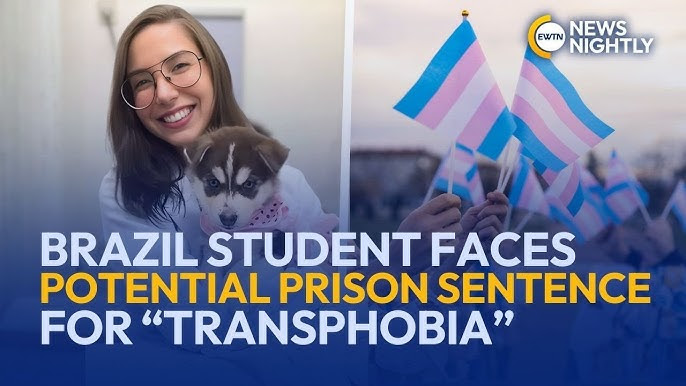
It sounds like something torn from the pages of dystopian fiction: a courtroom, a judge, and a citizen facing years behind bars–not for violence, not for fraud, not for theft, but for stating a belief about biology. Yet this is not fiction. This is happening now to Isadora Borges in Brazil, and if the world shrugs, the precedent could echo across continents like a thunderclap warning too many ignored.
Borges, a 34-year-old veterinary student, stands accused of “transphobia” for social media posts written years ago stating that transgender women are biologically male and that DNA cannot be altered by surgery or hormones. Those statements sparked a complaint from politician Erika Hilton, which in turn triggered a federal criminal case. Prosecutors are pursuing two counts, each carrying potential prison time. Combined, she could lose up to a decade of her life for words typed on a keyboard.
Pause and consider the gravity of that. Ten years. For speech. For opinion. For belief.
According to ADF International, even the judge has acknowledged the posts appear to reflect personal opinion rather than discriminatory intent. Yet the machinery of prosecution grinds forward anyway, fueled by a legal doctrine born when the Supreme Federal Tribunal ruled in 2019 that homophobia and transphobia should be treated as racism under existing law. With that single judicial stroke, categories of speech became potential crimes–without legislators ever voting to create such statutes.
This is how freedom erodes in the modern age: not with tanks in the streets, but with rulings in courtrooms.
The world only started paying attention after Elon Musk amplified discussion of the case online. That fact alone should trouble anyone who believes moral clarity should not depend on algorithmic virality. Why did it take a billionaire’s repost for millions to notice that a woman could be imprisoned for stating a view shared by countless religious believers? Where is the roar of protest from churches, seminaries, and Christian leaders who have long warned that freedom of conscience is fragile?
Silence, in moments like this, is not neutrality. It is surrender.
This is not an isolated tremor. Pastor Douglas Baptista previously faced criminal charges for publishing a book explaining a traditional Christian understanding of sexuality. Those charges were dropped–but the warning shot had already been fired. The message was unmistakable: certain beliefs, if spoken aloud, may draw the attention of prosecutors.
Columnist Mary Anastasia O’Grady of the Wall Street Journal argues that cases like this reveal a judiciary accumulating extraordinary power–effectively shaping law, enforcing it, and judging it. Whether one agrees fully or not, the trajectory is impossible to ignore. When courts become arbiters of acceptable opinion, the boundary between justice and ideology begins to dissolve.
Supporters of such prosecutions often insist they are protecting dignity and preventing harm. But history teaches a sobering truth: once governments claim authority to criminalize viewpoints, they rarely stop with one category. Today it may be gender doctrine. Tomorrow it could be political dissent. Next year it might be religious orthodoxy itself. The principle is what matters. If the state can jail someone for holding the “wrong” belief, no belief is truly safe.
The danger is not disagreement. Free societies thrive on disagreement. The danger is enforced agreement.
Christians, of all people, should recognize the stakes. The Bible contains teachings that have challenged cultural norms for two thousand years. If expressing those teachings can be prosecuted as hate speech, then faith is no longer a protected liberty–it is a regulated activity permitted only when it aligns with prevailing ideology. That is not pluralism. That is permission-based belief.
The deeper issue reaches beyond theology or politics. It is about the architecture of freedom itself. Laws always reflect worldviews. And when a worldview gains legal teeth, it gains the power to punish. Every generation must decide whether the law will guard citizens’ rights to speak–or guard authorities’ power to silence.
If Borges is convicted, the verdict will not simply close one case. It will open a door. And once a government proves it can imprison someone for peaceful expression, that door rarely closes again.
The question confronting the world is stark and unavoidable: will we defend the right to hold unpopular beliefs while we still can–or will we wait until dissent itself is declared illegal?
Magog / Khamenei threatens to sink US carrier as negotiations resume

“More dangerous than the aircraft carrier is the weapon that can send it to the bottom of the sea,” Khamenei threatened.
As a second round of high-stakes U.S.–Iran negotiations opened in Geneva, Iran’s Supreme Leader Ayatollah Ali Khamenei issued a pointed warning to Washington, escalating rhetoric even as diplomatic talks resumed.
Responding to repeated U.S. military warnings, Khamenei said, “The U.S. president keeps saying that his army is the strongest in the world. The strongest army in the world can sometimes receive such a strong blow that it cannot rise again.”
He added, “They constantly say we sent an aircraft carrier toward Iran. Well, an aircraft carrier is certainly a dangerous tool, but more dangerous than the aircraft carrier is the weapon that can send it to the bottom of the sea.”
The remarks came as negotiations formally got underway Tuesday, with Iranian Foreign Minister Abbas Araghchi arriving in Geneva and meeting Omani Foreign Minister Badr Albusaidi, whose country is serving as mediator between the sides.
According to Iranian officials speaking to Reuters, progress in the talks will depend on Washington lifting sanctions and avoiding what Tehran describes as unrealistic demands.
Iran is reportedly seeking the removal of all sanctions while framing discussions as confidence-building measures around what it calls its peaceful nuclear program, stressing that no outcome has been predetermined.
Iranian Foreign Ministry spokesman Esmail Baghaei told the IRNA news agency that the second round of indirect negotiations effectively began a day earlier with preparatory discussions between Iran and Oman.
He said Iran’s positions had already been conveyed and that, beginning at 10:00 a.m. Geneva time, the Iranian and American delegations were present at the negotiation venue, exchanging messages through Omani intermediaries.
Baghaei added that consultations involving the head of the International Atomic Energy Agency distinguished this round from previous talks and said the Iranian delegation arrived “fully prepared” on both nuclear-technical and economic issues, including sanctions relief, which he said demonstrated Tehran’s seriousness about achieving a results-focused dialogue.
Speaking Monday aboard Air Force One, President Donald Trump said he would be involved “indirectly” in the negotiations. “I’ll be involved in those talks, indirectly. And they’ll be very important,” Trump told reporters, adding that he believes Tehran is motivated to reach an agreement.
“I think they want to make a deal. I don’t think they want the consequences of not making a deal,” Trump said.
The sharp exchange of warnings and demands highlights the tense backdrop surrounding the negotiations, with diplomacy proceeding alongside increasingly explicit threats from Tehran and continued U.S. military signaling in the region.