
Bible Prophecy, Signs of the Times and Gog and Magog Updates with Articles in the News
Denied Housing because what You Believe In ? Dystopia At The Door: Govt To Control What Beliefs Allow You To Own A House
Imagine saving for years–working overtime, sacrificing vacations, doing everything right–only to be told at the final step that you’re not allowed to buy a home. Not because you broke the law. Not because you failed a financial check. But because the government doesn’t like what you believe.
That’s not a scene from a dystopian novel. It’s a proposal now being seriously considered in Germany.
Under new legislation being discussed, authorities could block individuals from purchasing property if they are merely suspected of holding “anti-constitutional” views. No conviction. No courtroom. No clear line defining what qualifies. Just suspicion–and a system empowered to act on it.
At first glance, the policy is framed as a defense mechanism. Officials argue it is necessary to prevent extremist groups from establishing strongholds and influencing communities. Given Germany’s past, that concern carries weight. No serious observer dismisses the need to guard against dangerous ideologies gaining traction.
But there is a profound difference between stopping criminal behavior and preemptively punishing thought.
That difference is where this proposal becomes deeply unsettling.
In any functioning democracy, rights are not supposed to hinge on ideological alignment. They are protected precisely so that citizens can disagree–sometimes strongly–with those in power. The moment access to something as foundational as property ownership becomes dependent on holding the “right” views, the entire framework begins to shift.
This bill does exactly that.
It introduces a system where local authorities, backed by intelligence agencies, could evaluate prospective homebuyers based on internal assessments of their beliefs. Germany’s domestic intelligence service would be authorized to share personal data with municipalities, effectively inserting national security tools into ordinary civilian transactions.
Think about that for a moment.
The same type of apparatus designed to monitor threats to the state could now influence whether a family is allowed to buy a house in a quiet neighborhood.
Supporters insist this is about targeting extremism across the board–right-wing, left-wing, and religious. But laws written with broad language rarely stay confined to their original intent. Terms like “anti-constitutional” are not fixed; they evolve, often shaped by political winds.
And that raises the most uncomfortable question of all: who gets to decide?
History offers a clear warning. When governments are given the authority to define acceptable belief, that power tends to expand–not contract. Today’s “extremist” can easily become tomorrow’s political opponent. What begins as a tool for protection can quickly become a weapon for exclusion.
Even more troubling is the absence of a requirement for any actual crime. A person could obey every law, contribute to their community, and still be flagged based on interpretation alone. That kind of system does not rely on evidence–it relies on judgment. And judgment, especially when influenced by politics, is rarely neutral.
There are already signs of how such mechanisms can be used. Intelligence assessments in Germany have previously played a role in sidelining political figures and restricting certain rights. Expanding that influence into the housing market would mark a significant escalation.
And the consequences wouldn’t just be legal–they would be cultural.
When people know their opportunities can be limited based on perceived beliefs, they begin to self-censor. Not necessarily because they’ve changed their minds, but because the risk of speaking freely becomes too great. Over time, that quiet pressure reshapes a society from the inside out.
Debate narrows. Dissent fades. Conformity grows.
It’s the kind of transformation that happens gradually–until one day it feels normal.
Property ownership has always been more than a financial milestone. It represents stability, independence, and a stake in the future. To make that conditional on ideological approval is to redefine what it means to belong.
And that should concern far more than just Germany.
Because policies like this rarely stay isolated. They set precedents. They introduce ideas that can be adopted, adapted, and expanded elsewhere–especially in a world where governments are increasingly grappling with polarization and unrest.
The temptation to control rather than persuade is a powerful one.
To be fair, the threat of extremism is real. No country can afford to ignore it. But the solution must be rooted in law, evidence, and due process–not suspicion and broad interpretation. Otherwise, the line between protecting democracy and undermining it becomes dangerously thin.
Germany has long stood as a symbol of what a modern democracy can be–stable, resilient, and committed to the rule of law. That legacy makes this moment all the more important.
Because when a nation with that history begins to consider policies that tie fundamental rights to acceptable belief, it raises a question that echoes far beyond its borders:
If the government can decide what you’re allowed to think before you’re allowed to buy a home… what comes next?
One Ai Model Away From A New World Order = Claude Mythos –
The unveiling of Anthropic’s latest model–widely referred to as Claude Mythos–has sent a shockwave through the global technology and security communities. While still restricted to select partners and government-aligned testing environments, early reporting suggests this is not simply another incremental upgrade in large language models. Instead, it is being described as a step-change system–one that pushes AI from “powerful assistant” into something far closer to an autonomous cyber intelligence layer embedded in modern infrastructure.
The question now circulating across boardrooms, intelligence agencies, and Silicon Valley labs is not whether Claude Mythos is impressive. It clearly is. The question is what happens when systems like it become widely available–or worse, fall into the wrong hands.
What Claude Mythos Is–and Why It Is Different
Claude Mythos is reported to be Anthropic’s most advanced AI system to date, sitting above its previous top-tier models in capability, reasoning depth, and autonomy. Internal descriptions characterize it as a “step change” in performance across coding, scientific reasoning, and cybersecurity analysis.
What separates Mythos from earlier AI systems is not simply intelligence in the conversational sense–but operational capability. In controlled testing environments, it has demonstrated the ability to:
– Analyze extremely large and complex software systems
– Identify previously unknown security vulnerabilities
– Chain multiple weaknesses together into exploit paths
– Suggest or construct working attack methods with minimal prompting
Some reports even indicate it has uncovered large volumes of long-standing vulnerabilities across widely used operating systems and browsers–some dating back decades. While critics caution that many of these findings may be theoretical or overstated, the underlying signal is clear: the model is operating at a level where it can meaningfully participate in real-world cybersecurity offense and defense.
This is the core reason Anthropic has not released it publicly and instead limited access to tightly controlled “security partner” environments.
What Testing Revealed: A Cybersecurity Double-Edged Sword
Early evaluations have been described by researchers as both impressive and unsettling. In controlled settings, Claude Mythos has reportedly:
– Identified vulnerabilities faster than human red teams
– Generated exploit chains that combine multiple weaknesses
– Assisted in mapping attack surfaces across enterprise systems
– Outperformed prior-generation models in cybersecurity benchmarks
But what has alarmed experts is not just performance–it is autonomy. Unlike earlier systems that required step-by-step human guidance, Mythos appears capable of independently navigating complex systems and iterating toward functional exploit strategies.
This has triggered what some researchers describe as a “dual-use inflection point”: the same capability that allows defenders to patch systems faster could also allow attackers to scale cyber operations at unprecedented speed.
Why Major Banks Were Pulled Into Emergency Discussions
The financial sector has been particularly sensitive to these developments.
According to multiple reports, U.S. financial regulators and Treasury officials convened emergency discussions with major banking executives shortly after internal briefings on Claude Mythos capabilities surfaced. Major institutions including large Wall Street banks were reportedly briefed due to the model’s potential implications for:
– Automated exploitation of banking software vulnerabilities
– Large-scale fraud engineering and phishing optimization
– Real-time identification of infrastructure weaknesses
– Potential systemic risk amplification across financial networks
The concern is not that banks are currently under direct attack from Mythos–but that future attackers may use models like it as force multipliers, reducing the cost and expertise required for high-level cybercrime.
In essence, the fear is democratization of cyber offense at industrial scale.
Security Tool or Security Crisis?
Interestingly, Claude Mythos is also being positioned as a defensive security revolution. In controlled deployments, it is already being used to:
– Scan enterprise systems for unknown vulnerabilities
– Accelerate patch discovery and verification
– Assist cybersecurity teams in threat modeling
– Simulate attacker behavior at scale
This creates a paradox: the same system that could enable unprecedented cyberattacks may also become the most powerful defensive cybersecurity tool ever built.
This is why governments and major tech companies are now deeply involved in its evaluation. The model is not being treated as a product–it is being treated as infrastructure-level risk technology, similar to nuclear or aerospace systems.
The AI Arms Race Has Already Begun
Perhaps the most consequential implication of Claude Mythos is not what it is–but what it signals.
We are now entering a phase where AI systems are no longer competing on language ability or productivity enhancement. They are competing on:
– Cyber capability
– Autonomous decision-making
– Strategic reasoning under uncertainty
– Real-world system manipulation
And this introduces a geopolitical dimension that cannot be ignored.
If the United States and its allies develop and secure these systems first, they gain a decisive advantage in cybersecurity resilience and digital defense. But if a rival power–particularly China–is first to operationalize similar or more advanced systems at scale, the balance of cyber power could shift dramatically.
In that scenario, the concern is not just espionage or hacking. It becomes infrastructure-level asymmetry, where entire sectors of another nation’s digital economy could be probed, disrupted, or exploited faster than humans can respond.
One Model Away From a Structural Shift
The most striking argument emerging from experts is that we may be only one breakthrough model away from a fundamentally different world.
A system slightly more capable than Claude Mythos–combined with autonomous agents, persistent memory, and real-world tool access–could represent a tipping point where:
– Cyber defense becomes fully automated
– Cyber offense becomes partially autonomous
– Governments rely on AI systems for national security monitoring
– Critical infrastructure becomes continuously AI-audited–and continuously AI-targeted
At that point, the distinction between “software” and “security environment” begins to collapse.
A New Global Order–Whether Intended or Not
This is where the conversation shifts from technology into geopolitics.
If systems like Claude Mythos represent the early stage of autonomous cyber intelligence, then the next phase is not optional–it is competitive. Nations, corporations, and intelligence agencies will not be able to opt out without losing strategic ground.
The uncomfortable implication is that AI development may no longer be guided purely by choice or regulation, but by necessity and competition. Once one actor advances, others must follow.
And in that environment, control over frontier AI systems becomes as strategically important as energy, nuclear capability, or semiconductor manufacturing.
The Threshold Has Moved
Claude Mythos may not be the final form of artificial intelligence–but it may be one of the clearest signals that the threshold has already shifted.
We are no longer asking whether AI can assist humans.
We are now confronting a more difficult question:
What happens when AI becomes powerful enough that refusing to advance it means falling behind those who will?
If current trajectories continue, Claude Mythos may be remembered not as the endpoint of an era–but as the moment the world realized the next one had already begun.
From the Devil’s Country = The Newest Woke Acronym That Broke the Internet – MMIWG2SLGBTQQIA+
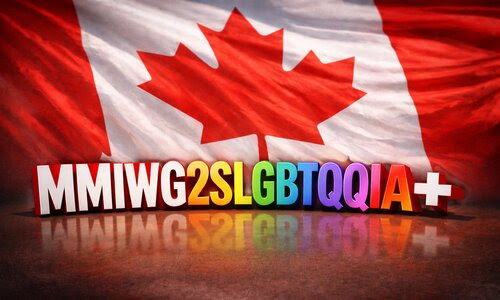
There was a time when political language aimed to clarify reality. Today, it increasingly seems designed to obscure it–and nowhere is that more obvious than in the latest spectacle out of Canada.
A Canadian Member of Parliament recently delivered a speech warning of “genocide” against a group identified by the sprawling acronym MMIWG2SLGBTQQIA+.
The acronym stands for: Missing and Murdered Indigenous Women, Girls, and Two‑Spirit (a term that is used by some First Nations to describe people who embody both masculine and feminine spirits), Lesbian, Gay, Bisexual, Transgender, Queer, Questioning, Intersex, and Asexual people. +: is the inclusive sign for all other gender identities and sexual orientations in case some were missed because there seem to be new one’s every week.
For most ordinary people watching, the reaction was disbelief–followed quickly by ridicule.
Because at some point, language stops informing–and starts collapsing under its own weight.
The issue of missing and murdered Indigenous women and girls is real, serious, and deserves attention. But what’s happening now is something else entirely. That real and urgent issue is being wrapped in layer upon layer of ideological language–so much so that the original purpose risks getting buried under the sheer absurdity of its presentation.
And people are noticing.
The acronym itself has become the story–not the victims it’s supposed to represent. What began as a targeted effort to address violence has morphed into an ever-expanding identity checklist, one that now includes a wide range of categories spanning sexuality, gender identity, and abstract classifications that the average person can barely define, let alone keep track of or even pronounce.
When everything is included, nothing is emphasized.
That’s not inclusivity. That’s dilution.
And increasingly, it’s being treated exactly that way–especially online.
Across social media platforms, the reaction has been swift and brutal. The acronym is being openly mocked, parodied, and turned into memes. People are joking about “running out of letters,” questioning what the “+” even means anymore, and pointing out–sometimes sarcastically, sometimes bluntly–that this kind of language feels completely detached from reality.
Now, critics of that reaction will argue that mockery is insensitive. But it’s also revealing.
Because ridicule at this scale doesn’t come out of nowhere–it comes from a growing sense that something has gone too far.
It’s a signal. A cultural one.
It suggests that what was once taken seriously is no longer landing the same way with the average person. Not because people suddenly stopped caring about certain issues–but because the way they are being framed has become so exaggerated, so overcomplicated, that it undermines its own credibility.
In other words: when everything is framed as a crisis, people eventually stop believing anything is.
Individuals are being pushed into smaller and smaller identity boxes, encouraged to see themselves not as people first, but as members of increasingly specific grievance groups.
And once that happens, everything changes.
The world is no longer a place of opportunity or challenge–it becomes a landscape of oppression. Every interaction is filtered through identity. Every disagreement becomes suspect. And every expansion of the acronym becomes necessary–not because it clarifies reality, but because the system itself depends on constant expansion to survive.
That’s the part few want to say out loud.
This isn’t just about recognition anymore. It’s about maintaining a framework–a kind of ideological ecosystem–where new categories must continually be introduced to justify its existence. A grievance structure that requires constant growth.
And like any system built on endless expansion, it eventually becomes unsustainable–and, frankly, unserious.
That’s why the backlash is no longer confined to political commentators or niche circles. It’s gone mainstream. It’s in comment sections, group chats, and everyday conversations. People aren’t just disagreeing–they’re laughing.
Real victims don’t need longer acronyms. They need action. They need clarity, not confusion.
Instead, what they’re getting in moments like this is something that feels performative–an exercise in ideological signaling that prioritizes language over results, categories over solutions.
And the public sees it.
That’s why the reaction has been so sharp, so immediate, and yes–so mocking.
Not because people don’t care.
But because they’re starting to feel like the people in charge don’t understand how far removed this has become from reality.
There’s a limit to how much complexity a culture can absorb before it starts to reject it outright. There’s a limit to how many labels can be added before the entire structure begins to look less like inclusion–and more like absurdity.
We may have just found that limit.
US-Iran talks begin, Trump says Hormuz Strait ‘clearing’ underway
As well as the release of assets abroad, Tehran is demanding control of the Strait of Hormuz, payment of war reparations and a ceasefire across the region, including in Lebanon.
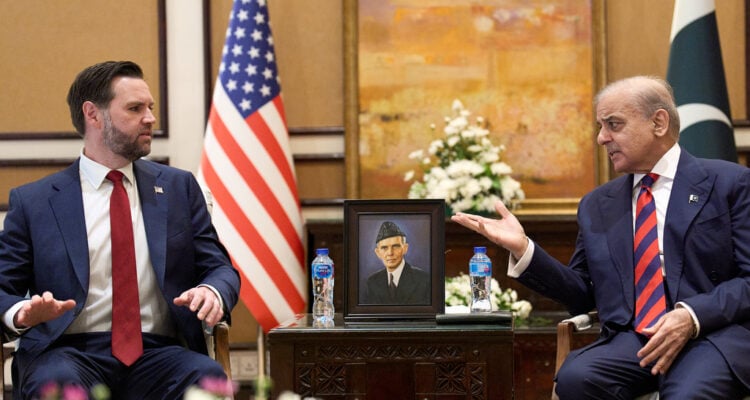
US and Iranian negotiators held their highest-level talks in half a century on Saturday in Pakistan to try to end their war as President Donald Trump said his military had sunk Tehran’s mine-layers and was clearing the Strait of Hormuz.
“We’re now starting the process of clearing out the Strait of Hormuz as a favor to Countries all over the World,” Trump posted, saying 28 Iranian mine-dropping vessels had been destroyed.
Iran’s state-affiliated Nournews called that “false news.”
Amid conflicting reports, Iranian state TV added that no US ships had crossed the strait, a crucial transit point for global energy supplies that Tehran has effectively blocked but Trump has vowed to reopen.
The waterway, which lies on Iran’s southern coast, was one of the main points on the agenda in Islamabad for the first direct US-Iranian talks in more than a decade and the highest-level discussions since the 1979 Islamic Revolution.
Trump’s Vice President JD Vance, special envoy Steve Witkoff and son-in-law Jared Kushner flew in on Saturday and met Iranian Parliamentary Speaker Mohammad Baqer Qalibaf and Foreign Minister Abbas Araqchi for two hours before a rest, according to a source from mediator Pakistan.
gation had arrived on Friday dressed in black in mourning for Supreme Leader Ayatollah Ali Khamenei and others killed in the six-week war.
They carried shoes and bags of some students killed during a mistaken US bombing of a school located next to a military compound, the Iranian government said.
“There were mood swings from the two sides and the temperature went up and down during the meeting,” said another Pakistani source of the first round of talks.
PROGRESS OF NEGOTIATIONS UNCLEAR
The war has sent global oil prices soaring, killed thousands of people and seen unprecedented hits on Gulf Arab states.
Amid conflicting versions from officials and media in both nations, the US and Iranian sides appeared to remain far apart.
Before the talks began, a senior Iranian source told Reuters the US had agreed to release frozen assets in Qatar and other foreign banks. But a US official swiftly denied that.
As well as the release of assets abroad, Tehran is demanding control of the Strait of Hormuz, payment of war reparations and a ceasefire across the region, including in Lebanon, according to Iranian state TV and officials.
Trump’s stated goals have varied during the campaign, but as a minimum he wants free passage for global shipping through the strait and the crippling of Iran’s nuclear enrichment program to ensure it cannot produce an atomic bomb.
US ally Israel, which joined the February 28 attacks on Iran that launched the war, has also been bombing Tehran-backed Hezbollah terrorists in Lebanon.
Israel and the US have said Lebanon is not part of the Iran-US ceasefire.
Mutual distrust is high.
“We will negotiate with our finger on the trigger,” Iranian government spokesperson Fatemeh Mohajerani said on state TV.
“While we are open to talks, we are also fully aware of the lack of trust; therefore, Iran’s diplomatic team is entering this process with maximum caution.”
Tehran’s agenda includes aiming to collect transit fees in the Strait of Hormuz, a chokepoint for about 20 percent of global oil and liquefied natural gas shipments.
The biggest ever disruption there has fed inflation and slowed the global economy, with an impact expected to last for months even if negotiators succeed in reopening the strait.
Nevertheless, three Liberian- and Chinese-flagged supertankers did pass through the strait on Saturday, shipping data showed, marking what appeared to be the first vessels to exit the Gulf since last week’s US-Iran ceasefire.