The Rise Of AI Christianity: Most Pastors Now Use AI For Sermon Preparation
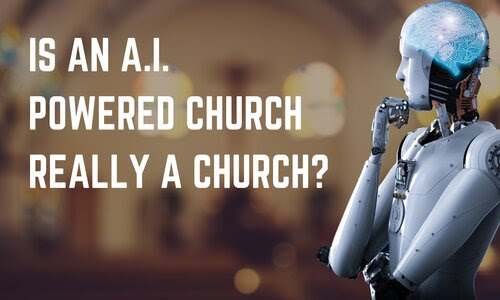
Artificial intelligence is rapidly transforming virtually every major institution in our society, and that even includes church. In the not too distant future, you may find yourself in a service where the songs have been written by AI, the prayers have been written by AI, and the sermon has been written by AI.
I realize that this may sound like science fiction to many of you, but the truth is that many churches are already leaning very heavily on AI technology. In fact, one recent survey discovered that most pastors are now using AI tools to help prepare their sermons…
A majority of pastors are now using artificial intelligence to prepare their sermons, with ChatGPT and Grammarly reported as the top two AI tools, new survey data shows.
“ChatGPT is the most visible generative AI tool that can engage in human-like conversations and assist with a wide range of tasks, from answering questions to generating content,” researchers wrote in “The 2025 State of AI in the Church Survey Report” prepared by AiForChurchLeaders.com and Exponential AI NEXT.
Needless to say, most people that are listening to these pastors have no idea that they are using AI technology.
And if nobody ever complains, they will just keep on doing it.
Personally, I had no idea that this had become so widespread. It is being reported that the survey actually found that almost two-thirds of all church leaders that prepare sermons “use AI tools in their sermon writing process”…
The data, based on responses from 594 pastors and church staff members, shows that church leaders are now more concerned about “the weighty ethical and practical considerations involved” in the use of AI as they continue their rapid embrace of the technology.
Nearly two-thirds of church leaders surveyed who prepare sermons say they use AI tools in their sermon writing process, the researchers note.
“This suggests that AI is quickly becoming a key tool for pastors in their weekly message preparation,” they wrote.
You would have to be pretty lazy to ask ChatGPT to write a sermon for you.
But even more important are the spiritual implications.
If pastors are relying on AI rather than God for their sermon ideas, what is being spiritually communicated to their flocks?
The same thing applies to the AI-generated Christian music which is now popping up on the charts.
Recently, an AI-generated “Christian artist” known as “Solomon Ray” went all the way to the top…
An AI-generated Christian artist named Solomon Ray has taken the gospel music world by storm after topping the iTunes and Billboard charts with his album “Faithful Soul.”
Described as a “Mississippi-made soul singer carrying a Southern soul revival into the present” on his Spotify profile, Ray made waves after releasing the five-song EP on Nov. 7.
The record rose to No. 1 on the iTunes Top 100 Christian and Gospel Albums chart within days, and two songs from the project – “Find Your Rest” and “Goodbye Temptation” – currently sit at No. 1 and No. 2 on Billboard’s Gospel Digital Song Sales chart, respectively.
The greatest Christian songs throughout history have been written by men and women that were being moved by God.
If God is not the spiritual source of Solomon Ray’s songs, where are they coming from?
What we are witnessing is the rise of “AI Christianity”, and that should chill all of us to the core.
Podcaster Joe Rogan is even suggesting that AI could be involved in the second coming of Jesus Christ…
The prophesied Second Coming of Jesus Christ may be triggered by an advanced, God-like computer, according to the world’s most famous podcast host.
Joe Rogan recently told the American Alchemy podcast that AI-powered machines could one day have a ‘virgin birth,’ creating advanced robots, or ‘offspring,’ capable of performing real-world miracles using technology.
‘Jesus is born out of a virgin mother. What’s more virgin than a computer?’ Rogan told podcast host Jesse Michels during the interview released on Sunday.
‘So if you’re going to get the most brilliant, loving, powerful person that gives us advice and can show us how to live, to be in sync with God, who better than artificial intelligence to do that?’
Really?
Has Joe Rogan totally lost it?
AI is not the savior of humanity.
Jesus Christ is the savior of humanity, and we need leaders that are willing to preach that message with authenticity and passion.
In a time when there is so much that is fake all around us, people are searching for what is real.
SIGNS OF THE TIMES
Will Age Verification Become The Trojan Horse For A National Digital ID?

There are moments in public policy when a proposal is presented as pure common sense–so obvious, so morally packaged, so politically irresistible–that few stop to ask the harder question: At what cost? Today, that moment is the swift and global push for mandatory age verification across the internet.
Last week, members of Congress reviewed 19 separate “online safety” bills, each promising to protect minors from the worst corners of the web. It sounds noble. It sounds responsible. It sounds overdue.
But beneath the surface, a different story is unfolding–one that privacy experts, digital rights organizations, and increasingly wary citizens are sounding the alarm over. The growing wave of age-verification requirements in the U.S., Europe, and now Australia’s sweeping new social media ban for teens, may well be the biggest step yet toward what governments have quietly desired for years: a national digital identification system.
The true danger lies not in the protection of minors, but in the system required to enforce it.
A Global Tide of Age Verification
The numbers are staggering:
25 U.S. states now require some form of age verification for accessing large categories of online content.
The UK has passed the Online Safety Act mandating verification.
And on December 10, Australia implemented a historic new law forcing social media platforms to delete or deactivate all accounts held by anyone under 16 years old–an unprecedented mandate that major platforms like Instagram, TikTok, and YouTube have already begun complying with.
Australia’s move is especially important. For better or worse, it acts as a policy test case for the rest of the Western world. When Australia imposed some of the strictest pandemic rules on Earth, other nations followed. When Australia launched sweeping online content restrictions, similar efforts emerged across Europe. It is widely expected that the teen social media ban will inspire new age-verification pushes in Canada, the UK, and eventually the United States.
Once the global policy dominoes start tipping, there’s no turning back.
The Trojan Horse: From “Protecting Kids” to ID-for-Everything
Advocates for digital liberty warn that mandatory age checks require one thing above all: identity proof. It may begin with uploading a driver’s license or submitting to a facial scan to prove you’re not a minor, but the long-term implications are far deeper.
Fight for the Future, a digital rights organization leading a week-long protest campaign, frames it bluntly:
Age verification means identification, and identification means surveillance.
Once the government or third-party firms must confirm your identity to access social media, video platforms, e-commerce, or even news websites, a universal digital identity infrastructure becomes unavoidable.
This is the Trojan horse.
Not because the government demands a national digital ID outright–but because age verification laws force it into place through the back door.
Every adult, of every age, would eventually be required to prove they are not a minor before accessing basic online utilities. As Fight for the Future campaigner Sarah Philips put it:
“In actuality, if we age-gate the internet and implement mandates, you have to prove that you’re not a child–whether you’re 18 or 50. Everyone will have to interact with this.”
Data Breaches, Third-Party Scans, and Permanent Digital Profiles
In most states, age verification is outsourced to third-party companies. These companies already struggle with breaches, hacks, and rampant data harvesting. Now imagine those same entities storing:
Facial scans
Government IDs
Browsing habits
Identity verification logs
All tied to a person’s permanent digital footprint.
Suddenly, online anonymity–the very thing that has protected political dissidents, whistleblowers, abuse survivors, and persecuted religious minorities–is gone.
And once governments discover the power of tying identification to content, the temptation to expand its use will be unstoppable.
Safety Is the Sales Pitch. Control Is the Destination.
No one denies the genuine need to protect children online. The dangers are real–predators, explicit content, radicalization, and exploitation.
But the question is not the goal. It is the mechanism.
Mandatory ID checks give governments something they have sought for years through proposals like REAL ID expansions, digital driver’s licenses, and global biometric travel systems:
a centralized identity layer that can track, monitor, restrict, or approve access to the digital world.
Today it is online safety.
Tomorrow it may be political speech, “misinformation,” religious content, or “extremism.”
And history teaches us that governments rarely abandon new powers–they expand them.
[Advertisement2]
Australia: The Signal to the World
Australia’s teen ban is being hailed as “the beginning of a new era.” But for privacy advocates, it resembles the beginning of a new surveillance architecture–one that other nations are already poised to adopt.
If every user must prove their identity to access social media, the infrastructure for universal digital identity is effectively built. Compliance becomes mandatory. Enforcement becomes automated. And dissent becomes traceable.
The Real Solution Congress Refuses to Touch
Digital rights groups insist the real path forward isn’t age verification–it’s comprehensive privacy legislation and strict limits on data collection by corporations.
Instead of creating a digital passport system for the entire population, lawmakers could simply regulate Big Tech’s predatory business models.
But those proposals don’t expand government reach. Age verification does.
A Future Defined by Permission Slips?
The great irony of this moment is that the push for safety may result in a world where every citizen must show digital papers to enter the online public square.
The question we must ask is simple:
Do we want a future where the government, or its corporate agents, must verify our identity before we speak, read, watch, or participate online?
Because that is the direction these laws are moving–quietly, quickly, and globally.
And unless citizens push back now, age verification may go down in history as the Trojan horse that delivered the first true national digital ID to the Western world.
GOG AND MAGOG UPDATE
IDF troops open fire on armed men approaching position in southern Syria

IDF troops operating near Khan Arnaba in southwestern Syria opened fire at a group of armed men traveling in pickup trucks that approached their position, according to Israeli media reports on Tuesday.
Soldiers identified several individuals advancing toward them and initiated a standard arrest procedure, which began with warning shots into the air in an effort to force the group to retreat.
When the men continued moving toward the forces, the troops shifted to live fire and struck two of the suspects, prompting the remaining individuals to flee the area.
Syrian outlets later reported that three civilians were hurt by what they described as the IDF’s “distancing fire,” noting that all three received medical treatment following the incident.
The episode took place amid heightened tension along the Syrian frontier, where Israeli forces have been working to prevent armed groups from approaching the border and to limit attempts by hostile organizations to use the area for infiltration or attacks.
Last month, IDF troops from the 55th Brigade killed three operatives of al-Jamaa al-Islamiya during a raid in Beit Jinn in southern Syria, an operation that also left six Israeli reservists wounded when their convoy was ambushed as it withdrew.
The group, tied to the Muslim Brotherhood and active alongside Hamas and Hezbollah since the start of the war, was responsible for repeated attacks on Israel.
Syrian media reported multiple casualties in the area, including civilians hurt by warning fire near Khan Arnaba earlier in the day.
In early December, Prime Minister Benjamin Netanyahu visited the wounded soldiers and said Israel is prepared to explore an arrangement with Damascus if it includes strict security guarantees, including a buffer zone preventing hostile forces from approaching the Golan Heights.