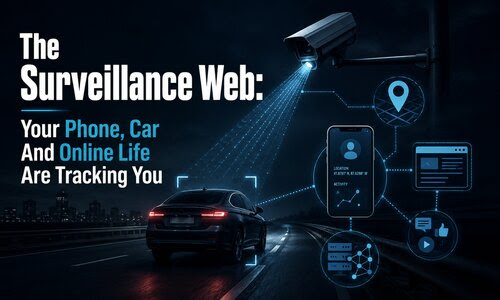
The Surveillance Web: Your Phone, Car And Online Life Are Tracking You
There was a time when being followed required someone to actually follow you.
A police officer had to sit outside your house. An investigator had to trail your car. A surveillance team had to photograph where you went and whom you met.
Today, much of that work can potentially be done by machines–and most people carry the tracking devices themselves.
A new roadside surveillance technology offers a glimpse of just how rapidly this world is changing. Leonardo, a major defense and security contractor, is marketing a system called SignalTrace that can detect electronic signals from devices traveling inside vehicles and correlate them with license-plate information.
In other words, the camera may no longer be watching only your car.
It may also be watching the digital devices traveling inside it.
Your Car Now Has An Electronic Fingerprint
Traditional automatic license-plate readers photograph passing vehicles and record their plates.
SignalTrace takes the concept further.
Leonardo says the system can identify groups of consumer electronic devices that routinely travel together–even when investigators do not know the license plate number. It can detect publicly broadcast signals associated with smartphones, Bluetooth wearables, vehicle electronics and other devices and use that combination to create what the company calls an electronic fingerprint.
Think about what that means.
Your car drives past a sensor every morning carrying your smartphone, smartwatch and wireless earbuds.
Day after day, the same collection of electronic devices appears alongside the same vehicle.
Eventually, the devices themselves become part of the vehicle’s identifying signature.
Even if the plate were changed or unavailable, the electronic pattern could potentially remain recognizable.
This technology is being promoted for legitimate law-enforcement purposes. But it also illustrates something far larger.
We are entering an age in which almost everything we carry creates data.
Your Phone Has Become A Tracking Device
Most Americans probably understand that their smartphone knows where they are.
Far fewer realize how valuable that information can become once it enters the commercial data ecosystem.
According to the Electronic Frontier Foundation, location-data brokers collect information about the movements of hundreds of millions of people, much of it originating from third-party smartphone apps. That information can potentially reveal where people live, work, worship, protest and seek medical care.
The Federal Trade Commission has repeatedly taken action against companies accused of improperly collecting or selling sensitive location information.
In one case involving Gravy Analytics and Venntel, the FTC said location data could reveal visits to places including houses of worship and medical facilities and could even help determine associations between individuals.
Consider the implications.
Twenty years ago, determining who regularly attended a particular church might have required physical surveillance.
Today, location databases can potentially make similar patterns detectable from digital records.
That should concern Christians regardless of which political party currently controls Washington.
The question is not simply whether today’s government would misuse such information.
The question is whether the infrastructure exists for tomorrow’s government to do so.
Your Car May Be Tracking You Too
Even the vehicle carrying your phone can generate another layer of information.
The Federal Trade Commission finalized an order against General Motors and OnStar in January after alleging that the companies collected precise geolocation and driving-behavior information through connected vehicle services without adequately informing consumers and provided some of that information to third parties.
The FTC has warned more broadly that modern connected vehicles can collect sensitive information including location data.
So consider the growing digital trail.
Your phone can record where you travel.
Roadside cameras can record where your vehicle travels.
Your vehicle itself may generate location and driving information.
Now technology such as SignalTrace can potentially associate the electronic devices inside the vehicle with the vehicle passing the camera.
Each individual system may appear limited.
Combined, they create something far more powerful.
Then There Is Your Online Life
The surveillance trail does not end when you park the car.
Websites, apps and advertising networks routinely use identifiers, cookies and other technologies to understand users and deliver targeted advertising.
Advertising systems can also involve location information.
In March, the Electronic Frontier Foundation reported that Customs and Border Protection had used commercial advertising-related location data as part of its surveillance capabilities.
This highlights one of the most important aspects of the modern surveillance debate.
Governments do not necessarily need to build every database themselves.
Private companies have already constructed enormous data ecosystems for advertising, analytics, transportation and consumer services.
Government agencies may sometimes be able to purchase or access parts of that commercial ecosystem.
The dividing line between commercial tracking and government surveillance can therefore become surprisingly thin.
The Real Danger Is When The Databases Connect
One camera is not an all-seeing surveillance system.
One smartphone app is not either.
Neither is your car.
Neither is your browser history.
The transformation occurs when different pieces of information can be correlated.
License plate.
Phone identifier.
Vehicle location.
App location history.
Online activity.
Travel patterns.
Known associates.
Taken separately, each data point tells only part of the story.
Combined, they can create an extraordinarily detailed portrait of someone’s life.
That is why the most important technological development may not be better cameras.
It may be the growing ability to make different databases talk to one another.
“I Have Nothing To Hide” Is No Longer A Good Enough Answer
Whenever surveillance technology expands, the familiar response appears:
“If you’re not doing anything wrong, why worry?”
Because today’s innocent information can become tomorrow’s searchable history.
Imagine a government years from now deciding it wants to identify everyone who attended a particular political rally.
Or everyone who regularly visited a certain church.
Or everyone who repeatedly traveled with a particular person.
The surveillance does not necessarily have to begin after someone becomes a target.
The records may already exist.
Authorities–or potentially others with access–could simply look backward.
That changes the nature of privacy.
For most of human history, ordinary people enjoyed a degree of anonymity simply because tracking everyone was too difficult and expensive.
Technology is steadily removing that barrier.
We are building a world in which your phone identifies itself, your car records information, cameras recognize your vehicle, apps record movements and your online activity generates still another trail.
The biggest question may no longer be:
Are we being tracked?
Increasingly, the answer is obvious.
The question we should be asking is:
Who gets access to the record–and what happens when someone decides to use it?
When Abortion Becomes Something To Celebrate

They smiled. They applauded. Some appeared to laugh with joy.
The occasion?
Massachusetts Gov. Maura Healey was signing legislation that removes the state’s previous restrictions governing abortion after 24 weeks and replaces them with a standard based on a physician’s professional judgment.
But let’s put that into language everyone can understand.
The legislation contains no specific gestational-age cutoff. That means its legal framework can extend through the final weeks of pregnancy—right up until birth—subject to the physician’s professional judgment.
Forget the clinical terminology for a moment.
Picture a woman eight or nine months pregnant. The baby visibly moves beneath her clothing. The nursery may already be prepared. The car seat installed. Tiny clothes folded in a drawer.
We are talking about a child who could potentially be born and placed into his mother’s arms.
And as the legislation was signed, people applauded.
Perhaps that tells us something even more disturbing than the legislation itself.
From “Safe, Legal And Rare” To Applause
There was a time when even America’s most prominent abortion-rights politicians portrayed abortion as something society should hope to minimize.
Bill Clinton famously said abortion should be “safe, legal and rare.”
The word rare mattered.
It implicitly acknowledged that abortion wasn’t something to celebrate.
Look at where we are now.
Abortion is called freedom.
It is called empowerment.
It is called healthcare.
Removing restrictions is called progress.
And politicians gather around a desk while cameras roll and supporters applaud.
We haven’t simply changed abortion laws.
We have changed our attitude toward abortion itself.
Isaiah Warned About A World Like This
Nearly 2,800 years ago, the prophet Isaiah issued a warning that sounds remarkably relevant:
“Woe unto them that call evil good, and good evil; that put darkness for light, and light for darkness…” — Isaiah 5:20
Isaiah wasn’t merely describing people doing evil things. Human beings have always sinned.
He was describing something more dangerous: moral inversion.
Eventually the labels themselves become reversed.
What was once considered tragic becomes liberation.
What was once shameful becomes celebrated.
What once produced sorrow eventually produces applause.
That is why the Massachusetts signing ceremony deserves our attention.
Don’t Think “24 Weeks.” Think About The Baby.
Political debates have a way of hiding reality behind numbers.
Twenty-four weeks. Thirty weeks. Thirty-six weeks. Forty weeks.
For millions of people—particularly men who have never experienced pregnancy—those numbers can sound abstract.
So put them into terms everyone understands.
A typical full-term pregnancy is approximately 40 weeks.
Thirty-six weeks means roughly a month before the due date.
Thirty-eight weeks means birth may be just days away.
At that stage, nobody needs a medical degree to understand what is inside the womb.
There are arms. Legs. Fingers. Toes. A face. A beating heart.
The baby moves and kicks strongly enough that those movements can sometimes be seen through the mother’s abdomen.
The hospital bag may already be packed.
Family members may be waiting for the phone call.
Strangers see the expectant mother and ask:
When is the baby due?”
Nobody asks when the fetus is due.
And yet Massachusetts has removed its specific statutory conditions governing abortions after 24 weeks.
That is the reality obscured by clinical phrases such as “abortion access.”
We’re talking about a legal framework that can extend into the final months, weeks and potentially days before birth.
Across The Hall, Doctors Fight To Save The Same Child
Now consider the contradiction.
Imagine two rooms in the same hospital.
In one, a premature baby has just been delivered.
Doctors rush into action. Nurses monitor every breath. Parents stand nearby praying their tiny child survives.
Decades of medical advancement are brought to bear for one purpose:
Keep this baby alive.
Now imagine another child at a comparable—or even more advanced—stage of development who remains inside the womb.
What changed?
Not the child’s humanity.
Not the child’s DNA.
Not the child’s value.
Only the child’s location.
One may become the object of an extraordinary medical rescue effort.
The other exists under an abortion law containing no specific gestational-age cutoff.
How did a few inches come to make such an enormous difference in the protection afforded human life?
Science Has Made The Reality Harder To Ignore
Modern ultrasound has opened a window into the womb.
Parents watch their children move.
They see hands and feet.
They watch babies stretch, kick and turn.
They take ultrasound pictures home, send them to grandparents and post them in pregnancy announcements.
Nobody looks at the ultrasound of a wanted child and says, “Look at our reproductive tissue.”
They say:
Look at our baby.”
Science has made the humanity of the unborn increasingly difficult to hide behind political terminology.
Yet politically, parts of America continue moving in the opposite direction.
The Law Matters. But The Applause Matters More.
Years from now, perhaps the most revealing part of this story won’t be found in the legislative language.
It may be found in the video.
The smiles.
The laughter.
The applause.
Because laws tell us what governments permit.
Celebrations tell us what cultures value.
America didn’t arrive here overnight.
Moral boundaries rarely collapse all at once.
First something shocks us.
Then we tolerate it.
Then we normalize it.
Then we defend it.
Then we celebrate it.
And eventually we condemn those who still dare to call it wrong.
That is why Isaiah’s warning remains so powerful.
He warned about a world where evil receives a new name.
Where darkness is renamed light.
Where wrong is renamed right.
Where taking innocent life is renamed healthcare.
And where removing abortion restrictions extending into the final weeks before birth becomes an occasion for smiles, laughter and applause.
Massachusetts has changed its abortion law.
But perhaps something much bigger was on display at that signing ceremony.
The law showed us what Massachusetts now permits.
The applause showed us what our culture is becoming.