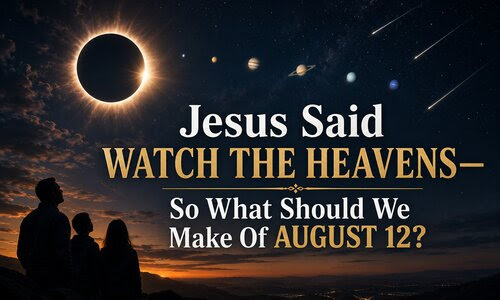
Jesus Said Watch The Heavens–So What Should We Make Of August 12?
Something unusual is about to happen in the heavens.
Before sunrise on August 12, six planets will be spread across the morning sky. Later that same day, the moon will pass directly between the Earth and sun, producing a total solar eclipse across portions of the Northern Hemisphere. Then, as darkness falls, one of the year’s most spectacular meteor showers will be reaching its peak.
It will be quite a day to look up.
NASA confirms that the August 12 total solar eclipse will sweep across Greenland, Iceland, northern Russia, the Atlantic Ocean, Spain and a small portion of Portugal. Parts of North America, Europe and Africa will experience a partial eclipse.
At roughly the same time, the Planetary Society says a six-planet “parade” will stretch across the predawn sky for several mornings. Jupiter, Mercury, Mars, Uranus, Saturn and Neptune will all be present, although Uranus and Neptune will require optical assistance to see.
And then there are the Perseids.
The American Meteor Society places the 2026 Perseid maximum around August 12-13, with virtually no moonlight to interfere with viewing. The Perseids are among the most anticipated meteor showers of the year, producing brilliant streaks of light across summer skies.
None of those things, by themselves, are supernatural.
Eclipses are predictable. Planetary movements are predictable. Meteor showers occur as Earth passes through debris left behind by comets.
But Christians should be careful about going from that scientific observation to another conclusion increasingly common in our secular age: that because something has a natural explanation, it therefore cannot have spiritual significance.
The Bible never makes that distinction.
Jesus Told Us To Look Up
When Jesus described conditions surrounding the end of the age, He included a remarkable statement:
“There shall be signs in the sun, and in the moon, and in the stars.” — Luke 21:25
That should at least get our attention.
Jesus didn’t tell His disciples to practice astrology.
But He did tell them that the heavens would matter.
That idea doesn’t begin in Luke.
Genesis 1:14 tells us that God created the lights in the heavens “for signs, and for seasons, and for days, and years.”
The prophet Joel spoke of “wonders in the heavens” and declared that the sun would be turned to darkness before the great and terrible Day of the Lord.
Jesus repeated similar imagery in Matthew 24.
And Revelation describes dramatic disturbances involving the sun, moon and stars as God’s judgments unfold.
In other words, Scripture repeatedly tells us that the God who created the heavens is perfectly capable of using them to get humanity’s attention.
The Danger Of Going Too Far
That doesn’t mean every eclipse is a prophecy.
Christians have repeatedly embarrassed themselves by assigning specific prophetic significance to astronomical events only to watch the predicted dates come and go.
We should learn from that.
There is no biblical passage saying that an eclipse on August 12, 2026 will trigger a war, economic collapse, earthquake or the return of Christ.
We should not manufacture prophecy where Scripture has given none.
The events themselves are remarkable enough. They don’t need embellishment.
But avoiding sensationalism does not require adopting the opposite extreme.
There is a difference between date-setting and watchfulness.
And Jesus repeatedly commanded the latter.
Perhaps The Message Is Simply: Look Up
Consider the strange contrast of our generation.
Humanity has never possessed more information, yet millions live with their faces permanently pointed downward.
Down at phones.
Down at screens.
Down at financial accounts.
Down at political arguments.
Down at an endless stream of crises, outrage and entertainment.
And Scripture continually tells believers to look in another direction.
Up.
“When these things begin to come to pass,” Jesus said, “then look up, and lift up your heads; for your redemption draweth nigh.”
Perhaps that is the most important way Christians should approach August 12.
Not by declaring that an eclipse proves something catastrophic must happen the following morning.
Not by creating prophetic timelines God never gave us.
But by remembering that history belongs to God–and so do the heavens.
The Heavens Above A Troubled World
The timing is nevertheless difficult to ignore emotionally.
We are watching wars and rumors of wars dominate headlines. Nuclear powers are confronting one another. Governments are preparing for conflicts that once seemed unimaginable. Economic systems are carrying staggering levels of debt. Artificial intelligence is transforming civilization at astonishing speed. Political instability is spreading across nations and earthquakes of increasing magnitude are spreading.
For Christians who take biblical prophecy seriously, those developments are already enough reason to remain spiritually awake.
Then, on August 12, millions will look toward the sky.
Some will see planets before sunrise.
Some will watch daylight dim as the moon moves across the face of the sun.
And later, under an exceptionally dark sky, countless streaks of light from the Perseids may flash overhead.
Is God telling us that something specific will happen?
We cannot say that.
But neither should Christians become so afraid of being called sensationalists that we forget what Scripture plainly says.
The heavens declare the glory of God.
Jesus told us there would be signs in the sun, moon and stars.
And He repeatedly told His followers to watch.
So enjoy the spectacle on August 12.
Marvel at the precision of a creation in which planets travel their appointed paths, the moon can cover the face of the sun, and Earth can pass through particles left behind by a comet traveling through the solar system.
But perhaps do something else as well.
Remember Who put it all there.
Remember where history is ultimately headed.
And remember the command Jesus gave to a generation awaiting His return:
Watch.
Is A Global Financial Crash Starting In Japan?
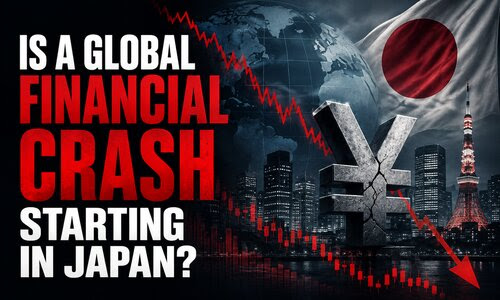
The unraveling of the yen carry trade is accelerating, and that is really bad news for the entire global financial system. For such a long time, investors could borrow yen for next to nothing and invest that money in financial assets all over the world. That helped to create some epic financial bubbles, but now the entire process has gone in reverse.
Interest rates in Japan have been spiking and the value of the yen has been plummeting. Those of you that have been following these developments already know that we are facing a very real financial doomsday scenario.
The yen fell so low last week that the U.S. Treasury felt forced to take emergency action.
Needless to say, that was extremely unusual.
An unprecedented intervention by Japan’s Ministry of Finance and the U.S. Treasury absolutely shocked investors throughout the globe…
The unprecedented U.S.-Japan intervention to support the yen may end up shaping market behavior.
Japan has intervened in currency markets before, but this episode was bigger than usual. It was backed by Washington, reportedly executed using the euro-yen cross rather than directly in dollar-yen, and accompanied by explicit political support.
Some investors consider this a major step.
“Japan’s Ministry of Finance and the U.S. Treasury have successfully weaponized the yen,” said Jesper Koll, expert director for Monex Group, referring to market deterrence. The intervention went beyond conventional foreign exchange management because the countries deployed public balance sheets in concert to influence market psychology, he said.
Unfortunately, that intervention didn’t fix things for long.
The yen is absolutely plummeting against the dollar today.
So what happens now?
Will the U.S. Treasury spend billions more to artificially prop up the yen?
Even if they do, it won’t work for long.
Meanwhile, Japanese bond yields have been going nuts…
And so now major financial institutions in Japan are facing staggering losses…
This is only the beginning.
The value of the yen is almost certainly going to continue to fall.
Japanese bond yields are almost certainly going to continue to go up.
And the pain will be felt all over the planet.
Earlier today, I came across a post on X that did a great job of explaining the magnitude of the crisis that we are potentially looking at…
It would be difficult for me to overstate how serious this is.
During a recent interview with Greg Hunter, Jim Rickards warned that the unwinding of the yen carry trade is “the financial equivalent of all out nuclear war”…
Eight-time, best-selling financial author Jim Rickards is warning of a financial calamity already underway that Treasury Secretary Scott Bessent is trying to contain. It is the Japanese yen carry trade where the US Treasury is propping up the yen’s value. Is the yen carry trade coming to a halt and can it blow up things? Rickards says, “The answer is yes and yes. . .. Somebody wrote me and asked if the yen carry trade is a big deal? I wrote them back and said there is nothing bigger. This is actually the biggest story in the world.”
In simple terms, the problem is people have been borrowing at 0% in yen to do deals around the world. Everything was fine until interest rates in Japan started going up after more than two decades. Rickards says, “This is the engine of global economic growth. It has been powering the US economy and the global economy for over 30 years. What could go wrong? The thing that could go wrong the fastest is if Japanese interest rates went up. . .. The bank of Japan says it is going to keep raising interest rates. It’s not going to the moon, but 3% for yen (and Japanese) interest rates is like going to the moon when it’s been 0% for 20 years. So, now, the yen carry trade is unwinding. . ..
The original borrower borrows dollars to pay back the yen loan, swaps the yen and pays back the yen loan. What if you can’t borrow? What if the bank says sorry, no soup for you. . .. Now, what do you do if you want to get out of the yen carry trade? You have to sell assets. So, you are going to sit there and make a lot less money or even lose money, or you are going to dump assets to get dollars to pay back the yen loan. They are both bad for the markets. It you have to sell assets, guess what? The price goes down, and other people have to sell assets. The next thing you know it’s a stampede, and everyone is running for the exit. This is not a few investment banks on Wall Street or a few hedge funds. This is the whole world getting out of the leveraged exchange rate engine that has been running the world for 30 years. That is the financial equivalent of all out nuclear war.”
As this crisis builds, it threatens to become an unstoppable tsunami which could end up ripping through everything.
Of course we are already witnessing some very serious trouble signs in U.S. financial markets.
Massive derivative losses have caused the stock price of the largest mortgage lender in the United States to utterly implode…
The already shredded stock of UWM Holdings, the parent company of United Wholesale Mortgage, the largest home-mortgage lender in the US with $40 billion in mortgage originations in Q2, plunged another 35% today, into penny-stock territory of $1.20 a share.
The company, which exclusively originates home loans through mortgage brokers, had gone public in January 2021 via merger with a SPAC that gave it a $16 billion valuation. It was the largest SPAC deal at the time and made CEO and founder Mat Ishbia a multi-billionaire. True to SPAC form, it has been a bloodbath for public investors ever since.
We aren’t talking about some Mickey Mouse operation.
This was the biggest mortgage lender in the entire country.
And then today we witnessed some very alarming forced liquidations of highly leveraged cryptocurrency positions including Bitcoin and Ether.
It is starting, and we can see the symptoms all around us.
For average Americans, harsh economic conditions are going to get even worse.
The size of the U.S. workforce has fallen by more than a million workers over the past year, and the cost of living has become extremely oppressive.
But these will be considered “good times” compared to what is coming.
It would greatly help if the Strait of Hormuz was reopened, but you can forget all about that now…
The only way that Iran will open up the Strait of Hormuz is if President Trump essentially throws up the white flag and gives the Iranians every single thing on their wish list…
Never threaten Iran with any language or insult the sanctities of this nation.
End the war and aggression against Iran and its allies in Lebanon, Palestine, Yemen, and Iraq forever.
Lift the naval blockade and withdraw its military forces (naval and air) from around Iran.
Pay the damages of the two wars of aggression and imposition on Iran without any reduction or reduction.
Lift the cruel and illegal sanctions against the Iranian nation.
Unconditionally release the frozen and stolen assets of the Iranian people.
Trump can never possibly agree to all of that.
In fact, he just responded to Iran’s demands by demanding that they pay reparations…
As I have been saying all along, there isn’t going to be a deal.
So the price of oil is going to go even higher, and our stockpiles are going to continue to get drained…
As negotiations between the US and Iran to reopen the Strait of Hormuz go nowhere, oil prices continue to slide lower on some naive hope that a resolution to the conflict will magically emerge. Meanwhile, both commercial and strategic stocks continue to be drained at a historic pace, and one day virtually every tank bottom will be hit, sparking a historic surge in commodity prices as the market realizes that physical always wins the war with paper oil.
That day just got closer today when the US reported that crude oil stocks in the Strategic Petroleum Reserve fell below 300 million barrels for the first time since early 1983, as global inventories are under pressure due to the Iran war.
The SPR fell by 6.1 million barrels to 298.7 million barrels last week, according to data released by the Department of Energy on Monday. The reserve is at its lowest level since January 1983.
The war in the Middle East is far from over, and the really painful chapters of the global energy crisis are ahead of us.
At the same time, a new global financial crisis is suddenly erupting in Japan.
We just keep getting hit by one thing after another.
All of the pieces of the puzzle are coming together all at once, and not in a good way.