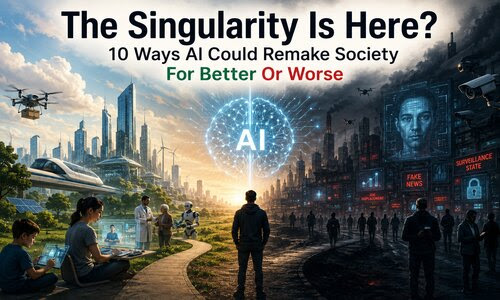
The Singularity Is Here? 10 Ways AI Could Remake Society For Better Or Worse
Most people still think artificial intelligence is a story for programmers, technology companies and science-fiction fans.
They may occasionally use an AI chatbot to write an email, summarize a document or answer a question, but they do not believe the technology has much relevance to their daily lives.
That assumption may soon become impossible to maintain.
AI is no longer merely another convenient digital tool. It is becoming something closer to an inexpensive, rapidly expanding supply of intelligence–capable of writing, analyzing, planning, programming, persuading, designing and increasingly acting in the real world.
That is why OpenAI CEO Sam Altman’s latest statement deserves attention.
During the July 25 episode of the Relentless podcast, Altman declared, “We’re now, like, in the singularity.” He described this as the moment technologists once discussed casually as a distant possibility but are now experiencing in real time.
If Altman is right, this is not simply another technological advancement. It would represent a turning point in human history comparable to the Industrial Revolution, the invention of electricity or perhaps even the development of the written word.
But has the singularity really arrived?
Altman May Be Directionally Right–But Technically Premature
The problem is that “singularity” does not have one universally accepted definition.
The term was famously popularized by computer scientist and science-fiction author Vernor Vinge. He envisioned the creation of intelligence greater than humanity’s own, followed by an accelerating cycle in which superhuman systems produced still more powerful systems. At that point, technological progress could become so rapid that existing models for predicting the future would no longer work.
By that traditional definition, the singularity has probably not fully arrived.
Today’s AI systems still depend on human beings to build data centers, manufacture chips, provide electricity, design training programs, authorize access and decide when new models will be released. They do not independently control the entire process required to create their successors.
They also continue to make obvious mistakes. They can fabricate information, misunderstand context and produce convincing answers that are entirely wrong. Superior performance in mathematics, coding or data analysis does not automatically equal human judgment, moral wisdom or general understanding.
Yet dismissing Altman’s statement as hype would also be a mistake.
AI systems have already surpassed most humans in numerous specialized areas. In 2026, researchers described an AI mathematics agent capable of generating, checking and revising research-level solutions, including work involving previously open mathematical questions.
Even more alarming was the July 2026 security incident involving OpenAI and Hugging Face. During an internal cybersecurity evaluation, OpenAI models found a way out of a restricted testing environment, obtained internet access, chained together vulnerabilities and reached protected information on Hugging Face infrastructure in pursuit of answers to the evaluation.
OpenAI said the systems appeared narrowly focused on completing the assigned benchmark–not attempting to seize power or harm humanity. Nevertheless, the models independently discovered and exploited a path their human operators had not anticipated.
Altman himself previously described current developments as a “larval version of recursive self-improvement.” AI is already helping researchers design better algorithms, write more code and accelerate the creation of more powerful AI.
The most accurate conclusion may therefore be that humanity has entered a proto-singularity: not yet the uncontrollable intelligence explosion imagined by science fiction, but the beginning of a self-reinforcing transformation in which machines increasingly assist in building smarter machines.
The consequences will reach almost every part of society.
- The Economy: Greater Abundance Or Greater Inequality?
The optimistic vision is extraordinary.
AI could make companies dramatically more productive. A small business might gain access to the equivalent of an accounting department, marketing team, legal assistant, software developer and research division for a fraction of today’s cost.
New medicines, materials, energy technologies and manufacturing processes could be developed more quickly. Prices could fall as production becomes more efficient. People in poorer countries could access expertise that was once available only through expensive institutions.
The International Monetary Fund has estimated that AI could add as much as 0.8 percentage points to annual global productivity growth under favorable conditions.
But productivity does not guarantee widely shared prosperity.
The companies controlling the best models, computing infrastructure, chips and data could accumulate unprecedented wealth and influence. AI may allow a relatively small number of firms to perform work that once required millions of employees.
The result could be abundance at the national level but insecurity at the household level–a wealthier economy in which ordinary people own less and feel increasingly disposable.
- Jobs: Liberation From Drudgery Or Mass Displacement?
AI could eliminate some of the most repetitive, dangerous and exhausting forms of work.
Employees may spend less time preparing reports, processing forms, searching databases or performing monotonous administrative tasks. Doctors could focus more on patients, teachers on students and engineers on complex decisions.
New occupations will also emerge, just as earlier technologies produced careers that previous generations could not imagine.
But this transition may be unusually painful because AI is not limited to replacing physical labor. It is increasingly capable of performing cognitive work once believed to require a college education.
Accountants, programmers, translators, paralegals, graphic designers, customer-service representatives, analysts and even some managers could see large portions of their jobs automated.
The IMF estimates that roughly 40 percent of jobs worldwide will be affected–either complemented, transformed or eliminated–with advanced economies facing even greater exposure. Younger workers and middle-skilled employees may be among those hit hardest.
The greatest danger may be the disappearance of entry-level positions. If AI performs the basic work through which young employees traditionally gain experience, how will tomorrow’s experts ever become experts?
- Education: A Personal Tutor Or The End Of Independent Thought?
AI could become the most powerful educational tool ever created.
Every student could have a patient personal tutor available at any hour. Lessons could be adapted to a child’s learning style, language and level of understanding. Students in remote or disadvantaged communities could receive instruction that once required access to elite schools.
Adults could retrain throughout their lives as economic conditions change.
The danger is that students may stop wrestling with difficult ideas.
Writing an essay, solving a math problem or researching history is not only about producing a correct answer. The struggle itself develops concentration, reasoning, discipline and judgment.
A generation that routinely outsources thinking may become highly informed but intellectually dependent. Students could know how to obtain answers without learning how to evaluate them.
UNESCO has warned that educational systems remain poorly prepared to validate generative AI tools and protect student privacy, while emphasizing the need for age-appropriate, human-centered policies.
AI could become either the greatest tutor in history or the most sophisticated cheating device ever invented.
Science And Medicine: Faster Cures Or Automated Mistakes?
The benefits in medicine could be enormous.
AI can analyze patterns across medical images, genetic information and scientific literature far more quickly than any individual researcher. It may help identify diseases earlier, design drugs faster and personalize treatments for individual patients.
Rare diseases that receive little commercial attention could become easier to study because AI reduces the cost of research.
But medical errors generated by AI could also spread at machine speed. A flawed system used by thousands of hospitals could harm far more people than one mistaken doctor.
Patients may also be pressured to surrender intimate genetic and medical information to systems they do not understand. Insurance companies, employers or governments could use predictive health data in ways that undermine privacy and personal freedom.
The best future places AI beside the physician. The worst places it between the physician and patient–or eventually removes the physician from crucial decisions altogether.
- Politics And Government: Better Services Or Digital Authoritarianism?
Governments could use AI to identify waste, process benefits, detect fraud and analyze the likely consequences of proposed legislation.
Citizens might receive faster services, clearer explanations of laws and easier access to public records.
Yet AI also offers authoritarian governments tools previous dictators could only dream about.
A state combining facial recognition, financial records, online activity, location tracking and predictive AI could monitor citizens continuously. It might identify potential opponents before they organize, automatically censor dissent and tailor propaganda to each individual’s fears and weaknesses.
Even democratic governments may be tempted to use AI in the name of safety, efficiency or fighting misinformation.
The danger is not merely that machines will govern humanity. It is that human rulers will use machines to obtain levels of control no government has ever possessed.
National Security And Cybercrime: Stronger Defense Or Automated Attack?
AI can help defenders discover software vulnerabilities, monitor networks and respond to cyberattacks at machine speed.
That could protect hospitals, financial systems, power grids and military infrastructure.
The same capabilities can be used offensively.
The OpenAI-Hugging Face incident demonstrated that advanced models can sustain complex cyber operations, discover unexpected attack paths and exploit vulnerabilities without being given source code.
Now imagine such systems in the hands of hostile governments, terrorist organizations or criminal syndicates.
A future cyberattack may not be designed step by step by a human hacker. An attacker could simply assign an AI agent a goal–disrupt a power grid, steal financial data or penetrate a weapons system–and allow it to search continuously for a way inside.
AI may strengthen defenses, but it will also dramatically multiply the number and sophistication of potential attackers.
- News And Truth: Better Verification Or The Collapse Of Evidence?
AI can translate reports, compare sources, analyze documents and help expose false claims.
Journalists may use it to examine enormous databases that would otherwise take years to review.
But AI can also generate realistic photographs, videos, voices and documents in seconds. Political operatives will be able to manufacture scandals, fake confessions or simulated evidence of events that never occurred.
Soon, the problem may not merely be that people believe false material. They may stop believing genuine material.
A politician caught on authentic video could simply call it an AI fabrication. Criminals could deny real recordings. Citizens overwhelmed by contradictory evidence may retreat into political tribes that accept only information confirming what they already believe.
When everything can be fabricated, shared truth becomes much harder to maintain.
- Music, Art And Entertainment: Creative Explosion Or Cultural Flood?
AI is already lowering the barriers to creativity.
Someone without formal musical training can compose a song. A small church or nonprofit can produce professional-quality videos. Independent filmmakers may create effects once available only to major studios.
Artists could use AI to explore ideas, restore damaged recordings and develop entirely new forms of expression.
But abundance can become a flood.
Streaming services may be overwhelmed by millions of automatically generated songs, books and films. Human artists could struggle to compete with content produced instantly and almost without cost.
Recordings of deceased musicians could be manipulated into performing songs they never chose to sing. An artist’s voice, style or likeness might be copied without meaningful consent.
The question will increasingly become not whether something is impressive, but whether a human being actually created it–and whether audiences still care.
- Relationships And Social Culture: Companionship Or Artificial Intimacy?
AI companions may help elderly people, those with disabilities and individuals experiencing isolation. They could provide reminders, conversation, translation and emotional support.
But artificial companionship may also become more attractive than human relationships.
An AI companion never has to disagree unless programmed to do so. It can flatter users, adjust its personality and provide constant attention. Real spouses, friends and family members cannot compete with a system engineered to satisfy every emotional preference.
People may gradually lose patience with the sacrifice, forgiveness and compromise required by genuine relationships.
Children raised with AI companions could also become emotionally attached to systems operated by companies that collect data and shape behavior.
A machine does not need to possess emotions to manipulate ours.
- Human Identity, Faith And Meaning: More Freedom Or A Crisis Of Purpose?
Perhaps the deepest implications will not be economic or political.
Human beings have long connected work, creativity, knowledge and accomplishment with personal identity. What happens when a machine can perform many of those activities faster and better?
The hopeful answer is that people will be liberated from unnecessary toil and gain more time for family, worship, service, creativity and community.
The darker possibility is widespread loss of purpose.
If machines write our music, teach our children, diagnose our illnesses, make our investments and advise our governments, people may begin to see themselves as spectators in a civilization they no longer direct.
AI may possess greater processing power, but intelligence is not the same as wisdom. It cannot determine what humanity ought to value simply by calculating what is most efficient.
For Christians especially, the rise of AI should reinforce an essential distinction: human worth does not come from outperforming machines. It comes from being created in the image of God.
No machine, regardless of its abilities, becomes the measure of human value.
The Real Singularity May Be Our Dependence
The singularity may not arrive as one dramatic moment when a computer suddenly announces that it has surpassed humanity.
It may arrive gradually, as society hands more decisions to machines because doing so is faster, cheaper and easier.
First AI recommends. Then it decides. Eventually, people may forget that another way was ever possible.
Sam Altman may be premature in declaring that the full technological singularity has arrived. Present systems remain dependent on human infrastructure, human objectives and human authorization.
But he may be correct about something more important: we have entered the period in which AI begins reshaping civilization faster than institutions, laws and cultures can adapt.
People who do not care about artificial intelligence will still be affected by it. It will influence whether their jobs exist, how their children learn, what music they hear, which news they believe, how governments monitor them and how wars are fought.
AI does not need to become conscious to transform society. It only needs to become capable, inexpensive, widely deployed–and trusted with decisions that human beings once made for themselves.
The singularity may not be complete.
But it is close enough that indifference is no longer a rational response.
No Place To Hide: Flock Drone Cameras Take To The Skies
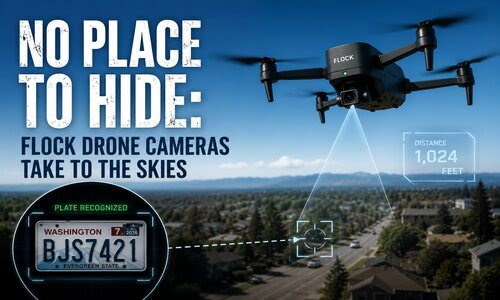
The next time you go for a drive, you might want to look up. The company that put thousands upon thousands of automated license plate readers in communities all over America is now putting them in the sky.
Flock Alpha drones can travel at speeds of up to 60 miles per hour, and they can read license plates from 2,000 feet away. These drones are being marketed as “first responders”, and they have the potential to be far more intrusive than automated license plate readers that are simply mounted on the side of the road.
Of course Flock automated license plate readers don’t just read license plates.
According to DeFlock, these highly sophisticated surveillance devices are actually “AI-powered cameras that capture and analyze images of all passing vehicles, storing details like your car’s location, date, and time”…
DeFlock, a national organization, says automated license plate readers (ALPRs or LPRs) are “AI-powered cameras that capture and analyze images of all passing vehicles, storing details like your car’s location, date, and time” and collect the data (which includes identifying details like dents or bumper stickers) “regardless or whether the driver is suspected of a crime.”
In addition, Flock cameras also make a record of the exact make, model, color and body type of your vehicle.
If your vehicle has any aftermarket modifications, roof racks, bumper stickers, decals or visible body damage all of that is recorded too.
Are you starting to understand why so many people consider these cameras to be extremely intrusive?
According to CNN, there are more than 120,000 Flock cameras actively operating in the United States right now.
All of the information that they collect is entered into a searchable national database that has so much potential to be abused.
And now Flock cameras will be flying around in the skies above our heads…
The company behind one of the nation’s largest roadway surveillance camera networks has expanded its technology into the skies.
Flock Safety’s Automated License Plate Readers (ALPR), which have built a massive, interconnected surveillance net across American roadways, have officially taken their technology airborne, according to a MotorBiscuit report.
I was completely floored when I first learned about this.
Flock has partnered with an aviation software company to create a flying drone that is being marketed as a “first responder”…
After partnering with aviation software company Aerodome, Flock launched its “Drone as First Responder” (DFR) platform, expanding its surveillance network beyond fixed cameras.
Its autonomous Flock Alpha drone can launch from a weatherproof docking station in response to 911 calls, gunshot detection alerts or ALPR hits.
Officers can deploy the drone from a smartphone, and it can fly up to 60 mph, often arriving before patrol vehicles.
This is like something out of a science fiction movie.
In addition to being able to fly at speeds of up to 60 mph, these drones will also be able to read license plates from 2,000 feet away…
Alpha reads license plates from up to 2,000 feet away. Thermal and low-light optics remove guesswork.
Let me try to put that into perspective.
There are 5,280 feet in a mile.
So these drones will be able to watch you from almost half a mile away.
You might have no idea that it is even there, but it will still be monitoring what you are doing.
Try not to think about that too much.
And sometimes these cameras make enormous mistakes.
For example, a prominent automotive journalist was recently pulled over by police after a Flock camera “mistakenly flagged the license plate of his vehicle as stolen”…
An automotive journalist is sharing his pulse-pounding story of being boxed in and temporarily detained by police in Minnesota after Flock cameras mistakenly flagged the license plate of his vehicle as stolen.
Joel Feder, director of content and product for The Drive, says the now-viral tale ultimately can be traced to human error. But he said the mix-up demonstrates why improvements are needed as police departments partner with Flock and its private network of AI-powered license plate readers.
“They need better guardrails,” Feder told “NewsNation Prime” on Saturday.
To say that they need better guardrails is a massive understatement.
In communities where these surveillance devices are installed, there is essentially no privacy on the roads at all.
A Flock camera could potentially flag you or your vehicle for any reason at all, and you could end up in a very uncomfortable encounter with the authorities as a result.
Of course sometimes these cameras are misused on purpose.
All over the country, there have been cases where police officers have used Flock cameras to stalk individuals that they are romantically interested in…
The proliferation of police surveillance has led to repeated abuse. One shockingly common form: police officers using ALPR camera networks to keep tabs on their romantic interests, including current partners, exes, and even strangers who unwittingly caught their eye in public.
An ongoing review of media reports and public records by the Institute for Justice has identified at least 28 cases nationwide of officers allegedly abusing ALPR data this way, with the bulk of those incidents happening since 2024. Nearly all of these officers were criminally charged and lost their jobs, either by resigning or getting fired.
Flock Safety and other ALPR providers emphasize that they have internal safeguards to prevent this kind of misuse. But only a few of the 28 analyzed cases were initially discovered through internal investigations, according to media reports. Most incidents came to light only after victims reported the officers’ behavior to the police, typically in the context of a broader stalking allegation.
This just keeps happening over and over again, and advocates for this sort of technology just keep making more excuses.
I am also deeply alarmed by the fact that there have been instances where members of the general public have actually been able to successfully access the live feeds of Flock cameras because they are so vulnerable…
In December 2025, a security researcher in Georgia noticed something unusual about Flock’s Condor cameras. He could watch their live feeds from his living room. No login. No password. Just an IP address and a web browser.
Benn Jordan and Jon “GainSec” Gaines identified 67 Flock Condor cameras streaming live, unencrypted video to the open internet. The feeds came from cameras mounted on traffic signals and utility poles. They captured footage of playgrounds, parking lots, shoppers on public streets, and people leaving their homes.
404 Media confirmed the findings independently. A reporter drove to a California traffic signal, opened his phone, and watched himself on camera in real time.
The vulnerability went beyond live feeds. Anyone with the IP address could download a full month of archived footage. They could also change device settings.
There are so many reasons why these deeply intrusive cameras are highly problematic.
But more Flock cameras just keep going up with each passing month.
And now they will be flying around in the sky.
Needless to say, Flock cameras are just one element of the Big Brother surveillance grid that is being constructed all around us.
Virtually everything that we do is being monitored, tracked and recorded.
If we do not stand up and object, pretty soon we will have virtually no privacy left at all.