NEWS MANNA –
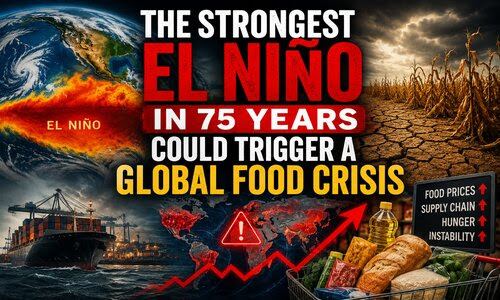
The Strongest El Niño In 75 Years Could Trigger A Global Food Crisis
For most people, El Niño sounds like just another weather event. Meteorologists talk about warmer ocean temperatures, shifting wind patterns, and changing rainfall, while the rest of us assume it is simply another season of unusual weather.
But this time is different.
The latest forecasts from NOAA’s Climate Prediction Center suggest the current El Niño could become one of the strongest recorded in the last 75 years. While no single weather event guarantees disaster, history shows that powerful El Niño cycles have repeatedly triggered droughts, floods, crop failures, livestock losses, and soaring food prices across multiple continents at the same time.
That should concern every family–not because panic is warranted, but because our modern food system is far more fragile than most people realize.
For decades we’ve been told globalization made everything more efficient. It certainly did. The problem is that efficiency often came at the expense of resilience.
Today, many of the world’s most important food supplies are concentrated in surprisingly few locations.
Three countries dominate the export market for many staple crops including corn, soybeans, rice, sugar, and palm oil. That works wonderfully during good years. But when one of those regions experiences drought, flooding, or severe storms, the entire world feels the consequences.
It’s the agricultural version of putting all your eggs in one basket.
Now imagine several baskets getting hit simultaneously.
That is exactly why economists are paying such close attention to this developing El Niño.
Goldman Sachs analysts recently warned that modern agricultural markets have become increasingly vulnerable because weather disruptions no longer remain local problems. Governments often react by restricting exports to protect their own populations, importers begin stockpiling supplies, and suddenly a modest production shortfall snowballs into a global price shock.
We watched this happen during the COVID pandemic.
We watched it after Russia invaded Ukraine.
And we could see it again if weather conditions deteriorate over the coming year.
The concern isn’t simply whether rice production falls in one country or sugar harvests disappoint somewhere else. The real danger lies in how governments respond.
Once nations begin limiting exports, global supply shrinks even further.
Panic buying begins.
Prices spike.
Poorer nations struggle to compete for available food.
History shows this chain reaction often creates far more damage than the original harvest loss itself.
This developing El Niño arrives at perhaps the worst possible time.
Global fertilizer markets remain vulnerable to geopolitical instability. Shipping lanes through the Middle East continue to face uncertainty. Energy prices influence fertilizer production, transportation costs, and irrigation expenses. Many countries are also expanding biofuel mandates that divert crops like corn, sugar, and vegetable oils away from food production and toward fuel.
Every one of these factors individually raises costs.
Together they create the perfect environment for food inflation.
Many Americans assume our grocery stores insulate us from these global problems.
That assumption deserves reconsideration.
The average supermarket carries only a limited inventory. Modern supply chains operate on “just-in-time” logistics designed to minimize storage costs rather than maximize emergency reserves. If multiple disruptions occur simultaneously, shortages can develop surprisingly quickly.
We’ve already seen glimpses of this over the past several years.
Egg shortages.
Olive oil shortages.
Coffee price spikes.
Chocolate becoming more expensive.
Produce shortages after regional weather disasters.
None of these occurred because the world ran out of food.
They occurred because localized disruptions rippled through highly interconnected supply chains.
Now multiply that across dozens of agricultural commodities at once.
The consequences could extend far beyond higher grocery bills.
Food insecurity has historically been one of the world’s greatest drivers of political instability.
The Arab Spring was fueled in part by soaring bread prices.
Numerous governments throughout history have fallen after prolonged food shortages.
Migration often accelerates when farming regions become unproductive.
Civil unrest increases when basic necessities become unaffordable.
Food has always been about much more than food.
It is about national security.
It is about economic stability.
It is about social order.
One overlooked concern involves human psychology.
Markets often react before harvests fail.
If traders anticipate poor crops, prices begin climbing months in advance. Governments seeing higher prices may impose export restrictions before shortages even materialize. Consumers respond by buying more than usual. Retailers order larger inventories.
Fear itself becomes part of the supply problem.
This feedback loop can turn uncertainty into reality.
Does that mean catastrophe is inevitable?
No.
NOAA itself cautions that even the strongest El Niño events do not produce identical outcomes everywhere. Some regions benefit from increased rainfall while others suffer drought. Weather remains notoriously difficult to predict with precision.
That uncertainty cuts both ways.
Forecasts could improve.
Or they could worsen.
What deserves attention isn’t merely this year’s weather outlook.
It is what this developing situation reveals about the extraordinary fragility of the global systems we have built.
Our grandparents lived in communities that often produced much of their own food locally.
Today, a meal on your dinner table may depend upon fertilizer produced on another continent, shipped through contested waterways, applied to crops thousands of miles away, harvested by imported labor, processed elsewhere, transported across oceans, and delivered through logistics networks operating with minimal margin for error.
It’s an astonishing achievement.
It’s also remarkably vulnerable.
Scripture repeatedly reminds us that mankind ultimately does not control creation. Weather, harvests, and the rhythms of the earth remain under God’s sovereign authority. Throughout biblical history, droughts and famines often exposed humanity’s dependence upon Him rather than our own ingenuity.
Whether this El Niño ultimately becomes historic or merely another challenging weather cycle remains to be seen.
But one lesson is already clear.
Our food system is far less secure than many imagine.
The next major global crisis may not begin with a financial collapse or military conflict.
It may begin quietly–in fields drying under relentless heat, in flooded rice paddies thousands of miles away, and eventually, in the price tag on the groceries sitting in your shopping cart.
The Temptation To Go Back: Is Egypt Still Calling Your Name?

Two women. Two dramatic testimonies. Two public professions of faith.
And now, two highly publicized returns to the world they once appeared to leave behind.
Former adult entertainer Crystal DiGregorio recently announced her return to producing explicit content through OnlyFans after years serving as a pastor alongside her husband. Rather than describing her decision as a moral failure, she argues that her understanding of Scripture has changed and that nudity itself is not inherently sinful.
While Christians have long agreed that the human body is God’s good creation and not sinful in itself, that isn’t really the issue. The purpose of platforms like OnlyFans is not simply to display the human body but to monetize sexual desire and intentionally stimulate lust–something Scripture repeatedly warns against.
Meanwhile, former adult film icon Jenna Jameson, who publicly embraced Christianity and spoke about leaving pornography behind, has returned to hosting a male strip revue while continuing to live with same sex partners. She insists the new venture is different from her former career, describing it as entertainment rather than a return to pornography.
Many Christians will read these stories with disappointment. Others will be tempted to simply shake their heads and move on.
But perhaps these headlines should cause us to ask a far more uncomfortable question.
How often are we tempted to return to Egypt ourselves?
Looking at both stories, one pattern begins to emerge. One woman eventually returned to producing explicit content. The other publicly embraced Christianity yet continued living in ways many Christians understand to be at odds with Scripture’s call to holiness. Whatever may have been in their hearts, both stories illustrate a sobering reality: following Christ is not simply about adding Him to our lives. It is about surrendering every area of our lives to His lordship.
And that raises a question every believer should ask.
Are we doing the same thing?
Following Christ has never meant simply adding Jesus to our existing life. It means placing every part of our life under His authority–even the parts we most want to keep.
Too often we negotiate with God.
“You can have my Sundays.”
“You can have my language.”
“You can have my finances.”
“But don’t ask me to give up this relationship.”
“Don’t ask me to surrender this habit.”
“Don’t ask me to let go of this identity.”
We leave one room of our heart locked, hoping Jesus will be satisfied with the rest of the house.
But Jesus doesn’t rent rooms in our lives.
He becomes Lord of the entire house.
That has always been humanity’s struggle.
After God delivered Israel from four centuries of slavery, one might assume they would never want to return. They had witnessed the Red Sea part before their eyes. They had watched Pharaoh’s army destroyed. They were being fed by manna from heaven and led by a pillar of cloud by day and fire by night.
Yet when hardship came, they repeatedly cried out, “Let’s go back to Egypt.”
Think about how astonishing that is.
Egypt was the place of slavery.
Egypt was where their children suffered.
Egypt was where they cried out for deliverance.
Yet once they were free, they remembered Egypt not for its chains but for its comforts.
Isn’t that exactly how temptation works?
Satan rarely invents new temptations.
He simply reminds us of the old ones.
He doesn’t show us the shame, the brokenness, the emptiness, or the consequences. He edits our memories, leaving only the pleasure.
He reminds the alcoholic of the first drink–not the destroyed family.
He reminds the addict of the high–not the chains.
He reminds the adulterer of the excitement–not the devastation.
He reminds the porn user of the momentary pleasure–not the spiritual emptiness that follows.
He reminds us of everything we think we gained while carefully hiding everything we lost.
The serpent hasn’t changed his strategy since the Garden of Eden.
“Did God really say…?”
That question still echoes today.
One of the most dangerous forms of backsliding isn’t simply falling into sin.
It’s redefining sin so we no longer have to repent of it.
When culture becomes our authority instead of Scripture, almost any behavior can be justified. What once required repentance becomes reframed as authenticity, freedom, or self-expression. But God’s standards do not change simply because our culture does.
Notice what happened. The first step wasn’t simply returning to an old lifestyle. It was first redefining what Scripture says about that lifestyle. Throughout history, behavior usually changes only after theology changes. We convince ourselves something is no longer sin, and then our conscience no longer protests what our flesh already desired.
Yet before we become too focused on Crystal DiGregorio or Jenna Jameson, perhaps we should remember that most of us have our own Egypt.
It may not be pornography.
It may be bitterness.
It may be greed.
It may be pride.
It may be alcohol.
It may be unforgiveness.
It may be the approval of other people.
It may be a relationship God has repeatedly told us to leave behind.
Whatever it is, every believer has an area where the old life whispers, “Come back.”
That’s why Scripture repeatedly warns us to remain watchful. Spiritual drift rarely happens overnight. It begins with small compromises. A neglected prayer life. A Bible left unopened. Isolation from Christian fellowship. A quiet decision to keep one corner of our lives outside Christ’s rule.
Eventually, what was once only tolerated becomes embraced.
And what was embraced becomes defended.
Thankfully, the gospel offers something better than simply trying harder.
Christ not only forgives our past–He gives us a new identity. We are no longer slaves trying to escape Egypt. We are children of God learning to walk in freedom. That doesn’t mean temptation disappears. It means we now have the power, through the Holy Spirit, to say no to the life that once enslaved us.
Most of us will never face the same public temptations as these two women. But every one of us has an Egypt.
The question isn’t whether we’ll hear the voice calling us back.
We will.
The question is whether we’ll remember the chains instead of the comforts.
Sin always promises freedom but ultimately delivers bondage. Christ sometimes calls us down difficult roads of surrender, but His path always leads to life.
The Christian life isn’t simply about leaving Egypt once.
It’s about refusing to turn around every time the wilderness becomes difficult.