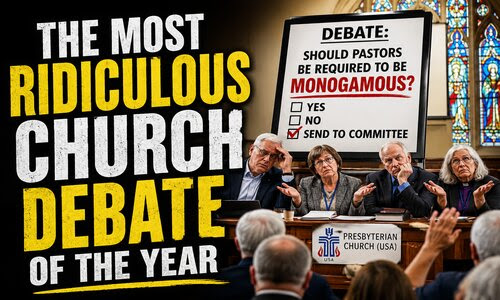
The Most Ridiculous Church Debate Of The Year
For years we’ve been told there are certain issues that are simply too controversial to decide.
So what do organizations do?
They create a committee.
Study it.
Delay it.
Hope the controversy cools off before anyone has to take a position.
That’s exactly what happened this week.
The only problem?
The organization wasn’t a Fortune 500 company trying to navigate corporate politics.
It wasn’t Congress trying to avoid a difficult vote.
It was a Christian denomination trying to decide whether its pastors should be… monogamous.
Yes, you read that correctly.
The Presbyterian Church (USA) postponed debate over a proposal that would explicitly require its clergy to be monogamous, referring the matter to committee after the issue generated significant disagreement among delegates. Let that sink in for a moment. A church couldn’t decide whether those entrusted with preaching God’s Word should be expected to remain sexually faithful to one spouse.
How did we arrive at a place where one of Christianity’s oldest and most basic moral standards has become too controversial to affirm?
The proposal itself should have been anything but groundbreaking. It sought to reaffirm what Christians have understood for centuries–that those called to lead Christ’s Church should model biblical standards in both doctrine and personal conduct. Yet even that proved too much for many within the denomination, particularly those who argued such language would exclude or stigmatize people in alternative relationship arrangements, including polyamorous relationships.
Rather than settle the issue, the denomination chose a familiar institutional escape hatch: send it to committee.
Anyone who has watched politics knows the strategy well. When leaders don’t want to make a difficult decision–or fear upsetting influential factions–they study it. They appoint a task force. They refer it for further consideration. Sometimes committees are valuable. Other times they simply become a place where difficult truths are parked until a future meeting.
Unfortunately, that appears to be what happened here.
The deeper concern isn’t merely the delay itself. It is what the delay reveals.
Consider what is actually being debated.
It isn’t an argument about worship music or church budgets.
The controversy is whether pastors should be expected to practice monogamy.
Fifty years ago, no Christian would have imagined that question needing a committee.
Scripture certainly doesn’t treat it as controversial.
When outlining the qualifications for elders and overseers, the Apostle Paul describes church leaders as being “the husband of one wife,” managing their households well and living lives worthy of imitation. Throughout both the Old and New Testaments, God’s design for marriage is consistently presented as an exclusive covenant marked by lifelong faithfulness.
Those standards were never viewed as oppressive limitations. They were evidence of spiritual maturity.
But increasingly within parts of the modern church, biblical standards are no longer measured by whether they are faithful to Scripture. They are measured by whether they align with contemporary cultural values.
That is a profound shift.
The question quietly changes from, “What does God require?” to “Who might feel excluded?”
Of course, Christians are called to love every person. Every church should welcome people seeking Christ regardless of their past, their struggles, or the sins that have marked their lives. The Gospel is for everyone.
But welcoming sinners is not the same thing as redefining the qualifications for spiritual leadership.
Grace never requires compromising truth.
History shows that theological drift rarely happens overnight. It moves incrementally. One accommodation becomes the justification for another. Teachings that were once unquestioned become optional. Eventually, convictions once considered foundational are portrayed as intolerant.
The Presbyterian Church (USA) has followed that pattern for years, revising longstanding positions on sexuality and marriage while continuing to experience declining membership. Rather than asking whether accommodation to the culture has strengthened the church, many appear determined to continue down the same road.
The irony is difficult to miss.
The culture promises relevance through compromise, yet every compromise seems to create another demand for further change. The finish line never stays in the same place.
Today’s debate over monogamy would have shocked previous generations of Christians. One can’t help but wonder what tomorrow’s “too controversial” biblical teaching will be.
This story ultimately isn’t about polyamory.
It isn’t even about one denomination.
It is about whether the Church will continue to believe that Scripture speaks with authority even when its teachings collide with the spirit of the age.
Because if a church can no longer confidently say that its pastors should be faithful to one spouse without referring the question to committee, then the greatest controversy isn’t over marriage.
It’s over whether God’s Word still has the final say.
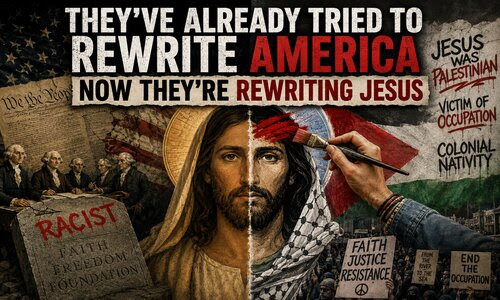
They’ve Already Tried To Rewrite America-Now They’re Rewriting Jesus
There was a time when history mattered.
Today, history is treated like wet clay–something to be molded into whatever shape best serves the political cause of the moment. Statues are toppled. Founding Fathers are recast as villains. National histories are rewritten through ideological lenses.
Now, even Jesus Christ isn’t off limits.
The latest attempt comes from the orbit of New York City’s socialist mayor, Zohran Mamdani. Reports indicate that his wife, Rama Duwaji, is co-hosting a luxury spiritual retreat in Corsica where attendees–paying as much as $5,000–will meditate on Mary as a “Palestinian woman giving birth under occupation.”
It’s difficult to know where to begin.
This isn’t creative theology.
It isn’t historical scholarship.
It isn’t even remotely true.
It is political propaganda dressed in religious language.
And it represents yet another effort to hijack Christianity in service of a modern ideological movement.
The Left Has Been Trying To “Palestinianize” Jesus For Years
This didn’t begin with Zohran Mamdani’s wife.
For years progressive activists, celebrity pastors, academics, and social media influencers have repeated variations of the same claim.
“Jesus was Palestinian.”
“Jesus was the first Palestinian refugee.”
“Jesus was a victim of Israeli occupation.”
Christmas after Christmas we’ve watched churches display nativity scenes draped in Palestinian flags. During every major Israel-Hamas conflict, social media fills with graphics insisting that Jesus was somehow Palestinian.
The narrative is always the same.
If activists can convince Christians that Jesus was Palestinian rather than Jewish, they can subtly reshape how believers think about Israel, biblical prophecy, and today’s Middle East.
It is one of the most successful examples of historical revisionism in recent years because it sounds compassionate while quietly rewriting nearly every historical fact surrounding Christ’s birth.
There Was No Such Thing As A Palestinian
Here’s the inconvenient problem.
Palestine didn’t exist.
Not as a nation.
Not as a people group.
Not as an ethnicity.
Not in the first century.
Jesus was born in Bethlehem in Judea.
Mary was Jewish.
Joseph was Jewish.
Their relatives were Jewish.
Their Scriptures were Jewish.
Their Temple was Jewish.
Their festivals were Jewish.
Their genealogy was Jewish.
The Gospels go to extraordinary lengths to establish Jesus’ Jewish ancestry because it fulfilled hundreds of Old Testament prophecies concerning Israel’s Messiah.
The very opening chapter of Matthew exists for that reason.
Luke traces His lineage for the same reason.
Paul repeatedly identifies Jesus as the promised descendant of David.
The writer of Hebrews identifies Him as coming from the tribe of Judah.
This isn’t a minor detail.
It is central to the entire Gospel.
The name “Palestine” itself wasn’t applied to Judea until roughly a century after Christ’s death, when Emperor Hadrian renamed the province “Syria Palaestina” following the Bar Kokhba revolt in an effort to erase the Jewish identity of the land.
Ironically, the people claiming Jesus was Palestinian are borrowing a name created by pagan Rome to diminish Israel.
Erasing Jesus’ Jewish Identity Isn’t An Accident
This is about far more than semantics.
If Jesus is no longer understood as Israel’s Jewish Messiah, then the biblical story itself begins to unravel.
God’s covenant with Abraham becomes blurred.
The promises to David lose their context.
Messianic prophecy becomes detached from Israel.
The unique role of the Jewish people in redemptive history fades into the background.
Once that foundation is removed, replacing biblical theology with modern political activism becomes much easier.
This isn’t merely historical revision.
It’s theological revision.
Even Islam Doesn’t Teach What They’re Selling
The irony becomes even more striking when viewed through the lens of Islam.
Muslims do honor Mary–Maryam–as one of the greatest women who ever lived.
She is the only woman mentioned by name throughout the Quran.
But Islam does not teach the same Mary Christians believe in.
Christians believe Mary gave birth to God incarnate–the eternal Son of God who died on the cross for the sins of the world and rose bodily from the grave.
Islam explicitly rejects every one of those central truths.
Jesus (Isa) is regarded only as a prophet.
He is not the Son of God.
His crucifixion is denied or radically reinterpreted.
His resurrection–the very heart of Christianity–is rejected.
So while Mary is honored in Islam, she exists within an entirely different theological framework.
The retreat’s messaging attempts to merge Christianity, Islamic reverence for Mary, and modern Palestinian nationalism into one emotionally compelling narrative.
The result isn’t biblical.
It isn’t Islamic.
It isn’t historical.
It’s ideological.
Truth Is Becoming The First Casualty
Perhaps the most alarming part of all this is how easily so many people accept it.
Most Christians know very little about Jewish history.
Many couldn’t explain why Matthew begins with a genealogy or why Luke carefully documents Christ’s ancestry.
That biblical illiteracy creates fertile ground for political myths.
If people don’t know Scripture, almost any story can be inserted into it.
That’s exactly what we’re witnessing.
Jesus becomes whatever modern activists need Him to be.
A socialist.
A revolutionary.
A refugee.
A Palestinian.
Anything–except the Jewish Messiah Scripture actually presents.
Christians Should See What’s Happening
This debate isn’t really about Mary.
It’s about authority.
Will Christians allow twenty-first century political activists to redefine biblical history?
Or will we allow Scripture–and history–to speak for themselves?
Mary was not a Palestinian woman giving birth under occupation.
She was a Jewish virgin from Nazareth, chosen by God to bear the promised Messiah exactly as the prophets foretold centuries in advance.
That isn’t merely a historical detail.
It is one of the pillars upon which the Gospel itself stands.
When a culture starts rewriting history, it won’t stop with kings, presidents, or civilizations.
Eventually, it comes for Christ Himself.
And that is exactly what we’re watching happen.