Bible Prophecy, Signs of the Times and Gog and Magog Updates with Articles in the News
Dying Liberal Churches Continue To Elevate Unbiblical Leadership
There was a time when America’s mainline Protestant denominations filled massive sanctuaries, shaped public culture, and sent missionaries around the world. Today, many of those same denominations are shrinking at a historic pace, closing churches, selling off properties, and watching younger generations drift away. Yet instead of asking why their pews continue to empty, many of their leaders appear determined to double down on the very theological changes that helped accelerate the decline.
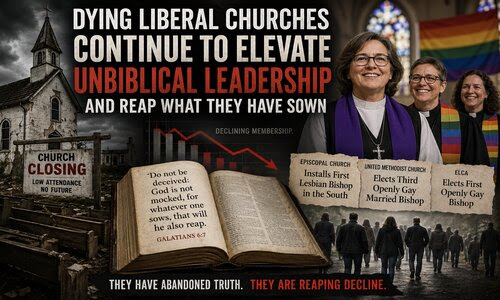
The latest example comes from the Episcopal Church, where the Rev. Sarah Fisher was installed as bishop of the Episcopal Diocese of East Carolina. Fisher, who is in a same-sex relationship with the Rev. Mandy Brady, reportedly became the first openly lesbian Episcopal bishop leading a diocese in the southern United States. Her election was celebrated as a historic milestone by church leaders, but it also serves as another reminder of how far many mainline denominations have moved from historic biblical Christianity.
Supporters view such developments as progress. Critics see something very different: a denomination continuing to elevate leaders whose lifestyles openly contradict centuries of Christian teaching while wondering why membership continues to collapse.
The numbers tell a sobering story.
The Episcopal Church had approximately 2.1 million members in 2006. By 2023, membership had fallen to roughly 1.54 million. The decline has been relentless. Churches have closed, congregations have merged, and attendance has steadily weakened. The downward trend accelerated following the denomination’s embrace of progressive theological positions, including the consecration of Gene Robinson in 2003 as the church’s first openly gay bishop. That decision triggered a massive exodus of conservative congregations and years of legal battles over church property.
Yet rather than viewing these developments as a warning sign, many leaders appear committed to pushing even further.
The Episcopal Church is hardly alone.
The United Methodist Church recently experienced one of the largest denominational splits in modern American history. Thousands of congregations chose to leave over disagreements surrounding biblical authority, sexuality, and doctrine. In the midst of that turmoil, the denomination celebrated the election of another openly gay married bishop, Kristin Stoneking, after delegates voted to remove longstanding restrictions regarding LGBTQ clergy and leadership.
The Evangelical Lutheran Church in America (ELCA) has followed a similar path. In 2025, the Metropolitan New York Synod elected Katrina Foster as its first openly gay bishop. The denomination has spent years embracing progressive positions on sexuality and gender identity, while also elevating transgender and openly LGBTQ leaders into prominent roles.
At some point, an obvious question must be asked.
If these changes are supposedly revitalizing Christianity, where are the crowds?
Where is the growth?
Where is the revival?
The answer is difficult to ignore.
Most of the denominations leading the charge into progressive theology are simultaneously among the fastest-declining religious bodies in North America.
This is not merely a political issue. It is fundamentally a theological one.
Historically, Christianity has grown when churches confidently proclaimed biblical truth, called people to repentance, preached salvation through Jesus Christ, and distinguished themselves from the surrounding culture. The early church did not attract converts because it mirrored Rome. It attracted converts because it stood apart from Rome.
Today, many liberal denominations appear to be pursuing the opposite strategy.
Rather than confronting culture, they often seek affirmation from it.
Rather than asking what Scripture teaches, many appear more concerned with what modern activists demand.
Rather than calling people to transformation through Christ, they increasingly reshape doctrine to accommodate contemporary social movements.
The result should not surprise anyone.
When churches become nearly indistinguishable from secular culture, people begin asking an uncomfortable question: why bother attending church at all?
If a congregation simply echoes the same messages people hear from universities, Hollywood, corporate diversity departments, and social media, the church ceases to offer something unique. It loses its prophetic voice. It loses its spiritual authority. Eventually, it loses its members.
Ironically, many of the fastest-growing churches around the world are those doing the exact opposite.
Across Africa, Asia, Latin America, and even pockets of North America, churches that maintain traditional biblical teachings continue to grow. They preach repentance. They preach the authority of Scripture. They preach Christ crucified and risen. They offer certainty in a confused age rather than confusion wrapped in religious language.
The contrast could hardly be clearer.
Liberal denominations frequently speak about inclusion, diversity, and relevance. Yet year after year, they continue reporting declining attendance, declining membership, declining baptisms, and aging congregations.
Meanwhile, churches that refuse to surrender biblical convictions often face criticism from the culture but continue attracting those hungry for truth.
None of this means every conservative church is healthy or every liberal church is empty. But broad trends matter. And the broad trend is undeniable.
When denominations spend decades undermining biblical authority, redefining morality, and elevating leaders whose lifestyles openly conflict with historic Christian teaching, they should not be shocked when fewer people view them as trustworthy guardians of the faith.
Galatians 6:7 contains a timeless principle: “Do not be deceived: God is not mocked, for whatever one sows, that will he also reap.”
For decades, many mainline denominations have sown theological compromise. They have sown accommodation to cultural pressures. They have sown doubt regarding the authority of Scripture.
Now they are reaping the harvest.
The tragedy is not merely declining membership statistics. The deeper tragedy is that many souls searching for truth enter these churches looking for biblical guidance and instead receive affirmation of the very culture that has already left so many spiritually empty.
A church cannot abandon its foundation and expect the structure to remain standing forever. History–and increasingly the membership rolls–are proving that lesson in real time.
The State Of Canadian Christianity Is Much Much Worse Than Most Realize
There are survey results that make you pause. Then there are survey results that leave you wondering whether entire generations have sat in church buildings without ever hearing the basic truths of the Christian faith.
A newly released State of Theology survey from Ligonier Ministries Canada and Lifeway Research falls firmly into the second category.
The findings are nothing short of shocking.
What makes them even more alarming is that these are not the beliefs of the general Canadian public. These are the beliefs of people classified as evangelicals–the very segment of Christianity that has historically been known for taking the Bible seriously, emphasizing personal salvation through Jesus Christ, and defending core Christian doctrine.
If these are the beliefs of evangelicals, one can only imagine what similar polling might reveal among Canada’s increasingly liberal mainline denominations.
The survey found that 73 percent of Canadian evangelicals agreed with the statement that “Everyone is born innocent in the eyes of God.” Another 60 percent agreed that “Everyone sins a little, but most people are good by nature.”
Those answers directly contradict one of the most foundational teachings of Christianity.
The Bible teaches that humanity has inherited a fallen nature through Adam’s sin. Scripture repeatedly describes mankind as spiritually dead, separated from God, and in desperate need of redemption. The Gospel itself begins with the reality that humanity has a sin problem that cannot be solved through personal goodness or moral effort.
If people are born innocent and are mostly good by nature, then why did Jesus have to die?
That is not a minor theological disagreement. It strikes at the very heart of the Gospel message.
Yet the surprises do not stop there.
Perhaps one of the most astonishing findings in the survey is that 66 percent of Canadian evangelicals agreed with the statement that “The Holy Spirit is a force but is not a personal being.”
This is remarkable because 93 percent of the same respondents affirmed belief in the Trinity.
How can both statements be true?
The doctrine of the Trinity teaches that God exists eternally as Father, Son, and Holy Spirit–three distinct persons sharing one divine essence. To deny the personhood of the Holy Spirit is to deny a central component of the Trinity itself.
It would be similar to claiming belief in a triangle while insisting one of its sides does not exist.
The survey appears to reveal what the late theologian R.C. Sproul often called “happy inconsistencies”–people affirming Christian labels while simultaneously holding beliefs that undermine those very labels.
But even that explanation may not fully account for what these numbers reveal.
Consider another statistic.
Forty-five percent of Canadian evangelicals agreed that “Jesus was a great teacher, but he was not God.”
Read that again.
Nearly half of self-identified evangelicals deny the deity of Christ.
Yet according to the survey’s own definition, these same individuals affirm that the Bible is their highest authority and that salvation comes through Jesus Christ alone.
The contradiction is staggering.
The New Testament repeatedly and explicitly identifies Jesus as divine. The opening chapter of John’s Gospel declares that “the Word was God.” Thomas worships the risen Christ by declaring, “My Lord and my God.” Jesus Himself accepted worship, forgave sins, and claimed titles reserved for God alone.
Christianity without the deity of Christ is not Christianity at all.
It becomes merely another moral philosophy built around a remarkable teacher.
The survey also found that 28 percent of Canadian evangelicals believe the Bible contains helpful myths but is not literally true.
Again, the contradiction is difficult to ignore.
How can Scripture be the highest authority in someone’s life if it is viewed primarily as mythology?
An authority that cannot be trusted cannot truly function as an authority.
The deeper issue revealed by this survey may be the growing disconnect between Christian identity and Christian understanding.
For generations, many Canadians have continued to identify as Christian culturally even as biblical literacy has collapsed. Churches have increasingly emphasized feelings over doctrine, experience over truth, and personal fulfillment over discipleship.
The result is a Christianity that often retains Christian vocabulary while losing Christian content.
People still use words like salvation, grace, faith, and Jesus. But many no longer understand what those words actually mean.
This is not merely a Canadian problem. Similar surveys in the United States have shown troubling levels of theological confusion. But Canada’s increasingly secular culture appears to be accelerating the trend.
For decades, Christian leaders warned that biblical illiteracy would eventually produce doctrinal confusion. That prediction now appears to be playing out before our eyes.
The solution is not despair but discipleship.
The Church does not need better marketing strategies. It does not need trendier programs. It does not need more cultural accommodation.
It needs a renewed commitment to teaching the Word of God clearly, faithfully, and unapologetically.
The Apostle Paul warned that a time would come when people would not endure sound doctrine. We may be witnessing the consequences of that warning today.
These survey results should serve as a wake-up call for every pastor, church leader, parent, and believer in Canada.
A nation cannot preserve biblical Christianity if it no longer understands what biblical Christianity teaches.
The numbers in this survey are not merely statistics. They are a spiritual alarm bell ringing across the Canadian Church.
And it is getting harder to ignore.