
Bible Prophecy, Signs of the Times and Gog and Magog Updates with Articles in the News
Isaiah called it. Trump made it official. On Friday night, it happened. (The Doctrine of Demons called Christian Zionism Had there National Sabbat day )
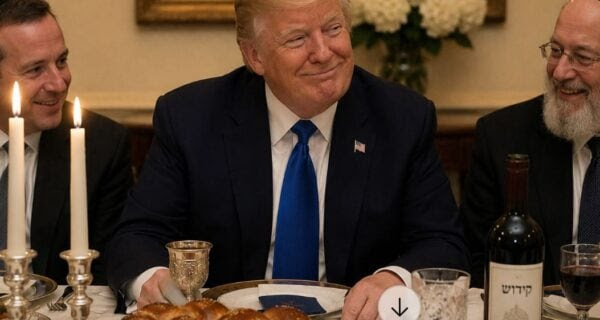
Dalia Boteach did not expect to spend Friday night explaining two thousand years of Jewish practice to her Christian dinner guests. But that is what happened — and nobody planned it.
The evening started the way every traditional Shabbat does. Boteach lit the candles, blessed the wine, and led her guests through the hymns that welcome the Sabbath, prayer booklets in Hebrew and English open in front of them so they could follow along. Then came the meal: challah, chicken soup, brisket, kugel. And then the conversation took a turn.
Every Israeli soldier is sworn into the army with a hand on the Hebrew Bible, yet most have never opened the books of Jewish law that grew out of it. That contradiction came up at the table, and before long, Boteach pulled one of those volumes off the shelf and set it down in front of her guests. Her Christian guests have heard plenty about these books online — most of it negative, slanderous, and inaccurate. What they saw at Boteach’s table was not a secret. It was an argument: generations of Jewish sages debating, disagreeing, and illuminating each other across two thousand years.
“Jews don’t shy away from hard topics,” Boteach told them. “Every question gets brought to the table.”
This is what it looks like when Christians actually sit together with Jews at the Shabbat table, rather than simply admiring it from a distance. And it happened because of two things coming together at exactly the right moment.
President Trump’s call for Americans to observe Shabbat on May 15-16 was the first in American history. Israel365 Action had spent months building the Shabbat Table, a program that brings Christian families into traditional Jewish homes for an authentic Friday night experience, and timed its launch to coincide with this moment. This past weekend, Jewish families in ten communities across America — Fort Lauderdale, Hollywood, Atlantic Beach, Dallas, Nashville, Columbus, and more — opened their doors to Christian guests for Friday night Shabbat dinner.
None of this surprised Rabbi Tuly Weisz, founder of Israel365. In his book Universal Zionism, he argues that we are living through the third stage of Zionism — the stage in which Israel turns outward toward the nations, fulfilling the promise God made to Abraham: “In you all the families of the earth shall be blessed” (Genesis 12:3). The Jewish-Christian alliance, in his reading, is not a feel-good interfaith project. It is a civilizational partnership, and it is built not at conferences but around tables. “The Jewish-Christian alliance that is essential to Israel’s future cannot be sustained by conferences and newsletters. It is built around tables, and Shabbat has been setting those tables for three thousand years.”
The prophet Isaiah saw this moment coming. “As for the Nations who attach themselves to the Lord… all who observe the Sabbath and do not desecrate it… I will bring them to My sacred mountain… For My House shall be called a house of prayer for all peoples” (Isaiah 56:6-7). For millennia, that was a promise. Last Friday night, in ten cities across America, it was a dinner.
Ahad Ha’am, the great early Zionist thinker, wrote that more than the Jews kept the Shabbat, the Shabbat has kept the Jews. What happened last Friday suggests something more: that the table Jews have been setting for three thousand years may be exactly what Christians need now.
The Jews , want their 3rd Jewish Temple . will a Synagogue fill the Gap == Thirty Years After His Father’s Call, Rabbi Eliyahu Renews Fight for Temple Mount Synagogue
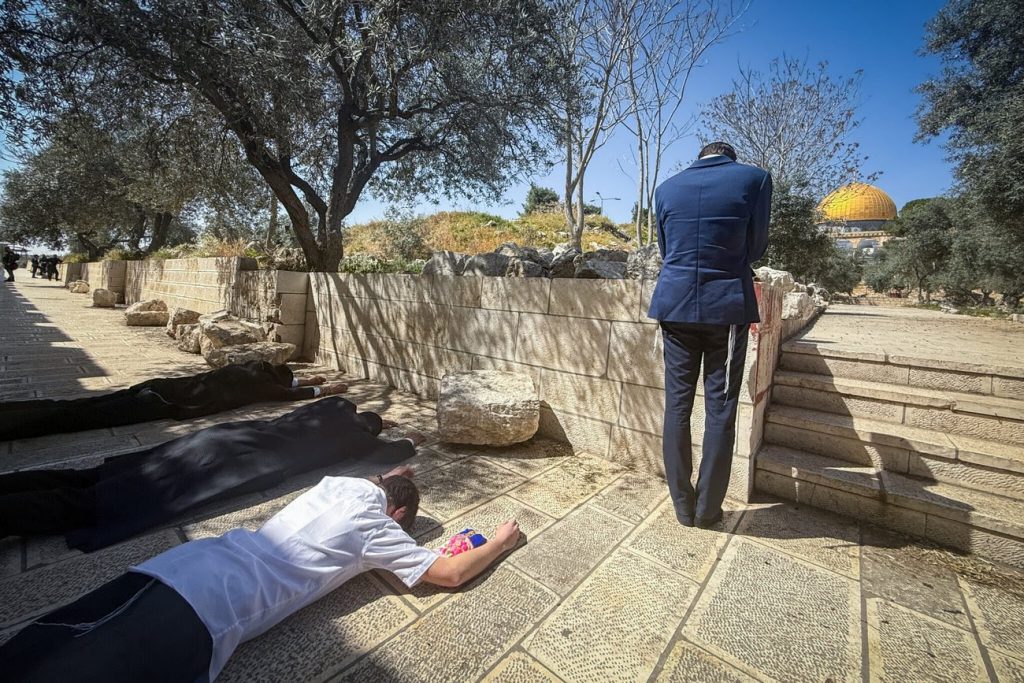
On Yom Yerushalayim (Jerusalem Day), Rabbi Shmuel Eliyahu, Chief Rabbi of Tzfat (Safed), stood opposite Har HaBayit (the Temple Mount) and declared what Israeli law already mandates but Israeli governments have refused to enforce: Jews have the right to pray at their holiest site, and it is time to build a synagogue there.
“You see here the (black-domed) mosque that is behind me, Al-Aqsa — that is from the exile,” Rabbi Eliyahu said. “For 2,000 years, we were in exile, so they built this structure here, but in truth, the First Temple and Second Temple were here, and the Third Temple will be here. That is a fact.”
Rabbi Shmuel Eliyahu and Jewish children take part in a special prayer for rain at the Kinneret, the Sea of Galilee, in northern Israel, October 29, 2025. Photo by Michael Giladi/Flash90
The call was a direct challenge to a policy that contradicts Israel’s own law.
The Protection of Holy Places Law, passed by the Knesset on June 27, 1967 — the same day Israel extended its jurisdiction over unified Jerusalem — guarantees that Holy Places shall remain accessible to all faiths without interference, and explicitly criminalizes acts that violate the freedom of access of members of different religions to places sacred to them. Violators face up to seven years for desecrating a holy place and five years for obstructing access. The law applies to Jews and Muslims alike — in theory.
In practice, the law has never been applied equally. Jews are afforded limited access to visit the Temple Mount, restricted to certain hours and barred on Fridays and Shabbat and weekdays at night. Jews are frequently barred from praying there and may not perform Jewish rituals at the site. Muslims are permitted 24/7 access, and all Muslim prayer is permitted. Israel entrusted the internal religious administration of the Mount to the Islamic Waqf, a Jordanian-controlled religious trust. The result is a legal absurdity: the state that passed a law guaranteeing religious access to all faiths actively enforces the denial of that right to Jews. Christians are also restricted and barred from praying or displaying religious symbols. Israeli police also prohibit the display of Israeli flags.
Israeli courts have periodically acknowledged this contradiction. In May 2022, Jerusalem Magistrate’s Court Justice Zion Saharay ruled that bowing and reciting Shema — “Hear O Israel, the Lord is our God, the Lord is One” — does not constitute a reasonable suspicion of conduct likely to cause a breach of peace, overturning a 15-day ban imposed on three Jewish teenagers who had prayed on the site. Saharay cited remarks by Israel Police Chief Kobi Shabtai himself, who had publicly stated that officers would ensure freedom of religion for “all residents of the country” at the site. The Jerusalem District Court ultimately reversed the magistrate’s ruling under government pressure, with the state invoking security concerns to override both the law and its own police chief’s stated policy.
The Israeli government’s response was telling. The Prime Minister’s Office issued a statement insisting that no change to the status quo was planned and that the magistrate’s ruling “does not establish anything regarding the permissibility of Jewish prayer in general at the Temple Mount.” In other words, the courts may rule what they will; Jews still cannot pray.
This is not a new battle. It is a decades-long one, and it has a history the Israeli government would prefer to forget.
The actions of the Israeli police and the statements by Netanyahu contradict the Prophet Isaiah who declared: “Ki veiti beit tefillah yikarei l’chol ha’amim” — “For My house shall be called a house of prayer for all peoples” (Isaiah 56:7).
Rabbi Eliyahu’s father, the late Sephardi Chief Rabbi Mordechai Eliyahu, took that verse seriously. In the early 1990s, Chief Sephardi Rabbi Mordechai Eliyahu began advocating the construction of a synagogue on the Temple Mount in Solomon’s Stables — a large underground space constructed by King Herod that had remained largely empty. It seemed an ideal solution, allowing Jewish access that was separate from Muslim entrances.
The Waqf’s was a wanton demolition of Judaism’s holiest site and a site Muslims claimed to revere. The Waqf began construction on Solomon’s Stables in 1996, without a permit and in gross violation of the status quo agreement signed two years earlier, in which Israel granted custodianship to Jordan. The builders used heavy equipment to clear the site, destroying artifacts of immense archaeological importance and damaging the structural integrity of the southern wall of the Temple Mount. The Waqf announced its intention to build the country’s largest mosque, capable of accommodating 10,000 worshippers. Later that year, the El-Marwani Mosque was inaugurated. The underground mosque is always open to Muslims, but prayers are only held there on Muslim holidays when rain or heat makes outdoor prayer uncomfortable.
WATCH: Dramatic mid-air collision between US fighter jets