
Bible Prophecy, Signs of the Times and Gog and Magog Updates with Articles in the News
A.I. Enabled Warfare Is About To Change Everything
On January 9th, Secretary of War Pete Hegseth wrote a memo which included the following:
“President Trump makes clear in Executive Order 14179, “It is the policy of the United States to sustain and enhance America’s global Artificial Intelligence (AI) dominance in order to promote human flourishing, economic competitiveness, and national security.” In the national security domain, AI-enabled warfare and AI-enabled capability development will re-define the character of military affairs over the next decade. This transformation is a race – fueled by the accelerating pace of commercial AI innovation coming out of America’s private sector. The United States Military must build on its lead over our adversaries in integrating this technology, established during President Trump’s first term, to make our Warfighters more lethal and efficient. To this end, aligned with America’s AI Action Plan, I direct the Department of War to accelerate America’s Military AI Dominance by becoming an “AI-first” warfighting force across all components, from front to back.”
According to Hegseth, the United States is engaged in a race to develop A.I.-enabled warfare and A.I.-enabled capability development, and “We will become an ‘A.I.-first’ warfighting force across all domains.”
To do this, the Pentagon is taking a wartime approach to delivering these capabilities, with an emphasis on three areas – warfighting, intelligence, and enterprise operations.
A.I.-Focused “Pace-Setting Projects”
The means to implement this acceleration is the launch of seven Pace-Setting Projects (PSPs), each with a single accountable leader and aggressive timelines.
According to the Department of War, these seven PSPs will establish a new A.I. execution standard for the entire Department. They are as follows:
1) Swarm Forge: Competitive mechanism to iteratively discover, test, and scale novel ways of fighting with and against A.I.-enabled capabilities – combining America’s elite warfighting units with elite technology innovators.
2) Agent Network: Unleashing A.I. agent development and experimentation for A.I.-enabled battle management and decision support, from campaign planning to kill chain execution.
3) Ender’s Foundry: Accelerating A.I.-enabled simulation capabilities – and sim-dev and sim-ops feedback loops – to ensure we stay ahead of A.I.-enabled adversaries.
4) Open Arsenal: Accelerating the TechINT-to-capability development pipeline, turning intel into weapons in hours, not years.
5) Project Grant: Enabling transformation of deterrence from static postures and speculation to dynamic pressure with interpretable results.
6) GenAI.mil: Providing Department-wide access to frontier generative A.I. models, like Google’s Gemini and xAI’s Grok, for all Department of War personnel at Impact Level (IL-5) and above classification levels.
7) Enterprise Agents: Building the playbook for rapid and secure A.I. agent development and deployment to transform enterprise workflows.
In the end, these initiatives will integrate A.I. into every aspect of the Department of War, from weapons on the battlefield to the Department’s back-office systems.
In the process, will these PSPs transform the world?
I don’t know.
However, I do know this…
Their pursuit is a sign of the times in which we live – a transformative era of rapidly developing military technologies.
These technologies will radically alter the global power structure, eventually resulting in one nation (or a coalition of nations) establishing a global empire.
Rapid Innovation and Exponential Change
The Russia-Ukraine war demonstrates how much the modern battlefield has changed. Conventional military hardware, and some cases even soldiers themselves, have been rendered obsolete in the face of drone warfare.
Meanwhile, the types of drones deployed and the methods of their deployment rapidly evolve on a weekly, if not daily, basis as lessons learned on the battlefield are integrated into the next generation of drones.
This is what the Open Arsenal PSP hopes to address.
To understand just how rapidly the world is changing, look at the stated purpose of Open Arsenal.
It’s to accelerate the technology intelligence-to-capability development pipeline, “turning intel into weapons in hours, not years.”
Let that sink in.
“Turning intel into weapons in hours, not years.”
This is a radical transformation of the old order.
Not only does this translate into fielding superior weapons on the battlefield, but it means the adoption of a whole new method of defense procurement.
Most conventional weapons systems are obsolete in the face of A.I.-enabled drone warfare, but so too are the days of conventional weapon systems development, where it takes 10 to 15 years from initial design to appearance on the battlefield.
The Pentagon is aiming to reduce that timeline to hours.
Decentralized Drone Swarms
Even the drone warfare of the last few years is becoming obsolete in the face of A.I.-enabled drone swarms.
In the Forbes article, “Swarm Forge: Pentagon’s Mass-Drone Test Signals Near-Term Deployment,” we read:
“The Nemyx distributed swarming engine runs as an app on each of the drones,” says Meier. “They communicate with each other and organise themselves to attack targets in priority order.”
The drones exchange information including relative location and ‘heartbeat’ status, and which target they are homing in on. The swarm is synchronised so that if one drone is lost, another automatically takes over its target.
Meier notes that the swarm’s robust mesh network is highly resistant to jamming, greatly aided by simple physics. It requires relatively little power to jam communications between a nearby drone and an operator many miles away, it is much harder to jam communications between drones which are much closer to each other than to the jammer.
“Even if all communication is lost, each drone will use its best efforts to hit its target,” says Meier.
Decentralized, A.I.-controlled drone swarms are already here, and they’re evolving quickly.
Expect to see stronger, faster, larger, and ever more capable drone swarms in the months and years ahead.
Already, drone swarms are growing exponentially. As Forbes states:
“The swarms are getting larger. Auterion are currently operating swarms of up to 22 units, but that number doubles every few months.”
The article doesn’t specify an exact number of months, but let’s assume the size of drone swarms doubles every four months. Where does that put us?
1 year from now = 176 drones in a swarm
2 years from now = 1,408 drones in a swarm
3 years from now = 11,264 drones in a swarm
4 years from now = 90,112 drones in a swarm
5 years from now = 720,896 drones in a swarm
That’s the power of exponential change, and it’s the era in which we now live.
Netanyahu Meets The Evangelical Warriors Of The IDF

When 17 young evangelical soldiers walked into the Prime Minister’s Office in Jerusalem, they brought with them something that no diplomatic briefing could: the faces of people who chose to bleed for the Jewish state.
Sons and daughters of Christian families who uprooted their lives, moved to Israel, and handed their children over to a military fighting for its survival. Prime Minister Benjamin Netanyahu greeted each one personally, looked them in the eye, and listened.
The meeting, facilitated by the International Christian Embassy Jerusalem (ICEJ), also included more than 20 Arab Christians serving in the Israel Defense Forces (IDF). Among those in attendance were the siblings of Uriah Bayern, a German-born Christian soldier who fell in the early weeks of the war in Gaza. Bayern’s family has lived in Israel for decades and operates a nursing home for Holocaust survivors in the north of the country. Netanyahu greeted them with particular care.
Voluntary service in the defense of Israel by those with no legal obligation carries a weight all its own. These soldiers were not drafted. They chose.
“I’m here in the Prime Minister’s Office with an extraordinary group of young men and women,” Netanyahu said in a video released during the meeting. “These are Christian soldiers, men and women, in the Israeli Defense Forces. They fill all the important positions in our incredible military and they do incredible work.”
Netanyahu did not shy away from the controversy that preceded the meeting. In the days before the gathering, the IDF jailed two soldiers for 30 days and removed them from combat duty for damaging a statue of Jesus during operations in southern Lebanon, a decision condemned across the political and religious spectrum, including by Israeli rabbis. The Prime Minister addressed it directly: the conduct of those two soldiers stands in stark contrast to the reality of Christian men and women wearing the IDF uniform.
“This is completely contrary to what is presented outside,” Netanyahu said. “It’s not only that Israel fights for the rights of Christians around the Middle East, but that Israel has Christian soldiers who fight for the defense of Israel and for our Christian brethren throughout the area, throughout the region and beyond.”
ICEJ President Jürgen Bühler described the path to the meeting. “We were approached a few days ago by the Prime Minister’s Office to join a special reception at his office for Christian, mostly Arab soldiers,” Bühler said. When he informed the PMO that evangelical soldiers, children of Christian expatriates, were also serving, the response was immediate: bring as many as possible.
“Some served in elite units, others as pilots, many fought in Gaza,” Bühler recounted. “He was very moved — encouraged by their stories, especially those who come from abroad in our service.” Bühler told Netanyahu directly: “These are the modern-day Orde Wingates and Lord Petersons in the IDF.”
Netanyahu cited the Jewish historian Joseph Klausner, including his work Jesus of Nazareth, as having shaped his own understanding of Christianity, a striking disclosure that underscored the depth of his engagement with the soldiers’ world, not merely a courtesy call.
Approximately 185,000 Christians live in Israel today, making up just under 2% of the population. Hundreds serve voluntarily in the IDF. Lt. Col. (Res.) Ihab Shlayan, the highest-ranking Christian to have served in the IDF, has put it plainly: “As Christians living in the Holy Land, we see what is going on in the Middle East and the rest of the world and understand that despite the problems, we are in the safest country in the region and are at home here.”
That reality stands in sharp relief against what is happening to Christian communities across the broader region — in Syria, in Iraq, in Lebanon — where ancient Christian populations have been decimated or displaced. Israel named its first Christian ambassador as special envoy to the Christian world the week prior to the meeting, a signal of where the country’s priorities lie.
“Israel is the one country in the Middle East where the Christian community is thriving, is growing, and it’s expanding,” Netanyahu told the soldiers. “And I want to salute all of you.”
The Jewish state and its Christian soldiers are, together, standing between that swallowing and the people of the region. Sunday’s meeting in Jerusalem was a recognition of that fact, quiet, personal, and long overdue.
A Nation Drying Out: Why This Drought Could Hit Your Wallet And Dinner Table
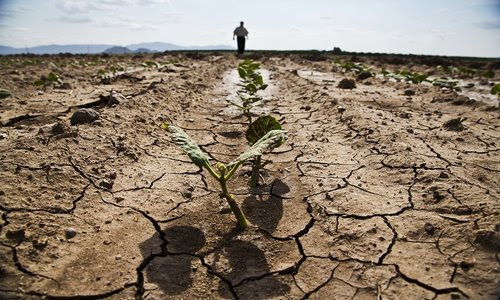
There’s a quiet crisis unfolding across America–and unlike a stock market crash or a breaking geopolitical conflict, it doesn’t come with flashing headlines or urgent alerts. It creeps. It spreads. And right now, it’s covering nearly two-thirds of the country.
More than 60 percent of the United States is experiencing drought conditions, approaching levels not seen since the devastating dry spell of 2012. From the parched landscapes of Utah and Colorado to the unusually dry fields of Florida and Georgia, the warning signs are everywhere: shrinking reservoirs, cracked soil, struggling crops, and rising wildfire risk. It may not feel urgent yet to the average American–but it should.
Because drought doesn’t just stay in the fields. It shows up later in your grocery bill, your utility costs, and even the broader economy.
The Hidden Pipeline From Drought to Your Kitchen
At first glance, drought might seem like a regional agricultural problem. But in reality, it disrupts a vast and interconnected system–the American food supply chain.
When states like Utah see precipitation drop by nearly 60 percent, or when Colorado’s snowpack–critical for water supply–is described as “historically bad,” the ripple effects begin immediately. Farmers depend on predictable water cycles. Without them, planting becomes riskier, yields shrink, and entire crops can fail.
In places like Florida, drought is already choking off pasture growth, forcing cattle ranchers to spend more on feed or reduce herd sizes altogether. That translates directly into higher beef and dairy prices down the line. Row crops like corn, soybeans, and cotton–staples of both human and animal consumption–are also struggling to get into the ground due to dry, hardened soil.
And here’s where it becomes personal: when farmers produce less, suppliers charge more. Grocery stores pass those costs along. Consumers feel the squeeze.
If drought conditions persist into the summer–as forecasts suggest–they could collide with peak growing season, compounding the damage. The result? Smaller harvests, tighter supply, and rising food prices just as households are already grappling with inflation fatigue.
Water: The Resource We Assume Will Always Be There
Beyond food, water itself is becoming a growing concern. In parts of the country, restrictions are already being implemented. Cities like Raleigh, North Carolina, have limited outdoor water use, while other regions are bracing for tighter controls if conditions worsen.
This raises a deeper issue: America’s water infrastructure–and our expectations around it–are being stress-tested.
Reservoirs across the West rely heavily on snowpack. But with warmer temperatures causing earlier and faster snowmelt, much of that water is lost before it can be effectively stored and used during the hot summer months. It’s a mismatch between nature’s timing and human need.
Even if rain comes, it may not solve the problem. Severely dry soil often can’t absorb sudden heavy rainfall, leading to runoff and even flash flooding rather than meaningful replenishment.
In other words, relief isn’t just about more rain–it’s about the right kind of rain at the right time. And that’s far from guaranteed.
The Economic Domino Effect
Drought doesn’t just impact farms–it reverberates across the entire economy.
Agriculture is a foundational industry. When it struggles, transportation, manufacturing, and retail sectors feel the impact. Lower crop yields can affect everything from food processing plants to export markets. Rural economies, heavily dependent on farming, can experience sharp downturns.
There’s also the energy factor. Hydropower generation can decline when water levels drop, potentially increasing reliance on more expensive energy sources. Meanwhile, wildfire risk–already elevated in drought-stricken areas–can lead to billions in damage, insurance losses, and emergency response costs.
All of this feeds into a broader economic picture that becomes harder to stabilize.
And while one drought season may not trigger a crisis on its own, repeated or prolonged drought cycles can reshape entire regional economies. We’ve seen it before–and we may be seeing the early stages of it again.
A Summer That Could Define the Year
Looking ahead, much hinges on the coming months. Meteorologists point to the possibility of shifting climate patterns, including a developing El Niño, which could bring some relief to certain regions. But hope is not a strategy–and even optimistic forecasts suggest drought will persist across large portions of the country through at least mid-summer.
That means the next 90 days could be critical.
Will rains arrive in time to salvage crops? Will reservoirs stabilize–or continue to fall? Will food prices spike again just as consumers thought inflation was easing?
These are not abstract questions. They are the kinds of developments that quietly shape everyday life in profound ways.
Why This Matters Now
It’s easy to overlook drought because it doesn’t disrupt daily routines overnight. But that’s exactly what makes it dangerous.
By the time the full impact is felt–at the checkout line, in utility bills, in economic data–it’s already too late to reverse many of the effects.
This is one of those moments where awareness matters. Where understanding the connection between weather patterns and economic reality can help individuals, businesses, and policymakers prepare rather than react.
Because the truth is simple: water is the foundation of everything–from the food we eat to the stability of the economy itself.
And right now, across much of America, that foundation is under strain.